Is Ghee Healthier Than Oil? Ghee vs Vegetable Oil Compared
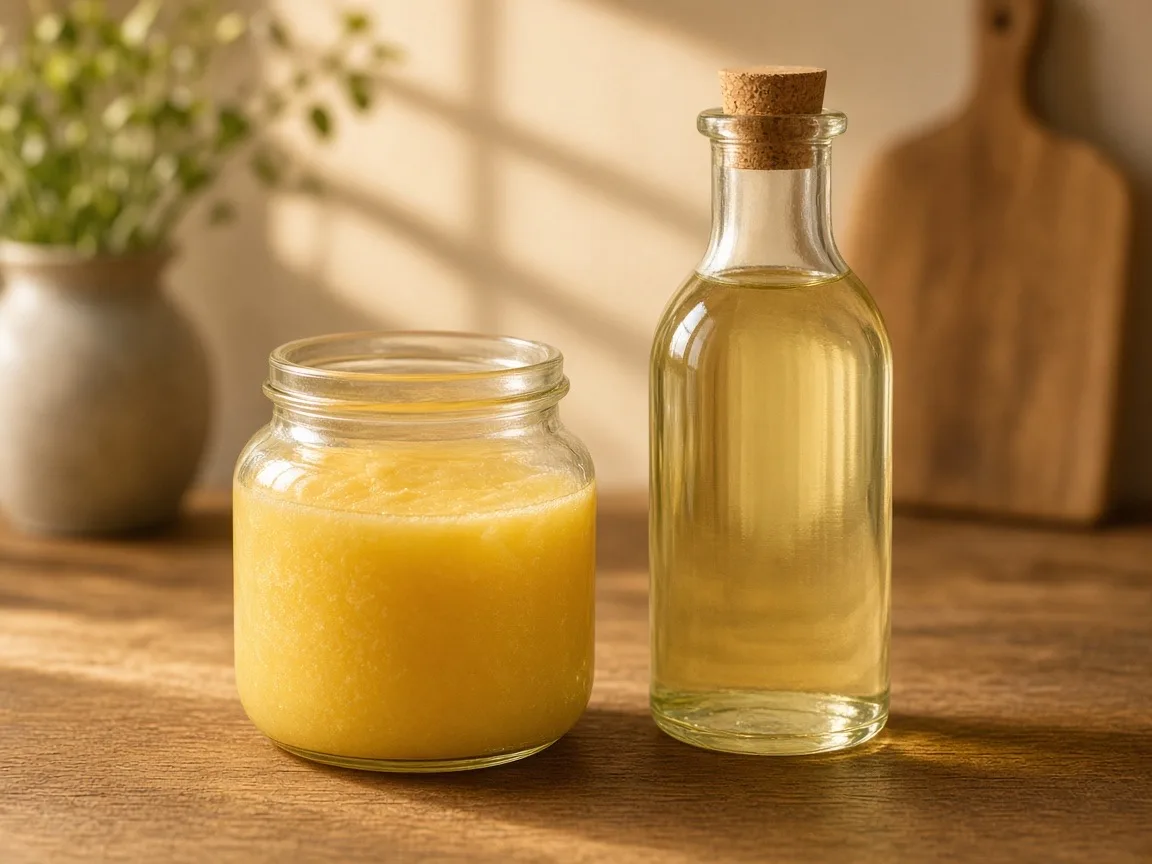
Ghee vs vegetable oil is not a contest one fat wins. Use 1 to 2 teaspoons of ghee a day where you taste it, on dal, roti, or khichdi, and a vegetable oil such as groundnut or mustard for the rest of the cooking. Ghee has far more saturated fat. Sunflower and soybean oil have far more omega-6. ICMR-NIN's 2024 guidelines ask you to limit both.
Is ghee healthier than vegetable oil?
Not across the board. Ghee is healthier to use in small amounts for flavour, and a liquid oil is the better base for most of the day's cooking. A tablespoon of ghee carries about 7.9 g of saturated fat against 1.4 g in sunflower oil, while sunflower oil carries about 8.9 g of omega-6 against 0.3 g in ghee, per USDA FoodData Central.
So the useful question is which fat for which job, and how much. ICMR-NIN's Dietary Guidelines for Indians (2024) set a daily limit for all visible fat, ghee and oil together, and inside that limit they say to keep ghee or butter to 1 or 2 teaspoons. At home our family eats exactly that: 1 to 2 teaspoons of ghee each a day, on roti, dal, and khichdi. If you want to know what ghee is before comparing it, start with what is ghee.
What is in one tablespoon of ghee vs oil?
The calories are almost the same, about 112 in a tablespoon of ghee and 119 to 124 in a tablespoon of oil. What changes is the kind of fat. These are USDA's figures for each fat, worked out for its own tablespoon weight.
1 tbsp
kcal
Sat fat
Omega-6
Omega-3
Ghee
112
7.9 g
0.3 g
0.2 g
Sunflower oil
120
1.4 g
8.9 g
0.0 g
Soybean oil
120
2.1 g
6.9 g
0.9 g
Groundnut oil
119
2.3 g
4.3 g
0.0 g
Mustard oil
124
1.6 g
2.1 g
0.8 g
Canola oil
124
1.0 g
2.7 g
1.3 g
Omega-6 is linoleic acid and omega-3 is alpha-linolenic acid, as USDA lists them. Source: USDA FoodData Central, SR Legacy, checked 26 September 2026.
Two things stand out. Ghee is the saturated fat in the line-up, which is why ICMR-NIN keeps it to a teaspoon or two. And "vegetable oil" is not one thing: sunflower and soybean oil are mostly omega-6, while mustard and canola oil are mostly monounsaturated fat with some omega-3. The full label for ghee, vitamins included, is on ghee nutrition facts.
Which is better for tadka, frying, roti, and sweets?
Ghee for the spoon you taste, oil for the bulk and for frying. Save or screenshot this table; it is how we would split a week of Indian cooking.
Kitchen job
Use
Why
Tadka on dal, a spoon on roti or khichdi
Ghee, 1 teaspoon
You taste it, so a little goes far.
Everyday sabzi and curry base
Groundnut, mustard, or another oil you trust
This is most of the day's fat. Switch between oils.
Deep frying puri, pakora, bhajia
Oil, used once
Frying needs a lot of fat. Filter it, use it in curry within a day or two, and do not fry in it again.
Paratha, halwa, ladoo, sheera
Buffalo ghee
The dish is built on the ghee's taste and texture.
Salad or a raw drizzle
Cold-pressed oil
Ghee sets solid on cold food.
Anything that asks for vanaspati
Neither: use ghee or oil instead
ICMR-NIN says to avoid hydrogenated fat.
Choose ghee if
- The fat is the flavour: a tadka poured over dal at the end, a spoon on hot rice, roti, or khichdi.
- You are making paratha, halwa, ladoo, or sheera, where oil changes the dish.
- You want vitamins A, E, and K from the fat itself; USDA lists them in ghee, and ICMR-NIN notes that fat helps the body take up these vitamins from the rest of the meal.
Choose oil if
- You need a lot of fat at once: deep frying, or the base of a big pot of curry.
- You want a flat taste, or the dish is built on mustard or coconut oil.
- You have high LDL cholesterol or heart disease and your doctor has asked you to cut saturated fat.
Mustard oil has its own page: ghee vs mustard oil. So does the most common refined bottle, ghee vs sunflower oil.
Is refined oil the same as vegetable oil?
Mostly, yes. In Indian shops "vegetable oil" and "refined oil" usually mean the same clear bottle: sunflower, soybean, rice bran, groundnut, or a blend, pressed or extracted from seeds and then refined. Cold-pressed (kachi ghani) oil is the same seed without the refining.
ICMR-NIN's 2024 guidelines explain what refining does. Crude oil straight from the seed can carry gums, waxes, free fatty acids, and residues, so it is refined with chemicals to make it safe, odourless, and longer-lasting. Refining does not change the fatty acid mix, so refined sunflower oil has the same omega-6 as cold-pressed. It does remove some antioxidants and phytosterols, and preservatives are often added. Cold-pressed oil keeps those antioxidants, but the guidelines note it can still carry the same unwanted compounds as crude oil. Their advice for every extracted oil, refined or not, is the same: use it in moderation, and get the rest of your fat from a variety of oilseeds, nuts, and whole grains.
Ghee skips all of that. It is butter or makkhan cooked until the water leaves and the milk solids brown, then strained. Nothing is extracted and nothing is added. The one fat to keep out of the kitchen is the one that pretends to be ghee: vanaspati, or "vegetable ghee", which the guidelines say carries trans fats. More on that in ghee vs vanaspati.
Is ghee or oil better for the heart and cholesterol?
For the heart, oil is the better daily base and ghee belongs in teaspoons. ICMR-NIN's 2024 guidelines say saturated fat raises total and LDL cholesterol and the risk of heart attack and stroke, and they list ghee and butter among the fats to limit.
USDA FoodData Central, SR Legacy. Checked 26 September 2026.
| Item | Value |
|---|---|
| Ghee | 62 g |
| Groundnut oil | 17 g |
| Soybean oil | 16 g |
| Mustard oil | 12 g |
| Sunflower oil | 10 g |
| Canola oil | 7 g |
That does not make seed oil a free pass. The same guidelines ask you to moderate oils high in omega-6, such as sunflower and safflower, and to get omega-3 from mustard oil, soybean, fenugreek seeds, green leafy vegetables, and nuts. Two teaspoons of ghee a day, about 6 g of saturated fat, fits inside that advice for most healthy adults. If you have high LDL, diabetes, or heart disease, your doctor or dietitian sets your own fat limit, and that comes before any blog. Our longer answer is on ghee for cholesterol.
How much ghee and oil should you use in a day?
ICMR-NIN's 2024 guidelines put all visible fat, ghee and oil together, at 20 to 50 g a day depending on how active you are, and they count a household teaspoon as 5 g. Keep ghee to 1 or 2 of those teaspoons and give the rest to oil.
Who
All fat
Ghee
Oil
Sedentary woman
20 g (4 tsp)
1 tsp
3 tsp
Sedentary man, or moderately active woman
30 g (6 tsp)
1 to 2 tsp
4 to 5 tsp
Moderately active man, or heavy-work woman
40 g (8 tsp)
2 tsp
6 tsp
Heavy physical work, man
50 g (10 tsp)
2 tsp
8 tsp
Daily visible fat limits from ICMR-NIN Dietary Guidelines for Indians 2024, Guideline 7. The ghee and oil split is ours, inside those limits.
In a real day, 30 g looks like this: one teaspoon of ghee on the morning roti, one teaspoon in the dal tadka at lunch, and four teaspoons of oil across the sabzi and dinner curry. Pour from a teaspoon, not the bottle, for a week and you will see how fast a "little oil" becomes 50 g. Pregnant and breastfeeding women have different needs; the guidelines ask them to get more of their fat from nuts, seeds, and fish rather than more oil. More on portions in how much ghee per day.
Does ghee handle high heat better than oil?
Ghee is steadier in a hot kadhai than sunflower or soybean oil, because it has very little of the fat that breaks down with heat. USDA lists 3.7 g of polyunsaturated fat in 100 g of ghee, against 58 g in soybean oil and 66 g in sunflower oil.
That matters most when oil is heated again and again. ICMR-NIN's 2024 guidelines say repeated heating oxidises polyunsaturated fat into harmful compounds. Their household rule: filter oil used once for frying, use it for curry within a day or two, and never fry in it again. Ghee can burn too. When we cook makkhan into ghee on the chulha, we take it off when the bubbling goes quiet and the solids turn golden-brown. Past that point the batch turns dark and bitter and smells burnt, and it never goes in a jar. So a hot tadka in ghee is fine; a smoking pan of anything is not. The full heat guide is ghee for high heat cooking, and reuse is covered in reheating ghee.
Can you replace oil with ghee spoon for spoon?
Yes. A tablespoon of ghee weighs 12.8 g and a tablespoon of oil about 13.5 to 14 g, per USDA, so swapping one for the other barely changes the fat or the calories. The difference is taste and texture.
Ghee sets in a cool kitchen, so it does not work for salads or cold chutneys. It browns faster than neutral oil when you fry onions for a long time, so keep the flame at medium. In baking it replaces oil or melted butter well; the adjustments are on ghee for baking. The bigger point is that a full swap breaks the daily limit. Replacing every spoon of oil with ghee would put 20 to 30 g of ghee in a day. Swap the tadka and the roti; keep oil for the rest. How to cook with ghee day to day is on cooking with ghee.
What mistakes do people make when switching from oil to ghee?
- Swapping every spoon. Ghee replaces the oil in the tadka, not the oil in the whole kitchen.
- Buying the cheapest "ghee". A tin labelled vegetable fat, or a jar priced far below milk cost, may not be milk fat at all. Our checks are on how to identify pure ghee.
- Frying in ghee to be healthy, then reusing it. Deep frying is where oil makes sense, used once.
- Keeping one high omega-6 oil for years. ICMR-NIN asks you to moderate oils like sunflower and safflower. Switching between groundnut, mustard, and sunflower gives a better mix of fats than any single bottle.
- Ignoring the doctor. With a heart, cholesterol, or kidney condition, your own fat limit comes first.
Comparing ghee with other fats? We also cover ghee vs coconut oil, ghee vs olive oil, and ghee vs groundnut oil.
Which ghee should sit next to your oil bottle?
If ghee is only one or two teaspoons a day, those teaspoons should be real milk fat. Warm a spoon: it should smell of toasted milk, not packing oil. Once it cools, slow-cooked ghee often turns grainy. Check the FSSAI licence number on the label. Our full ranking of jars is on best ghee in India.
For the daily spoon on dal and roti we use our own A2 Gir cow ghee: grass-fed Gir milk set to curd, churned, and cooked in a matki on the chulha, made after you order, about ₹14 a teaspoon at ₹2,399 a litre. For paratha, halwa, and ladoo, Jafarabadi buffalo ghee is the one we reach for. We test every month against the FSSAI limits; see how we make ghee.
Gir cow ghee: the daily teaspoon
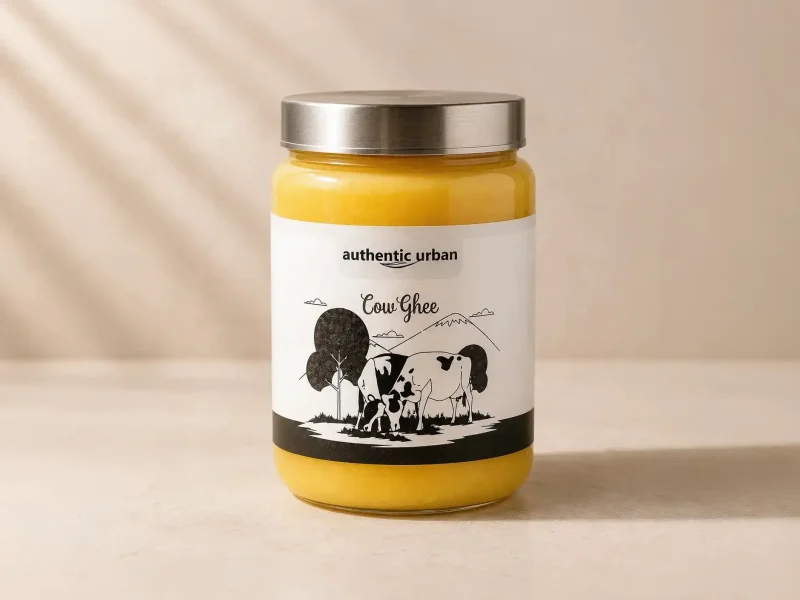 1 Litre
Buffalo ghee: paratha and sweets
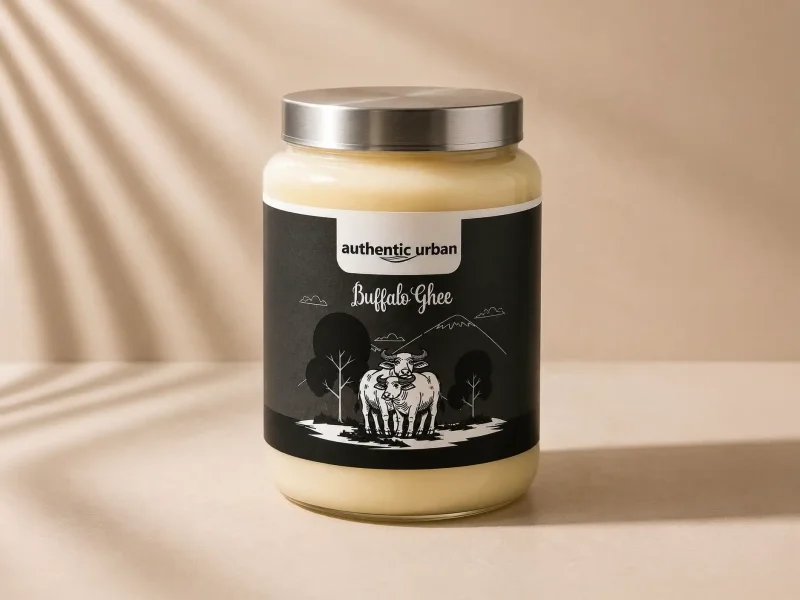 1 Litre
Each order is cooked after you place it, and the packing video is of that batch. Past order videos are on the shop.
FAQ
Is vegetable ghee the same as ghee?
No. "Vegetable ghee" is vanaspati: vegetable oil that has been partly hydrogenated so it sets solid and looks like ghee. ICMR-NIN's 2024 guidelines say hydrogenation creates trans fats, which are more harmful than saturated fat, and advise against using vanaspati as a cooking medium. Real ghee is only milk fat cooked clear. If a label says vegetable fat or hydrogenated oil, it is not ghee.
Is ghee healthier than canola oil?
For a spoon on dal, ghee gives the taste you want. For the bulk of the day's cooking, canola brings far less saturated fat: USDA lists 7.4 g per 100 g for canola against 61.9 g for ghee. Canola also carries omega-3, about 9 g per 100 g, and is mostly monounsaturated fat. Use a teaspoon of ghee where you taste it and a liquid oil for the rest, inside the ICMR-NIN daily fat limit.
Is ghee or oil better for weight loss?
Neither saves calories. USDA lists 876 kcal in 100 g of ghee and 884 in 100 g of sunflower or groundnut oil, so a tablespoon of either is about 112 to 124 kcal. For weight loss, the amount matters more than the fat. Measure with a teaspoon, keep ghee to one or two a day, and cut fried snacks before you worry about which bottle you cook with.
Can I mix ghee and oil in the same tadka?
Yes, and many cooks do. Heat a little oil first for the jeera and mustard seeds, then add half a teaspoon of ghee at the end for aroma. The oil takes the first blast of heat and the ghee keeps its smell. You use less ghee this way and still taste it. Keep the flame medium so neither fat smokes before the spices go in.
Why does ghee cost so much more than oil?
Ghee is made from milk, and a lot of it. We use about 30 to 35 litres of milk for 1 kg of cow ghee, and 22 to 25 litres for buffalo ghee. Seed oil is pressed or extracted from cheap seeds at factory scale. At our price, a 5 g teaspoon of Gir cow ghee costs about ₹14, or about ₹28 for two teaspoons a day.
Is desi ghee better than refined oil for children?
For a child over one year, a teaspoon of ghee on dal, rice, or roti is a normal part of Indian meals, and it helps them take up the vitamins A, D, E, and K from the rest of the food. Their other cooking can still be done in oil. For babies under one, ask your paediatrician how and when to add any fat. Do not replace milk or meals with extra ghee.
About the editorial team
Authentic Urban TeamBilona ghee makers, Gir Somnath, Gujarat
We are the Parmar family in Gir Somnath, Gujarat. We have made ghee here since 2016 and sold it online since 2025. We make only Bilona ghee, test it every month, and anyone is welcome to visit and watch it being made. Our Gir cows and Jafarabadi buffalo are grass-fed village animals that graze near the Gir forest, with no hormones or milk boosters. We set their milk to curd, churn it, and cook the makkhan on a wood chulha. These articles come from that kitchen and from what customers ask us on WhatsApp. We are ghee makers, not doctors.
Sources
- Dietary Guidelines for Indians, 2024 (Guideline 7, printed pp. 51-56), ICMR-National Institute of Nutrition. Checked 26 Sep 2026.
- Butter oil, anhydrous (FDC ID 173412), SR Legacy, USDA FoodData Central. Checked 26 Sep 2026.
- Oil, sunflower, linoleic (approx. 65%) (FDC ID 171025), SR Legacy, USDA FoodData Central. Checked 26 Sep 2026.
- Oil, soybean, salad or cooking (FDC ID 171411), SR Legacy, USDA FoodData Central. Checked 26 Sep 2026.
- Oil, peanut, salad or cooking (FDC ID 171410), SR Legacy, USDA FoodData Central. Checked 26 Sep 2026.
- Oil, mustard (FDC ID 172337), SR Legacy, USDA FoodData Central. Checked 26 Sep 2026.
- Oil, canola (FDC ID 172336), SR Legacy, USDA FoodData Central. Checked 26 Sep 2026.