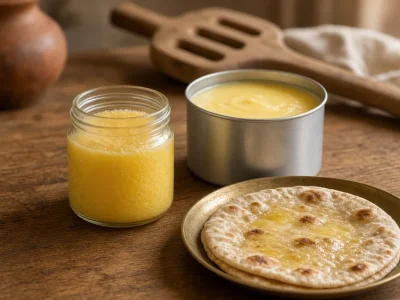
Gir Cow Ghee vs Regular Ghee: What Differs, What to Buy
Gir cow ghee vs regular ghee: in the jar, both are at least 99.5% milk fat with about 44 kcal a teaspoon. The real differences are the cow (Gir, an Indian breed with mostly A2 milk, against mostly crossbred milk), the method (curd Bilona against cream), the taste, and a price over three times higher. We make Gir cow ghee, so weigh our view with that in mind.
Gir cow ghee vs regular ghee: which is better?
Gir cow ghee is the better jar for eating by the spoon, if you can pay about 3.5 times more for it. It is not a different food. A teaspoon of either gives the same fat and calories, and the breed studies show small gaps that point both ways. What you pay for is the milk of one named Indian breed, usually the slower curd method, and a fuller taste.
The daily teaspoon on roti, dal, rice
Gir curd ghee, if the price fits. You taste the ghee here, and curd ghee smells more of toasted milk.
A child's dal or khichdi (over one year)
Either, if it is pure and fresh. The breed does not change what a child needs.
Deep frying
Neither. Fry in oil and keep ghee for the plate.
Halwa, ladoo, paratha
Buffalo ghee. It is richer and cheaper than Gir cow ghee for a big batch.
A tight monthly budget
A smaller jar of curd ghee, used only where you taste it, with oil for the rest of the cooking.
This page compares Gir ghee with the packet cow ghee most Indian homes buy. If you are choosing between two desi breeds, read Sahiwal ghee vs Gir ghee instead.
What is regular ghee made from?
Regular cow ghee in India is mostly made from the milk of crossbred cows, collected by dairies from many villages and turned into ghee from cream or butter. The label says "cow ghee" and names no breed, because the law does not ask it to.
The government's Basic Animal Husbandry Statistics 2025 show where India's milk came from in 2024-25. Crossbred cows gave 30.8% of all milk and foreign breeds 1.9%. Named Indian breeds, Gir among them, gave 11.2%, and local cows of no set breed 9.6%. Buffalo gave the largest share, about 43%. So of all cow milk, roughly 6 litres in 10 come from crossbred or foreign cows, and about 2 in 10 from named Indian breeds like Gir.
FSSAI's ghee standard does not ask about the cow either. It defines milk fat products as made from milk or milk products, and sets limits for moisture (at most 0.5%), milk fat (at least 99.5%), and free fatty acids (at most 2.0%), with tests that catch vegetable oil and other fats. A jar that passes is legal ghee whatever the breed. What those tests can and cannot catch is on how to identify pure ghee.
What is a Gir cow, and why does it give less milk?
Gir is an Indian dairy breed from Saurashtra in Gujarat, named after the Gir forest. It is red or speckled red, with horns that curl back in a half-moon and long ears folded like a leaf. It gives less milk than a crossbred cow, and that one fact drives most of the price gap.
NDDB's breed profile puts the average Gir lactation at about 2,110 kg of milk, with 4.6% fat (3.9 to 5.1%). Across India in 2024-25, crossbred and foreign cows gave 9.05 kg of milk a day on average, and Indian and local cows 3.86 kg, per the government's figures. That average mixes many breeds and village cows, not Gir alone, but the direction holds: a Gir cow gives far fewer litres a day, so each litre costs more to produce.
We are in Gir Somnath, in Saurashtra, and every cow batch we make is Gir cow milk from our own animals and partner farmers around us. About 30 to 35 litres of milk go into 1 kg of our cow ghee. Rajesh looks after the animals and knows which season the milk runs heavy: in winter the milk is richer and gives more makkhan per litre, and in summer the fat drops.
Gir cow ghee vs regular ghee side by side
The two jars differ at the farm and the counter, not in the nutrition label. "Regular" here means packet cow ghee that names no breed and makes no curd claim.
Gir cow ghee vs regular cow ghee
| Factor | Gir cow ghee | Regular cow ghee |
|---|---|---|
| Milk | Gir cows only, an Indian breed from Saurashtra | Cow milk, breed not named; mostly crossbred cows |
| A2A2 cows in gene tests (2023) | 93% of Gir cows | 3% of Jersey and Holstein cows |
| Milk per cow per day (India, 2024-25) | 3.86 kg, all Indian and local cows | 9.05 kg, crossbred and foreign cows |
| Usual method | Curd churned (Bilona), in most jars | Cream or butter, in a dairy plant |
| FSSAI standard | At least 99.5% milk fat | At least 99.5% milk fat |
| A 5 g teaspoon (USDA) | About 44 kcal, 5 g fat | About 44 kcal, 5 g fat |
| Price per litre, median (our index) | ₹2,499 | ₹711 |
| Price per teaspoon | ₹12.5 | ₹3.6 |
Verdict: Same fat, same calories, same legal standard. Gir ghee costs more for the breed, the curd method, and the taste.
Basic Animal Husbandry Statistics 2025 (DAHD); Khan et al., Animal Biotechnology, 2023; FSSAI Chapter 2.1 (2023); USDA FoodData Central; Ghee Price Index, September 2026. Checked 28 September 2026.
The full label of a spoon of ghee, from calories to vitamins, is on ghee nutrition facts.
Is Gir cow ghee healthier than regular ghee?
Not by much that you could measure on your plate. A 5 g teaspoon of any ghee gives about 44 kcal, 5 g of fat, 3.1 g of it saturated, and 13 mg of cholesterol, per USDA FoodData Central. The breed moves the fat mix a little, and the studies do not agree on which way.
Does A2 milk matter once it is ghee?
Very little. Gir milk is mostly A2: in a 2023 study of 1,000 milk samples (Khan et al., Animal Biotechnology), 93% of Gir cows carried two A2 genes, the highest of the Indian breeds tested. Jersey and Holstein cows were the opposite, with only 3% A2A2 and most carrying the A1 gene. But USDA lists just 0.28 g of protein in 100 g of ghee, about 14 mg in a teaspoon, so there is almost no A1 or A2 protein left to digest. The trials, and who paid for them, are on A2 vs A1 ghee.
Does the breed change the fat?
A little, and in both directions. A 2023 study in the International Journal of Dairy Technology (Singh and colleagues) tested milk from Gir, Sahiwal, Tharparkar, and the crossbred Karan Fries cow on similar feed. Milk fat from the crossbred cows was more saturated, and the Gir, Sahiwal, and Tharparkar milk fat had more monounsaturated fat, the kind in olive oil.
A 2025 study in Food Chemistry: X (Kataria and Singh) made ghee from the Indian Deoni breed and from Holstein Friesian milk. This time the Holstein ghee had more polyunsaturated fat and more alpha-linolenic acid, a plant-type omega-3. So one study favours the Indian breeds and one favours the foreign cow. On a 5 g teaspoon, gaps of a few percent are a fraction of a gram. The cow's feed moves these numbers too, as grass-fed vs regular ghee shows.
Does Bilona add butyric acid or nutrients?
Not in the one study that tested it. Many Gir ghee pages say curd churning raises butyric acid. Kataria and Singh made ghee three ways from the same milk (curd, cream, and fermented cream) and found no difference in the fatty acids by method, in either breed. The method did change the smell: curd and fermented-cream ghee had more flavour compounds, the toasted, slightly tangy notes you notice on hot rice. USDA lists about 0.16 g of butyric acid in a teaspoon of ghee in general.
The limit on how much to eat is the same for both jars. Count ghee inside the day's fats and oils, and if you have a heart, liver, or cholesterol problem, ask your doctor or dietitian how much fat suits you. The breed does not change that answer.
Does Gir cow ghee taste different from regular ghee?
Yes, but mostly because of the method and the cooking, not the cow. Curd ghee cooked slowly smells of toasted milk and often sets grainy; cream ghee from a dairy plant is milder and smoother.
In our kitchen the milk is set to curd overnight, churned for 30 to 45 minutes, and the makkhan is cooked in a matki on a wood chulha for 45 to 90 minutes. We take it off when the bubbling goes quiet and the milk solids turn golden-brown. It cools grainy, and "why is it grainy?" is the question customers ask us most on WhatsApp. The colour also moves with the season: our cow ghee turns more yellow in the monsoon, when the animals eat green fodder. So colour tells you about the feed and the season, not the breed. More on the method in Bilona ghee vs cream ghee and on colour in white ghee vs yellow ghee.
Why does Gir cow ghee cost about 3.5 times more?
Because a Gir cow gives fewer litres, and curd ghee takes more milk and time. In our September 2026 price index, curd Gir cow ghee had a median of ₹2,499 a litre (₹12.5 a teaspoon), and regular packet cow ghee ₹711 (₹3.6 a teaspoon).
Ghee Price Index, September 2026: each brand's own shop page, 25 and 26 September 2026; our own live price.
| Item | Value |
|---|---|
| Gir cow curd (Bilona) ghee, median of 7 | ₹2,499 a litre |
| Our A2 Gir cow Bilona ghee | ₹2,399 a litre |
| Mother Dairy Premium Gir Cow Ghee (no curd claim) | ₹1,651 a litre |
| Amul Gir Cow Ghee (no curd claim) | ₹1,400 a litre |
| Regular packet cow ghee, median of 11 | ₹711 a litre |
| Cheapest regular cow ghee in the index | ₹616 a litre |
Our own is ₹2,399 a litre, about ₹12.0 a teaspoon. At two teaspoons a day for one person, the gap between a median Gir curd jar and a median packet is about ₹536 a month. Curd to ghee takes us the better part of two days, and the yield is lower than cream ghee. The full rupee cost of a kilo is on why Bilona ghee is expensive, and every brand's price is in our Ghee Price Index, September 2026.
Are dairy Gir cow ghee packs the same as Gir Bilona ghee?
No. They name Gir milk, per their own pages, but make no curd or Bilona claim, and they sit between the two groups on price.
In the September 2026 index, Mother Dairy Premium Gir Cow Ghee was ₹1,651 a litre, and Amul Gir Cow Ghee was ₹1,400 a litre. That is less than any curd Gir jar we listed and more than the regular packs. If what you want is Gir milk at a lower price, these packs give you that. If you want the curd method and its taste, they do not say they use it. The two big dairy brands are compared on Amul vs Mother Dairy ghee.
Should you buy Gir cow ghee or regular ghee?
Buy Gir curd ghee for the ghee you eat by the spoon, and do not pay Gir prices for ghee that goes into a frying pan.
Choose Gir cow ghee if
- Most of your ghee goes on roti, dal, and rice, where you taste it.
- You want milk from one named Indian breed, from a maker who shows you the cows.
- You eat one or two teaspoons a day, so the monthly gap is small.
Regular ghee is enough if
- You care about price first and the taste of the ghee does not matter much to you.
- The ghee is only one of many strong flavours in the dish.
- You already eat it without trouble. The breed will not change how it sits with you.
Three kitchens, three answers
A couple who eat a teaspoon each on hot roti
Buy the Gir curd ghee. Two teaspoons a day is about 300 ml a month, so a 500 ml jar lasts close to seven weeks, and this is the use where you taste the difference every day.
A family of five cooking sabzi in ghee
Cook the sabzi in oil and keep one jar of Gir ghee for the table. Cooking every dish in ghee makes it easy to eat far more fat than you meant to, whatever the breed, and oil costs a fraction of Gir ghee.
A parent choosing for a toddler
Choose a pure, fresh cow ghee and keep the amount small: a teaspoon in dal or khichdi at a meal for a child over one year. The daily amounts are on ghee for toddlers.
Mistakes people make
- Taking "A2" or "desi cow" on a pack to mean Gir. Neither names the breed.
- Paying Gir prices, then frying puris in it. Ghee for frying is money burnt; use oil.
- Eating more because the breed sounds healthier. A teaspoon of Gir ghee has the same 44 kcal.
- Reading deep yellow as proof of Gir. Green fodder and the season set the colour.
- Expecting every jar to look the same. Real curd ghee changes a little from batch to batch.
How to check a Gir cow ghee label: 7 points
Save or screenshot this before you buy. Then check the jar itself with our 2-minute purity checker.
- 1 The label says "Gir cow", not only "desi cow" or "A2". A2 is a protein claim; it does not name a breed.
- 2 The seller names where the cows are: a district or village in Saurashtra, or a farm you could visit.
- 3 The method is in plain words: milk set to curd, churned, and the butter cooked. "Traditional process" alone says nothing.
- 4 You can see the animals or your own batch being made, on video or in person.
- 5 The FSSAI licence number is printed and checks out on foscos.fssai.gov.in.
- 6 The price makes sense. Curd Gir ghee in our index sits at ₹2,200 to ₹3,595 a litre; a curd Gir claim far below that deserves a question.
- 7 No health promise for the breed, such as "Gir ghee for the heart" or "cures acidity".
What "A2" on a label means, and what it does not, is on what is A2 ghee.
Which Gir cow ghee do we keep at home?
Whichever jar you pick, warm a spoon first: it should smell of toasted milk, never flat or sharp. Our ranking of cow ghee brands, Gir curd jars and others, with dated prices, is on best cow ghee in India.
We make both jars below, so weigh our view with that in mind. Our A2 Gir cow ghee is Gir cow milk from Gir Somnath, and our Jafarabadi buffalo ghee is from the local buffalo breed. The animals graze on village pasture near the Gir forest, with no hormone injections. Both jars are curd Bilona, cooked after you order, with a video of your jar on WhatsApp, and Varsha tastes every batch. We test every month against the FSSAI limits, and anyone can visit; see how we make ghee.
Gir cow ghee: the daily teaspoon
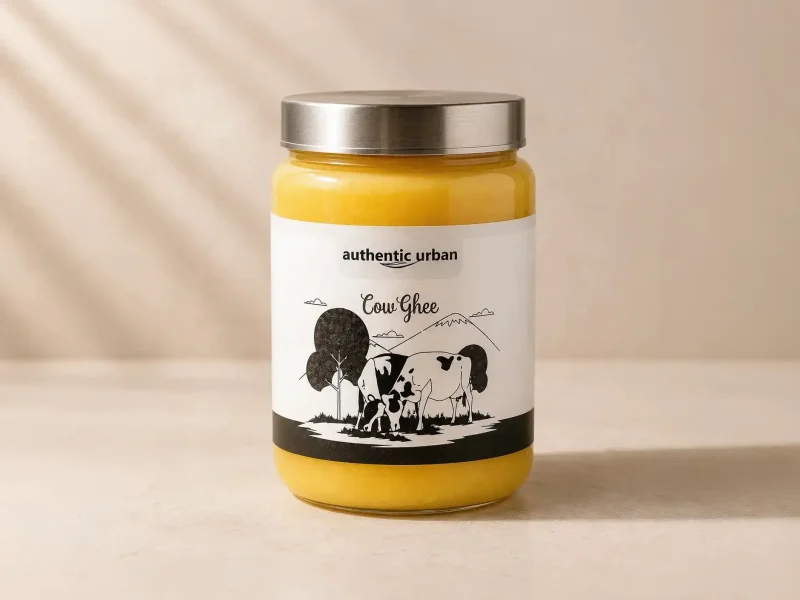 1 Litre
Buffalo ghee: paratha and halwa
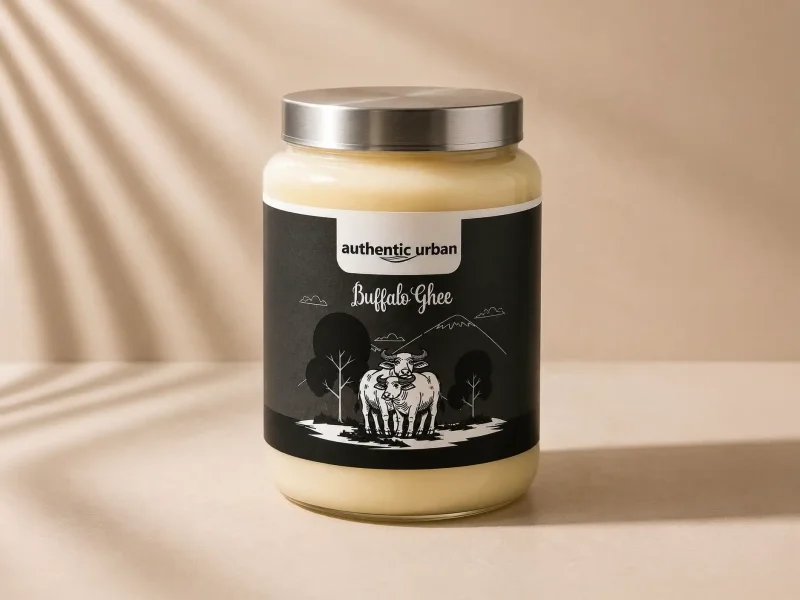 1 Litre
Each order is cooked after you place it, and the packing video is of that batch. Past order videos are on the shop.
FAQ
Which is the best Gir cow ghee to buy in India?
We put our own A2 Gir cow ghee first, and we make it, so weigh that. The milk is from Gir cows in Gir Somnath, set to curd overnight, churned, and cooked on a wood chulha after you order, and you get a video of your jar. After ours, look for curd Gir ghee from a named district in Saurashtra with a farm you can visit; our best cow ghee ranking lists them with prices.
Is Gir cow ghee better for babies than regular ghee?
No study shows the breed matters for a child. What matters is that the ghee is pure and fresh and the amount is small: for a child over one year, a teaspoon stirred into dal, rice, or khichdi at a meal, counted with the family's cooking oil. Do not start ghee for a baby under one without asking your paediatrician how and when to add fat.
Is buffalo ghee the same as regular ghee?
No. Buffalo ghee is its own product, sold as buffalo ghee, and it is whiter, firmer, and richer than cow ghee. Buffalo gave about 43% of India's milk in 2024-25, per the government's livestock statistics, so plain "ghee" or "pure ghee" packs that do not name the animal can hold buffalo milk fat. A pack labelled "cow ghee" should be cow milk only.
Can a lab test tell whether ghee is from Gir cows?
Not the tests in the FSSAI ghee standard. They check moisture, milk fat, free fatty acids, and signs of vegetable oil or other fats, which catches a lot of adulteration but never names the cow breed. A Gir claim is checked at the source: the district, the farm, and whether the seller lets you see the cows being milked and the ghee being made.
Does Gir cow ghee have more vitamin A than regular ghee?
We found no study that measures it side by side. USDA lists about 42 µg of vitamin A in a 5 g teaspoon of ghee in general. Vitamin A and yellow beta-carotene reach milk fat mostly from green fodder, so the season and the feed move them more than the breed. Our cow ghee turns more yellow in the monsoon, when the animals eat green fodder.
How long does Gir cow ghee last once opened?
Our sealed jars keep 9 to 12 months at room temperature, and an open jar keeps well for months if water and crumbs stay out. Use a dry spoon, shut the lid, and keep it away from the stove and sunlight. The breed makes no difference to shelf life; moisture left in the ghee and a wet spoon do. A sharp or paint-like smell means it has gone off.
About the editorial team
Authentic Urban TeamBilona ghee makers, Gir Somnath, Gujarat
We are the Parmar family in Gir Somnath, Gujarat. We have made ghee here since 2016 and sold it online since 2025. We make only Bilona ghee, test it every month, and anyone is welcome to visit and watch it being made. Our Gir cows and Jafarabadi buffalo are grass-fed village animals that graze near the Gir forest, with no hormones or milk boosters. We set their milk to curd, churn it, and cook the makkhan on a wood chulha. These articles come from that kitchen and from what customers ask us on WhatsApp. We are ghee makers, not doctors.
Sources
- Basic Animal Husbandry Statistics 2025 (species-wise milk contribution and average yield, 2024-25, pp. 23-25), Department of Animal Husbandry and Dairying, Government of India. Checked 28 Sep 2026.
- Gir (breed profile, compiled from NBAGR's AGRI-IS), NDDB Dairy Knowledge Portal. Checked 28 Sep 2026.
- Potential status of A1 and A2 variants of bovine beta-casein gene in milk samples of Indian cattle breeds (Khan R et al.), 2023, Animal Biotechnology. Checked 28 Sep 2026.
- Evaluation of nutritional quality of fat obtained from different breeds of cow and buffalo with respect to fatty acids and in vitro digestibility (Singh R et al.), 2023, International Journal of Dairy Technology. Checked 28 Sep 2026.
- Effect of processing methods on fatty acid composition and flavour profile of clarified butter (ghee) obtained from Deoni and Holstein Friesian cow breeds (Kataria D, Singh G), 2025, Food Chemistry: X. Checked 28 Sep 2026.
- Butter oil, anhydrous (SR Legacy 173412), USDA FoodData Central. Checked 28 Sep 2026.
- Food Safety and Standards (Food Products Standards) Compendium, Chapter 2.1: Dairy products and analogues, version 01.09.2023 (pp. 26-27, milk fat products and ghee), FSSAI. Checked 28 Sep 2026.