Ghee vs Mustard Oil: Which Is Healthier? Erucic Acid, Uses
Ghee vs mustard oil: for everyday cooking, mustard oil is the healthier fat, and ghee is the teaspoon you add where you taste it. Per USDA, mustard oil has 11.6 g of saturated fat per 100 g against 61.9 g in ghee, and it brings omega-3. Its one open question is erucic acid, about 41% of the oil, which the EU caps and India allows.
Ghee vs mustard oil: which is healthier?
Mustard oil, for most of your cooking. A teaspoon of it has about 0.6 g of saturated fat; a teaspoon of ghee has about 3.1 g. Ghee wins on taste in dal, roti, and sweets, and it carries some vitamin A. So keep ghee to 1 or 2 teaspoons a day and cook the rest in mustard oil or another liquid oil.
Both have the same calories, about 44 in a 5 g teaspoon. What differs is the kind of fat. These are USDA FoodData Central's figures, worked out for the 5 g household teaspoon that ICMR-NIN uses. Save this table; it answers most of the "which is better" arguments at the dinner table.
1 tsp (5 g)
Ghee
Mustard oil
Calories
44 kcal
44 kcal
Saturated fat
3.1 g
0.6 g
Monounsaturated fat
1.4 g
3.0 g
of which erucic acid
0 g
2.1 g
Omega-6 (linoleic acid)
0.11 g
0.77 g
Omega-3 (ALA)
0.07 g
0.30 g
Cholesterol
13 mg
0 mg
Vitamin A
42 µg
0 µg
Vitamin D
0
Not listed
USDA FoodData Central, SR Legacy: butter oil, anhydrous (173412) and mustard oil (172337). Mustard oil's cholesterol from ICMR-NIN (plant foods have none). Checked 27 September 2026.
Three rows decide it. Saturated fat is five times higher in ghee. Omega-3 is four times higher in mustard oil, and ICMR-NIN's 2024 guidelines name rapeseed and mustard among the foods that give both omega-6 and omega-3. And erucic acid, the row most comparison pages skip, is zero in ghee and about 2 g in a teaspoon of mustard oil. Many pages also say ghee is rich in vitamin D; USDA lists none. Ghee's full label is on ghee nutrition facts.
What is erucic acid, and is mustard oil safe to eat?
Yes, in India it is a legal, everyday cooking oil, and the best-known Indian study found lower, not higher, heart risk in people who cook with it. Erucic acid is a fat found in mustard and old rapeseed varieties. Fed in large amounts to young rats, it builds up fat in the heart muscle, and that animal finding is why other countries limit it.
The rules differ sharply by country:
- European Union. The European Food Safety Authority set a tolerable daily intake of 7 mg per kg of body weight, and in 2019 the EU cut the cap on erucic acid in vegetable oils from 50 g to 20 g per kg (2%), as a 2021 paper in Food Science & Nutrition (Russo and colleagues) sets out.
- United States. The FDA does not allow mustard oil as a cooking oil, per a 2022 review in the Journal of Clinical Lipidology (Poddar and colleagues).
- India. FSSAI's oil standards (Chapter 2.2, version of August 2025) allow plain mustard oil with no erucic acid cap. They also define a separate "low erucic acid" mustard oil, which may have no more than 2% erucic acid.
Here is the maths the top pages skip. USDA puts erucic acid at 41.2 g per 100 g of mustard oil. Against the EFSA line for a 60 kg adult (420 mg a day) and a 20 kg child (140 mg a day):
Mustard oil eaten
Erucic acid
vs EFSA line, 60 kg adult
vs EFSA line, 20 kg child
1 teaspoon (5 g)
Erucic acid: 2,060 mg
Adult: About 5 times
Child: About 15 times
4 teaspoons (20 g), a sedentary woman's whole visible fat for the day
Erucic acid: 8,240 mg
Adult: About 20 times
Child: Not a child's portion
Low erucic mustard oil, 4 teaspoons (at the FSSAI 2% cap)
Erucic acid: Up to about 400 mg
Adult: Just under the line
Child: Not a child's portion
Erucic acid: USDA FoodData Central (172337), 41.2 g per 100 g. EFSA tolerable daily intake 7 mg per kg body weight and FSSAI low erucic cap 2%. Our arithmetic.
Read this table with care. The EFSA line is built on rat studies with a safety margin, not on harm seen in people. Indian mustard oils vary in erucic acid, and the USDA figure is one sample. The same 2022 review notes that the Lipid Association of India calls mustard oil heart-healthy, and it asks the FDA to review its ban because human benefits have been reported. What the table does show is that a family cooking only in mustard oil eats far more erucic acid than the European line allows, and children more so for their size.
The simple fix is not to rely on a single oil. Keep mustard oil for the dishes that need it and use groundnut or another oil for part of the day, or buy a pack labelled low erucic acid. Ghee has no erucic acid, but it is not the swap: it would add saturated fat instead. For how ghee compares with sunflower, soybean, and refined oils, see ghee vs vegetable oil.
Which is better for the heart and cholesterol?
Mustard oil. It has far less saturated fat, and an Indian study found lower heart attack risk in people who cooked with it rather than sunflower oil. Ghee is fine at a teaspoon or two; the risk comes from using it as the main cooking fat.
USDA FoodData Central, SR Legacy (171412, 173412, 171410, 172337, 171025), rounded to the gram. Checked 27 September 2026.
| Item | Value |
|---|---|
| Coconut oil | 83 g |
| Ghee | 62 g |
| Groundnut oil | 17 g |
| Mustard oil | 12 g |
| Sunflower oil | 10 g |
ICMR-NIN's 2024 guidelines call visible saturated fat high above 10 g a day, and they name ghee and butter first. At USDA's figures, ghee reaches 10 g in about 3.2 teaspoons; mustard oil takes about 17. That is why a Bengali kitchen that cooks the whole day in mustard oil and adds a teaspoon of ghee to the dal sits well inside the line, and a kitchen that cooks everything in ghee does not.
The best-known Indian study on mustard oil is a 2004 case-control study in the American Journal of Clinical Nutrition (Rastogi and colleagues): 350 heart attack patients and 700 matched controls in New Delhi and Bangalore. Cooking with mustard oil instead of sunflower oil went with about half the risk (relative risk 0.49), and frying in it with less than a third (0.29). A case-control study shows a link, not proof, and it did not compare mustard oil with ghee.
For ghee itself, the trial evidence and the dose by lipid report are on ghee for cholesterol. If you have heart disease, high LDL, or diabetes, your doctor or dietitian sets your fat limit, and that comes before any comparison here.
Which should you use for tadka, fish, frying, and sweets?
Mustard oil for the cooking, ghee for the finish. This is how we would split the two across a week of Indian meals:
Kitchen job
Use
Why
Shorshe maach, macher jhol, fish fry
Mustard oil
Bengali and Odia fish is built on its bite. Ghee tastes out of place.
Mango, lime, or chilli achaar
Mustard oil
The pickle needs a liquid oil that coats the pieces, and the classic taste is sarson.
Everyday sabzi and curry base
Mustard oil, or switch with groundnut
This is most of the day's fat. Mustard oil has a fifth of ghee's saturated fat.
Deep frying pakora, puri, litti
Mustard or groundnut oil, used once
Frying soaks up a lot of fat. In ghee that is mostly saturated.
Tadka poured over dal, a spoon on roti or rice
Ghee, 1 teaspoon
You taste it. This is the spoon ICMR-NIN allows.
Sarson da saag, makki roti
Mustard oil to cook, ghee on top
The Punjabi way: the saag is cooked, then finished with a little ghee.
Halwa, ladoo, paratha, sheera
Buffalo ghee
The sweet or bread is built on ghee's taste and grain. Mustard oil would spoil it.
Choose ghee if
- The fat is the flavour: a tadka poured over dal, a spoon on rice, roti, or khichdi.
- You are making halwa, ladoo, sheera, or paratha.
- Someone at the table cannot stand the sharp smell of sarson.
Choose mustard oil if
- The dish is Bengali, Odia, Bihari, Kashmiri, or a North Indian pickle.
- It is the everyday sabzi, curry, or anything fried.
- You want more omega-3 and less saturated fat in the day's cooking.
Day-to-day cooking with ghee, amounts included, is on cooking with ghee.
Can you fry in mustard oil, and should you smoke it first?
Yes, mustard oil is a traditional frying oil, and the Indian study above linked frying in it with lower heart risk than sunflower oil. Use it once. ICMR-NIN's 2024 guidelines say oil used for frying should be filtered, used for curry within a day or two, and not used to fry again, because reheated oil forms harmful compounds.
Many cooks heat kachi ghani mustard oil until it just starts to haze and turns paler before the spices go in, to take off the raw bite. Heat it to that point once, lower the flame, and cook. Do not leave it smoking. We could not find a primary measurement of mustard oil's smoke point to quote, and the "249°C" and "250°C" figures that pages repeat have no source, so we have left numbers out. Watch the pan instead. When we cook makkhan into ghee on the chulha, we take it off as the bubbling goes quiet and the solids turn golden-brown. Past that point the batch goes dark and bitter and smells burnt, and it never goes in a jar. Any fat that keeps smoking in your kadhai has gone the same way.
Ghee is not a better frying fat just because it takes heat: a kadhai of ghee puts days of saturated fat into the food. For ghee's heat limits and deep frying, see ghee smoke point.
Can you mix ghee and mustard oil?
Yes, at home, and many North Indian cooks do: sabzi or saag cooked in mustard oil, a little ghee on top at the end. Count both toward the day's fat, and keep the ghee part to 1 or 2 teaspoons.
Buying a mixed bottle is different. Since 8 June 2021, FSSAI has banned blending mustard oil with other oils to make "multi-source" edible oils, as Business Today reported on 9 June 2021; the oil industry body quoted there said the ban means pure mustard oil reaches buyers. If a pack sells itself as mustard oil mixed with another oil, leave it. The same worry, a strong smell covering a cheaper fat, is behind many fake ghee cases; our checks are on how to identify pure ghee.
How much ghee and mustard oil can you use in a day?
All visible fat together, 20 to 50 g a day (4 to 10 teaspoons) by activity, with ghee at 1 or 2 teaspoons of that. These are ICMR-NIN's 2024 figures, and the rest can be mustard oil or another liquid oil.
Adult
Visible fat a day
One way to split it
Sedentary woman
20 g (4 tsp)
1 tsp ghee on dal or roti, 3 tsp mustard oil in the sabzi and curry
Sedentary man
30 g (6 tsp)
1 to 2 tsp ghee, 4 to 5 tsp mustard or another oil
Moderately active man
40 g (8 tsp)
2 tsp ghee, the rest split between mustard and groundnut oil
Heavy physical work, man
50 g (10 tsp)
2 tsp ghee, the rest in liquid oils
Visible fat by sex and activity: ICMR-NIN Dietary Guidelines for Indians 2024, printed p. 54. Women with moderate and heavy activity: 30 g and 40 g.
At home in Gir Somnath we eat 1 to 2 teaspoons of ghee each a day, on roti, dal, and khichdi, and more only in winter sweets. The rest of the cooking is oil. To work out your own family's ghee and oil, try our ghee calculator. The full answer on portions by age is how much ghee per day.
How do you pick a good mustard oil and a good ghee?
Read the label against the FSSAI rules. This checklist fits on one screenshot:
- Mustard oil: FSSAI licence number on a sealed pack. FSSAI requires mustard oil to pass a test for argemone oil, a toxic weed oil, and to have no added colour or flavour.
- "Kachi ghani" means something. FSSAI allows the words only if the oil has at least 0.20% allyl isothiocyanate, the pungent compound. A pale, mild bottle sold as kachi ghani is worth a second look.
- No "blended mustard oil". Mixing mustard oil into other oils has been banned since June 2021.
- "Low erucic acid" is a real category. If you want less erucic acid, FSSAI caps these packs at 2%.
- Ghee: FSSAI licence, and the smell of a warm spoon. It should smell of toasted milk, not packing oil or perfume.
- Ghee price that makes sense. We need about 30 to 35 litres of milk for 1 kg of cow ghee. A jar priced below what the milk costs is a warning sign.
- Grain is normal. Slow-cooked ghee often turns grainy as it cools. Melting in summer is not spoiling; a sour or paint-like smell is.
Using mustard oil for massage rather than food? The comparison for babies is on ghee for baby massage. Other oils, one at a time: ghee vs coconut oil and ghee vs olive oil.
Which ghee should sit next to your mustard oil?
If mustard oil does the cooking and ghee is only a teaspoon or two, that teaspoon should be real milk fat. Check the FSSAI licence, warm a spoon and smell it, and expect some grain once it cools. Our full ranking of jars is on best ghee in India.
We make both jars below, so weigh our view with that in mind. For the spoon on dal and roti we use our own A2 Gir cow ghee: grass-fed Gir milk set to curd, churned, and cooked in a matki on the chulha, made after you order, with a video of your jar on WhatsApp. For halwa, ladoo, and paratha, Jafarabadi buffalo ghee is the one we reach for. We test every month against the FSSAI limits; see how we make ghee.
Gir cow ghee: the daily teaspoon
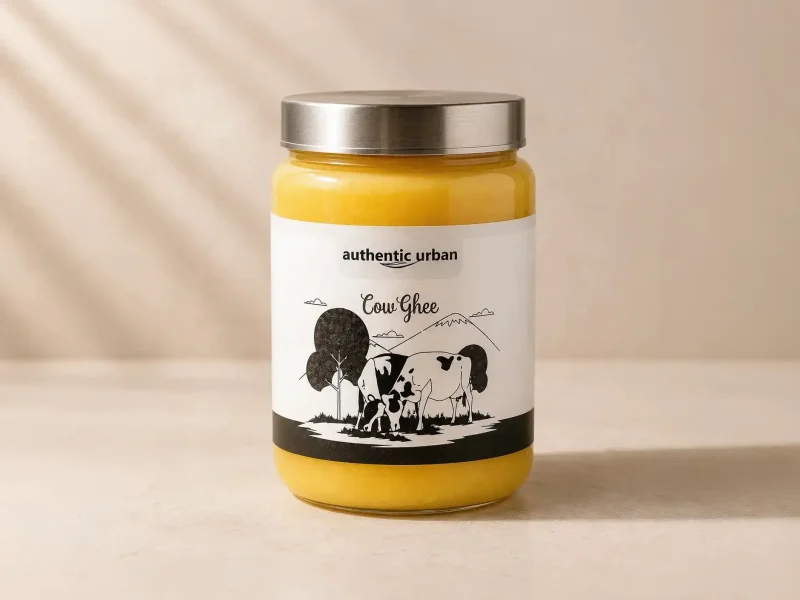 1 Litre
Buffalo ghee: halwa and paratha
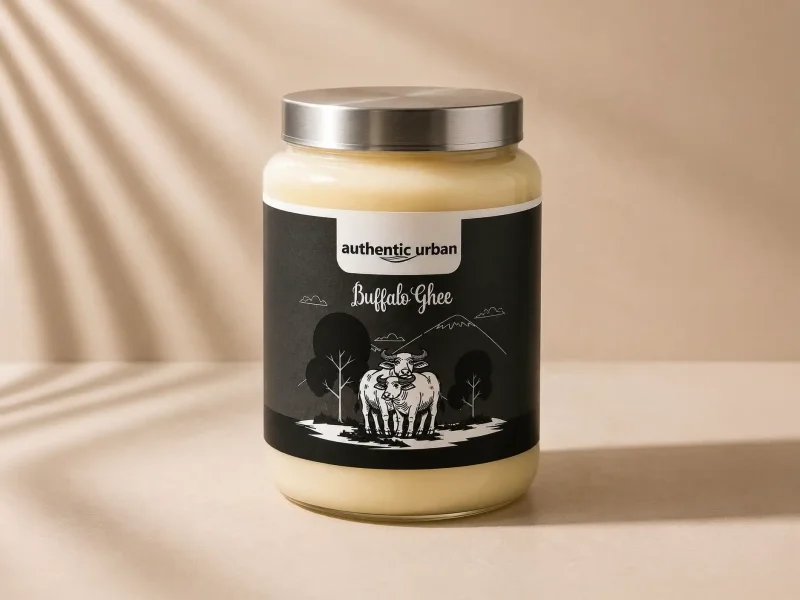 1 Litre
Each order is cooked after you place it, and the packing video is of that batch. Past order videos are on the shop.
FAQ
Which ghee is best to keep next to mustard oil?
We make ghee, so weigh this with that in mind: our Authentic Urban A2 Gir cow ghee for the daily spoon, and our Jafarabadi buffalo ghee for sweets and paratha. Both are curd-churned Bilona, cooked after you order, with a video of your jar. Whatever you buy, check the FSSAI licence number, and warm a spoon: it should smell of toasted milk, not packing oil.
Is kachi ghani mustard oil better than refined mustard oil?
Kachi ghani means cold pressed. ICMR-NIN's 2024 guidelines say cold pressed oils keep antioxidants and other plant compounds, but can also carry the unwanted compounds of crude oil. Refining removes those, and some antioxidants with them. FSSAI lets a pack say kachi ghani only if its allyl isothiocyanate, the pungent compound, is at least 0.20%. Both are legal to eat. Buy a sealed pack with an FSSAI licence either way.
Which is better for weight loss, ghee or mustard oil?
Neither. A 5 g teaspoon of either has about 44 calories, per USDA FoodData Central, so the amount matters, not the bottle. Mustard oil is the better cooking oil for the heart because it has less saturated fat, but pouring more of it will not help weight loss. Measure oil with a spoon, keep ghee to 1 or 2 teaspoons, and cut fried snacks first.
Does mustard oil have cholesterol like ghee?
No. ICMR-NIN's 2024 guidelines note that plant foods have no cholesterol, so mustard oil has none. Ghee has about 13 mg in a teaspoon, per USDA. The bigger point is ghee's saturated fat: the same guidelines say saturated fats raise total and LDL cholesterol. If your LDL is high, your doctor sets your fat limit.
Can I use mustard oil instead of ghee in halwa or ladoo?
You can, but it changes the sweet. Halwa, ladoo, and sheera are built on ghee's taste and the way it sets as it cools; mustard oil stays liquid and tastes sharp even after heating. If you want less ghee in sweets, make smaller portions rather than switching the fat. For sweets we reach for buffalo ghee, which sets firmer and grainier.
Is ghee or mustard oil better for diabetics?
Neither contains carbohydrate, so neither raises blood sugar by itself. For diabetes the bigger risk is the heart, which is why mustard oil, with a fifth of ghee's saturated fat, suits the daily cooking better, and ghee stays at 1 or 2 teaspoons. Your doctor or dietitian decides the total fat for you, especially if your cholesterol or kidney tests are off.
About the editorial team
Authentic Urban TeamBilona ghee makers, Gir Somnath, Gujarat
We are the Parmar family in Gir Somnath, Gujarat. We have made ghee here since 2016 and sold it online since 2025. We make only Bilona ghee, test it every month, and anyone is welcome to visit and watch it being made. Our Gir cows and Jafarabadi buffalo are grass-fed village animals that graze near the Gir forest, with no hormones or milk boosters. We set their milk to curd, churn it, and cook the makkhan on a wood chulha. These articles come from that kitchen and from what customers ask us on WhatsApp. We are ghee makers, not doctors.
Sources
- Dietary Guidelines for Indians, 2024 (Guideline 7, printed pp. 52 to 55; Guideline 15, printed p. 93), ICMR-National Institute of Nutrition. Checked 27 Sep 2026.
- Oil, mustard (FDC ID 172337), SR Legacy, USDA FoodData Central. Checked 27 Sep 2026.
- Butter oil, anhydrous (FDC ID 173412), SR Legacy, USDA FoodData Central. Checked 27 Sep 2026.
- Oil, peanut, salad or cooking (FDC ID 171410), SR Legacy, USDA FoodData Central. Checked 27 Sep 2026.
- Oil, sunflower, linoleic (FDC ID 171025), SR Legacy, USDA FoodData Central. Checked 27 Sep 2026.
- Oil, coconut (FDC ID 171412), SR Legacy, USDA FoodData Central. Checked 27 Sep 2026.
- Food Safety and Standards Regulations, Chapter 2.2: Fats, oils and fat emulsions, version 5 (01.08.2025), 2.2.1 (6) and (7), FSSAI. Checked 27 Sep 2026.
- Erucic acid concentration of rapeseed (Brassica napus L.) oils on the German food retail market (Russo et al., 2021), for the EFSA TDI and the EU maximum level, Food Science & Nutrition. Checked 27 Sep 2026.
- Mustard oil and cardiovascular health: Why the controversy? (Poddar et al., 2022), Journal of Clinical Lipidology. Checked 27 Sep 2026.
- Diet and risk of ischemic heart disease in India (Rastogi et al., 2004), American Journal of Clinical Nutrition. Checked 27 Sep 2026.
- FSSAI urges states to enforce ban on blending of mustard oil with other cooking oils (9 June 2021), Business Today. Checked 27 Sep 2026.