Ghee vs Olive Oil: Which Is Healthier for Indian Cooking?
Ghee vs olive oil: olive oil is the healthier everyday cooking fat, with about 0.7 g of saturated fat a teaspoon against 3.1 g in ghee, per USDA. Ghee is the better finishing fat for Indian food, a teaspoon on dal, roti, or khichdi. So cook the sabzi in olive oil or another liquid oil, and keep ghee to the 1 or 2 teaspoons a day that ICMR-NIN allows.
Ghee vs olive oil: which is better?
For health, olive oil. For taste in Indian food, ghee. A teaspoon of each has the same 44 calories, but olive oil is mostly monounsaturated fat and ghee is mostly saturated fat. Use olive oil (or groundnut or mustard oil) for the bulk of the day's cooking, and ghee as the teaspoon you can taste.
Most pages on this question pick one winner for every job, or tell you olive oil cannot go near a kadhai. Neither is right. The table below puts a teaspoon of each side by side, from USDA FoodData Central, worked out for the 5 g household teaspoon that ICMR-NIN uses.
1 tsp (5 g)
Ghee
Olive oil
Calories
44 kcal
44 kcal
Saturated fat
3.1 g
0.7 g
Monounsaturated fat
1.4 g
3.7 g
Polyunsaturated fat
0.2 g
0.5 g
Butyric acid (C4)
0.16 g
0 g
Cholesterol
13 mg
0 mg
Vitamin A
42 µg
0 µg
Vitamin E
0.14 mg
0.72 mg
Vitamin K
0.4 µg
3.0 µg
Vitamin D
0
0
Smoke point
220 to 240°C
175 to 205°C
Nutrients: USDA FoodData Central, SR Legacy, butter oil anhydrous (173412) and olive oil, salad or cooking (171413). Smoke points: Kumar and Jadhav, Frontiers in Food Science and Technology, 2026, Table 2. Checked 27 September 2026.
Ghee brings things olive oil does not: about 42 µg of vitamin A and 0.16 g of butyric acid a teaspoon. Olive oil brings more vitamin E and vitamin K, and no cholesterol. Neither has vitamin D, whatever some labels suggest. The full ghee label is on ghee nutrition facts.
Is ghee or olive oil healthier for the heart?
Olive oil. It has about a fifth of ghee's saturated fat, and in the one trial that fed people both, ghee pushed heart markers up compared with olive oil.
USDA FoodData Central, SR Legacy (171412, 173412, 171410, 171413, 172337), rounded to the gram. Checked 27 September 2026.
| Item | Value |
|---|---|
| Coconut oil | 83 g |
| Ghee | 62 g |
| Groundnut oil | 17 g |
| Olive oil | 14 g |
| Mustard oil | 12 g |
ICMR-NIN's 2024 guidelines call visible saturated fat high above 10 g a day, and name ghee, butter, palm oil, and coconut oil as the fats that push people over it. At USDA's figures, ghee reaches 10 g in about 3.2 teaspoons. Olive oil would take about 14 teaspoons, more than most people's whole day of cooking fat. That is the real reason the guideline stops ghee at 1 or 2 teaspoons and says nothing of the kind about olive oil.
What the ghee vs olive oil trial found
A crossover trial in the British Journal of Nutrition (2022) gave 30 healthy adults in Iran about 30 g a day of ghee for 4 weeks and 30 g of olive oil for another 4 weeks. On ghee, apoB (the particles that carry LDL) rose by 0.09 g/l and non-HDL cholesterol by 0.53 mmol/l, compared with olive oil. LDL rose too, but not by enough to be sure. Weight did not differ. Thirty grams is about 6 teaspoons, three times the ICMR-NIN ghee limit, so the trial says a lot of ghee is worse than olive oil, not that a teaspoon on dal is harmful. The full table is on is ghee healthy.
Where olive oil's heart reputation comes from
Most "olive oil protects the heart" lines trace back to PREDIMED, a trial in Spain. Its corrected 2018 report in the New England Journal of Medicine followed 7,447 adults aged 55 to 80 at high heart risk for a median of 4.8 years. Those given a Mediterranean diet with extra virgin olive oil had fewer heart attacks, strokes, and heart deaths than those told to cut fat (hazard ratio 0.69). That was a whole way of eating, with vegetables, fish, and nuts, tested against advice. It does not mean olive oil poured into a fried Indian snack protects anyone.
If your LDL is high, or you have diabetes or heart disease, your doctor or dietitian sets your fat limit, and it comes before any comparison here. The detail for a lipid report is on is ghee bad for cholesterol.
Can you use olive oil for Indian cooking and tadka?
Yes, at a medium flame. Olive oil smokes earlier than ghee, 175 to 205°C against 220 to 240°C in a 2026 review in Frontiers in Food Science and Technology, so a jeera or rai tadka in olive oil needs a gentler hand. But smoking earlier does not mean it breaks down faster.
A 2018 lab study in Acta Scientific Nutritional Health heated 10 supermarket oils for 6 hours at 180°C, about deep-frying heat, and measured the polar compounds (the breakdown products that pile up in used oil). Extra virgin olive oil ended with some of the lowest levels, even though its smoke point was among the lowest. The seed oils with the highest smoke points broke down the most.
Oil
Polar compounds after 6 h at 180°C
Smoke point (fresh)
Sunflower oil
21.75%
255°C
Grapeseed oil
20.24%
268°C
Canola oil
17.32%
256°C
Rice bran oil
15.66%
237°C
Extra virgin olive oil
10.5%
207°C
Coconut oil
9.68%
191°C
De Alzaa, Guillaume, and Ravetti, Acta Scientific Nutritional Health, 2018. Oils heated without food. Smoke points rounded. Checked 27 September 2026.
Two limits. The lab that ran it, Modern Olives in Australia, works in the olive oil trade. And ghee was not in the test, so this table cannot tell you whether ghee or olive oil holds up better. What it does show is that "olive oil turns toxic in a kadhai", a line on many Indian pages, including our own old version of this post, is not what the measurements say.
At the stove, watch the fat, not the number. When we cook makkhan into ghee on the chulha, it comes off the flame as the bubbling goes quiet, the solids turn golden-brown, and it smells of toasted milk. Past that point the batch turns dark and bitter and smells burnt, and it is never packed. Any fat that is smoking in your kadhai has gone the same way, ghee included. The full heat guide is ghee smoke point.
Which fat for which kitchen job
Kitchen job
Use
Why
Tadka poured over dal, a spoon on roti, rice, or khichdi
Ghee, 1 teaspoon
Here the fat is the flavour. Olive oil tastes grassy and peppery next to hing and jeera.
Everyday sabzi, bhuna masala, poha, upma
Olive oil, or groundnut or mustard oil
This is most of the day's fat. ICMR-NIN asks you to keep saturated fat low, and all three are low in it.
Deep frying puri, pakora, samosa
Groundnut or another liquid oil, used once
A full kadhai of extra virgin olive oil is expensive to throw away, and a full kadhai of ghee is days of saturated fat.
Paratha, halwa, ladoo, sheera
Buffalo ghee
The dish is built on ghee's taste and grain. Olive oil does not give it.
Salad, chaat dressing, hummus, a drizzle on soup
Extra virgin olive oil
Used cold, you keep its flavour. Ghee sets hard on a cold plate.
Vegan or dairy-free cooking
Olive oil
Ghee is milk fat.
Frying is the one job where the oil you fry in matters less than what you do with it after. ICMR-NIN's 2024 guidelines say to filter oil used once for frying, use it in curry within a day or two, and never fry in it again. Whether ghee can be reheated the same way is on reheating ghee.
Choose ghee if
- The fat is the flavour: tadka on dal, a spoon on rice, roti, or khichdi.
- You are making paratha, halwa, ladoo, or sheera.
- You want the vitamin A that comes with the fat, and you are not avoiding dairy.
Choose olive oil if
- It is the everyday cooking fat, used by the spoonful across the day.
- The dish is cold: salad, dressing, dip, or a drizzle after cooking.
- You cook vegan, or someone at the table avoids milk.
Which olive oil is right for Indian cooking?
Extra virgin for cold dishes and medium-heat cooking; a plain refined olive oil only if you want a neutral oil and do not mind the price. The names on the bottle mean different things:
- Extra virgin olive oil is pressed from the fruit without refining. It keeps its flavour and natural antioxidants. In the 2018 study it smoked at about 207°C.
- Virgin olive oil is also pressed, but of a lower grade. The same study measured its smoke point at about 175°C, the lowest of the three olive grades.
- Olive oil, "pure", or "light" is mostly refined olive oil blended with some virgin oil. "Light" means light in taste, not in calories: it has the same 44 calories a teaspoon. It smoked at about 208°C, no higher than extra virgin.
- Pomace olive oil, the tins often sold "for Indian cooking", is taken from the pulp left after pressing and then refined. It is a refined oil like any other, and none of the extra virgin trials used it.
ICMR-NIN's guidelines note that pressed oils, virgin or cold pressed (kachi ghani), keep more of their antioxidants, while refining removes some of them without changing the fat itself. So if you buy olive oil for its health reputation, buy extra virgin and use it where you would use any good oil. If you want a cheaper everyday oil for Indian food, groundnut and mustard oil are low in saturated fat too; they are compared on ghee vs vegetable oil.
Is ghee or olive oil better for weight loss?
Neither. Both carry about 44 calories a teaspoon, and in the 4-week ghee vs olive oil trial, body weight did not differ between the two fats.
Weight follows the amount. A kadhai of sabzi made with 12 teaspoons (60 g) of olive oil carries about 530 calories of fat, and the olive oil label does not change that. Measure the oil with a spoon, cut fried snacks first, and keep ghee to 1 or 2 teaspoons where you taste it. Portions for weight loss are on ghee for weight loss.
How much ghee and olive oil can you use in a day?
All visible fat together, 20 to 50 g a day (about 4 to 10 teaspoons), with ghee at 1 or 2 teaspoons of it. That is ICMR-NIN's 2024 advice: 20 g for a sedentary woman, 30 g for a sedentary man, and up to 40 or 50 g for heavy physical work.
For a sedentary woman, that is 4 teaspoons in the whole day. One teaspoon of ghee on roti or dal leaves 3 teaspoons of olive or another liquid oil for cooking. That is roughly how we eat at home: 1 to 2 teaspoons of ghee each a day, on roti, dal, and khichdi, and more only in winter sweets. To work out your own family's ghee and oil, try our ghee calculator. The full answer on portions is how much ghee per day.
Three kitchens: which fat should each use?
A family that switched everything to olive oil
Keep olive oil for the sabzi and salads, but bring back a teaspoon of ghee on dal or roti if you miss it; it fits the limit. Stop deep frying in extra virgin olive oil to be healthy. A liquid oil used once does the job for much less.
A home that cooks everything in ghee
Move the everyday cooking, the bhuna and the sabzi, to olive, groundnut, or mustard oil. Keep ghee for the tadka poured on top and the spoon on roti. The food still smells of ghee, with a fraction of the saturated fat.
Someone whose LDL came back high
Olive oil for cooking is a sound swap here, and the trial above points the same way. Ask your doctor whether the teaspoon of ghee stays; many people keep it, but that is their call to make with you.
Comparing with other oils? See ghee vs coconut oil and ghee vs avocado oil.
A 7-point checklist for ghee and olive oil at home
Save or screenshot this; it is the whole page in seven lines.
- 1 Keep ghee to 1 to 2 teaspoons a day for each adult, measured with a real 5 ml spoon.
- 2 Cook the everyday sabzi in a liquid oil (olive, groundnut, or mustard), at a medium flame.
- 3 Pour ghee where you taste it: tadka on dal, a spoon on roti or khichdi.
- 4 Use extra virgin olive oil cold or at medium heat. Buy pomace or "light" olive oil only as a plain refined oil.
- 5 Deep fry in a liquid oil, once. Filter it and use it in curry within a day or two.
- 6 Take any fat off the flame the moment it smokes, and wipe the kadhai before the next batch.
- 7 Count all of it: the day's visible fat is 20 to 50 g, about 4 to 10 teaspoons, depending on how active you are.
Which ghee should sit next to your olive oil?
If ghee is only a teaspoon or two a day, that teaspoon should be real milk fat. Warm a spoon: it should smell of toasted milk, not packing oil. Once it cools, slow-cooked ghee often turns grainy. Check the FSSAI licence number on the label, and see how to identify pure ghee. Our full ranking of jars is on best ghee in India.
We make both jars below, so weigh our view with that in mind. For the spoon on dal and roti we use our own A2 Gir cow ghee: grass-fed Gir milk set to curd, churned, and cooked in a matki on the chulha, made after you order, with a video of your jar on WhatsApp. For paratha, halwa, and ladoo, Jafarabadi buffalo ghee is the one we reach for. We test every month against the FSSAI limits; see how we make ghee.
Gir cow ghee: the daily teaspoon
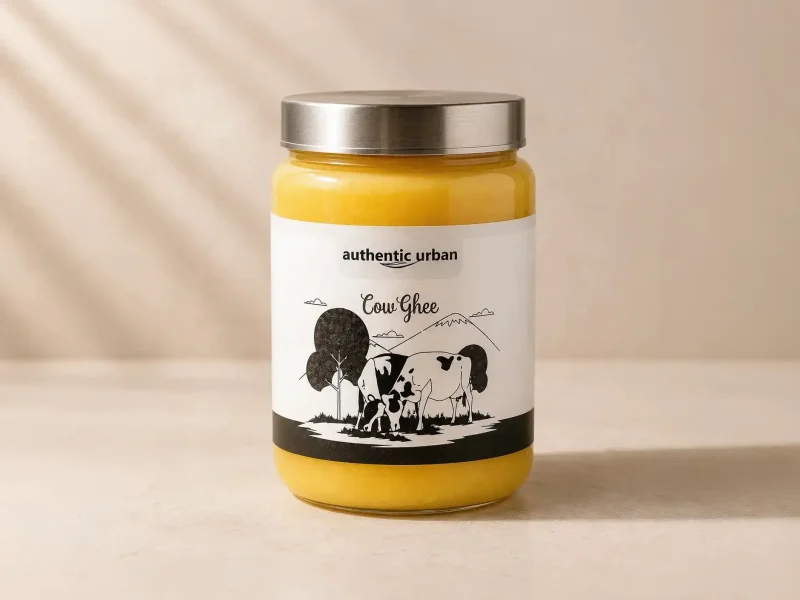 1 Litre
Buffalo ghee: paratha and halwa
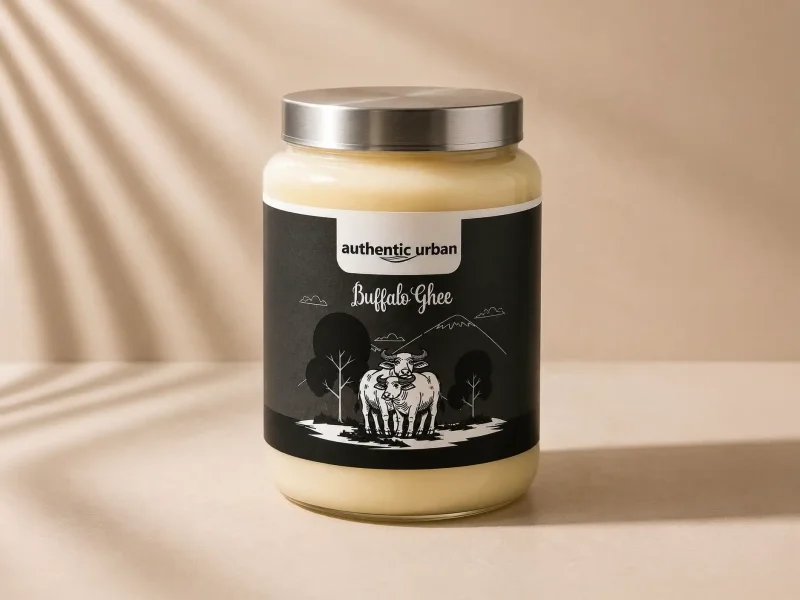 1 Litre
Each order is cooked after you place it, and the packing video is of that batch. Past order videos are on the shop.
FAQ
Is A2 Gir cow ghee healthier than olive oil?
Not for the heart. A2 describes the protein in the milk, and ghee is almost all fat, so the A2 label does not change its fat. A2 Gir ghee has about the same saturated fat per teaspoon as any ghee, around 3 g, against under 1 g in olive oil. Choose A2 Gir ghee for taste and how it is made, and keep it to 1 or 2 teaspoons a day.
Is ghee or olive oil better for diabetics?
Neither has carbohydrate, so neither raises blood sugar by itself. For diabetes the bigger concern is the heart, and saturated fat is where the two differ: about 3 g a teaspoon in ghee, under 1 g in olive oil. Cook in a liquid oil, keep ghee to a teaspoon or two on dal or roti, and follow the fat limit your doctor or dietitian gives you.
Can I mix ghee and olive oil in the same tadka?
Yes. Many cooks heat a little olive oil for the jeera and onion, then add half a teaspoon of ghee at the end for its smell. The oil takes the long cooking and the ghee is the flavour, so you use less ghee than a full ghee tadka. Keep the flame at medium, and count both toward the day's fat.
Which is better for a child's food, ghee or olive oil?
For a child over one year, a teaspoon of ghee on dal, rice, or khichdi is the usual Indian choice, and it brings some vitamin A that olive oil does not have. Olive oil is fine for the rest of the family's cooking in normal amounts. For a baby under one, ask your paediatrician how and when to add any fat to meals.
Is olive oil or ghee better for massage and dry skin?
Both work as a coat that holds moisture in dry skin, heels, and lips. Olive oil is thinner and spreads more easily over large areas; ghee is thicker and suits small dry patches. Patch test either on the inner arm for 24 hours first, and stop if you see redness, itching, or new pimples on the face. For a baby's skin, ask your paediatrician first.
Does olive oil go bad faster than ghee?
Once opened, both last longest in a closed container away from the stove and sunlight. A sealed jar of our ghee keeps 9 to 12 months at room temperature; after opening, use a dry spoon and close the lid. Olive oil keeps best in a dark bottle, capped. Throw out either one if it smells stale, sour, or like old paint.
About the editorial team
Authentic Urban TeamBilona ghee makers, Gir Somnath, Gujarat
We are the Parmar family in Gir Somnath, Gujarat. We have made ghee here since 2016 and sold it online since 2025. We make only Bilona ghee, test it every month, and anyone is welcome to visit and watch it being made. Our Gir cows and Jafarabadi buffalo are grass-fed village animals that graze near the Gir forest, with no hormones or milk boosters. We set their milk to curd, churn it, and cook the makkhan on a wood chulha. These articles come from that kitchen and from what customers ask us on WhatsApp. We are ghee makers, not doctors.
Sources
- Dietary Guidelines for Indians, 2024 (Guideline 7, printed pp. 54 and 55; Guideline 15, printed p. 93), ICMR-National Institute of Nutrition. Checked 27 Sep 2026.
- Butter oil, anhydrous (FDC ID 173412), SR Legacy, USDA FoodData Central. Checked 27 Sep 2026.
- Oil, olive, salad or cooking (FDC ID 171413), SR Legacy, USDA FoodData Central. Checked 27 Sep 2026.
- Oil, coconut (FDC ID 171412), SR Legacy, USDA FoodData Central. Checked 27 Sep 2026.
- Oil, peanut, salad or cooking (FDC ID 171410), SR Legacy, USDA FoodData Central. Checked 27 Sep 2026.
- Oil, mustard (FDC ID 172337), SR Legacy, USDA FoodData Central. Checked 27 Sep 2026.
- Understanding the techno-functionality of ghee as a cooking medium (Kumar D, Jadhav HB), 2026 (Table 2, smoke points), Frontiers in Food Science and Technology. Checked 27 Sep 2026.
- Evaluation of Chemical and Physical Changes in Different Commercial Oils during Heating (De Alzaa F, Guillaume C, Ravetti L), 2018, Acta Scientific Nutritional Health. Checked 27 Sep 2026.
- Effects of diets rich in ghee or olive oil on cardiometabolic risk factors in healthy adults: a two-period, crossover, randomised trial (Mohammadi Hosseinabadi and Nasrollahzadeh, 2022), British Journal of Nutrition. Checked 27 Sep 2026.
- Primary Prevention of Cardiovascular Disease with a Mediterranean Diet Supplemented with Extra-Virgin Olive Oil or Nuts (Estruch et al., 2018), New England Journal of Medicine. Checked 27 Sep 2026.