Ghee vs Coconut Oil: Which Is Healthier, and When to Use
Ghee vs coconut oil has no healthier winner: both are mostly saturated fat, so use a teaspoon of ghee where you taste it, on dal, roti, or khichdi, and coconut oil where the dish is built on it, like avial or Kerala fish curry. Coconut oil carries more saturated fat, 82.5 g per 100 g against 61.9 g in ghee, per USDA. Ghee carries cholesterol and vitamin A. ICMR-NIN's 2024 guidelines ask you to limit both.
Ghee vs coconut oil: which is better for your kitchen?
Pick by the dish, not by health. Ghee is better for North and West Indian food, sweets, and the spoon on hot dal. Coconut oil is better for Kerala, Konkan, and coastal dishes that taste of it, and for anyone who avoids dairy. For the bulk of the day's cooking and for deep frying, neither is the best choice: a liquid oil is.
That last point is where most "ghee vs coconut oil" pages go wrong. They crown one saturated fat over the other. ICMR-NIN's Dietary Guidelines for Indians (2024) name coconut oil, palm oil, ghee, and butter together as saturated fats, and ask you to limit all of them. Save or screenshot this table; it is how we would split the two in a week of cooking.
Kitchen job
Use
Why
Tadka poured over dal, a spoon on roti or rice
Ghee, 1 teaspoon
You taste it. Coconut oil changes the dish.
Avial, thoran, Kerala fish curry, appam stew
Coconut oil
The dish is built on its smell. Ghee tastes out of place.
Deep frying puri, pakora, banana chips
Groundnut or another liquid oil, used once
Frying takes a lot of fat. Both ghee and coconut oil would put a day's saturated fat in the kadhai.
Paratha, halwa, ladoo, sheera
Buffalo ghee
The sweet or bread is built on ghee's taste and grain.
Payasam, unniyappam, coconut barfi
Ghee to finish, coconut in the dish
South Indian sweets often use both: coconut milk or grated coconut, then ghee-fried cashews on top.
Vegan or dairy-free cooking
Coconut oil
Ghee is milk fat.
Everyday sabzi base
Neither: a liquid oil
This is most of the day's fat. ICMR-NIN asks you to limit saturated fats.
If you are comparing ghee with sunflower, soybean, or refined oil instead, that has its own page: ghee vs vegetable oil.
What is in a teaspoon of ghee vs coconut oil?
The calories are the same, about 44 in a 5 g teaspoon of either. The fats inside are very different. These are USDA FoodData Central's figures, worked out for the 5 g household teaspoon that ICMR-NIN uses.
1 tsp (5 g)
Ghee
Coconut oil
Calories
44 kcal
45 kcal
Saturated fat
3.1 g
4.1 g
Monounsaturated fat
1.4 g
0.3 g
Polyunsaturated fat
0.2 g
0.1 g
Lauric acid (C12)
0.14 g
2.09 g
Caprylic + capric (C8, C10)
0.18 g
0.61 g
Butyric acid (C4)
0.16 g
Almost none
Cholesterol
13 mg
0 mg
Vitamin A
42 µg
0 µg
Vitamin D
0
0
Smoke point
220 to 240°C
175 to 205°C
Melts at
27 to 40°C
24 to 27°C
Nutrients: USDA FoodData Central, SR Legacy, butter oil anhydrous (173412) and coconut oil (171412). Smoke points and melting ranges: Kumar and Jadhav, Frontiers in Food Science and Technology, 2026, Table 2. Checked 27 September 2026.
Three rows matter most. Coconut oil has about a third more saturated fat per spoon, and most of it is lauric acid. Ghee has cholesterol, about 13 mg a teaspoon, and coconut oil has none. Ghee brings about 42 µg of vitamin A a teaspoon; coconut oil brings none. Several top pages say ghee is rich in vitamin D, but USDA lists zero vitamin D for both fats. Ghee's full label is on ghee nutrition facts.
Which is healthier, ghee or coconut oil?
Neither is healthy in large amounts, and in a teaspoon neither is a problem for most healthy adults. The difference is how fast each one uses up the day's saturated fat.
USDA FoodData Central, SR Legacy (171412, 173412, 171410, 172337), rounded to the gram. Checked 27 September 2026.
| Item | Value |
|---|---|
| Coconut oil | 83 g |
| Ghee | 62 g |
| Groundnut oil | 17 g |
| Mustard oil | 12 g |
ICMR-NIN's 2024 guidelines call visible saturated fat high above 10 g a day, and they name ghee, butter, palm oil, and coconut oil as the fats that push people over it. At USDA's figures, coconut oil reaches 10 g in about 2.4 teaspoons, ghee in about 3.2, groundnut oil in about 12, and mustard oil in about 17. So two teaspoons of ghee a day fits; two teaspoons of ghee plus coconut oil in the sabzi does not.
What the cholesterol trials show
We could not find a trial that fed people ghee against coconut oil directly. Three trials come close, and they point the same way:
- Coconut oil vs liquid oils. A 2020 review of 16 trials in Circulation (Neelakantan and colleagues) found coconut oil raised LDL cholesterol by about 10.5 mg/dL compared with non-tropical vegetable oils such as olive, soybean, or canola. It also raised HDL by about 4 mg/dL, and did not change measures of body fat or blood sugar.
- Coconut oil vs butter. A 2018 trial in BMJ Open (Khaw and colleagues) gave about 90 healthy adults aged 50 to 75 in the UK 50 g a day of virgin coconut oil, butter, or olive oil for 4 weeks. Butter raised LDL more than coconut oil. Butter is not ghee, and 50 g is five times the ICMR-NIN ghee limit, so treat this as a hint, not a verdict.
- Ghee vs olive oil. A trial in the British Journal of Nutrition (2022) gave 30 healthy adults about 30 g a day of ghee or olive oil for 4 weeks each. Ghee raised apoB and non-HDL cholesterol compared with olive oil; the LDL rise was not significant.
The shared lesson: both fats raise cholesterol markers against liquid oils when eaten by the tablespoon. None of these trials tested a teaspoon a day, which is how we eat ghee at home: 1 to 2 teaspoons each, on roti, dal, and khichdi. If you have high LDL, diabetes, or heart disease, your doctor or dietitian sets your fat limit, and that comes before any comparison. More on ghee for cholesterol.
Which is better for tadka, frying, and sweets?
Ghee takes more heat. A 2026 review in Frontiers in Food Science and Technology lists ghee's smoke point at 220 to 240°C and coconut oil's at 175 to 205°C. A jeera tadka in ghee can be hot and fast; in coconut oil, keep the flame at medium.
The numbers you see elsewhere, ghee at 485°F (about 252°C) and virgin coconut oil at 350°F (about 177°C), are repeated from page to page without a source, so we have left them out. What matters at the stove is the sign, not the degree. When we cook makkhan into ghee on the chulha, we take it off as the bubbling goes quiet and the solids turn golden-brown. Past that point the batch turns dark and bitter and smells burnt, and it never goes in a jar. Any fat that is smoking in your kadhai has gone too far, ghee included. The full heat guide is ghee for high heat cooking.
Choose ghee if
- The fat is the flavour: tadka on dal, a spoon on rice, roti, or khichdi.
- You are making paratha, halwa, ladoo, or sheera.
- You want the vitamin A that comes with the fat, and you are not avoiding dairy.
Choose coconut oil if
- The recipe is Kerala, Konkan, Mangalorean, or Tamil and asks for it.
- You cook vegan, or someone at the table avoids milk.
- You want no dietary cholesterol from the fat itself.
For deep frying, choose neither. Frying soaks up a lot of fat, and in either of these it is mostly saturated. Use groundnut or another liquid oil once, then filter it and use it in curry within a day or two, as ICMR-NIN advises. How to cook with ghee day to day is on cooking with ghee.
Does coconut oil's MCT make it better for weight loss?
No. A teaspoon of coconut oil has the same 44 calories as a teaspoon of ghee, and the Circulation review found no change in measures of body fat from coconut oil compared with other oils.
Coconut oil is sold as an MCT fat (medium-chain triglycerides, fats 6 to 12 carbons long). It does have more of them than ghee. But the two MCT fats that supplement oils are built on, caprylic (C8) and capric (C10), come to about 12 g per 100 g of coconut oil in USDA's figures, against about 3.6 g in ghee. Most of coconut oil's "MCT" is lauric acid, 41.8 g per 100 g. In the 2018 BMJ Open trial, 4 weeks of 50 g a day of coconut oil did not change weight or waist size compared with butter or olive oil.
For weight, the amount matters far more than the jar. Keep ghee to the 1 to 2 teaspoons ICMR-NIN allows, measure with a spoon, and cut fried snacks first. The concentrated MCT product is compared on ghee vs MCT oil, and portions for weight loss on ghee for weight loss.
How much ghee and coconut oil can you use in a day?
Together, 1 to 2 teaspoons a day for most healthy adults, with the rest of your cooking fat from liquid oils. ICMR-NIN's 2024 guidelines put all visible fat at 20 to 50 g a day depending on activity, and ask you to limit ghee or butter to 1 or 2 teaspoons, or avoid it.
The guidelines do not give coconut oil its own teaspoon limit, but they group it with ghee as a saturated fat and count it toward the same 10 g mark. In a Kerala kitchen where coconut oil is the daily cooking fat, that means the everyday tadka and thoran are already the saturated fat for the day, and ghee is for a festival payasam. In a Gujarati or Punjabi kitchen, the ghee on roti and dal is the saturated fat, and coconut oil is for the odd coastal recipe. To work out your own family's ghee and oil, try our ghee calculator. The full answer on portions is how much ghee per day.
Three kitchens: which fat should each use?
A family in Kochi that cooks in coconut oil
Keep coconut oil for the dishes that need it, and move the rest of the cooking, the everyday sabzi and anything fried, to a liquid oil. Add ghee for sweets and the child's rice, not on top of a full coconut-oil day.
A dal-roti home in Ahmedabad or Delhi
A teaspoon of ghee on roti and one in the dal tadka is the day's saturated fat. Coconut oil adds nothing here except for the odd avial or coastal curry; do not add it "for MCTs".
Someone whose LDL came back high
Switching from ghee to coconut oil is not a fix; the review above found coconut oil raises LDL against liquid oils too. Cut the total saturated fat, cook in groundnut or mustard oil, and ask your doctor whether the teaspoon of ghee stays.
What mistakes do people make with ghee and coconut oil?
- Swapping ghee for coconut oil to "protect the heart". Coconut oil has more saturated fat per spoon, not less.
- Pouring coconut oil into coffee or smoothies for weight loss. A tablespoon is over 120 calories, and the trials found no weight change.
- Deep frying in either to be healthy. Frying is where a liquid oil, used once, makes sense.
- Using both freely on the same day. One teaspoon of each is about 7 g of saturated fat, most of the 10 g mark.
- Reading a melted jar as spoiled. Coconut oil turns liquid above about 27°C, and ghee softens in heat too. In summer our own ghee stays liquid in the jar, and the complaint we hear most in hot months is a jar that melted or leaked in transit. Melting is not spoiling; a sour or paint-like smell is. Storage is covered in how to store ghee.
- Buying the cheapest ghee. A jar priced below what the milk costs may not be milk fat. Our checks are on how to identify pure ghee.
Using either one on skin or hair instead of eating it? Coconut oil and ghee are compared for hair on ghee for hair, and in the navel on ghee in the belly button.
Which ghee should sit next to your coconut oil?
If ghee is only a teaspoon or two a day, that teaspoon should be real milk fat. Warm a spoon: it should smell of toasted milk, not packing oil. Once it cools, slow-cooked ghee often turns grainy. Check the FSSAI licence number on the label. Our full ranking of jars is on best ghee in India.
We make both jars below, so weigh our view with that in mind. For the spoon on dal and roti we use our own A2 Gir cow ghee: grass-fed Gir milk set to curd, churned, and cooked in a matki on the chulha, made after you order, with a video of your jar on WhatsApp. For halwa, ladoo, and payasam, Jafarabadi buffalo ghee is the one we reach for. We test every month against the FSSAI limits; see how we make ghee.
Gir cow ghee: the daily teaspoon
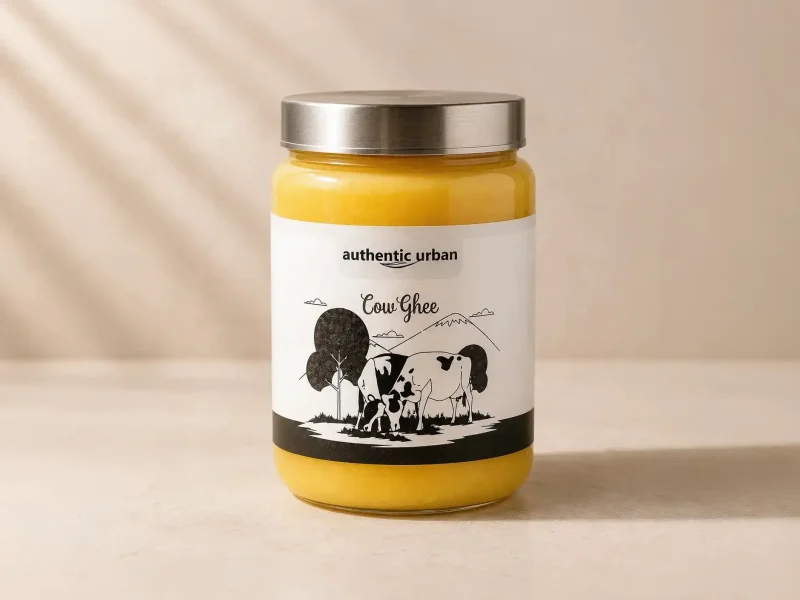 1 Litre
Buffalo ghee: halwa and payasam
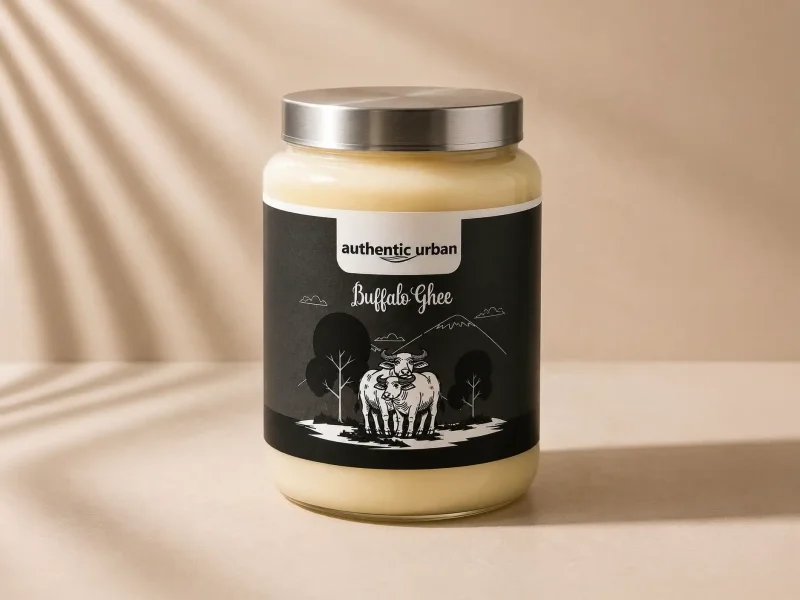 1 Litre
Each order is cooked after you place it, and the packing video is of that batch. Past order videos are on the shop.
FAQ
Is ghee or coconut oil better for skin and hair?
On hair, coconut oil is the usual Indian choice: it is thinner, spreads easily, and washes out more easily than ghee. On dry skin, heels, and lips, both work as a coat that holds in moisture. Patch test either one on the inner arm for 24 hours first. Stop if you get itching, redness, or new pimples on the face.
Can I mix ghee and coconut oil in the same pan?
Yes. Many Kerala and Mangalorean cooks start a dish in coconut oil and finish with a spoon of ghee, or fry cashews in ghee for a coconut-milk payasam. Keep the flame medium, because coconut oil smokes first. Count both toward the day's fat: one teaspoon of each is about 7 g of saturated fat, most of the ICMR-NIN 10 g mark.
Which is better for babies and children, ghee or coconut oil?
For a child over one year, a teaspoon of ghee on dal, rice, or khichdi is the usual Indian choice, and it brings some vitamin A that coconut oil does not. Families in Kerala cook children's food in coconut oil too, and that is fine in normal amounts. For a baby under one, ask your paediatrician how and when to add any fat.
Is coconut oil or ghee better for diabetics?
Neither has carbohydrate, so neither raises blood sugar on its own. The 2020 Circulation review found coconut oil did not change blood sugar markers compared with other oils. For diabetes the bigger worry is the heart, and both are saturated fats that ICMR-NIN asks you to limit. Keep the pair to 1 or 2 teaspoons a day, and follow your doctor's fat limit if your cholesterol is high.
Which is better for oil pulling, ghee or coconut oil?
Coconut oil is the more common modern choice for oil pulling, and sesame oil the classical one. Ghee is also used in Ayurvedic households, and warm ghee feels softer on dry gums. Swish a teaspoon for a few minutes, spit it into the bin rather than the sink, because fat blocks drains, and rinse. Oil pulling does not replace brushing twice a day or a dentist visit for bleeding gums.
Why does coconut oil go solid in winter and ghee stay soft?
They melt at different points. A 2026 review in Frontiers in Food Science and Technology puts coconut oil's melting range at 24 to 27°C and ghee's at 27 to 40°C, because ghee is a mix of many fats that set at different temperatures. So coconut oil turns fully solid or fully liquid, while ghee often sets grainy and soft in between. Neither change affects quality.
About the editorial team
Authentic Urban TeamBilona ghee makers, Gir Somnath, Gujarat
We are the Parmar family in Gir Somnath, Gujarat. We have made ghee here since 2016 and sold it online since 2025. We make only Bilona ghee, test it every month, and anyone is welcome to visit and watch it being made. Our Gir cows and Jafarabadi buffalo are grass-fed village animals that graze near the Gir forest, with no hormones or milk boosters. We set their milk to curd, churn it, and cook the makkhan on a wood chulha. These articles come from that kitchen and from what customers ask us on WhatsApp. We are ghee makers, not doctors.
Sources
- Dietary Guidelines for Indians, 2024 (Guideline 7, printed pp. 52 and 54; Guideline 15, printed p. 93), ICMR-National Institute of Nutrition. Checked 27 Sep 2026.
- Butter oil, anhydrous (FDC ID 173412), SR Legacy, USDA FoodData Central. Checked 27 Sep 2026.
- Oil, coconut (FDC ID 171412), SR Legacy, USDA FoodData Central. Checked 27 Sep 2026.
- Oil, peanut, salad or cooking (FDC ID 171410), SR Legacy, USDA FoodData Central. Checked 27 Sep 2026.
- Oil, mustard (FDC ID 172337), SR Legacy, USDA FoodData Central. Checked 27 Sep 2026.
- Understanding the techno-functionality of ghee as a cooking medium (Kumar D, Jadhav HB), 2026 (Table 2, smoke points and melting ranges), Frontiers in Food Science and Technology. Checked 27 Sep 2026.
- The Effect of Coconut Oil Consumption on Cardiovascular Risk Factors: A Systematic Review and Meta-Analysis of Clinical Trials (Neelakantan et al., 2020), Circulation. Checked 27 Sep 2026.
- Randomised trial of coconut oil, olive oil or butter on blood lipids and other cardiovascular risk factors in healthy men and women (Khaw et al., 2018), BMJ Open. Checked 27 Sep 2026.
- Effects of diets rich in ghee or olive oil on cardiometabolic risk factors in healthy adults: a two-period, crossover, randomised trial (Mohammadi Hosseinabadi and Nasrollahzadeh, 2022), British Journal of Nutrition. Checked 27 Sep 2026.