Ghee vs Butter: Which Is Healthier, and When to Use Each
Ghee vs butter: they are the same milk fat, so neither is much healthier. Butter is about 16% water, which is why a teaspoon has 36 calories against 44 in ghee. Use ghee for tadka, roti, and Indian sweets, where butter burns, and butter for toast, pav, and cakes. ICMR-NIN puts both on one line: 1 to 2 teaspoons a day in total.
Is ghee healthier than butter?
Only a little, and only for some people. Gram for gram of fat, ghee and butter are the same fat: USDA FoodData Central lists saturated fat at about 62% of the fat in each. Butter looks lighter per spoon because it carries water. Ghee wins on heat, salt, and keeping. It also has less milk protein, which matters if dairy troubles you.
Here is a 5 g household teaspoon of each, the spoon ICMR-NIN uses, worked from USDA's figures for ghee and unsalted butter. Screenshot it; it settles most of the "ghee is healthier" and "butter is lighter" arguments.
1 tsp (5 g)
Ghee
Butter
Calories
44 kcal
36 kcal
Fat
5.0 g
4.1 g
Water
about 0
0.8 g
Saturated fat
3.1 g
2.5 g
Milk protein (casein and whey)
14 mg
43 mg
Milk sugar
0
3 mg
Butyric acid
0.16 g
0.16 g
Cholesterol
13 mg
11 mg
Vitamin A
42 µg
34 µg
Sodium
0.1 mg
0.6 mg unsalted, 32 mg salted
USDA FoodData Central, SR Legacy: butter oil, anhydrous (173412), butter without salt (173430), butter salted (173410). Checked 29 September 2026.
So the fair comparison is the fat, not the spoon. It takes about 6.1 g of butter to carry the fat in one teaspoon of ghee, and at that amount the calories and saturated fat come out even. The full ghee label, with calories per tablespoon and 100 g, is on ghee nutrition facts.
What is the difference between ghee and butter?
Butter is milk fat with water held inside it; ghee is that butter cooked until the water is gone and the milk solids have browned and been strained off. FSSAI's standard (Chapter 2.1, 2023) calls butter a water-in-oil emulsion and lets table butter hold up to 16% water, 2% milk solids, and 3% salt, with at least 80% milk fat. Ghee must be at least 99.5% milk fat with no more than 0.5% moisture.
In our kitchen in Gir Somnath the butter is the step before the ghee. We set Gir cow milk to curd overnight and churn it for 30 to 45 minutes until the makkhan separates. That makkhan goes into a matki on a low wood flame for 45 to 90 minutes. The loud bubbling at the start is the water boiling out. When it goes quiet, the milk solids turn golden-brown, and the kitchen smells of toasted milk, it is ghee. That is the whole difference between the two fats, and it is why hot ghee takes more heat than butter can.
If you stop earlier, before the solids brown, you get clarified butter, which is paler and milder. How that differs from ghee, and what FSSAI calls it, is on clarified butter vs ghee.
Ghee vs butter, side by side
| Factor | Ghee | Butter | Winner |
|---|---|---|---|
| What it is | Milk fat with the water and most milk solids cooked out | Churned cream or curd: fat with water held inside | Tie |
| Fat (FSSAI minimum) | 99.5% | 80% table butter, 76% white butter | Tie |
| Water (FSSAI maximum) | 0.5% | 16% table butter | Ghee ✓ |
| Smoke point | 220 to 240°C | 140 to 180°C | Ghee ✓ |
| Salt | None | Up to 3% in salted butter | Ghee ✓ |
| Taste | Toasted, nutty milk | Fresh cream, often salty | Tie |
| Keeping | Room temperature, sealed jar keeps months | Fridge, as the pack says | Ghee ✓ |
| Price per kg as sold | ₹815 (Amul Cow Ghee) | ₹460 (Amul salted butter) | Butter ✓ |
| Best at | Tadka, roti, dal, Indian sweets | Toast, pav, cakes, pastry | Tie |
Verdict: Ghee for the hot pan, the roti, and Indian sweets. Butter for toast, pav, and Western baking. Fat standards: FSSAI Chapter 2.1 (2023). Smoke points: Kumar and Jadhav, Frontiers in Food Science and Technology 2026. Prices: Amul butter on bigbasket, 29 September 2026; Amul Cow Ghee from our Ghee Price Index, September 2026.
Which is better for cooking: ghee or butter?
Ghee, for almost every Indian dish that meets a hot pan. A 2026 review in Frontiers in Food Science and Technology (Kumar and Jadhav) lists ghee's smoke point at 220 to 240°C and butter's at 140 to 180°C in the same table. The same review puts frying with ghee at 160 to 180°C, which is the top of butter's range. Butter's milk solids are what burn first.
This is how we would split the jobs at home:
Kitchen job
Use
Why
Jeera or hing tadka on dal
Ghee, 1 tsp
The tadka pan runs hotter than butter can take. Butter's milk solids go brown and then black before the jeera splutters.
Roti, phulka, khichdi on the plate
Ghee
Ghee is the taste people expect, and it stays soft on a warm roti without turning watery.
Paratha on the tawa
Ghee for cooking, a dab of white butter on top if you like
The tawa is hot enough to scorch butter. Butter on the finished paratha is for taste only.
Halwa, ladoo, mysore pak, barfi
Buffalo ghee
These are roasted in fat for a long time. Butter's water spits and its milk solids burn.
Pav bhaji, toast, bread
Butter
The pav and toast taste people know is butter, and a flat tawa at medium heat does not burn it in the time it takes.
Cakes, cookies, puff pastry
Butter, or ghee with water added back
Western recipes count on butter's water for rise and flaky layers.
Deep frying puri, pakora, samosa
Groundnut or another liquid oil
Frying soaks up far more fat than a teaspoon. Neither ghee nor butter belongs in a kadhai full of oil for a daily meal.
Heat limits, deep frying, and why some jars smoke early are on ghee smoke point.
Choose ghee if
- The pan gets hot: tadka, a paratha on the tawa, roasting suji or besan.
- It goes on roti, dal, rice, or khichdi, where you taste the fat.
- Milk protein or milk sugar gives you trouble in small amounts.
- You watch salt, or you want a fat that keeps in the cupboard.
Choose butter if
- You are spreading it cold on toast or finishing pav on a medium tawa.
- A cake, cookie, or pastry recipe was written for butter and counts on its water.
- You want the fresh cream taste of makkhan on a finished paratha or saag.
Does butter have casein and lactose? Is ghee better for dairy trouble?
Yes, butter has both, in small amounts, and ghee has less. USDA lists 0.85 g of protein (mostly casein and whey) in 100 g of butter and 0.28 g in ghee, so butter has about three times the milk protein. Butter's milk sugar is 0.06 g in 100 g, about 3 mg a teaspoon; ghee has none listed.
For lactose intolerance, both are tiny next to a glass of milk, and many people manage either. For a true milk allergy, ghee is not safe just because it has less: the traces left can still set off a reaction, and an allergist decides. What remains in a spoon of ghee, and who should avoid it, is on does ghee have casein, and lactose per serving of ghee, butter, milk, and curd is on ghee and lactose intolerance.
Does ghee have more butyrate than butter?
No. USDA lists the same 3.23 g of butyric acid in 100 g of butter and 100 g of ghee, about 0.16 g a teaspoon in each. Many pages say ghee "concentrates" butyrate. Cooking out the water does not add any, and USDA's own numbers show a spoon of butter carrying as much.
Either way it is a small amount next to what your gut bacteria make from fibre in dal, vegetables, and whole grains. What swallowed butyrate does, and how much ghee makes sense for the gut, is on butyrate in ghee.
Ghee or butter: which is better for cholesterol, weight, and blood pressure?
Neither, for cholesterol or weight: they count the same. ICMR-NIN's 2024 dietary guidelines list ghee and butter among the sources of saturated fat, say saturated fat raises total and LDL cholesterol, and give them one shared limit: "ghee or butter" at 1 to 2 teaspoons a day, or avoid if possible. That is 1 to 2 teaspoons of the two together, not each.
Blood pressure is where they part. Salted butter carries sodium; ghee does not. USDA lists 643 mg of sodium in 100 g of salted butter, and Amul's own label on bigbasket shows 836 mg, about 42 mg a teaspoon. Ghee has about 0.1 mg. If you are on a low-salt diet, switch toast butter to unsalted or count it.
If your LDL is high, you have heart disease, or your doctor has set a fat limit, that limit comes first. Ghee's case by lipid report is on ghee for cholesterol, and the portion by age is on how much ghee per day.
Why does ghee cost more than butter?
Because about a sixth of a kilo of butter is water, while ghee is all fat and takes longer to make. Price them per kilo of milk fat and the gap narrows: on bigbasket on 29 September 2026, Amul Pasteurised Butter was ₹230 for 500 g, at 80 g of fat per 100 g on its page. That is ₹460 a kilo, or ₹575 per kilo of fat.
Butter: bigbasket, 29 September 2026, at 80% fat per the page. Ghee: Ghee Price Index, September 2026, each brand's own page, 25 and 26 September 2026, and our own live price, at 865 g a litre (USDA) and 99.5% fat.
| Item | Value |
|---|---|
| Authentic Urban A2 Gir cow Bilona ghee | ₹2,787 per kg of fat |
| Authentic Urban Jafarabadi buffalo Bilona ghee | ₹2,323 per kg of fat |
| Amul Cow Ghee | ₹819 per kg of fat |
| Amul Pasteurised Butter (salted) | ₹575 per kg of fat |
Amul Cow Ghee was ₹705 a litre in our Ghee Price Index (September 2026), about ₹819 per kilo of fat. Ours costs more again, and we would rather say why than hide it: our cow ghee is ₹2,399 a litre because it is made from curd, not cream. It takes about 30 to 35 litres of Gir cow milk for 1 kg, and curd to ghee takes the better part of two days. Whether making ghee from shop butter saves money is worked out on homemade ghee vs store bought.
Ghee or butter for paratha, pav bhaji, or a birthday cake?
Paratha takes ghee, pav bhaji takes butter, and a cake takes butter unless you adjust the recipe. Three situations we get asked about:
Sunday parathas for four
Cook them in ghee on the tawa: about a teaspoon each, on the fold and on the tawa. A spoon of white butter on top of the finished paratha is for taste and adds fat, so skip it for the one who is watching cholesterol. Folds and ghee per paratha are on the ghee paratha recipe.
Pav bhaji at home
Street pav bhaji is a butter dish, and the pav should be toasted in butter on a medium tawa. The bhaji can be cooked in either; ghee takes the long mashing on high heat better, and butter goes on at the end for the taste. Both, with amounts per plate, are on pav bhaji with ghee.
A butter cake, but only ghee in the house
It works if you weigh it: 100 g of butter becomes 82 g of ghee plus 16 ml of water, because the water is what you lost. Cup for cup, the cake turns greasy. The gram table and the bakes that still need butter are on ghee instead of butter in baking.
What mistakes do people make with ghee and butter?
The biggest is picking the "healthier" one and then using more of it. Keep this list:
- Comparing by spoon, not by fat. A teaspoon of butter is lighter on calories only because a sixth of it is water. Gram for gram of fat, the two are the same.
- Starting a tadka in butter. Its milk solids burn below the heat a tadka needs. Use ghee, or oil, for the hot pan.
- Forgetting the salt. Salted butter carries far more sodium than ghee. On a low-salt diet, count it with the rest of the day's salt.
- Swapping 1:1 in cakes. Ghee has no water, so a cup-for-cup swap makes cakes greasy and cookies spread. Weigh it and add the water back.
- Eating both freely because one is "healthy". ICMR-NIN puts ghee and butter on the same line: 1 to 2 teaspoons a day in total, not each.
- Leaving butter by the stove. Butter has water and milk solids and belongs in the fridge. Ghee keeps in the cupboard with a dry spoon and the lid shut.
- Buying ghee on price alone. A litre of real ghee needs a lot of milk. A jar far below the cost of that milk is worth a closer look.
What to check on a ghee label before you pay, and the jars we rank, are on best ghee in India.
Which ghee should you keep next to the butter?
If butter stays for toast and cakes, the ghee jar does the hot and Indian jobs. It should be all milk fat: check the FSSAI number on the label, warm a spoon and smell it for toasted milk, and expect some grain once it cools. A jar that is very cheap or smells of nothing is worth a closer look.
We make both jars below, so weigh our view with that in mind. For tadka and the spoon on dal and roti we use our own A2 Gir cow ghee: grass-fed Gir milk set to curd, churned into makkhan, and cooked in a matki on the chulha, made after you order, with a video of your jar on WhatsApp. For halwa, parathas, and a firmer fat in baking, Jafarabadi buffalo ghee is the one we reach for. We test every month against the FSSAI limits; see how we make ghee.
Gir cow ghee: tadka, roti, and the daily spoon
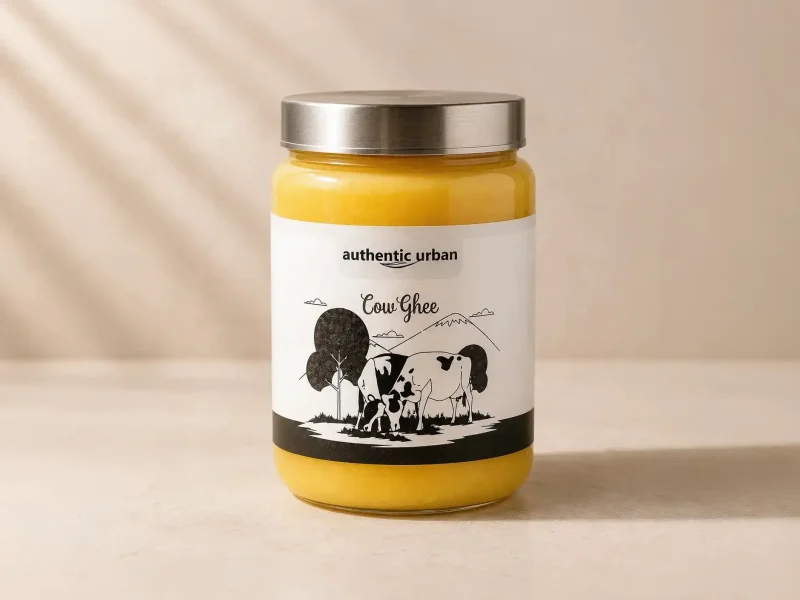 1 Litre
Buffalo ghee: halwa, paratha, and baking
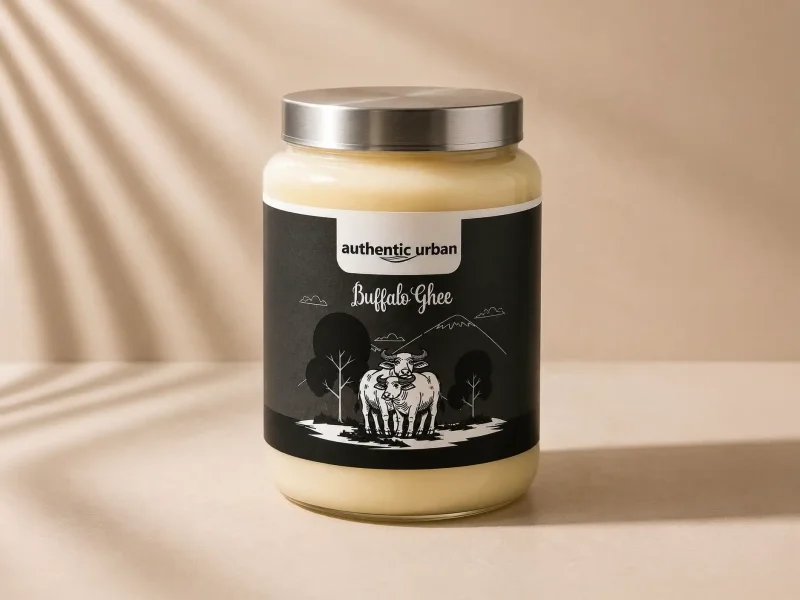 1 Litre
Each order is cooked after you place it, and the packing video is of that batch. Past order videos are on the shop.
FAQ
Which is the best ghee to use instead of butter?
We make ghee, so weigh this with that in mind: our Authentic Urban A2 Gir cow ghee for tadka, roti, and the daily spoon, and our Jafarabadi buffalo ghee for halwa, parathas, and bakes that need a firmer fat. Both are curd-churned Bilona, cooked after you order, with a video of your jar on WhatsApp. Whatever you buy, check the FSSAI number and warm a spoon: it should smell of toasted milk.
Is white butter (safed makkhan) healthier than ghee?
Not really. White butter is the same milk fat with its water and milk solids still in, so a spoon has a little less fat and fewer calories than a spoon of ghee, but gram for gram of fat they match. FSSAI allows white or cooking butter down to 76% milk fat. Makkhan also keeps far less well than ghee, which is why Indian homes cook it into ghee.
Can I make ghee from Amul butter at home?
Yes. Melt unsalted butter on a low flame and let it bubble until the bubbling goes quiet and the solids at the bottom turn golden-brown, then strain. At about 80% fat, 500 g of butter gives about 400 g of ghee, a little less once the brown residue is strained off. Use unsalted butter if you can, so the ghee does not taste salty. It will taste of cream rather than curd, because shop butter is made from cream.
Is ghee or butter better on a keto diet?
Both fit, because neither has real carbohydrate: USDA lists 0.06 g of sugar in 100 g of butter and none in ghee. Ghee is the easier one for a keto cook because it takes more heat and has no water to spit. Keto does not change the saturated fat maths, though. If your LDL is high, your doctor sets the limit, whatever the diet plan says about ghee or butter.
Can I use butter instead of ghee in halwa or ladoo?
You can in a pinch, but it will not taste or keep the same. Butter spits while its water boils off, and its milk solids brown in the pan long before the suji or besan is roasted, which can turn the sweet bitter. A halwa made with butter also keeps less well. If butter is all you have, melt it first and cook it into ghee, then roast.
Does ghee need the fridge like butter does?
No. Ghee has almost no water, so it keeps at room temperature. A sealed jar of ours keeps 9 to 12 months. Once open, use a dry spoon, shut the lid, and keep it away from the stove and sunlight. Butter is different: it still holds about 16% water and some milk solids, so keep it in the fridge and use it by the date on the pack.
About the editorial team
Authentic Urban TeamBilona ghee makers, Gir Somnath, Gujarat
We are the Parmar family in Gir Somnath, Gujarat. We have made ghee here since 2016 and sold it online since 2025. We make only Bilona ghee, test it every month, and anyone is welcome to visit and watch it being made. Our Gir cows and Jafarabadi buffalo are grass-fed village animals that graze near the Gir forest, with no hormones or milk boosters. We set their milk to curd, churn it, and cook the makkhan on a wood chulha. These articles come from that kitchen and from what customers ask us on WhatsApp. We are ghee makers, not doctors.
Sources
- Butter oil, anhydrous (FDC ID 173412), SR Legacy, USDA FoodData Central. Checked 29 Sep 2026.
- Butter, without salt (FDC ID 173430), SR Legacy, USDA FoodData Central. Checked 29 Sep 2026.
- Butter, salted (FDC ID 173410), SR Legacy, USDA FoodData Central. Checked 29 Sep 2026.
- Food Safety and Standards (Food Products Standards) Compendium, Chapter 2.1: Dairy products and analogues, version 01.09.2023 (p. 27 ghee; 2.1.9 butter, pp. 29 and 30), FSSAI. Checked 29 Sep 2026.
- Dietary Guidelines for Indians, 2024 (Guideline 7, printed pp. 52 and 54), ICMR-National Institute of Nutrition. Checked 29 Sep 2026.
- Understanding the techno-functionality of ghee as a cooking medium (Kumar and Jadhav, 2026), Table 2, Frontiers in Food Science and Technology. Checked 29 Sep 2026.