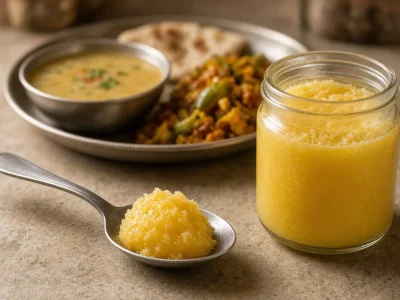
Is Ghee Good for Uric Acid? How Much, and What to Avoid
Is ghee good for uric acid? For most people, yes, at 1 to 2 teaspoons a day: ghee has almost no purines, the compounds your body turns into uric acid, so it does not push uric acid up the way organ meat, sardines, or beer can. It does not bring uric acid down either. Put it on dal, rice, or roti, and watch what else is on the plate.
Is ghee good for uric acid?
Ghee is safe for most people with high uric acid or gout at 1 to 2 teaspoons a day. It is almost pure fat, and fat carries no meaningful purines. So ghee is not the food to cut. It is also not a remedy: no study shows ghee lowers uric acid. The foods that move your number are meat, seafood, alcohol, and sugary drinks.
Uric acid is the waste your body makes when it breaks down purines, which come from your own cells and from food. When too much stays in the blood, it can form needle-like crystals in a joint, and that is a gout attack: sudden, severe pain, usually in the big toe, with hot, red, swollen skin, as the NHS describes it. MedlinePlus gives normal blood uric acid as 3.0 to 7.1 mg/dL for women and 4.0 to 8.6 mg/dL for men, and notes that labs vary, so read the range printed on your own report.
This page is for adults with a high uric acid report or diagnosed gout who want to know whether the ghee in their kitchen is a problem. Kidney disease is a different diet question, covered on ghee for kidney patients.
Does ghee increase uric acid?
No. Ghee does not raise uric acid, because it has almost nothing for your body to turn into uric acid. Purines sit in the cells of food, which is why organ meat, fish, and meat are rich in them. Fat has no cells. USDA FoodData Central lists ghee (butter oil) at 99.5 g of fat and only 0.28 g of protein per 100 g, about 0.01 g of protein in a teaspoon.
Ghee itself is not in the USDA purine database, but butter is. When butter was tested, a study in that database found no purines at all (reported as "not detected"). Ghee is butter with the water and milk solids cooked off, so it holds even less of what could carry purines.
You can see where that protein goes in our kitchen in Gir Somnath. We cook the makkhan in a matki on a low flame until the bubbling goes quiet and the milk solids sink and turn golden-brown. Those brown bits are the milk protein, and they stay in the pot when the ghee is poured off. A batch taken off the flame too early stays cloudy and holds moisture, and we do not pack it. How much milk protein is left in ghee, and why, is on casein and whey in ghee.
How many purines are in ghee compared with dal, milk, and meat?
A teaspoon of ghee has none worth counting, while 100 g of cooked chicken breast has about 369 mg. The chart puts common Indian portions side by side, using the USDA and ODS-NIH purine database (Release 2.0, March 2025), which pulls together tests from the US, Japan, and other countries.
USDA and ODS-NIH Database for the Purine Content of Foods, Release 2.0, March 2025; mg per 100 g scaled to each portion. Ghee row: butter, not detected.
| Item | Value |
|---|---|
| Ghee, 1 tsp (5 g) | 0 mg (Butter tested: none detected) |
| Milk, 1 glass (200 ml) | 1 mg (0.6 mg per 100 g) |
| Plain yogurt (curd), 150 g | 12 mg (8.3 mg per 100 g) |
| Cooked chickpeas (chole), 150 g | 17 mg (11.2 mg per 100 g) |
| Beer, 1 bottle (330 ml) | 28 mg (8.5 mg per 100 ml, and the alcohol matters more) |
| Cauliflower, 100 g | 33 mg (33 mg per 100 g) |
| Dry lentils (dal), 30 g | 67 mg (222 mg per 100 g dry) |
| Mutton, 100 g raw | 95 mg (94.9 mg per 100 g) |
| Sardine, 100 g raw | 211 mg (210.7 mg per 100 g) |
| Chicken liver, 100 g raw | 303 mg (302.6 mg per 100 g) |
| Chicken breast, 100 g cooked | 369 mg (368.6 mg per 100 g) |
Three things stand out. First, dairy is close to zero: a glass of milk has about 1 mg. Second, the big numbers are animal foods, and liver, sardines, and chicken breast sit far above everything else. Third, dry dal is higher than people expect per gram, but a normal serving is modest, and what the studies show about dal is in the next section.
Beer looks small here, but the purines are not why it matters; the alcohol is, as the section on what raises uric acid explains. The full label for a spoon of ghee, calories and all, is on ghee nutrition facts.
Can you eat dal and milk with gout?
Yes, for most people. The largest study on gout and diet found no extra risk from purine-rich plant foods, and its list of those foods included lentils, beans, and peas. In the New England Journal of Medicine in 2004, researchers followed 47,150 men for 12 years and counted 730 new cases of gout. Men who ate the most meat had a 41% higher risk than those who ate the least, and those who ate the most seafood a 51% higher risk. Purine-rich vegetables (peas, beans, lentils, spinach, mushrooms, oatmeal, and cauliflower) and total protein were not linked to more gout.
Dairy went the other way: men who ate the most dairy had 44% less gout than those who ate the least, and the link was strongest for low-fat dairy such as skim milk and low-fat yogurt. The authors point to milk proteins (casein and lactalbumin), which help the kidneys pass uric acid. Ghee has almost none of those proteins, so this is a reason to keep your glass of milk or bowl of curd, not a reason to add more ghee.
If you have been told to stop dal altogether, that leaves a vegetarian plate with very little protein. A bowl of dal with rice, a teaspoon of ghee on top, and a glass of milk is a sensible gout meal. If a particular food sets off your attacks every time, your own experience wins; note it and tell your doctor. An easy, gentle version of that plate is ghee khichdi.
How much ghee a day with high uric acid or gout?
Keep ghee to 1 to 2 teaspoons a day, the limit ICMR-NIN's 2024 dietary guidelines set for everyone, and eat it with meals. Uric acid does not change that number; your weight and cholesterol can lower it. No gout guideline sets a ghee dose, so the table is a careful starting point inside the ICMR-NIN limit.
Your situation
Ghee a day
Why
High uric acid on a report, no gout attacks
1 to 2 tsp a day
The ICMR-NIN limit for everyone. Ghee is not the problem here; alcohol, sugary drinks, meat portions, and weight are.
Gout, between attacks
1 to 2 tsp a day
Split across meals, on dal, rice, or roti. Use it in place of other fat, not on top of it.
Gout attack day
½ to 1 tsp
Eat light: khichdi or dal-rice, plenty of water. Ghee will not calm the joint; your prescribed medicine and ice do that.
Overweight and trying to lose weight
1 tsp a day
Each teaspoon is about 44 kcal. Weight loss helps uric acid; extra spoons of any fat work against it.
High LDL cholesterol or heart disease as well
Ask your doctor
Ghee is mostly saturated fat. Your lipid report sets the limit, not your uric acid.
Kidney disease, or uric acid kidney stones
Ask your doctor
Your doctor or renal dietitian sets your fat, protein, and fluid. Follow their limits over this table.
For adults. If your doctor or dietitian has set a fat limit, follow theirs.
At home each of us eats 1 to 2 teaspoons a day, on roti, dal, and khichdi. A teaspoon is 5 g of ghee and about 44 kcal, from USDA's 876 kcal per 100 g, so four extra spoons a day add close to 180 kcal. That is where ghee can hurt uric acid: slowly, through weight. The daily amount by age and activity is on how much ghee per day, and you can work out your home's daily ghee and oil for the whole family.
What raises uric acid more than ghee?
Alcohol, sugary drinks, large meat and seafood portions, dehydration, and extra weight all matter far more than ghee. The American College of Rheumatology's 2020 gout guideline suggests people with gout limit alcohol, purine-rich food, and high-fructose corn syrup, and lose weight if they are overweight.
- Alcohol. The ACR guideline cites data that more than 1 to 2 drinks in the previous 24 hours came with a 40% higher risk of a gout attack. Beer carries purines as well as alcohol.
- Fructose. The same guideline notes that 1 g of fructose per kg of body weight raises uric acid by 1 to 2 mg/dL within two hours. For a 60 kg adult that is 60 g of fructose, easy to reach with a large cold drink, packaged juice, and sweets in one sitting.
- Big meals and too little water. The NHS lists large meals, dehydration, and heavy drinking among common triggers of an attack, and advises plenty of fluids.
- Weight. The NHS names being overweight as a risk factor, and advises losing weight if you need to, but avoiding crash diets.
- Some medicines. MedlinePlus lists diuretics (water pills) and low-dose aspirin among drugs that can raise uric acid. Never stop a medicine on your own; ask your doctor whether yours matters.
Mutton biryani vs dal-rice: where the uric acid comes from
Put in an Indian kitchen, the ghee in a mutton biryani is the least of it. The mutton, the portion size, and the cold drink next to it are what your joint notices. A spoon of ghee on moong dal and rice is a different meal altogether.
Is ghee or oil better for gout?
Neither is better for uric acid: both are pure fat, and neither adds purines. A teaspoon of any oil also has about the same calories as a teaspoon of ghee. So choose by the cooking job and by your cholesterol, not by your gout.
Ghee suits the tadka and the spoon on dal or roti. Oil suits the sabzi and anything you fry. Ghee is mostly saturated fat, so if your LDL cholesterol is also high, keep ghee to the small spoon and cook the rest in oil; the lipid side is on ghee for cholesterol. Why the oil you fry in should not be reused again and again is on ghee vs vegetable oil.
Does ghee calm the inflammation of gout? No trial has tested that. The evidence on ghee and inflammation in general is on ghee for chronic inflammation, and the Ayurvedic joint routines, with their limits, are on ghee for joint pain.
What should you eat on a gout attack day?
Eat a light, low-purine meal such as khichdi or dal-rice with ½ to 1 teaspoon of ghee, and drink plenty of water. Food will not stop the attack. The NHS advice is to take the medicine you have been prescribed as soon as possible, rest and raise the limb, cool the joint with an ice pack wrapped in a towel for up to 20 minutes at a time, and keep bedclothes and pressure off it.
Skip alcohol, meat, fish, and sugary drinks until the joint settles. Do not rub warm ghee or anything else hard into a hot, swollen joint; pressure makes gout pain worse, and a hot joint with fever needs a doctor to rule out infection.
When should high uric acid go to a doctor?
See a doctor the first time you have gout-like pain, and whenever attacks keep coming back. The NHS says to see a GP for first symptoms or if your usual treatment is not working, and to get urgent help if the pain is getting worse and you have a high temperature or feel sick and cannot eat, because the joint may be infected.
Get urgent medical help for a hot, swollen joint with fever, pain that keeps getting worse, or feeling sick and unable to eat. Do not try ghee, or any diet change, first.
If you have frequent attacks, your doctor may start uric acid-lowering medicine. The NHS stresses taking it regularly even when you have no symptoms, and the ACR guideline strongly recommends keeping blood uric acid below 6 mg/dL for people on that treatment. Diet helps around the edges; the ACR notes that a small trial teaching a low-purine diet did not lower uric acid compared with a usual diet. We make ghee; we are not doctors. Your doctor decides your treatment and your fat limit. Who should keep ghee low for other reasons is on who should not eat ghee.
An 8-point uric acid plate checklist
Screenshot this and keep it by the kitchen.
- Keep ghee to 1 to 2 level teaspoons (5 ml each) a day, and measure them.
- Put the ghee on dal, rice, roti, or khichdi, in place of other fat, not on top of it.
- Watch the plate the ghee sits on: organ meat, sardines, prawns, and large meat portions carry the purines.
- Skip beer and spirits during a flare, and keep them rare between flares.
- Cut sugary drinks, packaged juice, and big sweet portions; fructose raises uric acid within hours.
- Drink water through the day, more in summer, unless your doctor limits fluid.
- If you are on uric acid medicine, take it every day, even when your joints feel fine.
- Recheck your uric acid when your doctor asks, and write the number and date down.
Which ghee for a uric acid-friendly kitchen?
Any pure ghee has almost no purines, so the brand does not change your uric acid. What you want is ghee that is fully cooked and dry, with no milk left in it, and no other fat mixed in. Well-made ghee is clear when melted, smells of toasted milk when warmed, and often sets grainy when cool. How to check any jar is on how to identify pure ghee, and our ranking of cow ghee on sale is best cow ghee in India.
We make and sell ghee, so weigh this with that in mind. For the daily teaspoon we would pick our own A2 Gir cow ghee: grass-fed Gir milk set to curd overnight, churned, and cooked in a matki on a wood chulha, made after you order, with a video of your jar sent on WhatsApp. At ₹2,399 a litre, a 5 ml teaspoon costs about ₹12. Our Jafarabadi buffalo ghee is the richer jar for sweets, best kept to small portions. We test every month against the FSSAI limits; the steps are on how we make ghee.
The daily spoon on dal and roti
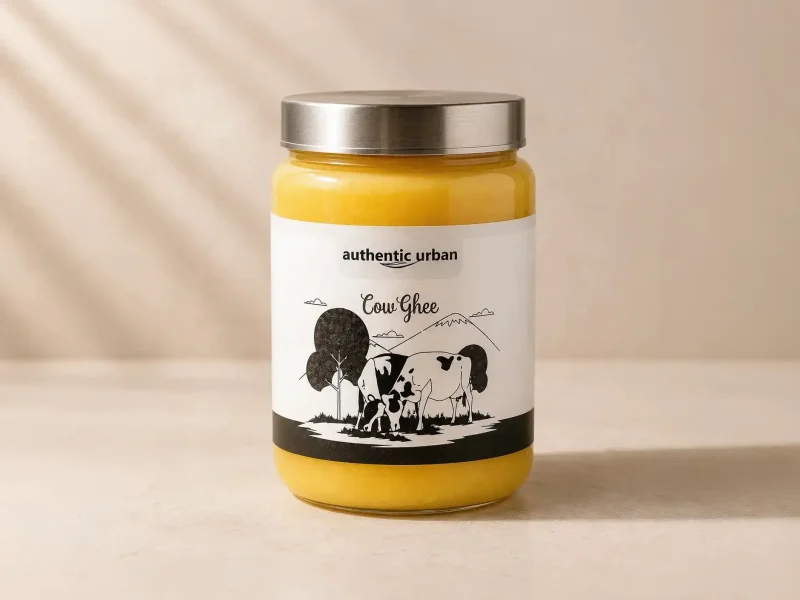 1 Litre
A small piece of halwa, now and then
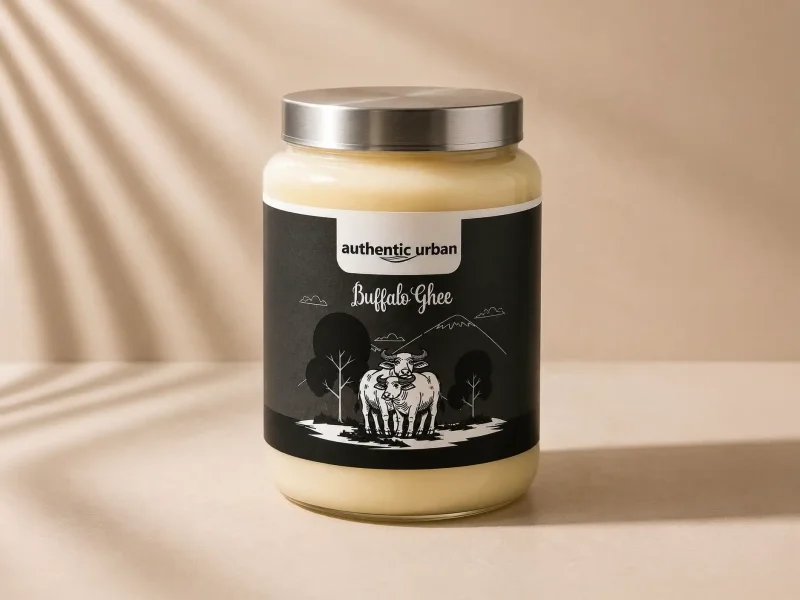 1 Litre
Each order is cooked after you place it, and the packing video is of that batch. Past order videos are on the shop.
FAQ
Uric acid me desi ghee kha sakte hai?
Haan, zyadatar logon ke liye. Desi ghee me purine lagbhag nahi hota, isliye ghee se uric acid nahi badhta. Din me 1 se 2 chammach, dal, chawal ya roti par, kaafi hai. Ghee uric acid kam bhi nahi karta. Asli dhyan sharab, meethe drinks, kaleji, machli aur zyada meat par rakhein, aur paani khoob piyein. Dard, sujan aur bukhar ho to doctor ko turant dikhayein.
Is cow ghee or buffalo ghee better for uric acid?
Neither has an edge for uric acid. Both are almost pure fat, and the milk protein that could carry purines is left behind in the pan when ghee is made. Pick by use: cow ghee for the daily spoon on dal and roti, buffalo ghee for sweets and parathas. The amount matters far more than the animal, so keep either to 1 to 2 teaspoons a day.
Does ghee with warm water in the morning reduce uric acid?
No study shows that it does. The water helps: staying well hydrated is part of the NHS advice for gout, because dehydration can set off an attack. The ghee adds nothing to that, only about 44 kcal a teaspoon. If you like the morning habit and your stomach is fine with it, keep it within your 1 to 2 teaspoons for the day, not in addition to them.
Is A2 ghee better for uric acid than regular ghee?
Not for uric acid. A2 names a type of milk protein, and USDA lists ghee at 0.28 g of protein per 100 g, which is almost nothing. Purines come with cells and protein-rich foods, not with fat. We make A2 Gir cow ghee and still would not sell it to you as a uric acid food. Buy it for taste and trust in how it is made.
Can I eat ghee sweets like halwa or ladoo with gout?
A small piece now and then is fine for most people. The ghee is not the concern; the sugar is. Table sugar is made of glucose and fructose, and the American College of Rheumatology notes that fructose raises uric acid within two hours. Keep sweets to a small portion after a meal, not a plateful, and skip them in the days around a flare.
Can I take ghee with allopurinol or febuxostat?
Normal cooking amounts of ghee are food, and your doctor will not usually ask you to stop them because of these medicines. What matters is taking the medicine every day as prescribed. The NHS says to keep taking uric acid-lowering medicine even when you have no symptoms. If you are unsure about any food with your tablets, ask your doctor or pharmacist.
Does ghee help gout joint pain?
There is no evidence that eating ghee or rubbing it on the joint eases a gout attack. Gout pain comes from uric acid crystals in the joint, and it needs the medicine your doctor gives. The NHS suggests rest, raising the limb, an ice pack wrapped in a towel for up to 20 minutes, and keeping pressure off the joint.
About the editorial team
Authentic Urban TeamBilona ghee makers, Gir Somnath, Gujarat
We are the Parmar family in Gir Somnath, Gujarat. We have made ghee here since 2016 and sold it online since 2025. We make only Bilona ghee, test it every month, and anyone is welcome to visit and watch it being made. Our Gir cows and Jafarabadi buffalo are grass-fed village animals that graze near the Gir forest, with no hormones or milk boosters. We set their milk to curd, churn it, and cook the makkhan on a wood chulha. These articles come from that kitchen and from what customers ask us on WhatsApp. We are ghee makers, not doctors.
Sources
- USDA and ODS-NIH Database for the Purine Content of Foods, Release 2.0 (March 2025), USDA Agricultural Research Service. Checked 27 Sep 2026.
- Butter oil, anhydrous (FDC ID 173412), SR Legacy, USDA FoodData Central. Checked 27 Sep 2026.
- Purine-rich foods, dairy and protein intake, and the risk of gout in men (Choi, Atkinson, Karlson, Willett, Curhan; New England Journal of Medicine, 2004, 350: 1093-1103), Europe PMC (PMID 15014182). Checked 27 Sep 2026.
- 2020 American College of Rheumatology Guideline for the Management of Gout (FitzGerald et al.), PubMed Central. Checked 27 Sep 2026.
- Gout, NHS. Checked 27 Sep 2026.
- Gout: treatment, NHS. Checked 27 Sep 2026.
- Uric acid blood test, MedlinePlus, US National Library of Medicine. Checked 27 Sep 2026.
- Dietary Guidelines for Indians, 2024 (limit ghee or butter to 1 to 2 teaspoons a day), ICMR-National Institute of Nutrition. Checked 27 Sep 2026.