CLA in Ghee: How Much Is in a Spoon, and Does It Work?
CLA in ghee is real but small: a teaspoon of cow ghee holds about 50 mg of CLA (conjugated linoleic acid, a fat made in the cow's stomach from grass), and buffalo ghee about 38 mg. The weight-loss trials used about 3,200 mg a day from capsules, so no sensible amount of ghee reaches a trial dose. Eat ghee for taste, at 1 to 2 teaspoons a day, not for CLA.
How much CLA is in ghee?
About 1 g of CLA in 100 g of cow ghee, which is roughly 49 mg in a 5 g teaspoon. Buffalo ghee came out lower, at about 38 mg a teaspoon. Those figures come from a 2020 study in Food Science and Technology (Pena-Serna and Restrepo-Betancur) that made cow and buffalo ghee in a farm dairy in Colombia and measured every fatty acid in it.
The chart puts those spoons next to the dose that weight-loss trials used. The yellow bar is 2 teaspoons, the most ghee ICMR-NIN's 2024 dietary guidelines suggest in a day.
Ghee: Pena-Serna and Restrepo-Betancur 2020, Table 2, scaled to a 5 g teaspoon and a 12.8 g tablespoon. Trial dose: median of 18 trials, Whigham and colleagues 2007.
| Item | Value |
|---|---|
| 1 tsp buffalo ghee (5 g) | 38 mg |
| 1 tsp cow ghee (5 g) | 49 mg |
| 2 tsp cow ghee, the ICMR-NIN daily top | 99 mg |
| 1 tbsp cow ghee (12.8 g) | 127 mg |
| Daily dose in weight-loss trials | 3,200 mg |
Two things to know about these numbers. First, CLA is not on a food label: USDA FoodData Central lists 876 kcal and every major fat for 100 g of ghee, but no CLA row at all, so the only figures come from lab studies. Second, they vary. A 2024 review in the Journal of Ayurveda and Integrative Medicine (Kataria and Singh) averaged published values and got 0.80% of the fatty acids for cow milk fat and 0.83% for buffalo, where the 2020 study found cow higher. Feed and season move CLA more than anything else.
Many ghee pages quote "4 to 7 mg per gram" or "50 to 100 mg per tablespoon" without naming a study. This page used to say the same. The measured figure for cow ghee works out to about 10 mg per gram, and about 127 mg in a 12.8 g tablespoon. The calories and the rest of the label are on ghee nutrition facts.
What is CLA, and which kind is in ghee?
CLA is a family of fats made from linoleic acid, the omega-6 fat in grass and seeds. Bacteria in a cow's or buffalo's stomach bend it into new shapes, and some of those end up in the milk fat. Ghee is almost pure milk fat, so it keeps them.
Two shapes matter. The one in ghee is c9,t11, also called rumenic acid; it was the CLA the 2020 study measured in both cow and buffalo ghee. The other, t10,c12, did not show up in either ghee in that study, but it is a large part of CLA capsules, or all of them in some trials. The capsule trials, good and bad, are mostly about that second one.
Main form
Ghee: c9,t11 (rumenic acid), made in the cow's stomach from grass fats
Capsules: A purified mix of c9,t11 and t10,c12, or pure t10,c12
Amount
Ghee: About 38 to 49 mg in a teaspoon
Capsules: About 3,200 to 3,400 mg a day in the trials below
Weight loss
Ghee: No trial has tested ghee for this
Capsules: About 0.7 kg more than placebo over 6 months or more
Known risks
Ghee: The saturated fat and calories of the ghee itself
Capsules: t10,c12 raised insulin resistance 19% in one trial; mixes lowered HDL
CLA has a trans bond in its chain, which is why some labs count it in the trans fat total of ghee. How much trans fat ghee has, and whether that matters, is on does ghee have trans fat.
Does CLA in ghee help weight loss?
No. The fat loss seen in CLA trials came from capsules at about 65 times the CLA in a teaspoon of ghee, and even then it was small. No trial has tested ghee's CLA for weight.
A 2007 meta-analysis in the American Journal of Clinical Nutrition (Whigham and colleagues) pooled 18 trials. At the median dose of 3.2 g of CLA a day, people lost about 0.09 kg of fat a week more than on placebo. A 2012 meta-analysis in the European Journal of Nutrition (Onakpoya and colleagues) kept only the 7 trials that ran 6 months or longer: about 0.7 kg more weight lost and 1.3 kg more fat, with side effects of constipation, diarrhoea, and soft stools. Its authors wrote that the clinical relevance is uncertain.
How much ghee would a trial dose take?
Now do the sum with ghee. To get 3,200 mg of CLA from cow ghee you would need about 65 teaspoons, some 320 g of ghee and roughly 2,800 kcal, a whole day's food for most adults in fat alone. Ghee helps a weight-loss plate only when it replaces oil, not when it is added on top; how that works is on does ghee boost metabolism.
Are CLA supplements safe, and is ghee's CLA the same risk?
Capsule CLA has side effects that ghee at 1 to 2 teaspoons does not come near. The risk sits with the t10,c12 form and with gram doses.
In a 2002 trial in Diabetes Care (Risérus and colleagues), 60 men with belly fat and signs of metabolic syndrome took 3.4 g of CLA a day for 12 weeks. Pure t10,c12 raised insulin resistance by 19% and blood glucose by 4%, and lowered HDL (the "good" cholesterol) by 4%. The mixed capsule changed no weight or body fat against placebo and lowered HDL by 2%. A 2010 review in PLoS One (Brouwer and colleagues) found that CLA raised the LDL to HDL ratio about as much as factory trans fat, per unit of energy.
Put that against a kitchen. Two teaspoons of cow ghee carry about 0.1 g of CLA, under 1 kcal of a 2,000 kcal day. The part of ghee that matters for cholesterol is its saturated fat, about 62 g in every 100 g by USDA's figures, and that is why the daily limit is in teaspoons. If you have diabetes, high LDL, or fatty liver, ask your doctor before starting any CLA capsule, and read ghee and cholesterol or can diabetics eat ghee for the ghee side.
Does grass-fed or Bilona ghee have more CLA?
Grass-fed, yes, by about two times. Bilona, no: the method of making ghee does not change its CLA.
The largest milk study on feed, a 2018 paper in Food Science & Nutrition (Benbrook and colleagues), measured 0.043 g of CLA per 100 g of milk from cows on an almost all-grass diet, against 0.019 g in regular US milk. That is about 2.3 times, not the "5 times" shop pages repeat. The study was part-funded by the dairy co-operative that sells that grass-fed milk, and one author worked there. What else grazing changes, and what it does not, is on grass-fed vs regular ghee.
On method, a 2025 study in Food Chemistry: X (Kataria and Singh) made ghee from curd butter and from cream butter of the same milk. The fatty acids did not differ, and CLA stayed the same. Bilona changes the smell of ghee, not its CLA. The steps and what each one does are on the Bilona method.
In our kitchen in Gir Somnath, the cows and buffalo, ours and our partner farmers', are village animals that graze on village pasture near the Gir forest. We see the feed in the jar every monsoon, when green fodder turns our cow ghee a deeper yellow. We have not had our ghee tested for CLA, though. We test every month against the FSSAI limits, and CLA is not one of them, so we do not print a CLA number on our jars.
Cow or buffalo ghee: which has more CLA?
Close enough not to matter. The 2020 study found about 49 mg a teaspoon in cow ghee and 38 mg in buffalo; the 2024 review of published values put them level. An 11 mg gap is a rounding error against a 3,200 mg trial dose.
Choose between them by the job. Cow ghee is lighter and suits the daily teaspoon on dal and roti; buffalo ghee sets firmer and suits sweets and parathas. The full comparison, with the fatty acids side by side, is on cow ghee vs buffalo ghee.
CLA claims about ghee, checked
These are the lines we found most often on ghee shop pages and wellness blogs, set against the studies above. Save it for the next "fat-burning ghee" advert.
"The CLA in ghee burns belly fat."
False at kitchen amounts
Fat loss was seen with about 3,200 mg of capsule CLA a day. That is some 65 teaspoons of cow ghee.
"Grass-fed ghee has 5 times more CLA."
Overstated
The largest milk study found about 2.3 times more CLA in fully grass-fed milk than in regular milk.
"Bilona ghee keeps more CLA than cream ghee."
Not supported
A 2025 study made ghee from curd and from cream of the same milk. CLA did not change.
"CLA ghee lowers cholesterol."
Rats only
The study behind it fed CLA-enriched ghee to young rats. No human trial has tested it.
"Ghee is one of the richest CLA foods."
True per gram of fat
A 2020 study put ghee above meat and other dairy for CLA per gram of fat. A spoon still holds milligrams.
"Add CLA capsules to your ghee for a better effect."
Ask a doctor first
Capsule CLA raised insulin resistance and lowered HDL in obese men. It is a different product from ghee.
The rat study behind the cholesterol claim (Chinnadurai and colleagues, Lipids in Health and Disease, 2013) fed ghee enriched in CLA to 21-day-old rats. It is a reason for someone to run a human trial, not a reason to eat more ghee. The wider question of whether ghee is good for you is on is ghee healthy.
How much ghee a day, then?
1 to 2 teaspoons, the limit in ICMR-NIN's 2024 dietary guidelines, whatever its CLA. At USDA's 876 kcal per 100 g, that is about 44 kcal a teaspoon. More ghee adds calories and saturated fat much faster than it adds CLA.
In our family we eat 1 to 2 teaspoons each a day, on roti, dal, and khichdi, and more in winter sweets. For your own household, the split between ghee and oil is worked out on how much ghee per day, and who should eat less, or ask a doctor first, is on who should not eat ghee. This page is about food. It is not medical advice, and ghee is not a treatment for weight, blood sugar, or cholesterol.
Which ghee to buy, if not for CLA?
Every real ghee has some CLA, and no jar has enough to act like a capsule. So choose on what you can check: a valid FSSAI licence, a clean smell of toasted milk when you warm a spoon, and a seller who shows how it is made. Our ranking of cow ghee brands, and how we judged it, is on best cow ghee in India.
Our A2 Gir cow ghee is Gir cow milk only, and our buffalo ghee is from Jafarabadi buffalo, both curd-churned Bilona and cooked after you order. You get a video of your own jar being cooked and packed. Every step, and the open invitation to visit, is on how we make ghee.
The daily teaspoon on dal and roti
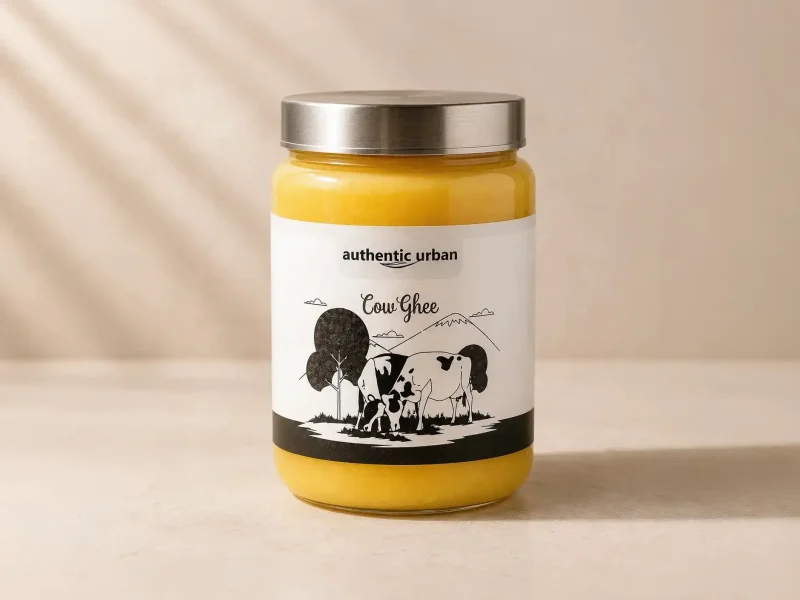 1 Litre
Sweets, parathas, and winter cooking
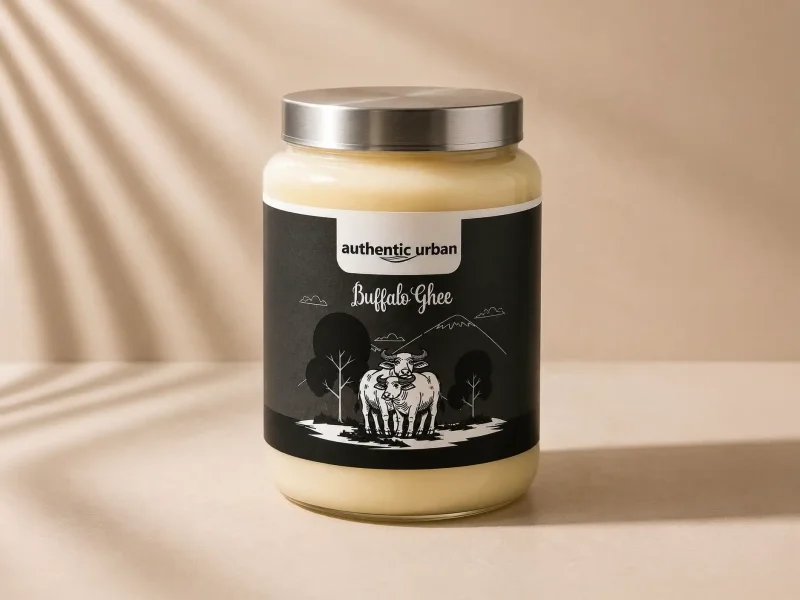 1 Litre
Each order is cooked after you place it, and the packing video is of that batch. Past order videos are on the shop.
FAQ
Does heating or cooking ghee destroy its CLA?
Normal cooking does not seem to remove it. Both lab studies we used made their ghee by heating butter to about 113 to 120°C, and still measured CLA in the finished ghee. We found no study on CLA after a tadka or a fry, so we cannot give a number for that. Smoking-hot ghee breaks down in other ways anyway, so keep the flame where the ghee shimmers, not smokes.
Does a glass of milk have more CLA than a spoon of ghee?
About the same. A 2018 US study measured 0.019 g of CLA in 100 g of regular milk and 0.043 g in fully grass-fed milk. A 200 ml glass of regular milk gives roughly 38 mg, close to a teaspoon of ghee at about 49 mg. Curd and paneer made from whole milk carry CLA too, because CLA sits in the milk fat.
Does A2 ghee have more CLA than regular ghee?
Not because it is A2. A2 describes a milk protein, and CLA is a fat that follows the animal's feed. Breed may matter a little: a 2025 study found CLA marginally higher in ghee from Deoni cows, an Indian breed, than from Holstein Friesians on the same processing. The gap was small, and feed still moves CLA far more than breed or label.
Is CLA the same as omega-3 or linoleic acid?
No. Linoleic acid is the omega-6 fat in seed oils like sunflower. CLA is a twisted form of it, made by bacteria in the cow's stomach, and it is neither an omega-3 nor an ordinary omega-6. Ghee has small amounts of all three. None of them is the reason to eat ghee; its taste in dal and roti is.
Can children or pregnant women take CLA supplements?
Do not start one without a doctor. The CLA trials we read were in adults, mostly overweight, and one found insulin resistance rising in obese men. We found no trial showing capsules are useful or safe for children or in pregnancy. The CLA in normal amounts of ghee, milk, and curd is part of ordinary food and needs no special care.
Should I pay more for ghee labelled "high CLA"?
No. FSSAI's ghee standard does not ask for a CLA figure, so a "high CLA" line on a jar is the seller's word unless a lab report comes with it. Even a jar with twice the usual CLA would add about 50 mg a teaspoon, far below the trial doses. Pay for clean taste, a valid FSSAI licence, and a seller who shows how the ghee is made.
About the editorial team
Authentic Urban TeamBilona ghee makers, Gir Somnath, Gujarat
We are the Parmar family in Gir Somnath, Gujarat. We have made ghee here since 2016 and sold it online since 2025. We make only Bilona ghee, test it every month, and anyone is welcome to visit and watch it being made. Our Gir cows and Jafarabadi buffalo are grass-fed village animals that graze near the Gir forest, with no hormones or milk boosters. We set their milk to curd, churn it, and cook the makkhan on a wood chulha. These articles come from that kitchen and from what customers ask us on WhatsApp. We are ghee makers, not doctors.
Sources
- Pena-Serna C, Restrepo-Betancur LF. Chemical, physicochemical, microbiological and sensory characterization of cow and buffalo ghee. Food Science and Technology 2020;40(Suppl. 2):444-450 (Table 2, CLA c9,t11), SciELO. Checked 28 Sep 2026.
- Kataria D, Singh G. Health benefits of ghee: Review of Ayurveda and modern science perspectives. J Ayurveda Integr Med 2024 (Table 2, fatty acids of milk fat by species), PubMed Central. Checked 28 Sep 2026.
- Kataria D, Singh G. Effect of processing methods on fatty acid composition and flavour profile of clarified butter (ghee) obtained from Deoni and Holstein Friesian cow breeds. Food Chemistry: X 2025;27:102489, PubMed Central. Checked 28 Sep 2026.
- Benbrook CM et al. Enhancing the fatty acid profile of milk through forage-based rations, with nutrition modeling of diet outcomes. Food Science & Nutrition 2018, PubMed Central. Checked 28 Sep 2026.
- Whigham LD, Watras AC, Schoeller DA. Efficacy of conjugated linoleic acid for reducing fat mass: a meta-analysis in humans. Am J Clin Nutr 2007, PubMed. Checked 28 Sep 2026.
- Onakpoya IJ et al. The efficacy of long-term conjugated linoleic acid (CLA) supplementation on body composition in overweight and obese individuals: a systematic review and meta-analysis of randomized clinical trials. Eur J Nutr 2012, PubMed. Checked 28 Sep 2026.
- Risérus U et al. Treatment with dietary trans10cis12 conjugated linoleic acid causes isomer-specific insulin resistance in obese men with the metabolic syndrome. Diabetes Care 2002;25(9):1516-1521, PubMed. Checked 28 Sep 2026.
- Brouwer IA, Wanders AJ, Katan MB. Effect of animal and industrial trans fatty acids on HDL and LDL cholesterol levels in humans: a quantitative review. PLoS One 2010;5(3):e9434, PubMed Central. Checked 28 Sep 2026.
- Chinnadurai K et al. High conjugated linoleic acid enriched ghee (clarified butter) increases the antioxidant and antiatherogenic potency in female Wistar rats. Lipids Health Dis 2013;12:121, PubMed Central. Checked 28 Sep 2026.
- Butter oil, anhydrous (FDC ID 173412), SR Legacy, USDA FoodData Central. Checked 28 Sep 2026.
- Dietary Guidelines for Indians, 2024 (limit ghee or butter to 1 to 2 teaspoons a day, printed p. 54), ICMR-National Institute of Nutrition. Checked 28 Sep 2026.