Why Ghee Tastes Different Each Batch, and When to Worry
Why ghee tastes different from one jar to the next: the milk changes with the season and the cow's feed, the curd sours faster in heat, and the cooking time decides how toasted the ghee smells. A new shade, grain, or level of nuttiness is normal. A sharp, soapy, sour, or burnt smell is not, and that jar should not be eaten.
Why does ghee taste different from the last jar?
Ghee tastes different because the milk behind it is never the same twice. Season, feed, and the stage of lactation change the fat and its carotene, and in curd ghee the souring and the cooking heat change the aroma. These shifts are normal. Only a sharp, sour, or burnt smell means the jar has a problem.
"Why is the colour different from last time?" is one of the questions we get most on WhatsApp, and "the colour differs from the photo" is one of the complaints we hear most. This page is the answer we give, with the one line that matters: what changed, and whether it is fine. The table covers the six usual causes.
Season of the milk
Richer, firmer jar in winter; thinner, more liquid jar in summer.
Normal? Yes
What the cow ate
Deeper yellow after green fodder, paler after dry fodder. Buffalo ghee stays white.
Normal? Yes
Stage of lactation
Milk fat rises from early to late lactation, so a small herd's milk shifts month to month.
Normal? Yes
How sour the curd got
More tang and a fuller, dahi-like aroma when the curd ripened further.
Normal? Yes
How long and hot it cooked
Milder and paler when taken off early; more toasted and nutty when cooked a little longer.
Normal? Yes, within limits
Age and storage of the jar
Sharp, soapy, or paint-like smell; sour or cheesy smell; mould.
Normal? No: the jar has gone off
The calories and the fat content do not change with any of this: ghee is almost pure milk fat in every season. The full label is on ghee nutrition facts. What changes is what you see, smell, and taste.
How does the season change ghee?
The season changes how much fat the milk carries and how fast the curd sours, so winter ghee and summer ghee from the same animals come out different. This is what we see through the year in Gir Somnath, where our Gir cows and Jafarabadi buffalo graze village pasture near the Gir forest.
Winter
Richer milk, more makkhan per litre, better yield.
Fine grain; sets firm; cow ghee a lighter yellow once the fields dry.
Summer
Lower fat in the milk. Curd sets and sours faster.
Stays liquid in the jar; can carry more tang from quicker souring.
Monsoon
Green fodder is back.
Cow ghee turns more yellow.
The animals add their own cycle on top of the weather. A 2021 review of pasture dairying in Foods (Timlin and colleagues) found milk fat at its lowest in early lactation, rising to a peak in late lactation. A big dairy pools milk from cows at every stage and evens this out. A family herd, where many animals calve in the same months, does not, so the milk of one month can feel richer than the next.
The same review found butter from grazing cows scored better on texture and spread more easily than butter from cows on mixed indoor rations, because grass-fed milk fat carries more of the softer oleic acid. That is one reason a jar can feel softer on the spoon in the green months. How each step of our Bilona batch shifts through the year is on the Bilona method.
Does the cow's feed change ghee colour and taste?
Yes. The yellow in cow ghee is beta-carotene from green fodder, so the shade follows what the cow ate in the weeks before. Green feed makes it deeper; dry fodder makes it paler. Taste moves less than colour, but grass-fed milk does give a fuller, softer fat.
A 2021 review of carotenoids in milk (Stephenson, Ross, and Stanton, Foods) calls fresh forage the richest carotenoid source for cows, and quotes Dutch bulk milk at 24.5 µg of total carotenoids per 100 g after summer against 16.8 µg after winter, with winter feeding cutting beta-carotene by 20%. The same pigment gives butter and ghee their yellow. In Gir Somnath we see it as monsoon cow ghee coming out more yellow once the fields turn green.
Buffalo ghee is the exception. A 2017 PLoS One study (Ullah and colleagues) notes that buffalo turn most of their beta-carotene into vitamin A, while cow milk keeps it in the fat globules. The milk still carries some (a 2019 Journal of Dairy Science study of Indian herds measured 4.33 µg per 100 mL in buffalo milk), but it does not end up as yellow in the ghee. That is why buffalo ghee stays white in every season. Which shade to buy, and why colour is not a purity test, is on white ghee vs yellow ghee. What else grass feeding changes, and what it does not, is on grass-fed vs regular ghee.
Why does one jar smell more nutty than another?
The smell comes mostly from two steps: how sour the curd got before churning, and how hot and how long the makkhan cooked. More souring gives more dahi-like aroma; more heat gives more toasted, nutty notes. A small change in either shows up in the jar.
Curd souring
A 2025 study in Food Chemistry: X (Kataria and Singh) made ghee from the same milk three ways: from fresh cream, from soured cream, and from curd butter, all clarified at 120°C. The curd and soured-cream ghees had more of the aroma compounds (acids, lactones, ketones, and the caramel-smelling maltol) than the fresh-cream ghee. The fatty acids were the same in all three. Souring changes the smell, not the fat.
This is where summer shows up in our kitchen. We set the milk to curd overnight, for 8 to 12 hours, and in summer the curd sets and sours faster. A summer batch can carry a little more tang than a winter one from the same cows. The study also found the breed mattered: ghee from Deoni cows had more lactones than ghee from Holstein Friesian cows, so two brands of curd ghee will not smell alike even in the same month.
Cooking heat
The INFLIBNET dairy technology course for Indian universities puts the usual clarifying temperature at 110 to 120°C, and about 120 to 140°C in southern India. It notes that the lactones behind ghee's sweet, rich smell rise as the temperature rises, and that desi ghee made from makkhan keeps aroma compounds formed while the dahi fermented.
We cook the makkhan on a wood chulha in a matki, on a low flame, for 45 to 90 minutes. It comes off when the bubbling goes quiet, the milk solids turn golden-brown, and it smells of toasted milk. A few minutes either side of that point is the difference between a mild jar and a nutty one. Past it, the batch turns dark and bitter; short of it, the ghee stays cloudy and keeps water. Neither of those goes in a jar, and Varsha tastes every batch before it is packed.
Why is this jar grainy when the last one was smooth?
Grain depends on temperature more than on the batch. Ghee that cools slowly in a cool room sets in fine grains; in summer, or in a warm kitchen, the same ghee can stay liquid or set smooth. In our kitchen winter ghee sets with a fine grain and summer ghee often stays liquid in the jar.
Transit adds its own change. A jar that melted in a hot van in May and set again at your home will not look like the one in the photo. That is the complaint we hear most in summer, and the ghee inside is the same. What the grains are, and how to get them back after a melt, is on why ghee is grainy.
Why does packet ghee taste the same every time?
Large dairies make ghee from cream or creamery butter pooled from many farms and cows at every stage of lactation, so the season averages out. Fresh cream, rather than curd, is the route the 2025 study linked to fewer aroma compounds. The result is a milder ghee that tastes alike from month to month.
That is a choice of method, not a sign of good or bad ghee. Sameness does not prove purity, and change does not prove it either. A buyer used to one packet brand is often surprised the first time a curd ghee smells stronger, or a winter jar looks paler. If you want to know how we make ours, step by step, it is on how we make ghee, and the difference between the two routes is on homemade vs store-bought ghee.
What other pages on this get wrong
- "Summer ghee has the strongest aroma because the heat speeds browning." We found no study that tests this. Room temperature does not change how hot the pan gets; the cook does. What summer does change is how fast the curd sours.
- "Deep gold means better ghee." Gold tracks green feed. A pale winter cow jar and a white buffalo jar can both be good ghee, and a dyed jar can be bright yellow.
- "Batch variation proves the ghee is pure." It shows the milk is not pooled from thousands of farms. It says nothing about added fat. For that you need the label and a lab report.
Is it normal, or has the ghee gone bad? 8 checks
Warm half a teaspoon in a steel spoon and smell it. Good ghee of any season smells of toasted milk. Save this list for the next time a jar seems off.
1. Shade of yellow differs from the last jar
Normal
Feed and season. Colour on its own proves nothing either way.
2. Grainy this time, smooth or liquid last time
Normal
Room temperature and how the jar cooled.
3. More or less nutty than before
Normal
Curd sourness and cooking time.
4. A mild tang, like good dahi
Normal for curd ghee
Aroma from the soured curd.
5. Sharp, soapy, or paint-like smell
Stop
Rancid fat. Do not eat or cook with it.
6. Sour, cheesy, or musty smell, or spots of mould
Stop
Water or milk solids got in and it spoiled.
7. Bitter, burnt taste and a dark brown colour
Stop using for food
Overcooked batch.
8. Cloudy, with water or a layer at the bottom
Use fast or discard
Undercooked: moisture left in, spoils quickly.
A jar that smelled fine when opened usually turns because of a wet spoon, a spot next to the stove, or warm ghee poured back in. A sealed jar keeps 9 to 12 months at room temperature; once open, use a dry spoon, keep the lid shut, and keep it away from the stove and sunlight. What makes ghee go rancid, and how long it lasts, is on does ghee go bad. If the worry is fake ghee rather than old ghee, taste will not settle it; start with how to identify pure ghee, or check your jar in 2 minutes.
Which ghee changes with the season, and which to buy?
Any curd ghee from one area's milk will change a little through the year. What should never change is the smell of toasted milk when you warm a spoon. If you are choosing a brand, our ranking, with how we judged it, is on best ghee in India.
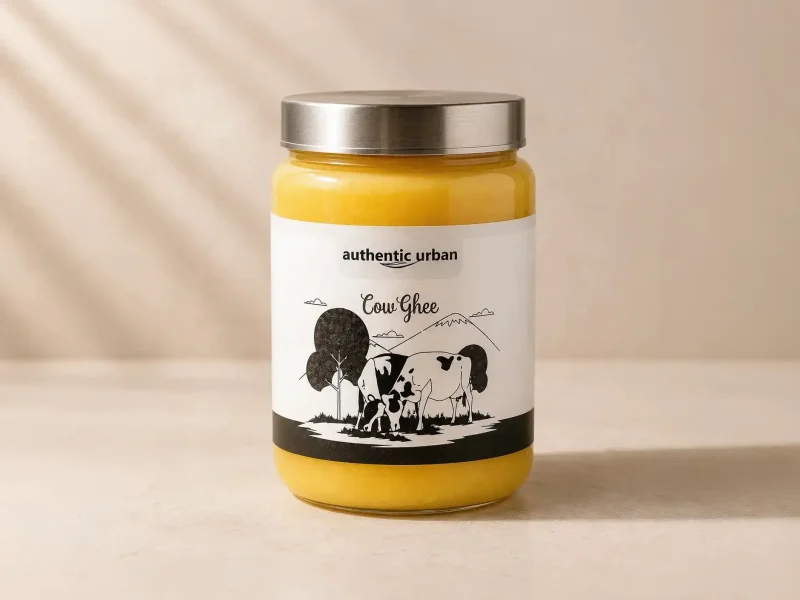
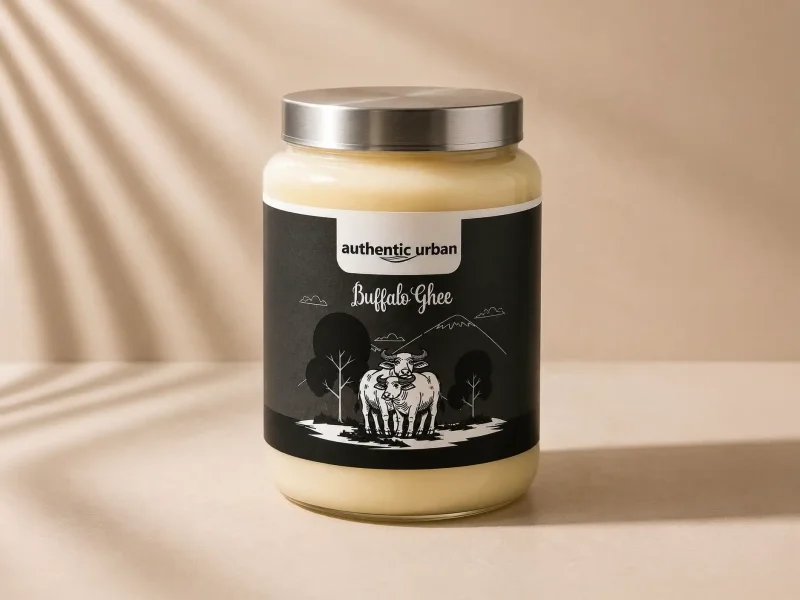
Our A2 Gir cow ghee is Gir cow milk only, and its shade follows the fodder. Our Jafarabadi buffalo ghee stays white. Both are curd Bilona, cooked after you order, with a video of your own jar on WhatsApp, so you see the colour of your batch before it ships. We test every month against the FSSAI limits, and anyone can visit and watch; see how we make ghee.
Gir cow ghee: yellow in monsoon, paler in winter
 1 Litre
Buffalo ghee: white all year, firmer set
 1 Litre
Each order is cooked after you place it, and the packing video is of that batch. Past order videos are on the shop.
FAQ
Does a different taste mean my ghee is adulterated?
Not on its own. A change in shade, grain, or nuttiness between two jars is what curd ghee does across seasons. Mixed-in vegetable fat is hard to catch by taste at all, which is why taste is a poor purity test. If a jar suddenly tastes flat, greasy, or leaves a waxy film in the mouth, check the FSSAI licence on the label and ask the seller for a recent lab report.
Which season's ghee is best for sweets?
Many cooks prefer winter ghee for ladoo, barfi, and halwa, because winter milk is richer and the ghee sets firm with a fine grain, which helps sweets hold their shape. Summer ghee is thinner in the jar but tastes just as good in a hot kadai. For most mithai the difference is small; use buffalo ghee if you want a firmer, richer set.
Can I mix an old jar of ghee with a new one?
Better not. If the old jar has picked up any moisture or has started to turn, it can shorten the life of the new ghee. Finish the old jar first, or keep the two separate and use the older one within a few weeks. Always use a clean, dry spoon, and never pour warm ghee from the pan back into a stored jar.
Does paler ghee have less nutrition?
The main difference is beta-carotene, which gives cow ghee its yellow and which the body turns into vitamin A. Paler winter cow ghee carries a little less of it. The fat itself, and the calories, stay the same in both. A teaspoon of ghee is not how an Indian plate gets its vitamin A, so do not choose a jar by shade.
Why does homemade ghee taste different from bought ghee?
Homemade ghee is usually cooked from malai collected over days or weeks, so it picks up a slight sourness and gets cooked by eye, often a little longer. That gives the brown, toasted flavour many families grew up with. Bought ghee made from fresh cream tastes milder. Neither is wrong; the aroma comes from the souring and the heat, not from purity.
Should I return a jar because it tastes different?
Only if it smells sharp, soapy, sour, cheesy, or burnt, or if it arrived cloudy with water in it. A different shade or grain is not a fault. Before you return it, warm half a teaspoon and smell it next to your last jar if you still have some. Our jars carry a 7-day quality return; a photo and a line on the smell help us check it quickly.
About the editorial team
Authentic Urban TeamBilona ghee makers, Gir Somnath, Gujarat
We are the Parmar family in Gir Somnath, Gujarat. We have made ghee here since 2016 and sold it online since 2025. We make only Bilona ghee, test it every month, and anyone is welcome to visit and watch it being made. Our Gir cows and Jafarabadi buffalo are grass-fed village animals that graze near the Gir forest, with no hormones or milk boosters. We set their milk to curd, churn it, and cook the makkhan on a wood chulha. These articles come from that kitchen and from what customers ask us on WhatsApp. We are ghee makers, not doctors.
Sources
- Stephenson RC, Ross RP, Stanton C. Carotenoids in Milk and the Potential for Dairy Based Functional Foods. Foods 2021;10(6):1263 (winter vs summer carotenoids in Dutch bulk milk; fresh forage as the richest source), PubMed Central. Checked 28 Sep 2026.
- Ullah R et al. Identification of cow and buffalo milk based on beta carotene and vitamin-A concentration using fluorescence spectroscopy. PLoS One 2017;12(5):e0178055, PubMed Central. Checked 28 Sep 2026.
- Bertolini F et al. Marker discovery and associations with β-carotene content in Indian dairy cattle and buffalo breeds. J Dairy Sci 2019;102(11):10039-10055, PubMed Central. Checked 29 Sep 2026.
- Timlin M et al. The Impact of Seasonality in Pasture-Based Production Systems on Milk Composition and Functionality. Foods 2021;10(3):607 (milk fat through lactation; pasture vs indoor-ration butter texture), PubMed Central. Checked 28 Sep 2026.
- Kataria D, Singh G. Effect of processing methods on fatty acid composition and flavour profile of clarified butter (ghee) obtained from Deoni and Holstein Friesian cow breeds. Food Chemistry: X 2025;27:102489, Food Chemistry: X (via PubMed Central). Checked 28 Sep 2026.
- Technology of Ghee making: Direct cream, Creamery butter, Continuous method (Technology of Milk and Milk Products, e-PG Pathshala), INFLIBNET Centre. Checked 28 Sep 2026.