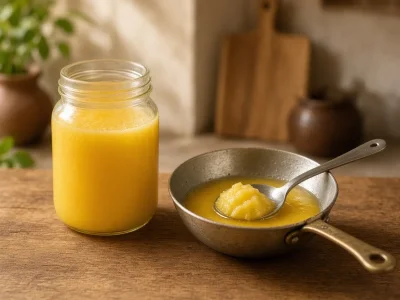
Medicated Ghee (Ghritam): How It Is Made, Uses, and Safety
Medicated ghee (ghritam) is ghee cooked again with herb paste and a herbal liquid until every drop of water is gone, so the herbs stay in the fat. Brahmi ghrita and Ashwagandha ghrita are the best known. In India they are sold as Ayurvedic medicines, under a drug licence with a 2-year expiry, in doses a vaidya sets. They are not a stronger version of the ghee on your roti.
What is medicated ghee?
Medicated ghee is plain ghee cooked a second time with herbs, following a fixed recipe from an Ayurvedic text, until the herbal water has boiled off. Ayurveda calls it ghrita or ghritam (both mean ghee) and the method Sneha Kalpana. It is taken as a medicine, by the spoon or the gram, for a set number of weeks.
This page is for anyone who has been told to take a ghrita, has seen Brahmi or Ashwagandha ghrita on a shelf, or wants to know whether they can make it at home. Two other old ghee traditions get mixed up with it: ghee kept for years, on purana ghrita, and ghee washed a hundred times for the skin, on shata dhauta ghrita. Where all of these sit in Ayurveda as a whole is on the Ayurvedic guide to ghee.
Plain ghee vs medicated ghee
Plain ghee
Medicated ghee (ghrita)
What it is
Plain: Butter or makkhan cooked until the water is gone
Medicated: Ghee cooked again with herb paste and a herbal liquid until that water is gone too
Sold as
Plain: Food, under an FSSAI licence
Medicated: "Ayurvedic medicine", under a drug manufacturing licence
Who decides the amount
Plain: You, inside a day's fat
Medicated: A vaidya (Ayurveda doctor), or the label
Shelf life
Plain: Months, depending on the maker
Medicated: 2 years from manufacture, by law
Taste
Plain: Toasted milk
Medicated: Of the herbs: often bitter, green, or earthy
Used on roti and dal
Plain: Yes
Medicated: No
Labelling and shelf life from the Drugs and Cosmetics Rules, 1945, Rules 161 and 161B. Checked 28 September 2026.
How is medicated ghee made?
By boiling ghee with a herb paste (kalka) and a much larger amount of herbal liquid (drava) on a low flame until the liquid is gone. The general ratio, from the Sharangadhara Samhita, is 1 part paste, 4 parts ghee, and 16 parts liquid, as set out in a 2023 review of Sneha Kalpana in the International Journal of Current Pharmaceutical Research. The liquid can be a herb decoction (kashaya), fresh juice, milk, or plain water, as the recipe says.
It is slow. In a 2024 study in the Journal of Ayurveda and Integrative Medicine, Singh and colleagues made three batches of Kalyanaka ghrita, a 28-herb formula. Each batch took on average 20.35 hours of cooking spread over three days, at an average of 83.5°C (between 66°C and 101°C). About 83% of the ghee came back as finished ghrita. Before starting, they pre-cooked the ghee with a few herbs and water, a step called murchana, which the authors say clears moisture and smell from the ghee so the batch keeps.
How do they know the ghrita is done?
The texts give signs rather than a clock. The Kalyanaka study used three: the froth on top settles; the leftover herb paste rolls between the fingers into a wick (varti); and that wick, held in a flame, burns without crackling, which means no water is left in it. The cook then stops at one of three stages. Mridu paka (soft paste) is kept for nasya, the nose drops; madhyama paka (medium) for medicines taken by mouth and for basti; and khara paka (hard, dry paste) for massage. The 2024 study stopped at madhyama and notes that cooking on to khara is not meant for internal use.
These are the same signs we watch for in our own kitchen in Gir Somnath, with no herbs at all. When we cook makkhan in the matki on the wood chulha, the ghee is ready only once the water in it has boiled away: the bubbling goes quiet, the milk solids turn golden-brown, and it smells of toasted milk. Take it off too early and the ghee comes out cloudy, holds moisture, and spoils fast; leave it too long and it turns dark and bitter. A ghrita has the same two ways to fail, with days of herb work lost in the batch. How we judge that point is on the Bilona method.
What are Brahmi ghrita, Ashwagandha ghrita, and the others used for?
Each ghrita is a different medicine, used for different complaints, and they are not swapped for one another. These are the five people search for most. The "used for" column is Ayurvedic tradition; the last column is what to know before taking it.
Ghrita
What goes in
Used for (tradition)
Know this first
Brahmi ghrita
Cow ghee cooked with brahmi juice, vacha, kushtha, and shankhapushpi (Charaka Samhita, Chikitsa 10.25).
Used for: In the text: unmada (mental illness) and apasmara (seizures). Today mostly sold for memory and focus.
Know this: One small 2022 trial in older adults; not a swap for seizure or psychiatric medicine.
Ashwagandha ghrita
Ghee cooked with ashwagandha root, alone or with other herbs.
Used for: Prescribed for weakness, tiredness, and sleep in Ayurvedic practice.
Know this: Ashwagandha itself has rare liver injury reports and many "do not take" groups (see below).
Triphala ghrita
Ghee cooked with the three fruits of triphala (amla, haritaki, bibhitaki).
Used for: Best known as the ghee used in netra tarpana, the eye procedure.
Know this: Eye use is a clinic procedure. Never put ghee in your own eyes.
Shatavari ghrita
Ghee cooked with shatavari root.
Used for: Prescribed in women's health in Ayurvedic practice.
Know this: Pregnancy and breastfeeding only with your obstetrician told.
Kalyanaka ghrita
Ghee cooked with 28 herbs.
Used for: Prescribed for mental health complaints in Ayurvedic practice.
Know this: A pharmacy product: one 2024 batch study took over 20 hours of cooking.
Brahmi ghee from Charaka Samhita, Chikitsa Sthana 10, verse 25 (Charaka Samhita Online). Kalyanaka herb count and cooking time from Singh et al. 2024. Ashwagandha safety from NCCIH, updated March 2023. Checked 28 September 2026.
Charaka's recipe names cow ghee, and cow ghee is still the usual base. Triphala ghrita for the eyes is used in a procedure where ghee is held over the open eye in a ring of dough; what that involves, and why it is not a home job, is on ghee for eyes (netra basti). Ghritas are also used in large, rising amounts in snehapana before Panchakarma, which is only done in a clinic; why it is not a home cleanse is on the ghee cleanse.
Does medicated ghee work? What the studies show
For the ghrita as a whole, the evidence is thin. We found one small human trial of Brahmi ghrita and none we could read for Ashwagandha ghrita. Most research is on the herbs as extracts in capsules, which is a different product.
- Brahmi ghrita, 2022. Chobe and colleagues gave 72 older adults with mild memory problems Brahmi ghrita, yoga, or both for eight weeks. Test scores rose in all three groups, and most in the group that did both. It was not randomised and had no group without treatment, so it cannot tell the ghrita apart from simply being in a study.
- Brahmi (bacopa) as a herb, 2026. A review of controlled trials in healthy people, in the International Journal of Neuropsychopharmacology, found no benefit of bacopa on processing speed, attention, working memory, or overall thinking.
- Ashwagandha as a herb. NCCIH, part of the US National Institutes of Health, says some ashwagandha preparations may help with insomnia and stress, the evidence on anxiety is unclear, and it may be safe for up to 3 months, with too little data on longer use.
- The carrier idea. Many plant compounds dissolve in fat, which is the reason given for cooking herbs into ghee. That is sound chemistry, but we found no study comparing a ghrita with the same herb taken without ghee.
So read "Brahmi ghrita improves memory" as tradition backed by one weak trial, not a proven effect. Food and habits that do more for memory are on ghee for brain health, and what helps with stress and sleep is on does ghee help anxiety and stress.
How much medicated ghee should you take, and when?
The amount your vaidya writes down, or the dose on the label, and no more. Unlike kitchen ghee, a ghrita's dose depends on the formula, your age, your digestion, and the reason you are taking it, so there is no general figure to copy from the internet.
- Measure it. Labels often give the dose in grams or ml. A level measuring teaspoon holds 5 ml; a kitchen spoon can hold twice that.
- Ask the when and with what. Before or after food, with warm water or warm milk: the vaidya decides, and it differs by formula.
- Ask how many weeks. A course has an end date. For anything with ashwagandha, NCCIH has safety data only up to 3 months.
- Count it as fat. A ghrita is still ghee. On days you take it, cut back the ghee on your food by the same amount. The daily limit for plain ghee is on how much ghee per day.
- Stop and call if you get loose stools, nausea, or a heavy, full stomach that does not settle in a day or two.
Can you make medicated ghee at home?
You can cook herbs into ghee as food, but we would not make a medicine ghrita at home. Jeera, hing, or turmeric warmed in ghee is kitchen flavour, eaten in kitchen amounts; our turmeric version is turmeric ghee and golden milk. Brahmi or Ashwagandha ghrita taken as a daily dose is a different thing.
Three reasons. First, you cannot know the strength: herb quality and cooking time change how much ends up in the ghee, and nothing at home measures it. Second, ghee with water left in it spoils, and a ghrita has sixteen parts of liquid to drive off, over many hours; a home batch stopped early can go bad in the jar. Third, a home jar has no batch record, so if something goes wrong, nobody can trace why. If your vaidya gives you a recipe and asks you to make it, follow it to the gram, start from plain cow ghee you trust (checks are on how to identify pure ghee), and stop only when the paste rolls into a dry wick that does not crackle in a flame.
Who should not take medicated ghee?
Nobody should take it without a vaidya's plan, and these people should also have their doctor agree first:
- Pregnant or breastfeeding women. NCCIH says ashwagandha should be avoided in pregnancy and not used while breastfeeding. Other ghritas vary by formula; tell your obstetrician before any.
- Thyroid or autoimmune disease, or surgery coming up. NCCIH does not recommend ashwagandha for these.
- Anyone on regular medicine. NCCIH lists possible ashwagandha interactions with medicines for diabetes, blood pressure, and seizures, with sedatives, immune-suppressing drugs, and thyroid hormone. Never stop a seizure or psychiatric medicine for Brahmi ghrita.
- Liver disease. Liver injury linked to ashwagandha supplements is rare but reported. Stop at once and see a doctor if your eyes or skin turn yellow, your urine goes dark, or you feel sick and itchy.
- Gallstones, pancreatitis, or a fat-restricted diet, and anyone with fever, a stomach infection, or loose stools. These are the same people who should go easy on plain ghee; the full list is on who should not eat ghee.
- Children, unless a paediatrician and a vaidya both agree.
Never put a ghrita in the nose or eyes yourself; those are clinic procedures (why is on ghee in the nose). We are ghee makers, not doctors: this page describes Ayurvedic tradition and a few studies, and it is not medical advice.
How to read a medicated ghee label: 8 checks
Rules 161 and 161B of India's Drugs and Cosmetics Rules, 1945, say what a ghrita label must show. Screenshot this before you buy:
1. The words "Ayurvedic medicine"
Rule 161 requires them. A jar sold as "herbal ghee" or "ghee with brahmi" without them is being sold as food, and nobody checked it as a medicine.
2. Manufacturing Licence Number
Printed as "Mfg. Lic. No." or "M.L.". This is a drug licence, not the FSSAI food licence on a ghee jar.
3. Every ingredient, with quantity
Botanical names, the plant part, and the amount of each, plus the text the recipe comes from. A long list may be on a leaflet inside.
4. Batch number
So the maker can trace your jar back to its cooking record.
5. Date of manufacture
The day the batch was finished or packed.
6. Expiry within 2 years
Rule 161B sets 2 years from manufacture for ghrita (3 years for taila, the oil versions). Do not buy a jar close to it.
7. Net content in grams or ml
Useful for working out how long a course lasts at your dose.
8. "For external use only"?
If it says this, it is for the skin or a procedure. Never swallow it.
Some ghritas carry one more line: "Caution: to be taken under medical supervision", in English and Hindi. Rule 161 requires it when a medicine for internal use contains a substance from the law's list of potent ingredients (Schedule E(1)). If you see it, do not take that jar on your own.
Which ghee for the everyday spoon?
Medicated ghee comes from a licensed Ayurvedic pharmacy, on your vaidya's word. The ghee you eat every day is a kitchen choice, and the same things matter as for a ghrita base: cooked until no water is left, with a smell of toasted milk and a grain when it cools. Our ranking of the cow ghee on sale is best cow ghee in India.
We make plain Bilona ghee only, with no herbs, and we do not sell medicated ghee. Our A2 Gir cow ghee comes from grass-fed Gir cows near the Gir forest: the milk is set to curd overnight, churned, and cooked in a matki on a wood chulha, after you order, and you get a video of your own jar on WhatsApp. For winter sweets, our Jafarabadi buffalo ghee is the richer jar. We test every month against the FSSAI limits; the steps are on how we make ghee.
The daily spoon on dal, roti, and khichdi
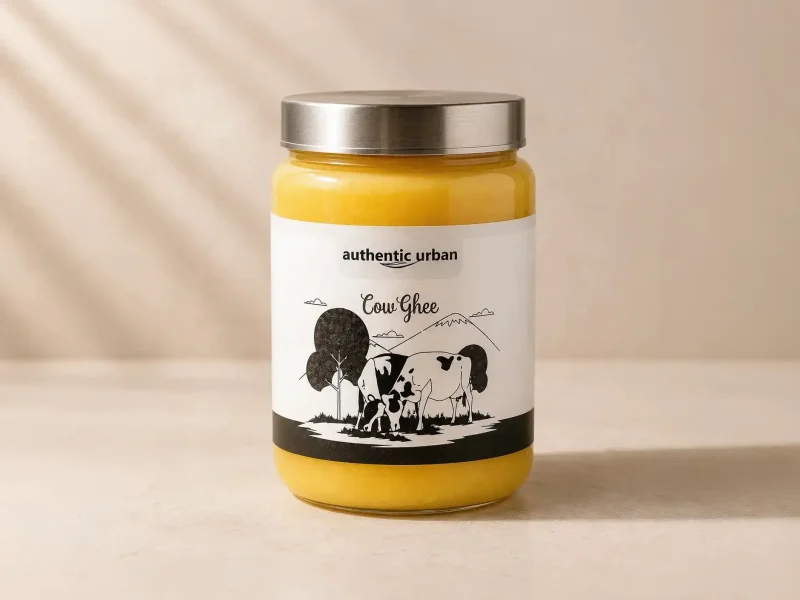 1 Litre
Winter sweets, halwa, and paratha
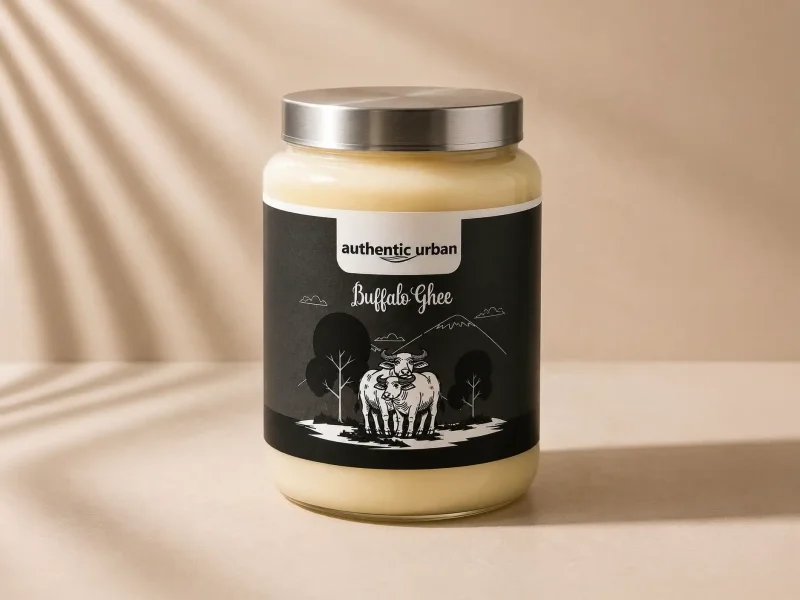 1 Litre
Each order is cooked after you place it, and the packing video is of that batch. Past order videos are on the shop.
FAQ
Is medicated ghee the same as purana ghrita?
No. Medicated ghee is ghee cooked with herbs, such as Brahmi or Triphala ghrita. Purana ghrita is plain ghee with nothing added, kept for years; Charaka counts it as purana at ten years. Some medicated ghee is made on old ghee, which is where the two names meet. Shata dhauta ghrita is a third thing again: plain ghee washed in water many times, for the skin, not for eating.
What is the difference between a ghrita and a taila?
Both are made the same way, by cooking herbs into a fat until the water is gone. A ghrita uses ghee as the fat; a taila uses an oil, most often sesame oil. Texts tend to use ghrita for medicines taken by mouth and taila for massage, though both are used both ways. Indian drug rules give ghrita a shelf life of 2 years and taila 3 years from manufacture.
Can children take Brahmi ghrita for studies or exams?
Not on a parent's own decision. The trials on brahmi were in adults, and a 2026 review of controlled trials in healthy people found no benefit of the herb on attention, memory, or thinking speed. A child who struggles in school needs the eyes, hearing, sleep, and learning checked. If a paediatrician and a vaidya both agree to a ghrita, follow their amount exactly and tell the school doctor.
Is medicated ghee safe with diabetes or high cholesterol?
Ask your doctor first. The ghee is still fat, so a daily dose counts inside your day's ghee and oil. The herbs matter more: NCCIH notes ashwagandha may interact with diabetes and blood pressure medicines. Take the jar, not just its name, to your appointment so the doctor can read every ingredient. Check your sugar more often in the first two weeks, and report lows.
How do I store medicated ghee once it is open?
Like any ghee, only more carefully, because it is a medicine with a dose. Keep the lid shut, use a dry spoon every time, and keep the jar away from the stove and sunlight. Do not top it up from another jar or mix two ghritas. Throw it out at the expiry date on the label, or sooner if it smells sour, soapy, or shows mould.
Can I apply Brahmi or Ashwagandha ghrita on hair or skin?
Some families rub a little on the scalp or soles as a household tradition, and vaidyas use ghritas outside the body too. There is no trial showing it grows hair or helps sleep that way. If you try it, patch test on the inner arm first and stop if it itches or reddens. Never put any ghrita in the eyes or nose yourself.
About the editorial team
Authentic Urban TeamBilona ghee makers, Gir Somnath, Gujarat
We are the Parmar family in Gir Somnath, Gujarat. We have made ghee here since 2016 and sold it online since 2025. We make only Bilona ghee, test it every month, and anyone is welcome to visit and watch it being made. Our Gir cows and Jafarabadi buffalo are grass-fed village animals that graze near the Gir forest, with no hormones or milk boosters. We set their milk to curd, churn it, and cook the makkhan on a wood chulha. These articles come from that kitchen and from what customers ask us on WhatsApp. We are ghee makers, not doctors.
Sources
- Charaka Samhita, Chikitsa Sthana 10 (Apasmara Chikitsa), verse 25: Brahmi ghee, cow ghee processed with brahmi, vacha, kushtha and shankhapushpi, English translation, Charaka Samhita Online. Checked 28 Sep 2026.
- Roshni VK, Sridurga Ch. A rational understanding of Sneha Kalpana. Int J Curr Pharm Res 2023;15(3):1-5 (1:4:16 ratio from Sharangadhara; mridu, madhyama and khara paka), International Journal of Current Pharmaceutical Research. Checked 28 Sep 2026.
- Singh Y, Ansari AA, Sharma RP, Parhate SM, Singh TR. Product development and characterization of a lipid-based Ayurvedic polyherbal formulation: Kalyanaka Ghrita. J Ayurveda Integr Med 2024;15(5):101011, PubMed Central. Checked 28 Sep 2026.
- Chobe S, Patra SK, Chobe M, Metri K. Efficacy of Integrated Yoga and Ayurveda Rasayana on cognitive functions in elderly with mild cognitive impairment: non-randomized three-arm clinical trial. J Ayurveda Integr Med 2022;13 (abstract), Europe PMC. Checked 28 Sep 2026.
- Marsh A, Quelch D, Mackonochie M, Hejmadi M, Rolfe V. The efficacy of nutritional phytochemical compounds in improving cognition. Int J Neuropsychopharmacol 2026;29 (abstract), Europe PMC. Checked 28 Sep 2026.
- Ashwagandha: usefulness and safety (last updated March 2023), NCCIH, US National Institutes of Health. Checked 28 Sep 2026.
- Drugs and Cosmetics Rules, 1945, Rule 161: labelling of Ayurvedic, Siddha and Unani drugs, Government of India (text on Indian Kanoon). Checked 28 Sep 2026.
- Drugs and Cosmetics Rules, 1945, Rule 161B: shelf life of Ayurvedic medicines (ghrita 2 years, taila 3 years), Government of India (text on Indian Kanoon). Checked 28 Sep 2026.