Ghee for Muscle Building: How Much, Pre and Post Workout
Ghee for muscle building works as fuel, not as protein. One teaspoon (5 g) adds about 44 kcal and almost no protein, so it helps you eat enough on training days while dal, curd, milk, eggs, or meat bring the protein your muscles use. Keep ghee to 1 to 2 teaspoons a day, and put it on the meal after training rather than the one just before.
Is ghee good for muscle building?
It helps a little, as calories, not as a muscle food. USDA FoodData Central lists ghee at 99.5 g of fat and 0.28 g of protein per 100 g, so a teaspoon gives about 44 kcal and 14 mg of protein. Muscle is built from protein plus strength training. Ghee can make the meal that carries that protein richer and easier to finish.
That still counts for something. ICMR-NIN's 2024 Dietary Guidelines for Indians say protein is not used well for building muscle unless the diet also has enough energy from carbohydrates and fats, and that without physical activity or resistance exercise, protein will not be used for muscle at all. Fat also helps you absorb vitamins A, D, E, and K from the rest of the plate. So a spoon of ghee on a training day is reasonable. A ladle is not, because it pushes out the dal and roti you need more.
We see why ghee has no protein every time we make it. About 30 to 35 litres of Gir cow milk go into 1 kg of our ghee. The milk is set to curd and churned until the makkhan separates; most of the protein stays behind in the chaas (buttermilk), and the rest in the milk solids that turn golden-brown in the matki. What goes into the jar is the fat. The trace of milk protein that stays in a spoon, and why it matters for milk allergy, is on does ghee have casein or whey.
How much protein do you need to build muscle, and how much is in ghee?
Most people who lift weights do well on 1.4 to 1.6 g of protein per kg of body weight a day, and ghee supplies none of it. The International Society of Sports Nutrition's 2017 position stand puts the useful range for building muscle at 1.4 to 2.0 g per kg. ICMR-NIN's 2024 guidelines note that intakes above about 1.6 g per kg add no further muscle gains from resistance training. The everyday adult requirement, without training, is 0.83 g per kg.
Body weight
Everyday need (0.83 g/kg)
Lifting (1.4 to 1.6 g/kg)
50 kg
42 g a day
70 to 80 g a day
60 kg
50 g a day
84 to 96 g a day
70 kg
58 g a day
98 to 112 g a day
80 kg
66 g a day
112 to 128 g a day
90 kg
75 g a day
126 to 144 g a day
0.83 g/kg (RDA) and the ~1.6 g/kg ceiling from ICMR-NIN Dietary Guidelines for Indians 2024, printed pp. 58 and 60; 1.4 g/kg lower bound from the ISSN position stand on protein and exercise, 2017. Checked 27 September 2026. Kidney disease changes these numbers; ask your doctor.
Here is where that protein actually comes from in an Indian kitchen, next to a teaspoon of ghee.
USDA FoodData Central SR Legacy (173412, 172421, 171287, 171265, 171284, 172430), per the portions shown, checked 27 September 2026.
| Item | Value |
|---|---|
| 1 tsp ghee (5 g) | 0 g |
| Thick dal, 1 katori (150 g cooked) | 14 g |
| 2 eggs (100 g) | 13 g |
| Glass of whole milk (244 g) | 8 g |
| Bowl of curd (200 g) | 7 g |
| Peanuts, 30 g | 8 g |
Food
Protein
Calories
1 tsp ghee (5 g)
14 mg
44 kcal
Thick dal, 1 katori (150 g cooked)
13.5 g
174 kcal
2 eggs (100 g)
12.6 g
143 kcal
Glass of whole milk (244 g)
7.7 g
149 kcal
Bowl of curd (200 g)
6.9 g
122 kcal
Peanuts, 30 g
7.7 g
170 kcal
USDA FoodData Central SR Legacy, per 100 g values scaled to each portion. Dal uses boiled whole lentils as the nearest match to a thick home dal; curd uses plain whole-milk yogurt. Checked 27 September 2026.
The ISSN suggests spreading protein as 20 to 40 g servings every 3 to 4 hours. For a 70 kg lifter aiming at about 100 g, that is four meals of dal, curd, milk, eggs, paneer, or meat, not four spoons of anything. ICMR-NIN's guidelines go further on powders: most athletes can meet their protein from food, protein supplements on top of a balanced diet do not build more muscle, and very high intakes over long periods are not advisable. The akhara diet people quote for wrestlers came with plenty of milk, and the milk is where the protein was.
How much ghee a day if you go to the gym?
One to two teaspoons a day, the same as for anyone else. ICMR-NIN's 2024 guidelines raise the total cooking fat allowed for active people, up to 40 g a day for a man with moderate activity and 50 g with heavy activity, but they keep ghee or butter at 1 to 2 teaspoons of that. The extra room is for oil, nuts, and seeds.
Adult
All visible fat a day
Of which ghee
Oil, nuts, seeds
Man, sedentary
All fat: 30 g (about 6 tsp)
Ghee: 1 to 2 tsp (5 to 10 g)
The rest: at least 20 g
Man, moderate activity
All fat: 40 g (about 8 tsp)
Ghee: 1 to 2 tsp (5 to 10 g)
The rest: at least 30 g
Man, heavy activity
All fat: 50 g (about 10 tsp)
Ghee: 1 to 2 tsp (5 to 10 g)
The rest: at least 40 g
Woman, sedentary
All fat: 20 g (about 4 tsp)
Ghee: 1 to 2 tsp (5 to 10 g)
The rest: at least 10 g
Woman, moderate activity
All fat: 30 g (about 6 tsp)
Ghee: 1 to 2 tsp (5 to 10 g)
The rest: at least 20 g
Woman, heavy activity
All fat: 40 g (about 8 tsp)
Ghee: 1 to 2 tsp (5 to 10 g)
The rest: at least 30 g
Visible fat (oil, ghee, butter added in cooking or at the table) by sex and activity, and the 1 to 2 teaspoon ghee limit, from ICMR-NIN Dietary Guidelines for Indians 2024, printed p. 54. Teaspoons at 5 g. Checked 27 September 2026.
Which row is yours depends on your whole day, not just the gym hour: a desk job with an hour of training is a different day from a labourer's or a farmer's. The older gym advice of 2 to 4 tablespoons a day works out to about 224 to 448 kcal of fat and 16 to 32 g of saturated fat from ghee alone, well past the limit. At home our family eats 1 to 2 teaspoons each a day on roti, dal, and khichdi, and more only in winter sweets like adadiya pak and gond. For everyone else in your house, see how much ghee per day, or work out your home's daily ghee and oil with the ghee calculator.
Should you eat ghee before a workout?
Only as part of a normal meal 3 to 4 hours before, not as a spoon just before training. The 2016 joint position statement from the American College of Sports Medicine and two dietetic bodies says a pre-exercise meal low in fat, fibre, and protein is preferred, because it is less likely to upset the stomach and it leaves the stomach faster. A spoon of ghee on top does the opposite.
What fuels a hard session is carbohydrate. The same statement suggests 1 to 4 g of carbohydrate per kg of body weight in the 1 to 4 hours before long or hard exercise, from foods that suit you. For a 70 kg person, even the low end is 70 g: a plate of poha, a banana, and a slice of toast. Ghee on that plate adds taste, not fuel you will feel in the first set.
When
What to eat
Ghee
3 to 4 hours before
Eat: A normal meal: roti or rice, dal or eggs, sabzi
Ghee: 1 tsp on the meal is fine
1 to 2 hours before
Eat: A light, starchy snack: poha, banana, toast, or a small bowl of rice
Ghee: Leave it out, or a thin smear at most
Under 1 hour before
Eat: Water, and a banana if you are hungry
Ghee: None
Within 2 hours after
Eat: A full meal with 20 to 40 g of protein and a plate of carbs
Ghee: 1 tsp on the dal, rice, or roti
Pre-exercise meal advice (1 to 4 g/kg carbohydrate, 1 to 4 h before; low fat, fibre, and protein) from the ACSM, Academy of Nutrition and Dietetics, and Dietitians of Canada joint position statement, 2016; protein after training from the ISSN position stand, 2017. Checked 27 September 2026.
If you train early on an empty stomach, a spoon of ghee in black coffee is a popular trend. It gives calories without carbohydrate, which is the opposite of what the position statement suggests for a hard session. What the small trials on it found, and whether it breaks a fast, is on ghee coffee benefits.
Is ghee good after a workout?
Yes, a teaspoon on the meal after training is the best place for it, as long as that meal brings the protein. The ISSN suggests 20 to 40 g of protein a serving, and says the muscle-building effect of a workout lasts at least 24 hours, so the exact minute matters less than eating a proper meal within a couple of hours.
Two post-workout plates with ghee
Both reach about 20 g of protein or more before the grain is counted.
Veg plate
- Thick dal, 1 katori (150 g) 13.5 g
- Bowl of curd (200 g) 6.9 g
- 1 tsp ghee on the dal 0 g
20.4 g protein, 340 kcal, before the rice or roti.
Egg plate
- 3 boiled eggs (150 g) 18.9 g
- Glass of whole milk (244 g) 7.7 g
- 1 tsp ghee on the roti 0 g
26.6 g protein, 408 kcal, before the rice or roti.
Add rice or two to three rotis for the carbohydrate your muscles refill with. Pages that say ghee "shuttles amino acids into muscle cells" after a workout give no study for it, and we could not find one. The fat simply slows the meal down a little and makes it taste better. If you are thin and eating to gain weight rather than training for size, the add-on plan on ghee for weight gain fits better.
Does ghee help muscle recovery and soreness?
Not in any way that has been tested: we could not find a single study of ghee and muscle soreness or recovery in people. The claim usually rests on butyric acid. USDA lists 3.23 g of it per 100 g of ghee, which is about 0.16 g in a teaspoon. What that butyrate does and does not do is on butyrate in ghee.
What does help recovery is well studied: enough protein spread over the day, carbohydrate to refill the muscle, sleep, and rest days. The ACSM statement suggests 1 to 1.2 g of carbohydrate per kg an hour for the first 4 hours when you have less than 8 hours before the next hard session, which is a lot of rice and roti. If a joint, not a muscle, is sore for more than a week, rest it and see a doctor or physiotherapist; ghee will not fix a strain.
How do you use ghee when bulking or cutting?
Keep ghee at 1 to 2 teaspoons in both phases and change the rest of the food. On a bulk, the extra calories should come from more of the meals you already eat. On a cut, ghee is one of the easiest things to over-pour, at 44 kcal a teaspoon.
- Bulking: add a fourth meal, an extra katori of dal, a glass of milk, or a handful of peanuts. Each brings protein with the calories. Stirring spoons of ghee into everything adds fat and little else.
- Cutting: keep one teaspoon for taste on the meal you enjoy most, and cut fried snacks, sweets, and sugary drinks first. The ACSM statement warns athletes against keeping fat below 20% of calories for long, since that makes it hard to get enough fat-soluble vitamins and essential fats.
- Before a weigh-in or show: that is a plan for a coach or sports dietitian, not a kitchen spoon.
Is ghee good for runners and endurance training?
A teaspoon on your rice or roti is fine, but carbohydrate, not ghee, is the fuel for running. The 2016 ACSM statement suggests about 5 to 7 g of carbohydrate per kg of body weight a day for about an hour of moderate training, and 6 to 10 g per kg for 1 to 3 hours a day. For a 60 kg runner, that is 300 g or more a day.
High-fat, low-carbohydrate diets for endurance have had a revival, and the same statement reviews them: training the body to burn more fat can match a high-carbohydrate diet at moderate pace, but performance at higher intensities is impaired. Race pace and hill repeats are where that shows. So keep ghee to its teaspoon, eat the rice, and save fat-heavy meals for well after the long run. Knee and joint pain is its own question; what food can and cannot do for it is on ghee for joint pain.
Who should ask a doctor before adding ghee to a gym diet?
Anyone with high LDL cholesterol, heart disease, fatty liver, gallstones, or kidney disease should let their doctor set the amount. A teaspoon of ghee has about 3.1 g of saturated fat by USDA figures, and a gym diet often adds more through paneer, eggs, and meat. We make ghee; we are not doctors or coaches.
- High cholesterol or a family history of early heart attacks: read ghee for cholesterol and get a lipid test before adding fat.
- Kidney disease: ICMR-NIN's guidelines say high-protein diets need care when kidney function is already reduced, so the protein targets above are not for you without your doctor.
- Gallstones, pancreatitis, or loose stools after fatty meals: these and other reasons to hold back are under who should not eat ghee.
- Low energy, low sex drive, or a doctor who mentioned low testosterone: that needs a blood test. What the studies on ghee and hormones show is on does ghee increase testosterone.
ICMR-NIN also advises that anyone who has been inactive should see a doctor before starting an exercise programme, and to stop and rest with breathlessness, pain, nausea, or headache.
A 7-point checklist for ghee on training days
Screenshot this and use it for a month, then check your weight, your lifts, and how you feel.
- Work out your protein target: body weight in kg times 1.4 to 1.6 on training days.
- Put a protein food on every plate: dal, curd, paneer, milk, eggs, chicken, or fish.
- Keep ghee to 1 to 2 teaspoons a day, and count it inside your cooking fat.
- Eat your pre-workout meal 2 to 4 hours before, light on ghee and fried food.
- Eat a full meal within 2 hours after training, with 1 tsp ghee on it if you like.
- Bulking: add food, not spoons of fat. Cutting: keep 1 tsp for taste, drop the fried snacks.
- Get a lipid test once a year if you eat ghee daily and train hard.
Which ghee for the gym?
Cow or buffalo makes no difference to your muscles: FSSAI sets the same 99.5% milk fat minimum for all ghee. What matters when you eat it every day is that it is real ghee you like the taste of. Warm a spoon: it should smell of toasted milk, not wax or nothing at all. Five home checks are on how to identify pure ghee, and our ranking of the jars on sale is best cow ghee in India.
We make and sell ghee, so weigh this with that in mind. For the daily spoon we would pick our own A2 Gir cow ghee: grass-fed Gir milk set to curd overnight, churned by the Bilona method, and cooked in a matki on a wood chulha, made after you order, with a video of your jar sent on WhatsApp. At ₹2,399 a litre, two 5 ml teaspoons a day come to about ₹24, or ₹720 a month. For parathas on a bulk, our Jafarabadi buffalo ghee is ₹1,999 a litre, about ₹10 a teaspoon. We test every month against the FSSAI limits; the steps are on how we make ghee.
The spoon on your post-workout dal
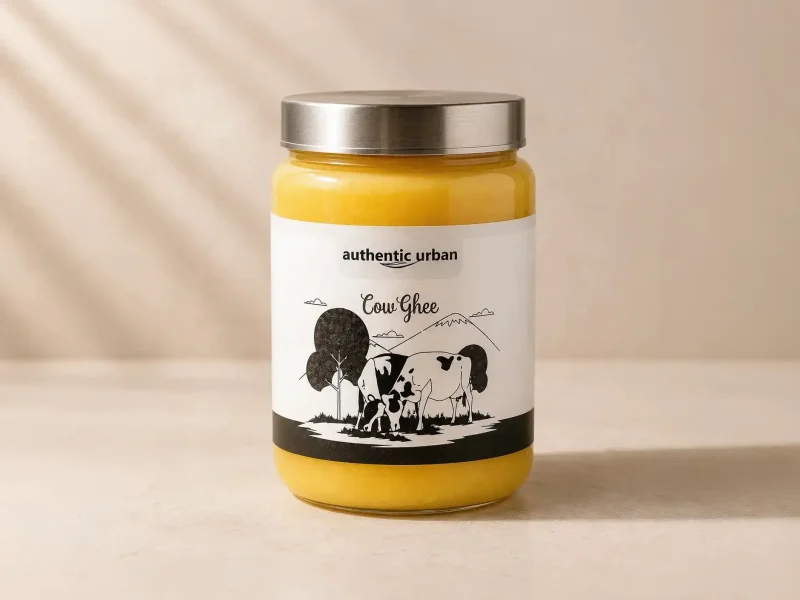 1 Litre
Paratha on a bulk
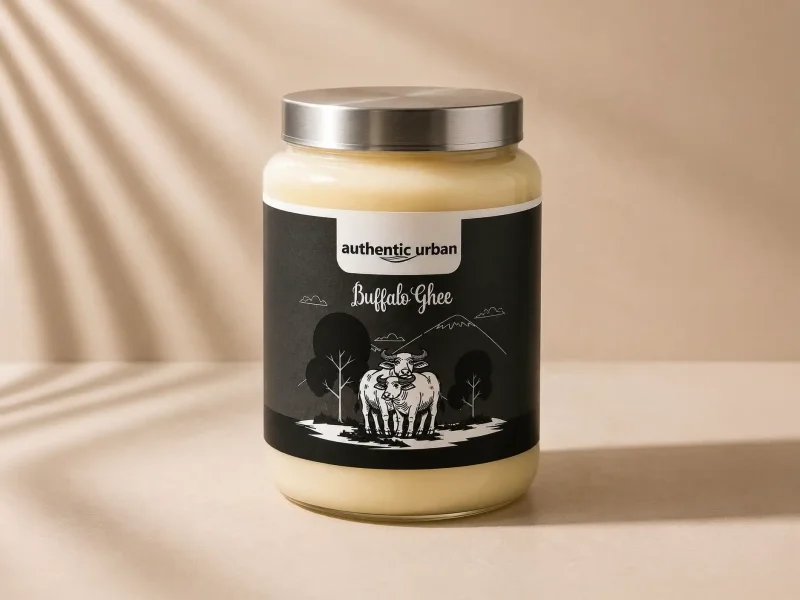 1 Litre
Each order is cooked after you place it, and the packing video is of that batch. Past order videos are on the shop.
FAQ
Gym jaane wale ghee kaise khaye?
Din mein 1 se 2 chammach ghee kaafi hai, workout ke baad wale khane mein dal, chawal, ya roti par. Ek chammach ghee mein lagbhag 44 kcal hoti hai aur protein na ke barabar. Muscle ke liye protein dal, dahi, paneer, doodh, ande, ya chicken se aata hai. Workout se theek pehle ghee wala bhaari khana na khayein; 2 se 4 ghante pehle khayein.
Can I add ghee to my protein shake?
You can, but it does little for muscle. A tablespoon of melted ghee adds about 112 kcal of fat to the shake and no protein. It also tends to separate and coat the shaker in a cold drink. If you need more calories, a banana, milk instead of water, or a spoon of peanuts blends better and brings some protein. Keep the ghee for your meal.
Is buffalo ghee better than cow ghee for bodybuilding?
No. FSSAI sets the same minimum of 99.5% milk fat for every ghee, so a teaspoon of cow or buffalo ghee gives about the same calories and almost no protein either way. Buffalo milk is richer, which is where the claim comes from, but that difference is in the milk, not the finished ghee. Pick by taste: cow ghee for the daily spoon, buffalo ghee for paratha and sweets.
Can teenagers who go to the gym eat ghee?
Yes, in normal kitchen amounts, 1 to 2 teaspoons a day on dal and roti. ICMR-NIN's 2024 guidelines ask children and teenagers aged 5 to 19 for at least 60 minutes of activity a day, with strength training on at least three days a week. What a growing teenager needs from the kitchen is enough total food and protein at each meal, not extra spoons of ghee or powders.
Ghee or MCT oil for the gym?
Neither builds muscle, since both are pure fat with no protein. MCT oil is sold as quick energy for workouts and keto diets; ghee is a cooking fat you already eat on dal and roti. For a normal gym routine the fuel before training should be carbohydrate, and after training, protein with a meal. Use a teaspoon of ghee for taste, and skip paying extra for MCT oil unless a dietitian suggests it.
Does ghee give you a six-pack or burn belly fat during exercise?
No food burns fat from one part of the body. Belly fat goes down when you eat fewer calories than you use over weeks, with training to keep the muscle. Ghee is about 44 kcal a teaspoon, so on a cut it is one of the things to measure, not a fat burner. A teaspoon on dal is fine; spoons in coffee and on every roti will slow the cut.
About the editorial team
Authentic Urban TeamBilona ghee makers, Gir Somnath, Gujarat
We are the Parmar family in Gir Somnath, Gujarat. We have made ghee here since 2016 and sold it online since 2025. We make only Bilona ghee, test it every month, and anyone is welcome to visit and watch it being made. Our Gir cows and Jafarabadi buffalo are grass-fed village animals that graze near the Gir forest, with no hormones or milk boosters. We set their milk to curd, churn it, and cook the makkhan on a wood chulha. These articles come from that kitchen and from what customers ask us on WhatsApp. We are ghee makers, not doctors.
Sources
- Dietary Guidelines for Indians, 2024 (fats, printed p. 53; visible fat by activity and the ghee limit, p. 54; Guideline 8 on protein and protein supplements, pp. 57 to 60; physical activity, p. 70), ICMR-National Institute of Nutrition. Checked 27 Sep 2026.
- Nutrition and Athletic Performance: Joint Position Statement of the Academy of Nutrition and Dietetics, Dietitians of Canada, and the American College of Sports Medicine (Med Sci Sports Exerc 2016;48(3):543-568), American College of Sports Medicine. Checked 27 Sep 2026.
- International Society of Sports Nutrition Position Stand: protein and exercise (J Int Soc Sports Nutr 2017;14:20), Journal of the International Society of Sports Nutrition. Checked 27 Sep 2026.
- Butter oil, anhydrous (FDC ID 173412), SR Legacy, USDA FoodData Central. Checked 27 Sep 2026.
- Egg, whole, raw, fresh (FDC ID 171287), SR Legacy, USDA FoodData Central. Checked 27 Sep 2026.
- Lentils, mature seeds, cooked, boiled, without salt (FDC ID 172421), SR Legacy, USDA FoodData Central. Checked 27 Sep 2026.
- Milk, whole, 3.25% milkfat, with added vitamin D (FDC ID 171265), SR Legacy, USDA FoodData Central. Checked 27 Sep 2026.
- Yogurt, plain, whole milk (FDC ID 171284), SR Legacy, USDA FoodData Central. Checked 27 Sep 2026.
- Peanuts, all types, raw (FDC ID 172430), SR Legacy, USDA FoodData Central. Checked 27 Sep 2026.
- Food Safety and Standards (Food Products Standards) Chapter 2.1: Dairy products and analogues, version 01.09.2023 (2.1.8 Standard for Milk Fat Products, p. 27), FSSAI. Checked 27 Sep 2026.