Ghee for PCOS: Is It Good, How Much, and for Fertility?
Ghee for PCOS is fine in small amounts: 1 teaspoon (5 g) with a meal, and no more than 2 teaspoons a day in total, the limit ICMR-NIN's 2024 guidelines set for ghee for every adult. Ghee does not treat PCOS, balance hormones, or bring back ovulation. Your lipid report decides whether you stay at 2 teaspoons or drop to 1, because 9 in 10 Indian women with PCOS in a 2024 national study had abnormal lipids.
Is ghee good for PCOS?
Ghee is safe for most women with PCOS at 1 to 2 teaspoons a day, eaten with a meal. It is not a treatment. The 2023 international PCOS guideline, the one gynaecologists and endocrinologists work from, found no evidence that any one diet composition works better than another for hormones, weight, or fertility. So the question is not "does ghee help" but "how much fits my reports".
This page is for women with a PCOS or PCOD diagnosis, and for those trying to conceive with it, who cook Indian food at home and want to know where ghee fits. We are a ghee-making family in Gir Somnath, Gujarat, not doctors. What we can give you is the kitchen maths and what the studies actually say. Your doctor sets the plan around your reports.
Why does your lipid report decide how much ghee?
Because abnormal cholesterol and triglycerides are the most common problem that comes with PCOS in India, and ghee is mostly saturated fat. The largest Indian study so far (Ganie and colleagues, JAMA Network Open, 2024) examined women aged 18 to 40 across five zones of the country. Among the 1,224 women with PCOS, 1,126 (about 92%) had dyslipidemia, and about one in three had fatty liver.
Ganie et al., JAMA Network Open, 2024. Women aged 18 to 40, recruited 2018 to 2022 across India.
| Item | Value |
|---|---|
| Abnormal lipids (dyslipidemia) | 92% |
| Obesity | 43% |
| Fatty liver (NAFLD) | 33% |
| Metabolic syndrome | 25% |
| Impaired glucose tolerance | 9% |
| High blood pressure | 8% |
| Diabetes | 3% |
ICMR-NIN's 2024 dietary guidelines say saturated fat raises total and LDL cholesterol and reduces insulin sensitivity. Those are the same two problems PCOS already pushes in the wrong direction. That is why a teaspoon is fine and a katori of ghee-soaked halwa every evening is not. For how ghee affects an LDL number in detail, read our page on ghee and cholesterol.
The 2023 guideline asks for a lipid profile for every woman at diagnosis, whatever her weight. If you have not had one, get it before you decide on ghee. Lean women are not exempt: the guideline says the raised risk of pre-diabetes and type 2 diabetes applies at any age and BMI.
How much ghee for PCOS per day?
One to two teaspoons a day, set by your reports. ICMR-NIN limits visible fat (all the oil and ghee you add while cooking) to 20 g a day for a woman with a desk-bound routine and 30 g for a moderately active one, and it limits ghee or butter to 1 to 2 teaspoons of that. Two teaspoons of ghee is 10 g, half the day's budget for a sedentary woman.
| Your situation | Ghee a day | Why |
|---|---|---|
| Normal lipid profile, weight your doctor is happy with | Up to 2 tsp (10 g) a day, split across meals | The ICMR-NIN cap for ghee for every adult |
| High LDL or triglycerides on the report | 1 tsp (5 g) a day, on one meal | Saturated fat raises LDL; the rest of the fat budget goes to mixed oils |
| Fatty liver on ultrasound | 1 tsp a day, and check with your doctor | One in three Indian women with PCOS had it in the 2024 national study |
| Pre-diabetes, high HbA1c, or on metformin | 1 to 2 tsp a day, on dal or sabzi, never with sweets | The sweet is the problem; the teaspoon on dal is not |
| Trying to conceive | Same as your lipid row above | No fertility dose exists; see the study below |
| Pregnant | Follow your obstetrician | Pregnancy has its own fat advice |
Count every teaspoon, not only the one on dal. Ghee in a paratha, in a laddoo, in the tadka for a restaurant dal: it all comes from the same 10 g. At home we each eat 1 to 2 teaspoons a day on roti, dal, and khichdi. The days that go over are the winter days of adadiya pak and gond, where one piece can carry more ghee than the whole day's meals. With PCOS, that sweet is the thing to watch, not the teaspoon on dal. The full daily picture for everyone is on how much ghee per day, and fatty liver has its own page: ghee for fatty liver.
Does ghee help insulin resistance in PCOS?
No trial shows that ghee improves insulin resistance in women with PCOS. The 2023 guideline calls insulin resistance a driver of PCOS, but it does not recommend any particular fat, and ICMR-NIN lists reduced insulin sensitivity among the effects of saturated fat. The claims you see online about CLA and butyrate in ghee come from lab and animal work, at doses a teaspoon does not reach.
Where ghee can help is in the swap. A teaspoon of ghee on dal and roti at home, in place of a fried snack or a bakery biscuit with chai, is a better day for blood sugar. The ghee did not do that; the meal did. The same logic, with numbers for sugar and HbA1c, is on can diabetics eat ghee. For the choice between ghee and refined oil for the rest of your cooking, see ghee vs vegetable oil.
Can ghee help you get pregnant with PCOS?
There is no evidence that ghee helps women with PCOS conceive. The study people quote is from the US Nurses' Health Study II (Chavarro and colleagues, Human Reproduction, 2007). It followed 18,555 women who tried to get pregnant over eight years; 438 had infertility from not ovulating.
Women who ate 2 or more servings a day of low-fat dairy had a higher risk of ovulation-related infertility than those who ate 1 serving a week or less (relative risk 1.85). Women who ate at least 1 serving a day of high-fat dairy had a lower risk (relative risk 0.73), but the range for that number (0.52 to 1.01) touches "no difference". The study was not about PCOS, did not test ghee, and it observed diets rather than changing them. It is a reason not to cut out full-fat dairy in a panic. It is not a reason to add spoons of ghee.
If you are searching "how to use ghee for fertility", the answer is the same teaspoon on your meals as the table above. The guideline says women with PCOS planning pregnancy should have their weight, blood pressure, diet, and nutrition checked and improved first, and it names letrozole as the first medicine for inducing ovulation in women with PCOS who are not ovulating. Male fertility is a separate page: ghee for testosterone and fertility. Once you are pregnant, the fat advice changes; see ghee during pregnancy.
Can ghee balance hormones?
No. Ghee does not balance estrogen, testosterone, thyroid hormone, or cortisol in any human trial. The claim rests on one true fact: the body makes sex hormones from cholesterol. ICMR-NIN's guidelines note that cholesterol is a precursor of many hormones, and in the same paragraph that the liver makes it whenever it is required. You do not need ghee to supply it, and more ghee does not mean more or better-balanced hormones.
The same teaspoon rule holds for the other hormone questions women ask us about:
- Thyroid: ghee does not change TSH or replace your tablet. Details on ghee for thyroid.
- Menopause: ghee is not a substitute for hormone therapy and does not stop hot flashes. See ghee for menopause.
- Period pain and PMS: a different question from irregular cycles. See ghee for period cramps.
What helps PCOS more than ghee?
Movement, weight care where weight is high, and the tests and medicines your doctor chooses. These are what the 2023 guideline recommends, in its own terms:
- Activity: 150 to 300 minutes a week of moderate activity (a brisk walk counts), or 75 to 150 minutes of vigorous activity.
- Weight: for women at a higher weight, managing it is linked to real improvements, and preventing further gain matters at every size.
- Sugar test: a 75 g oral glucose tolerance test is the most accurate check for women with PCOS, at any BMI.
- Lipid profile at diagnosis, as above.
- Medicines: metformin is considered for adults with a BMI of 25 or more; inositol may be tried, with limited proven benefit; letrozole is first for ovulation when you want to conceive. These are your doctor's decisions.
If you are cutting calories, a teaspoon of ghee is about 45 kcal (fat gives 9 kcal per gram, per ICMR-NIN). That is small enough to keep for taste. Our page on ghee for weight loss works through where it fits in a calorie deficit.
What does a PCOS day with ghee look like?
Two teaspoons, on the two meals where you taste them most, with oil for the rest of the cooking. One day at 10 g of ghee:
- Breakfast: besan chilla or eggs cooked in a little oil, no ghee. Tea without a biscuit.
- Lunch: 2 rotis, a katori of dal, sabzi, salad. 1 teaspoon of ghee on the hot dal.
- Evening: roasted chana or a fruit instead of namkeen.
- Dinner: moong dal khichdi with vegetables. 1 teaspoon of ghee on top.
PCOS ghee checklist
- Get a lipid profile and a sugar test before you decide the amount.
- Cap ghee at 2 teaspoons (10 g) a day; 1 teaspoon if LDL, triglycerides, or the liver scan are off.
- Measure with a real teaspoon for the first two weeks. A pour from the jar is often two or three.
- Put it on food you already eat: dal, khichdi, roti. Do not add new ghee drinks.
- Count ghee in sweets, parathas, and restaurant food inside the same limit.
- Swap it for other fat; do not add it on top.
- Recheck lipids when your doctor repeats them, and cut back if LDL has gone up.
When should you see a doctor first?
Before changing your diet at all if any of these apply: periods that have stopped, months of trying to conceive without success, fast weight gain, very high LDL or triglycerides, fatty liver, gallbladder stones, or a pregnancy. A gynaecologist or endocrinologist should see you, and a dietitian can build the plate around your reports. The list of people who should limit or skip ghee is on who should not eat ghee.
This page is general food information, not medical advice. PCOS needs a diagnosis and a plan from your own doctor.
Which ghee for a PCOS kitchen?
When you only eat two teaspoons a day, each one should be real ghee that tastes of it. Smell the jar: it should smell of toasted milk, not of nothing. A grainy set in winter is normal for Bilona ghee. Check the FSSAI licence on the label, and use our steps on how to identify pure ghee if a jar seems off.
We make Gir cow ghee by churning curd from Gir cow milk and cooking the makkhan on a wood chulha, and we cook each jar after you order, then send you the video of your jar on WhatsApp. That is the jar for the daily teaspoon. Keep Jafarabadi buffalo ghee for the rare laddoo or halwa, counted inside the same limit. Every step, and our monthly tests against the FSSAI limits, are on how we make ghee. If you are comparing brands, start with the best cow ghee in India.
The daily teaspoon on dal
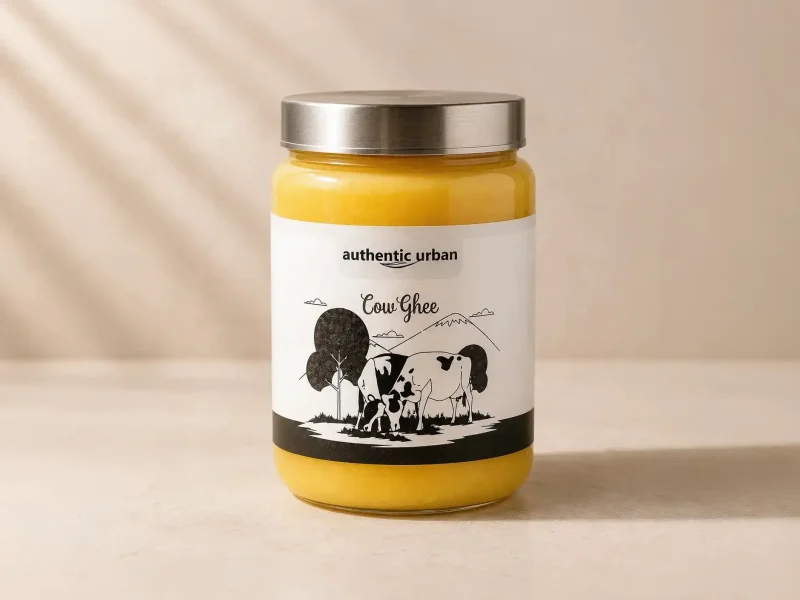 1 Litre
The occasional festival sweet
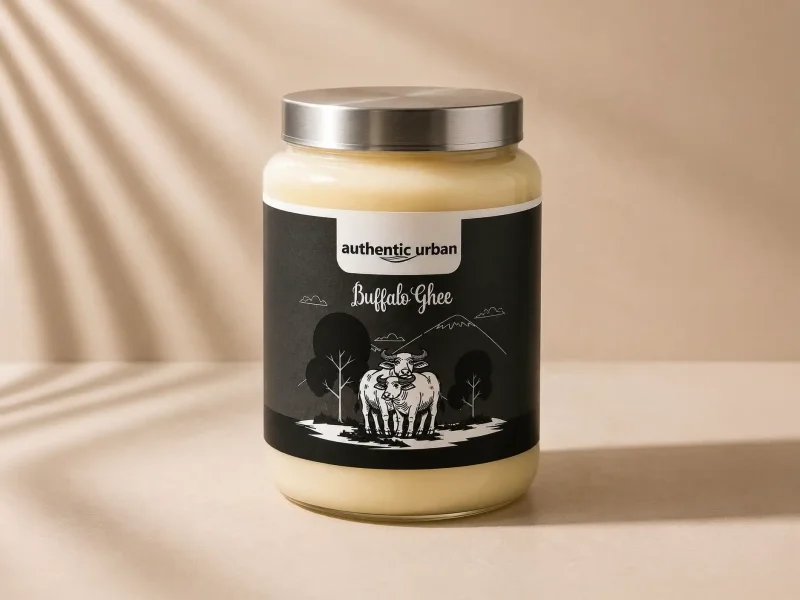 1 Litre
Each order is cooked after you place it, and the packing video is of that batch. Past order videos are on the shop.
FAQ
PCOD me ghee kha sakte hai?
Haan, kha sakte hain, par thoda. Din bhar me 1 se 2 chammach (5 se 10 gram) ghee, dal, khichdi ya roti par, khane ke saath. Agar report me LDL ya triglycerides zyada hain, to 1 chammach rakhiye. Ghee se PCOD theek nahi hota aur periods regular nahi hote. Mithai, halwa aur tali hui cheezon ka ghee bhi usi 2 chammach me ginna hai. Dawai aur test doctor ke saath chalte rahenge.
Is PCOD the same as PCOS, and does the ghee advice change?
In India the two words are used for the same condition in everyday talk: irregular periods, signs of high androgens such as acne or facial hair, and cysts or many follicles on the ovary scan. Doctors now mostly write PCOS. The ghee advice does not change with the name. It changes with your lipid profile, liver scan, and sugar tests, so bring those reports to the conversation.
Is ghee better than coconut oil or olive oil for PCOS?
No fat has been shown to be better for PCOS. The 2023 international PCOS guideline found no evidence that any one diet composition beats another for hormonal, metabolic, or fertility outcomes. ICMR-NIN advises keeping ghee to 1 to 2 teaspoons a day and taking the rest of your cooking fat from a mix of vegetable oils. So use ghee for the teaspoon where taste matters, and oil for the rest of the cooking.
Can I drink ghee in hot water on an empty stomach for PCOS weight loss?
It will not melt fat or fix insulin. A teaspoon of ghee in hot water adds about 45 kcal and counts towards the same 2-teaspoon daily limit. Weight changes with what you eat over the whole day. If you like the morning ritual, keep it to 1 teaspoon and remove a teaspoon of fat from lunch or dinner. Skip it if you have acidity or gallbladder trouble.
Does A2 or Gir cow ghee work better for PCOS?
No study compares A2 and regular ghee in women with PCOS. A2 describes a milk protein, and ghee is almost pure fat, with only traces of milk protein left after cooking. What matters for PCOS is the amount you eat and that the jar is real ghee, not a blend with vegetable fat. Choose A2 Gir cow ghee for taste and trust in the maker, not as a PCOS treatment.
Will ghee make me gain weight with PCOS?
Not at a teaspoon or two. Fat gives 9 kcal per gram, per ICMR-NIN, so 1 teaspoon (5 g) of ghee is about 45 kcal and 2 teaspoons about 90 kcal. Weight gain comes from the total day: extra ghee on top of oil, ghee-heavy sweets, and fried snacks add up fast. Swap ghee in for another fat rather than adding it, and the calories stay the same.
About the editorial team
Authentic Urban TeamBilona ghee makers, Gir Somnath, Gujarat
We are the Parmar family in Gir Somnath, Gujarat. We have made ghee here since 2016 and sold it online since 2025. We make only Bilona ghee, test it every month, and anyone is welcome to visit and watch it being made. Our Gir cows and Jafarabadi buffalo are grass-fed village animals that graze near the Gir forest, with no hormones or milk boosters. We set their milk to curd, churn it, and cook the makkhan on a wood chulha. These articles come from that kitchen and from what customers ask us on WhatsApp. We are ghee makers, not doctors.
Sources
- Recommendations From the 2023 International Evidence-based Guideline for the Assessment and Management of Polycystic Ovary Syndrome (Teede et al., 2023), The Journal of Clinical Endocrinology & Metabolism. Checked 27 Sep 2026.
- Prevalence, Phenotypes, and Comorbidities of Polycystic Ovary Syndrome Among Indian Women (Ganie et al., 2024), JAMA Network Open. Checked 27 Sep 2026.
- A prospective study of dairy foods intake and anovulatory infertility (Chavarro et al., 2007), Human Reproduction. Checked 27 Sep 2026.
- Dietary Guidelines for Indians, 2024 (fat 9 kcal/g, printed p. 9; saturated fat, insulin sensitivity, and cholesterol as a hormone precursor, p. 52; visible fat for women and the ghee limit, p. 54), ICMR-National Institute of Nutrition. Checked 27 Sep 2026.