Ghee for Menopause: Does It Help Hot Flashes? How Much
Ghee for menopause is food, not a treatment: it does not stop hot flashes and it does not replace HRT. One to two teaspoons a day on dal, roti, or khichdi is fine for most women after 45, and one is enough if your weight, sugar, or cholesterol is up. What eases hot flashes is cooling, fewer hot drinks, weight loss if needed, and treatment from a doctor.
Is ghee good for menopause?
Ghee is fine to eat during and after menopause, and it does not treat menopause symptoms. Keep it at 1 to 2 teaspoons a day, the limit ICMR-NIN's 2024 guidelines set for ghee or butter, and at 1 teaspoon if you are gaining weight or your lipid report is high. No study has tested ghee for hot flashes.
This page is for women in perimenopause (the years of irregular periods before they stop) and after menopause who want to know where the ghee jar fits. It is about food decisions. Choosing HRT, and checking your bones, heart, and thyroid, are for your doctor. If your periods are still regular and painful, read ghee for period cramps instead; if you want to know whether ghee balances hormones in general, that is answered on ghee for PCOS.
Does ghee help hot flashes?
No, not as far as anyone has measured. A hot flash (the NHS calls it a hot flush) is a sudden wave of heat in the face, neck, and chest, often with sweating, a racing heart, or anxiety. Here is each ghee claim you will see online, and what is actually known.
The claim
What is actually known
Ghee cuts hot flashes by 30 to 50%
No trial has given women ghee and counted their hot flashes. The percentage gets repeated from blog to blog without a study behind it. We used to print a version of it on this page; we took it out.
Ghee balances estrogen after menopause
Not shown. The ovaries make much less estrogen after menopause, and food fat does not replace it. Estrogen itself, as HRT, is the main treatment the NHS names for symptoms.
The omega-3 in ghee calms hot flashes
Ghee is mostly saturated fat, with little omega-3, and no hot flash study has used it.
Ghee is cooling, so it settles the heat
Ayurveda texts describe ghee as cooling (sheeta). That is a tradition, not a hot flash trial, and no study has tested ghee against flushes.
A diet change can ease hot flashes
Partly true, but in the other direction. In the largest trial, eating less fat and losing weight made hot flashes more likely to stop (details below).
The "cooling" idea deserves a word, because it is the one most families grow up with. Ghee's cooling nature in Ayurveda is about digestion and the body's temper over weeks, and it is why ghee is eaten through summer; we go through it on is ghee heating or cooling. A flush lasts a few minutes, and a spoon of ghee has never been shown to shorten one.
The largest diet trial on hot flashes went low fat
The Women's Health Initiative followed 17,473 women in the US, aged 50 to 79, who were past menopause and not on hormone therapy. Half were put on a diet with less fat and more fruit, vegetables, and whole grains. In the 2012 analysis in the journal Menopause, women on that diet were a little more likely to lose their hot flashes and night sweats within a year (odds ratio 1.14). Women who lost 10% or more of their body weight were more likely still (odds ratio 1.56), and large weight loss, over 10 kg, was what went with the end of moderate or severe flashes.
It was not a ghee trial, and it shows a link, not proof. What it does tell an Indian kitchen is plain: if you carry extra weight, adding spoons of ghee for the flashes pulls the wrong way. A teaspoon on dal is fine. A tablespoon "for hormones" has nothing behind it.
How much ghee a day during menopause?
One to two teaspoons a day is the ceiling, and one is enough for most women who sit most of the day. ICMR-NIN allows a sedentary adult woman 20 g of visible fat a day (oil, ghee, and butter together, about 4 teaspoons) and a moderately active woman 30 g. A teaspoon of ghee is 5 g of fat and about 45 kcal, since every gram of fat gives 9 kcal.
Your situation
Ghee a day
Why
Active, healthy weight, normal lipid report
1 to 2 tsp
The ICMR-NIN limit for ghee or butter, inside 30 g of total cooking fat for a moderately active woman.
Mostly sitting, or waist over 80 cm
1 tsp
ICMR-NIN gives a sedentary woman 20 g of visible fat a day, about 4 teaspoons for all cooking. One of them can be ghee.
High LDL, diabetes, or heart disease
½ to 1 tsp, or as your doctor says
Your report sets the number. Take it to the doctor before changing your fat.
Osteopenia or osteoporosis on a scan
1 to 2 tsp
No more than anyone else. Bones need calcium, vitamin D, and strength work.
On HRT or other menopause medicine
1 to 2 tsp
Ghee does not change the treatment. Keep taking what was prescribed.
For adult women. If a doctor has set your fat intake for cholesterol, liver, gallbladder, or weight, follow that.
In our home in Gir Somnath, each of us eats 1 to 2 teaspoons of ghee a day, on roti, dal, and khichdi. The extra comes in winter, in sweets like adadiya pak and gond, and that is where most families' ghee quietly doubles. We make ghee for a living and we still measure the spoon. For the right amount for everyone at your table, try our ghee and oil calculator; the amounts by age are on how much ghee per day.
What should you eat for hot flashes, with ghee?
Eat ordinary home meals with less chilli at night, and cut the hot drinks, not the ghee. The NHS names spicy food, caffeine, hot drinks, smoking, and alcohol as triggers to avoid or reduce, and suggests a cold drink, a fan, or a cool shower when a flush comes. Ghee is not on the trigger list, but it often arrives in a hot drink, and that part matters.
Meal
On the plate
Why
Morning
A glass of water, then poha, upma, or a besan chilla. Tea warm, not scalding, and only one cup.
The NHS lists caffeine and hot drinks among hot flush triggers.
Lunch
Dal, a leafy sabzi, 2 rotis, curd, and 1 tsp ghee on the dal
Curd and milk bring calcium; ghee brings almost none.
Evening
Roasted chana, a fruit, or buttermilk (chaas)
A cold drink is on the NHS list for easing a flush.
Dinner
Moong dal khichdi or roti-sabzi, light on chilli, with a jeera tadka in 1 tsp ghee
Spicy food is a common night trigger; a lighter dinner also helps sleep.
Bedtime
Skip it, or warm (not hot) milk without extra ghee
Hot drinks are an NHS-listed trigger, and night sweats are the flush in bed.
Haldi doodh and ghee coffee: the hot-drink trap
Two of the most shared menopause tips are a hot glass of haldi doodh with ghee at bedtime and ghee coffee in the morning. Both are hot drinks, and coffee adds caffeine: two of the triggers on the NHS list. If you love the haldi milk, let it cool to warm, drop the extra ghee, and have it an hour before bed rather than in bed. The recipe is on turmeric ghee golden milk. Ghee coffee is a large dose of fat in one cup, and a poor fit for night sweats; what it actually does is on ghee coffee benefits.
Keep a notebook for two weeks: each flush, the time, and what you ate or drank in the hour before. Most women find their own two or three triggers this way, and it is more useful to a doctor than any diet list.
Does ghee cause weight gain after menopause?
A teaspoon does not, but extra spoons add up faster after 45 than before. ICMR-NIN notes that women are at higher risk of becoming overweight after menopause, and treats a waist over 80 cm as a sign of risk for chronic disease. The NHS also lists weight gain around the stomach as a menopause symptom. Three extra teaspoons of ghee a day is about 135 kcal, every day, with nothing on the plate to show for it.
If your waist has grown, look at fried snacks, sweets, and the second roti with ghee before you look at the teaspoon on dal. The full plan, with plate swaps, is on ghee for weight loss. Weight loss is also the one diet change the WHI trial linked with fewer hot flashes, so it helps twice.
What helps hot flashes more than ghee?
HRT, CBT, and cooling help hot flashes; ghee does not. For many women with mild flashes, cooling and fewer triggers are enough. For flashes that break your sleep every night or stop your work, the NHS treatments below are what to ask a doctor about.
What
How
Evidence
HRT (estrogen)
Prescribed by a doctor after looking at your history
The NHS calls estrogen the main type of HRT for managing symptoms.
CBT (talking therapy)
A set number of sessions with a trained therapist
The NHS offers it for hot flushes, low mood, and sleep problems.
Non-hormonal medicines
Clonidine or an antidepressant, from a doctor
The NHS lists these when HRT does not suit or CBT has not helped.
Cooling at home
Cotton clothes, a fan, a cool bedroom, a cold drink or cool shower when a flush comes
NHS self-help list.
Losing weight if you carry extra
Slow, over months, with more vegetables and less fat and sugar
Women who lost 10% of their weight in the WHI trial were more likely to lose their hot flashes.
1 tsp ghee on a meal
Inside 1 to 2 tsp a day
Food and taste. Not tested for hot flashes.
Any medicine, hormonal or not, is decided with your doctor.
Herbal and "natural" menopause remedies are a separate question. The NHS says there is very little evidence on how well they work or how safe they are, and that some can cause serious side effects with other medicines. Tell your doctor about anything you take, even a kadha. Never stop prescribed HRT because you started eating ghee.
What about cholesterol and bones after menopause?
These two decide your ghee more than the hot flashes do. Ghee is mostly saturated fat, so if your LDL is high after menopause, the spoon comes down to ½ or 1 teaspoon and your doctor sets it; what the numbers on the report mean is on ghee for cholesterol.
Bones weaken after menopause, and ghee is not where calcium comes from. The NHS advises calcium foods such as milk and yoghurt, and weight-bearing exercise like walking. The calcium in a spoon of ghee next to curd, milk, and til, and when to ask for a bone density scan, are on ghee for bone health. Tiredness, weight gain, and dry skin in midlife can also be the thyroid; the thyroid tablet and ghee are covered on ghee for thyroid.
When should you see a doctor, not try more ghee?
See a doctor if your symptoms are getting in the way of sleep, work, or family life, and you want to know your options. The NHS also names a fast or pounding heartbeat, and periods that get heavier or more frequent in perimenopause, as reasons to go.
See a gynaecologist soon for any vaginal bleeding once your periods have stopped for 12 months or more, even spotting. Chest pain, fainting, or low mood most days for two weeks or more also need a doctor. None of these is a reason to try ghee first. Who should cut ghee right down is on who should not eat ghee.
A menopause kitchen checklist
Screenshot this and stick it near the stove.
- Keep ghee at 1 to 2 teaspoons a day, measured with a 5 ml spoon, on dal, roti, or khichdi.
- Write down every hot flush for 2 weeks: time, what you ate or drank in the hour before, and room heat.
- Drink tea and coffee warm, not scalding, and none after lunch. Skip ghee coffee.
- Keep chilli for lunch, not dinner. Keep a bottle of cold water by the bed.
- Measure your waist. Over 80 cm, cut cooking fat and sweets before adding anything.
- Get a lipid profile and blood sugar test once a year, and ask about a bone density scan.
- Any bleeding a year or more after your last period: see a gynaecologist that week.
Which ghee for the daily teaspoon after 45?
No ghee helps hot flashes more than another, so buy for taste and trust, and keep the spoon small. Good ghee smells of toasted milk when warmed, is clear when melted, and often sets grainy when cool. How to check any jar is on how to identify pure ghee, and our ranking of the cow ghee on sale is best cow ghee in India.
We make and sell ghee, so weigh this with that in mind. For the daily teaspoon we would pick our own A2 Gir cow ghee: grass-fed Gir cow milk set to curd overnight, churned, and cooked in a matki on a wood chulha, made after you order, with a video of your jar sent on WhatsApp. At ₹2,399 a litre, a 5 ml teaspoon costs about ₹12. Our Jafarabadi buffalo ghee is the richer jar for the odd halwa or ladoo. We test every month against the FSSAI limits; the steps are on how we make ghee.
The teaspoon on dal
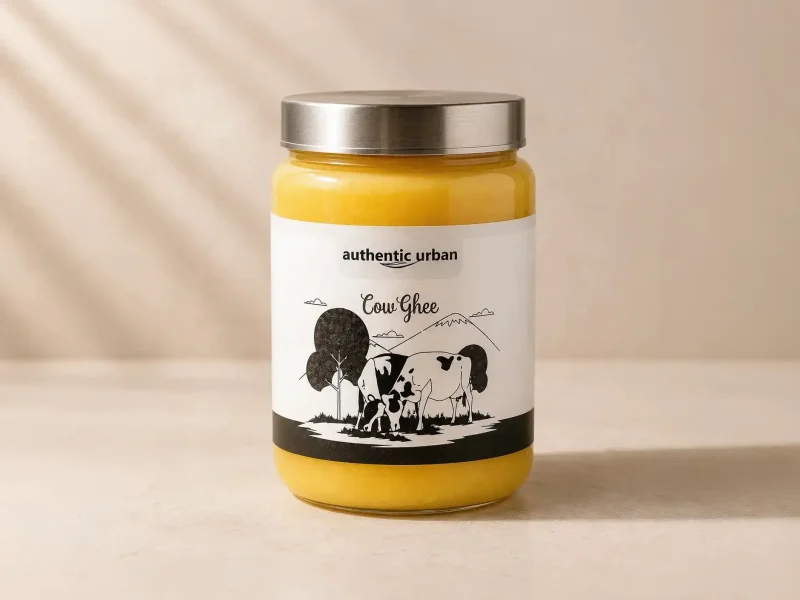 1 Litre
The winter sweet, small
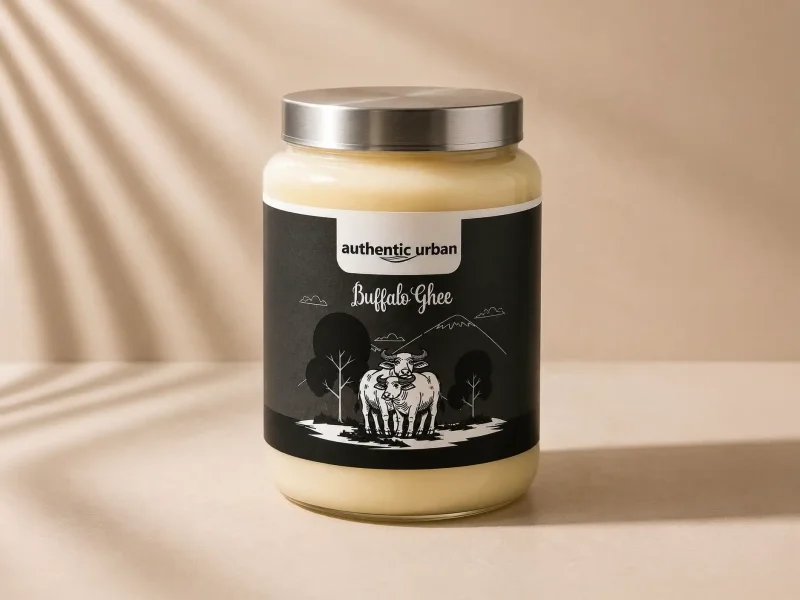 1 Litre
Each order is cooked after you place it, and the packing video is of that batch. Past order videos are on the shop.
FAQ
Menopause me ghee khana chahiye ya nahi?
Haan, kha sakte hain, lekin din me 1 se 2 chammach tak. Ghee se hot flashes kam nahi hote aur ye HRT ki jagah nahi le sakta. Agar wazan badh raha hai, cholesterol zyada hai, ya sugar hai, to 1 chammach kaafi hai aur doctor se poochhein. Garam chai, coffee aur mirch wala khana hot flash badha sakte hain, isliye unhe kam karein.
Can ghee help with vaginal dryness after menopause?
Eating ghee does not change vaginal dryness, which the NHS lists as a menopause symptom. Do not put ghee inside the vagina: kitchen ghee is not sterile, and oils can weaken latex condoms. The NHS names vaginal estrogen, as a cream or pessary, as a treatment for dryness and soreness after menopause, and a doctor can also suggest products made for the purpose. Ask even if it feels awkward.
Does ghee help with mood swings and poor sleep in menopause?
There is no study showing that ghee lifts mood or improves sleep in menopause. A warm, regular dinner with a teaspoon of ghee can make evenings calmer, and that is as far as it goes. The NHS suggests rest, regular exercise, relaxing activities, and CBT for low mood, anxiety, and sleep problems. Low mood most days for two weeks or more is a reason to see a doctor.
Is cow ghee or buffalo ghee better during menopause?
Neither has been tested for menopause, and both are almost pure fat at about 45 kcal a teaspoon. Cow ghee is lighter in taste and suits the daily teaspoon on dal or khichdi. Buffalo ghee is richer and sets firmer, better for the occasional halwa or ladoo. If your weight or cholesterol is up, pick one jar and keep the spoon small rather than switching jars.
Should I stop eating ghee if my cholesterol went up after menopause?
Not always, but cut it back and take the report to your doctor. Ghee is mostly saturated fat, which raises LDL in many people. Your doctor may allow ½ to 1 teaspoon a day once the rest of the diet is in order: fewer fried snacks, less sweet, more dal, vegetables, and whole grains. Do not stop a prescribed statin because you changed your ghee.
Are gond ke ladoo or methi ladoo good for menopause?
They are winter sweets in many Indian homes, and a small piece is fine as food. No study shows they ease hot flashes or strengthen bones. One ladoo can carry several teaspoons of ghee plus sugar, which uses up your whole day of fat. If you want one, have a small piece after lunch on a winter day and skip the extra ghee on dal that day.
About the editorial team
Authentic Urban TeamBilona ghee makers, Gir Somnath, Gujarat
We are the Parmar family in Gir Somnath, Gujarat. We have made ghee here since 2016 and sold it online since 2025. We make only Bilona ghee, test it every month, and anyone is welcome to visit and watch it being made. Our Gir cows and Jafarabadi buffalo are grass-fed village animals that graze near the Gir forest, with no hormones or milk boosters. We set their milk to curd, churn it, and cook the makkhan on a wood chulha. These articles come from that kitchen and from what customers ask us on WhatsApp. We are ghee makers, not doctors.
Sources
- Effects of a dietary intervention and weight change on vasomotor symptoms in the Women's Health Initiative (Kroenke and others; Menopause, 2012, 19(9): 980-8), Menopause (PMID 22781782). Checked 29 Sep 2026.
- Things you can do to help with menopause symptoms, NHS. Checked 29 Sep 2026.
- Treatment for menopause symptoms, NHS. Checked 29 Sep 2026.
- Symptoms of menopause, NHS. Checked 29 Sep 2026.
- Dietary Guidelines for Indians, 2024 (visible fat and ghee or butter 1 to 2 teaspoons a day, printed p. 54; weight after menopause and waist size, printed p. 64; 9 kcal per gram of fat, printed p. 110; teaspoon 5 g, household measures), ICMR-National Institute of Nutrition. Checked 29 Sep 2026.