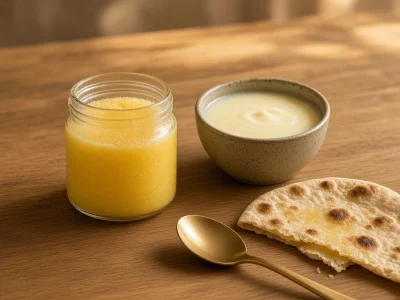
Amul vs Mother Dairy Ghee: Which Is Better? Price, Purity
Amul vs Mother Dairy ghee is close to a tie: both are dairy ghee sold under the same FSSAI standard, neither brand's page says how its cow ghee is made, and in September 2026 Mother Dairy's cow ghee cost ₹616 a litre against ₹705 for Amul. For the teaspoon you eat on roti and dal, we would buy neither. Our pick is Authentic Urban A2 Gir cow Bilona ghee, ₹2,399 a litre, cooked after you order.
Amul vs Mother Dairy ghee: which is better?
Neither is clearly better. On their own pages both sell cow ghee with no breed and no method stated, both must meet the same FSSAI limits, and the real difference is price: Mother Dairy's 1 L cow ghee pouch cost ₹89 a litre less than Amul Cow Ghee when we checked on 25 and 26 September 2026.
We are the Parmar family, and we make Bilona ghee in Gir Somnath, Gujarat, so we are not neutral. That is why every fact about the two brands below comes from their own pages or a dated shop listing, and our own pick is marked as ours. For daily food we would buy A2 Gir cow Bilona ghee over either tin. If you want the full ranking of ten brands, it is on best ghee in India.
Amul Cow Ghee vs Mother Dairy Cow Ghee, side by side
| Factor | Amul | Mother Dairy | Winner |
|---|---|---|---|
| Cow ghee, 1 L | ₹705 (Amul's shop) | ₹616 pouch (BigBasket) | Mother Dairy ✓ |
| Per teaspoon (5 mL) | ₹3.5 | ₹3.1 | Mother Dairy ✓ |
| Animal on the cow pack | Cow, breed not named | Cow, breed not named | Tie |
| Method on its page | Not stated | Not stated | Tie |
| Gir cow pack, per litre | ₹1,400 (500 mL, sold out) | ₹1,651 (500 mL) | Tie |
| Pack that does not name the animal | Pure Ghee, ₹660 | "Ghee" on its page | Tie |
| Buffalo ghee | Buffalo Ghee tin, ₹680 | Not in our index | Tie |
| FSSAI ghee standard | Must meet it | Must meet it | Tie |
Verdict: Close to a tie on the label. Mother Dairy's cow ghee pouch was ₹89 a litre cheaper in September 2026. Neither regular cow pack names a breed or a method.
Amul prices are from Amul's own shop. Mother Dairy does not sell these packs on its own site, so its prices are from BigBasket with no delivery location set. Both were read on 25 and 26 September 2026.
How much do Amul and Mother Dairy ghee cost?
Amul Cow Ghee cost ₹705 a litre and Mother Dairy Pure Cow Ghee ₹616 a litre in September 2026. That is ₹3.5 and ₹3.1 a teaspoon. Both brands also sell a Gir cow ghee in 500 mL, which works out to ₹1,400 a litre for Amul and ₹1,651 for Mother Dairy.
Ghee Price Index, September 2026: Amul's own shop and BigBasket for Mother Dairy, 25 and 26 September 2026. Gir packs are 500 mL, shown per litre. Amul Gir Cow Ghee was sold out on the check date.
| Item | Value |
|---|---|
| Authentic Urban A2 Gir cow Bilona (ours) | ₹2,399 a litre |
| Authentic Urban Jafarabadi buffalo Bilona (ours) | ₹1,999 a litre |
| Mother Dairy Premium Gir Cow Ghee | ₹1,651 a litre |
| Amul Gir Cow Ghee | ₹1,400 a litre |
| Amul Cow Ghee | ₹705 a litre |
| Amul Buffalo Ghee | ₹680 a litre |
| Amul Pure Ghee | ₹660 a litre |
| Mother Dairy Pure Cow Ghee | ₹616 a litre |
For a family of four eating one teaspoon each a day, a month of ghee costs about ₹370 with Mother Dairy's cow ghee, ₹420 with Amul's, and ₹1,440 with our Gir cow ghee. The gap between the two tins is small next to the gap between a tin and a Bilona jar. These numbers come from our monthly Ghee Price Index; offers change weekly, so treat them as the level, not the exact rupee. How prices move across the whole market is on ghee price in India.
"Why the price?" is one of the questions we are asked most on WhatsApp. The short answer is milk. About 30 to 35 litres of Gir cow milk go into 1 kg of our cow ghee, and curd to ghee takes the better part of two days. How much ghee a day makes sense for your family is on how much ghee per day.
Is Mother Dairy ghee pure? Is Amul ghee pure?
Both are sold as ghee under FSSAI's standard for milk fat products, which sets the same limits for every brand, and nothing on either brand's page suggests otherwise. "Pure" on a pack is part of the product name, not a test result. Mother Dairy's ghee page says its ghee is "rich in vitamin A" and has no industrial trans fats; it says nothing about the breed or how the ghee is made.
This is the bar any jar sold as ghee in India must clear, from FSSAI's Chapter 2.1, Dairy products (version 01.09.2023). Screenshot it and compare it with any lab report a brand shows you.
Moisture
At most 0.5%
Water left in the ghee is what turns it sour.
Milk fat
At least 99.5%
Ghee is almost pure fat; the solids should be cooked off and strained.
Free fatty acids (as oleic acid)
At most 2.0%
A high number points to old or badly stored fat.
Baudouin test
Negative
A lab test the ghee must pass; you cannot run it at home.
β-sitosterol
Absent
FSSAI's test for vegetable oil mixed into ghee.
Checking an Amul or Mother Dairy tin at home
At home you can check freshness, not the lab numbers. Warm a spoonful: it should melt clear and smell of cooked milk. A flat, waxy, or sour smell is a reason to stop, whatever the logo. Buy sealed packs from a shop that sells a lot of them, and read the packing date. The five home checks are on how to identify pure ghee. We test our own ghee every month against the limits above.
Pure ghee or cow ghee: which Amul or Mother Dairy pack are you comparing?
Compare cow ghee with cow ghee. Amul Pure Ghee does not name the animal on Amul's page, and Mother Dairy's plain "Ghee" does not either; only the cow packs say cow. FSSAI lets a product be named simply "ghee" when it comes from milk, so a pack that does not say cow may be buffalo or a mix.
This matters for price and for the plate. Buffalo ghee is whiter and sets firmer; cow ghee is more yellow and lighter. Mother Dairy's own page puts the yellow of its cow ghee down to beta carotene. If your family likes one and not the other, the name on the front tells you more than the brand. The two animals side by side are on cow vs buffalo ghee.
What about Amul Gir and Mother Dairy Gir cow ghee?
Both brands now sell a Gir cow ghee: Amul at ₹700 for 500 mL and Mother Dairy at ₹826 for 500 mL. Both name the Gir breed. Neither page we read says whether the ghee is made from curd or from cream, and neither calls it Bilona.
Gir is the breed of the cow, and Bilona is the method: milk set to curd, churned into makkhan, then cooked. A jar can have one without the other. Ours has both. Our milk sets to curd overnight, is churned for 30 to 45 minutes, and the makkhan cooks in a matki on a wood chulha for 45 to 90 minutes, which is why our litre costs more. How many packs on the market make each label claim is in our Ghee Claims Report, and the method difference, with no brand names, is on Bilona ghee vs cream ghee.
Which ghee should you use for each kitchen job?
Pick the fat by the food, not by the brand. Here is what we would reach for in each case, including the one where the answer is oil.
A teaspoon on roti, dal, rice, or khichdi
You taste this spoon, so buy the jar that smells of toasted milk.
Paratha, halwa, ladoo, festival sweets
Jafarabadi buffalo Bilona ghee
Richer and firmer, and cheaper per litre than our cow ghee.
Deep frying puri or pakora
Groundnut or mustard oil
A kadhai takes far more fat than a week of daily spoons.
An Amul or Mother Dairy tin is already open
Finish it, then choose the next jar by the checklist below
Warm a spoon first: if it smells clean, there is nothing to throw away.
For frying, a good oil does the job and saves your ghee for the table; the split is on ghee vs vegetable oil. Weighing up whether to leave an Amul tin for good? That question has its own page: A2 ghee vs Amul ghee. Amul against the other big name is Patanjali vs Amul ghee.
What should you check on the label before you buy?
Five questions, answered from the pack and one website, work for Amul, Mother Dairy, and every other jar. Save this list for the shop.
1. Does the front name the animal?
"Cow ghee" or "buffalo ghee" tells you something. "Pure ghee" or plain "ghee" does not.
2. Does it name a breed and say how it was made?
Gir, Sahiwal, Jafarabadi, and a word like curd or dahi. Neither brand's regular cow pack gives either.
3. Is the FSSAI licence real?
Type the 14-digit number into foscos.fssai.gov.in and match the name and address on the pack.
4. How old is it?
Read the packing date, not only the best-before. Fresher smells better.
5. What does a teaspoon cost?
Divide the price by the millilitres and multiply by 5. Compare the spoon you eat, not the tin.
The mistakes we see most are the small ones: setting a "Pure Ghee" price against a "Cow Ghee" price, comparing a 500 mL Gir pack with a 1 L tin without working out the litre, and reading "Gir" as if it meant Bilona. What Bilona actually involves is on the Bilona method.
Which ghee to buy instead of a dairy tin?
Whichever jar you pick, run the five checks above, warm a spoon and smell it, and look for fine grain once it cools. Slow-cooked Bilona ghee usually grains; it is one of the first things new customers ask us about.
For the food you taste, we would buy our own: A2 Gir cow ghee for the daily spoon and Jafarabadi buffalo ghee for sweets and parathas. We cook your jar after you order, from grass-fed village animals near the Gir forest, and send a video of it being cooked and packed on WhatsApp. You can also see how we make it, or visit the kitchen in Gir Somnath. Free delivery across India, COD, and a 7-day quality return.
A2 Gir cow ghee: roti, dal, the daily spoon
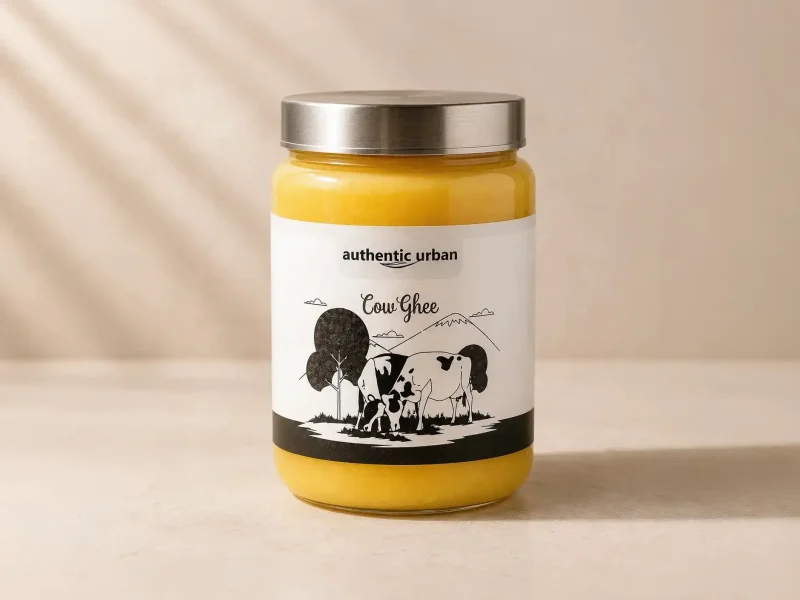 1 Litre
Buffalo ghee: paratha, halwa, sweets
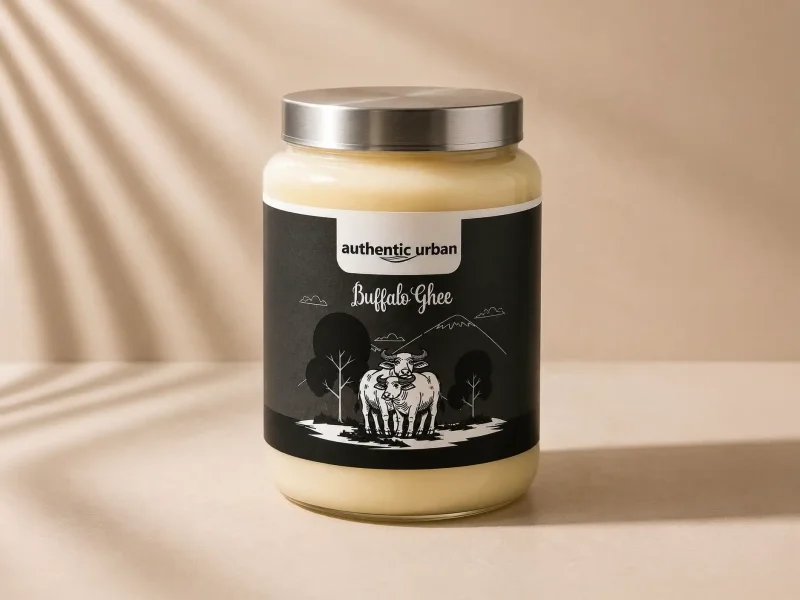 1 Litre
Each order is cooked after you place it, and the packing video is of that batch. Past order videos are on the shop.
FAQ
Which is the best ghee: Amul, Mother Dairy, or another brand?
For ghee you taste on roti and dal, our pick is Authentic Urban A2 Gir cow Bilona ghee, at ₹2,399 a litre. We make it, so weigh that: it is cooked after you order, from Gir cow milk set to curd, and you get a video of your own jar. GirOrganic and Gavyamart also name the Gir breed and a curd method. Amul and Mother Dairy are dairy ghee we do not rank for the spoon.
Is Mother Dairy ghee made from buffalo milk?
Its cow ghee says cow on the pack, and Mother Dairy's ghee page links the yellow colour of that pack to beta carotene. Its plain "Ghee" does not name the animal on that page. Under the FSSAI standard, a product can be sold simply as ghee if it is made from milk, so a pack that does not say cow may be buffalo or a mix. Read the front of the pack you are holding.
What is Mother Dairy Khaanti ghee or brown ghee?
Mother Dairy lists a Khaanti Ghee, which it calls brown ghee, beside its regular and cow ghee. Brown ghee is cooked longer, so the milk solids darken and the ghee tastes more toasted. It is still ghee and still a fat. Use it the way you would use any ghee, a teaspoon where you will taste it, and check the packing date before you buy.
Can I give Amul or Mother Dairy ghee to my baby?
Ask your paediatrician when to start ghee and how much, before any brand question. When the time comes, give the same jar you would happily eat yourself: fresh, smelling of toasted milk when warmed, from a maker who names the animal. A baby's portion is tiny, so a better jar costs only a little more per day. We do not suggest a dairy tin for this.
Why does Bilona ghee cost three times Amul ghee?
Because it starts from whole milk, not separated cream. At our kitchen in Gir Somnath, about 30 to 35 litres of Gir cow milk go into 1 kg of cow ghee. The milk sets to curd overnight, is churned for 30 to 45 minutes, and the makkhan cooks slowly for up to 90 minutes. Curd to ghee takes the better part of two days, and the yield is lower than cream ghee.
Should I keep ghee in the fridge once the tin is open?
No need, for any well-made ghee. Keep it away from the stove and sunlight, use a dry spoon every time, and shut the lid. Water from a wet spoon is what spoils ghee first. If a tin smells sour, soapy, or like old paint when warmed, stop using it whatever the brand. Follow the best-before date on the pack you bought.
About the editorial team
Authentic Urban TeamBilona ghee makers, Gir Somnath, Gujarat
We are the Parmar family in Gir Somnath, Gujarat. We have made ghee here since 2016 and sold it online since 2025. We make only Bilona ghee, test it every month, and anyone is welcome to visit and watch it being made. Our Gir cows and Jafarabadi buffalo are grass-fed village animals that graze near the Gir forest, with no hormones or milk boosters. We set their milk to curd, churn it, and cook the makkhan on a wood chulha. These articles come from that kitchen and from what customers ask us on WhatsApp. We are ghee makers, not doctors.
Sources
- Food Safety and Standards (Food Products Standards and Food Additives) Regulations, Chapter 2.1: Dairy products and analogues, version 01.09.2023 (2.1.8, Standard for Milk Fat Products), Food Safety and Standards Authority of India (FSSAI). Checked 26 Sep 2026.