Homemade Ghee vs Store Bought: Cost, Purity, Which to Pick
Homemade ghee vs store bought: from shop butter, homemade ghee costs about what a packet does (about ₹692 a litre in unsalted Amul butter against ₹705 for Amul Cow Ghee), so make it for the taste and the control, not to save money. From your own milk, set to curd and churned, it is the best ghee you can eat, if you have the milk and two days. We make and sell curd ghee, so weigh our view with that in mind.
Homemade ghee vs store bought: which is better?
Homemade ghee is better when you start from malai you already have or from milk you trust, and cook it slowly until dry. Store-bought is better when your only route is shop butter, because that saves you almost nothing, or when you want curd ghee without the two days of work. Neither is healthier by itself: both are at least 99.5% milk fat when made right.
You want cheaper ghee than a packet
Buy the packet. Ghee from unsalted shop butter costs about the same, before gas and time.
You have malai piling up in the fridge
Make it. The fat is already paid for with the milk, and malai ghee tastes fuller than butter ghee.
You want curd (Bilona) ghee for the daily teaspoon
Make it only if you have 26 to 30 litres of good milk and two days. Otherwise buy a curd jar from a maker who shows you the batch.
Frying puris or pakoras
Neither. Fry in oil and keep ghee for the plate.
Halwa, ladoo, paratha for a crowd
Buy buffalo ghee. It is richer and cheaper per litre than cow curd ghee.
This page is about the choice. The recipe, with heat and timings, is on how to make ghee at home.
Homemade vs store-bought ghee side by side
The two differ in cost, time, and who stands behind the jar, not in the nutrition label. "Homemade" here means ghee you cook yourself from butter, malai, or milk.
Homemade ghee vs store-bought ghee
| Factor | Homemade | Store-bought |
|---|---|---|
| Cost per litre (butter cost only) | ₹497 (salted) to ₹692 (unsalted) | ₹711 median packet; ₹2,399 median curd jar |
| Your time | About an hour at the stove from butter; two days from milk | None |
| What goes in | Whatever your butter, malai, or milk is | What the label and the seller say |
| Checked against FSSAI limits | No one checks it | Must meet them; the seller is answerable |
| Taste | Butter ghee is mild; malai and curd ghee smell fuller | Packets are mild; curd jars smell of toasted milk |
| Keeping | Depends on how dry you cooked it | A best-before on the label |
| Calories (USDA) | 876 kcal per 100 g | 876 kcal per 100 g |
Verdict: Same fat and calories. Homemade wins on control and, from malai or curd, on taste. Bought wins on time and on a standard someone must answer for.
Butter prices: bigbasket, 28 September 2026. Ghee prices: Ghee Price Index, September 2026. Calories: USDA FoodData Central. Butter and ghee limits: FSSAI Chapter 2.1 (2023).
Is homemade ghee cheaper than store-bought?
From shop butter, barely. From malai you would otherwise throw away, yes. From milk bought for the purpose, it costs close to a good curd jar, before your time.
Ghee from shop butter
Butter is about 80% fat, and ghee is the fat with the water and milk solids cooked out. FSSAI's standard asks table butter for at least 80% milk fat, and Amul's butter lists 80 g of fat per 100 g. USDA FoodData Central weighs a tablespoon of ghee at 12.8 g, which puts a litre at about 865 g. So a litre of ghee needs at least 1.08 kg of butter, and a little more in practice, because the brown residue holds back some fat.
On bigbasket on 28 September 2026, 500 g of Amul salted butter cost ₹230 and 500 g of Amul unsalted butter ₹320. That makes the butter alone for a litre of ghee ₹497 (salted) or ₹692 (unsalted). A litre of Amul Cow Ghee was ₹705, and the median regular packet cow ghee in our Ghee Price Index, September 2026 was ₹711. Add an hour of gas and your time, and the unsalted route costs the same as buying.
Salted butter is cheaper and works. Salt does not dissolve in fat, so it stays behind with the water and the brown bits, and those bits come out too salty to eat. Either way, the ghee you get is butter ghee made from cream, the same method as most packets, so it tastes like a packet too.
Butter: bigbasket, 28 September 2026, at 80% fat and USDA's 865 g a litre, butter cost only. Ghee: Ghee Price Index, September 2026, each brand's own shop page, 25 and 26 September 2026; our own live price.
| Item | Value |
|---|---|
| Homemade from Amul salted butter (butter cost only) | ₹497 a litre |
| Homemade from Amul unsalted butter (butter cost only) | ₹692 a litre |
| Amul Cow Ghee, bought | ₹705 a litre |
| Regular packet cow ghee, median of 11 | ₹711 a litre |
| Curd (Bilona) cow ghee, median of 9 | ₹2,399 a litre |
| Our A2 Gir cow Bilona ghee | ₹2,399 a litre |
Ghee from saved malai
This is where homemade ghee really is cheaper. The malai that sets on boiled milk is fat you have already paid for; skimming it only moves it from the milk glass to the ghee jar. The cost is time: a family drinking a litre or two a day collects malai for weeks before there is enough for a batch, and the malai has to stay cold and fresh all that while. Set with a spoon of curd and churned before cooking, it gives ghee with more aroma than shop butter.
Ghee from milk, the curd (Bilona) way
In our kitchen in Gir Somnath, 30 to 35 litres of Gir cow milk make 1 kg of cow ghee, which is 26 to 30 litres for a litre of ghee. At your milk price, the milk bill alone looks like this:
Milk at ₹60 a litre
₹1,560 to ₹1,800 for a litre of ghee
Milk at ₹80 a litre
₹2,080 to ₹2,400 for a litre of ghee
Milk at ₹100 a litre
₹2,600 to ₹3,000 for a litre of ghee
The median curd cow ghee in our index was ₹2,399 a litre. So making curd ghee at home is cheaper only if your milk is cheap and good, and you do not count two days of setting, churning, and cooking. Where the rest of a Bilona jar's price goes is on why Bilona ghee is expensive.
Is homemade ghee purer or safer than packet ghee?
Homemade ghee is exactly as pure as the butter, malai, or milk it came from. Cooking does not clean a bad start: if the butter had vegetable fat in it, so does the ghee.
A packed jar has to meet FSSAI's ghee standard: at most 0.5% moisture, at least 99.5% milk fat, free fatty acids at most 2.0%, a negative Baudouin test (which catches sesame oil and vanaspati), and no β-sitosterol, a plant sterol that shows up when vegetable oil is mixed in. The seller is answerable if a sample fails. That does not mean every jar on a shelf is tested, and it does not tell you the breed or the method. It means someone is on the hook.
Nobody tests your home batch, but you know what went in. That is the trade. If your milk comes from a dairy you trust, your ghee is as clean as it gets. If you are not sure of the butter, the kitchen checks that work, and the ones that mislead, are on how to identify pure ghee.
Does homemade ghee taste better?
Malai and curd ghee usually do; butter ghee tastes like a packet, because it is made the same way. The method changes the smell, not the fat.
A 2025 study in Food Chemistry: X (Kataria and Singh) made ghee from the same milk three ways: from curd butter, from cream butter, and from fermented cream butter. The fatty acids came out the same. The smell did not: curd and fermented-cream ghee had more of the flavour compounds that give ghee its toasted, slightly tangy notes. That is why ghee from malai set with curd, or from churned curd, smells fuller than ghee from shop butter.
In our kitchen the makkhan cooks in a matki on a wood chulha for 45 to 90 minutes on a low flame. It comes off when the bubbling goes quiet, the milk solids turn golden-brown, and it smells of toasted milk. Take it off earlier and the ghee is cloudy and keeps water; leave it longer and it turns dark and bitter. Varsha tastes every batch, and a burnt or undercooked one never goes in a jar; it stays for home use. The method compared jar to jar is on Bilona ghee vs cream ghee, and the curd method step by step on the Bilona method.
How long does homemade ghee last compared to a bought jar?
Well-cooked homemade ghee keeps as long as a bought jar; badly cooked ghee goes off in weeks. Water decides it. FSSAI allows ghee at most 0.5% moisture, and a batch taken off the flame too soon keeps more than that and spoils fast.
A sealed jar of ours keeps 9 to 12 months at room temperature. A bought jar carries a best-before date; a home batch has none, so you judge it. Signs that a home batch was not cooked dry: it looks cloudy, water beads at the bottom of the jar, or it smells sour within a few weeks. Keep that batch in the fridge and finish it soon. For any ghee, use a dry spoon, shut the lid, and keep the jar away from the stove and sunlight. What spoiled ghee smells like, and whether old ghee is safe, is on does ghee go bad.
Is "homemade" ghee sold on WhatsApp or Instagram the same as making it yourself?
No. Once someone else makes it and sells it, it is store-bought ghee without a store, and you should check it the way you would check a jar.
India's Food Safety and Standards Act, 2006 (Section 31) says no one may run a food business without a licence, and that small makers, including cottage and home businesses, must at least register with FSSAI. So a seller of "ghar ka ghee" should have a registration or licence number. Ask for it, check it on foscos.fssai.gov.in, and ask what milk it is, how it is made, and when the batch was cooked. A seller who cannot answer is selling you a story. Then warm a spoon: it should smell of toasted milk, or check the jar with our 2-minute purity checker.
Should you make ghee at home or buy it?
Make it when you have malai or milk you trust and you enjoy the cooking. Buy it when your only route is shop butter, or when you want curd ghee without giving up two days.
Make ghee at home if
- You boil milk daily and the malai would otherwise go to waste.
- You get milk straight from a farmer or dairy you trust.
- You can stay by the stove for the last half hour of cooking.
Buy ghee if
- You would be starting from shop butter: the saving is close to nothing.
- You want curd ghee but not the curd, the churning, and the two days.
- You need a lot at once, for a wedding, a puja, or winter sweets.
Three kitchens, three answers
A joint family boiling 3 litres of milk a day
Make it. The malai adds up in a week or two, costs nothing extra, and gives better ghee than any butter. Set it with curd before churning for a fuller smell.
A working couple in a city flat, buying butter to make ghee
Stop. Unsalted butter ghee costs about what a packet does, and it is the same cream method. Put the hour into something else and buy one good jar for the table.
A family that wants curd ghee for a toddler's dal
Buy a curd jar from a maker who shows you the batch, unless you have a trusted milk source and the time. The amount for a child over one is small; see ghee for toddlers.
Mistakes people make
- Believing homemade is always purer. It is as pure as the butter.
- Counting only the butter and not the gas and the hour at the stove.
- Pulling the pot off while it still crackles. That crackle is water, and water spoils ghee.
- Buying "homemade" from a stranger online and never asking for the FSSAI number.
- Eating more because it is homemade. It has the same 876 kcal per 100 g, per USDA.
The calories and fat in a spoon are on ghee nutrition facts.
Before you make or buy ghee: 7 checks
Save or screenshot this.
- 1 Making from butter: read the fat line. Table butter must be at least 80% milk fat under FSSAI; white or cooking butter only 76%, so it gives less ghee.
- 2 Making from malai: keep it in the fridge and cook it within the week, or add a spoon of curd and churn it. Old malai makes sour, sharp ghee.
- 3 Cooking: take it off only when the bubbling goes quiet and the solids are golden-brown. Pale solids mean water is still in the pot.
- 4 Storing: a bone-dry glass or steel jar, a dry spoon every time, lid shut, away from the stove.
- 5 Buying "homemade" from someone: ask for their FSSAI registration or licence number and check it on foscos.fssai.gov.in.
- 6 Buying a jar: the label names the animal (cow or buffalo), the method in plain words, a batch or packing date, and the FSSAI number.
- 7 Any ghee, home or bought: warm a spoon. It should smell of toasted milk, never flat, sour, or like old paint.
Which ghee do we keep when not making it?
If you buy, buy the ghee closest to what you would make at home from good milk: curd ghee that names its animals, with a batch you can see. Our ranking of brands, with dated prices, is on best ghee in India.
We make both jars below, so weigh our view with that in mind. Our A2 Gir cow ghee is Gir cow milk, and our Jafarabadi buffalo ghee is from the local buffalo breed, from our own animals and partner farmers in Gir Somnath, grazing near the Gir forest with no hormone injections. Every jar is set to curd, churned, and cooked on a wood chulha after you order, the way a home would make it, and a video of your jar comes on WhatsApp. We test every month against the FSSAI limits, and anyone can come and watch; see how we make ghee.
Gir cow ghee: the daily teaspoon
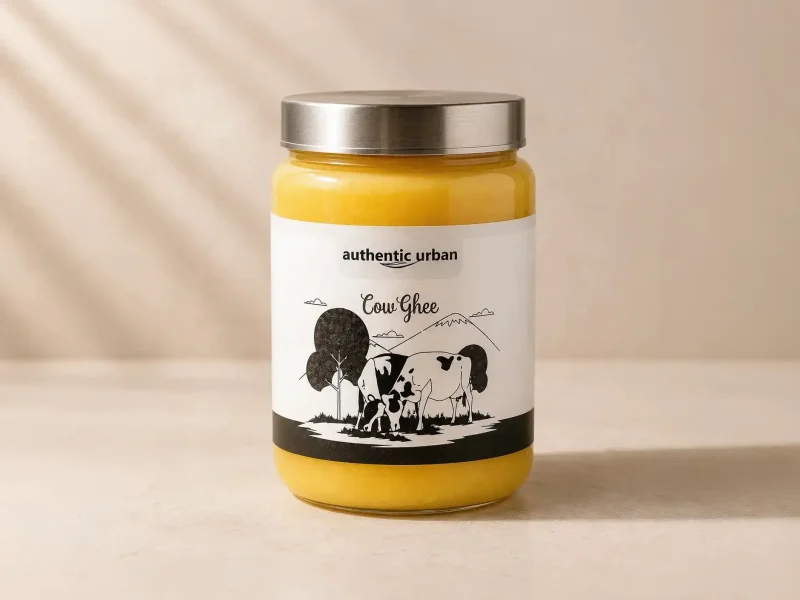 1 Litre
Buffalo ghee: halwa and paratha
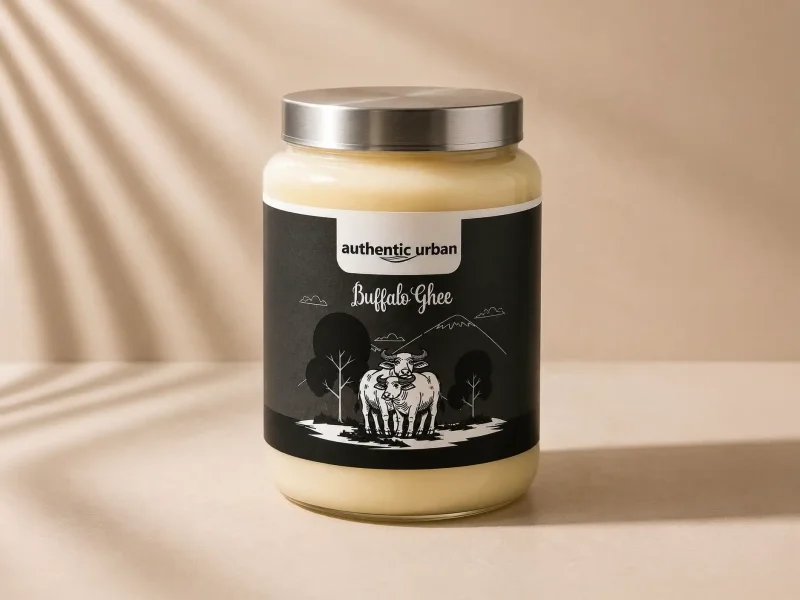 1 Litre
Each order is cooked after you place it, and the packing video is of that batch. Past order videos are on the shop.
FAQ
Which is the best store-bought ghee if I stop making it at home?
We put our own A2 Gir cow ghee first, and we make it, so weigh that. It is Gir cow milk set to curd overnight, churned, and cooked on a wood chulha in Gir Somnath after you order, with a video of your jar on WhatsApp. For sweets and parathas, our Jafarabadi buffalo ghee. After ours, pick a curd ghee that names its animals and lets you see the batch being made.
Is cow milk or buffalo milk better for making ghee at home?
Buffalo milk gives more ghee for the effort, because its milk is richer: in our kitchen about 22 to 25 litres make 1 kg of buffalo ghee, against 30 to 35 litres for cow ghee. Buffalo ghee comes out whiter and sets firmer, and suits halwa, ladoo, and paratha. Cow ghee is yellower and lighter, the one most families keep for the daily teaspoon on roti and dal.
What can I do with the brown residue left after making ghee?
The brown bits at the bottom of the pot are milk solids toasted in ghee, and many homes eat them. Mix them into roti or paratha dough, stir them into a little sugar or jaggery for children as a sweet, or add them to halwa. Use them the same day or the next, kept in the fridge, because they still hold moisture. If they taste bitter or burnt, throw them away.
Should homemade ghee be kept in the fridge?
Only if you are not sure it is fully cooked, or you make a large batch that will take months to finish. Ghee cooked until the bubbling stops holds almost no water and keeps well in a cool cupboard. If your batch looked cloudy or the solids were pale, keep it in the fridge and use it within a few weeks. A sour or sharp smell means it has turned.
Can I give homemade ghee to my baby?
For a child over one year, yes, if the butter or milk came from a source you trust and the ghee was cooked fully and kept clean. A teaspoon stirred into dal, rice, or khichdi at a meal is a common amount. For a baby under one, ask your paediatrician how and when to add fat before starting any ghee, homemade or bought.
Is desi ghee from the local dairy shop homemade?
Not always in the way the word suggests. Loose ghee at a dairy shop may be cooked in the back from the shop's own milk, or from cream or butter bought in, and it is often sold without a label, a batch date, or a named animal. Some of it is very good. Ask whose milk it is and when it was made, look for the FSSAI number at the counter, and smell a warm spoon first.
About the editorial team
Authentic Urban TeamBilona ghee makers, Gir Somnath, Gujarat
We are the Parmar family in Gir Somnath, Gujarat. We have made ghee here since 2016 and sold it online since 2025. We make only Bilona ghee, test it every month, and anyone is welcome to visit and watch it being made. Our Gir cows and Jafarabadi buffalo are grass-fed village animals that graze near the Gir forest, with no hormones or milk boosters. We set their milk to curd, churn it, and cook the makkhan on a wood chulha. These articles come from that kitchen and from what customers ask us on WhatsApp. We are ghee makers, not doctors.
Sources
- Food Safety and Standards (Food Products Standards) Compendium, Chapter 2.1: Dairy products and analogues, version 01.09.2023 (p. 27 ghee, p. 30 butter), FSSAI. Checked 28 Sep 2026.
- Food Safety and Standards Act, 2006, Section 31: Licensing and registration of food business, FSSAI. Checked 28 Sep 2026.
- Butter oil, anhydrous (SR Legacy 173412): energy, fat, and portion weights, USDA FoodData Central. Checked 28 Sep 2026.
- Effect of processing methods on fatty acid composition and flavour profile of clarified butter (ghee) obtained from Deoni and Holstein Friesian cow breeds (Kataria D, Singh G), 2025, Food Chemistry: X. Checked 28 Sep 2026.