Janmashtami Prasad Recipes: Panjiri, Makhan, Panchamrit
Janmashtami prasad for a home puja takes about 60 g of ghee: 40 g to roast a batch of dhaniya panjiri, 15 g for 12 pedas, and 1 teaspoon in the panchamrit. Makhan mishri needs no ghee at all, only fresh unsalted makhan and crushed mishri. Diyas take 1 to 2 teaspoons each on top of that, so a 250 ml jar covers the whole night.
How much ghee do you need for Janmashtami prasad?
About 60 g for the four prasad recipes on this page, plus 5 to 10 g for each diya. Panjiri takes most of it. Makhan mishri takes none, because the makhan is offered as it comes off the churn. So a 250 ml jar of ghee is enough for a family puja with three or four diyas, and a 500 ml jar leaves room for halwa the next morning.
The two jobs are different. Makhan (fresh white butter) goes on the thali raw, because Krishna is Makhan Chor, the butter thief of the Braj stories. Ghee is the cooking fat: it roasts the coriander, binds the peda, goes into the panchamrit, and lights the diya. Use this table to plan the shopping.
Dish
Ghee
Makes
Dhaniya panjiri, 1 batch
40 g (3 tbsp)
About 20 spoons of prasad
Makhan mishri
None
100 g fresh makhan and 25 g mishri, 8 to 10 small balls
Panchamrit
5 g (1 tsp)
About 1 cup for abhishek, then charnamrit
Peda
15 g (1 tbsp), plus a smear on the palms
12 pedas from 250 g khoya
Diyas
5 to 10 g (1 to 2 tsp) each
One small diya through the aarti
From the recipes on this page. Diya amount from our guide to ghee for puja.
How much a diya burns, and why the ghee for the lamp and the ghee for the prasad should come from separate bowls, is on ghee for puja and havan. Janmashtami falls in the monsoon, and that shows in the jar. Green fodder in these months makes cow ghee a deeper yellow than a winter batch, so your festival jar may look brighter than the last one. It is one of the questions we get most on WhatsApp in August.
How do you make dhaniya panjiri with ghee?
Grind 100 g of dry-roasted coriander seeds, roast the powder in 40 g of ghee on the lowest flame for 6 to 8 minutes until it smells nutty, add nuts and coconut, cool for 5 minutes, and mix in 80 g of powdered sugar. It makes about 310 g, twenty spoons of prasad. The flame decides everything: coriander powder turns bitter within a minute of catching.
One heaped tablespoon (15 g): 72 kcal, 1.3 g protein, 5.1 g fat (2.2 g saturated), 7.6 g carbohydrate, and 2.5 g fibre, worked out from USDA FoodData Central for each ingredient. It holds about 2 g of ghee and 4 g of sugar. Coriander seed is mostly fibre: USDA lists 41.9 g of fibre in 100 g of seed, which is why panjiri tastes dry until the ghee coats it.
Ingredients for 20 spoons
- 100 g coriander seeds (dhaniya), about 1 cup, or 100 g fresh coriander powder
- 40 g ghee (about 3 tbsp)
- 80 g powdered sugar (bura), about ½ cup
- 30 g almonds and 30 g cashews, chopped
- 30 g desiccated coconut
- 20 g makhana (optional, not in the calorie count)
- ¼ tsp elaichi powder, and tulsi leaves to offer
Steps, with heat and time
- Roast the seeds, 4 to 5 minutes on low. In a dry kadai, until they smell warm and one seed crushes easily. Cool, then grind fine. Sieve out the husk if you want smooth panjiri.
- Nuts, 3 to 4 minutes on low. Warm 1 tbsp of the ghee and roast the almonds, cashews, and makhana until golden. Lift them out and crush coarsely.
- Coriander in ghee, 6 to 8 minutes on the lowest flame. Add the rest of the ghee, then the powder. Stir without stopping. It is done when it smells nutty and turns one shade darker, not brown. Coconut goes in for the last minute.
- Cool, 5 minutes off the flame. Then mix in the sugar, elaichi, and nuts. Sugar in a hot kadai melts and makes lumps.
This is not the Punjabi atta panjiri with gond that new mothers eat in winter. That one takes about ten times the ghee and has its own recipe on panjiri recipe. Dhaniya panjiri is prasad, eaten a spoon at a time.
How do you make makhan at home for makhan mishri?
Collect malai from boiled milk in the fridge for 5 to 7 days, stir in 2 tbsp of curd and let it set overnight, then churn it cold with a cup of ice water until white butter clumps and floats. Wash the butter in ice water two or three times. That white butter is makhan.
Cold is the whole trick. If the malai is warm, you get thick buttermilk and no butter. In a mixer, pulse on the lowest speed for 5 to 10 minutes; with a wooden mathani, it takes longer and the butter comes up in softer lumps. At our kitchen in Gir Somnath the curd is churned for 30 to 45 minutes until the makkhan separates, and that makkhan is what we cook down into ghee in a matki on a wood chulha. The makhan on Krishna's thali is the step before ghee, taken off the churn and offered fresh.
Keep the buttermilk for chaas or kadhi. If you want ghee from the rest of the makhan after the festival, the flame and timing are on how to make ghee at home, and the curd-churned method at scale is on Bilona ghee.
Makhan mishri
For the thali: 100 g fresh makhan, 25 g mishri (rock sugar, about 2 tbsp) crushed coarse, 2 or 3 tulsi leaves. Fold the mishri into soft makhan with a spoon, so the crystals stay crunchy. Roll 8 to 10 small balls with cold, wet palms, or leave it in a small katori. Put a tulsi leaf on top. Keep it in the fridge until 20 minutes before the midnight puja, so it is soft when offered, not hard like a fridge block.
How do you make panchamrit for Janmashtami?
Whisk 1 cup (240 ml) of boiled and cooled milk with 2 tbsp curd, 1 tsp ghee, 1 tbsp honey, and 1 tbsp mishri or sugar, and add a few tulsi leaves. That is enough to bathe a small murti at midnight. What is collected after the abhishek is shared as charnamrit, a spoonful into each palm.
One teaspoon of ghee is enough. More floats on the milk as a yellow film and leaves the murti greasy. Some families add makhana, chopped dry fruit, or a few drops of Ganga jal; follow your own home.
No charnamrit for babies under 1 year. Panchamrit has honey in it, and the NHS advises no honey before age 1, because honey can occasionally carry bacteria that cause infant botulism, a serious illness. Touch the baby's forehead with a drop instead of putting it in the mouth, or make a small honey-free bowl for the little ones.
Panchamrit is milk and curd sitting in a warm room, so make it an hour before midnight, not in the afternoon, and finish it that night. When a baby can start on ghee in food, and how much, is on ghee for babies.
How do you make peda with ghee for Krishna bhog?
Cook 250 g of crumbled khoya in 15 g of ghee on low for 8 to 10 minutes, cool it until warm, knead in 80 g of powdered sugar and ¼ tsp elaichi, and shape 12 pedas. For the brown Mathura peda, keep the khoya on the flame for 15 to 20 minutes, stirring, until it turns light brown and smells of caramel.
- Khoya in ghee, 8 to 10 minutes on low. Crumble it into the warm ghee and keep stirring. It loosens, then comes together into a soft mass that leaves the kadai.
- For Mathura peda, 15 to 20 minutes. Keep going until it is light brown. Scrape the bottom all the time; burnt khoya spots will not come out.
- Cool until warm, then sugar. Knead in the sugar and elaichi with your hand. Add saffron soaked in a spoon of milk if you like.
- Shape. Smear a little ghee on your palms, roll 12 balls, flatten, and press a thumb dent or a pistachio in the middle. For Mathura peda, roll them in bura.
For the next morning's bhog, most homes add a halwa. The two made in the most temples are suji ka halwa and atta halwa (kada prasad), and both take far more ghee a bowl than anything on this page.
Why is my panjiri bitter, or my makhan not separating?
Bitter panjiri was roasted too hot, and makhan that will not separate is too warm. Both come down to temperature. Find your problem below.
Panjiri tastes bitter or smells burnt
Why: The coriander powder went into ghee that was too hot, or the flame stayed on medium.
Fix: It cannot be saved. Start again on the lowest flame and stir without stopping. Take it off the moment it smells nutty and turns one shade darker.
Panjiri is lumpy or sticky
Why: Sugar went into the hot kadai and melted.
Fix: Let the roasted mix cool for 5 minutes off the flame, then fold in powdered sugar. Break lumps between your palms.
Panjiri feels raw and dusty
Why: Too short a roast, or too little ghee for the powder.
Fix: Put it back on low for 3 to 4 minutes. If it will not clump when pressed, add 1 tsp ghee at a time.
Makhan will not separate
Why: The malai and curd were warm, or the churn ran too fast.
Fix: Add a handful of ice or 1 cup of ice-cold water and churn on low again. Warm cream only makes thick buttermilk.
Makhan smells sour or cheesy
Why: Malai kept too many days, or buttermilk left inside the butter.
Fix: Collect malai for a week at most, in the fridge. Wash the makhan in ice water two or three times until the water runs clear.
Peda is grainy or hard
Why: Khoya cooked too long after the sugar went in, or sugar added while the khoya was very hot.
Fix: Add sugar off the flame once the khoya is warm. If it has set hard, knead in 1 tbsp warm milk.
Ghee that is already old ruins prasad in the same way. Warm half a teaspoon before you start: it should smell of toasted milk. Sharp, sour, or crayon-like means the jar goes back. The signs are on does ghee go bad.
How long does Janmashtami prasad last?
Dhaniya panjiri keeps 2 to 3 weeks in a dry jar, peda 4 to 5 days in the fridge, and makhan mishri and panchamrit are for the same night. Screenshot this before you share prasad with neighbours.
Prasad
Keeps
Tip
Makhan mishri
Offer it the same night. Covered in the fridge, 2 days.
Take it out 20 minutes before the puja so it is soft, not hard.
Dhaniya panjiri
2 to 3 weeks in a dry, airtight jar.
Only a dry spoon goes in. Damp air makes it lumpy.
Panchamrit and charnamrit
Make it fresh and finish it the same night.
Milk and curd sitting warm overnight is not prasad you want to share.
Peda
4 to 5 days in the fridge.
Khoya goes sour fast in monsoon heat; keep pedas cold.
Panjiri lasts because it is dry: roasted powder, nuts, sugar, and a little ghee, with no milk or water. The ghee jar itself keeps the same way once open: a dry spoon, the lid shut, and away from the stove.
Cow or buffalo ghee for Krishna's bhog?
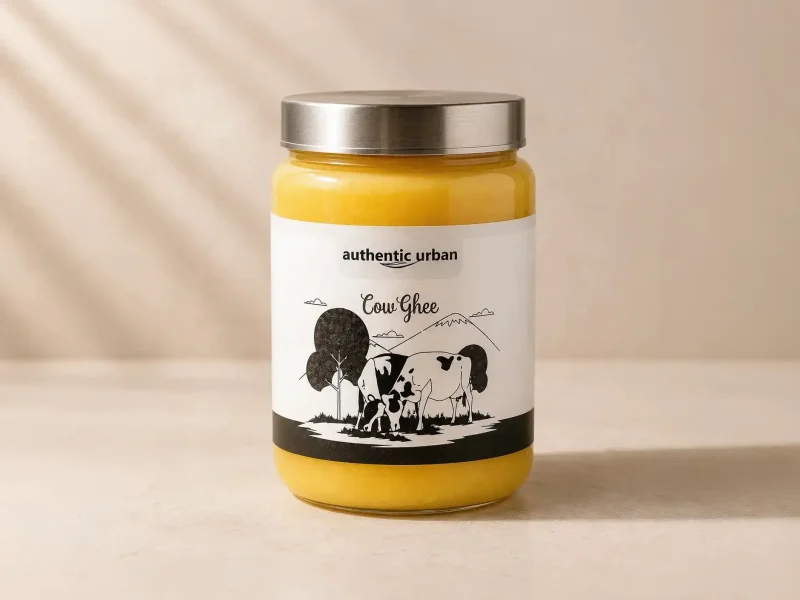
Most families use cow ghee for anything offered to Krishna, because he is Gopala, the cowherd, and cow ghee (gau ghrita) is what puja traditions ask for. That covers the panchamrit, the panjiri, and the diya. Cow ghee's lighter taste also lets the roasted coriander come through.
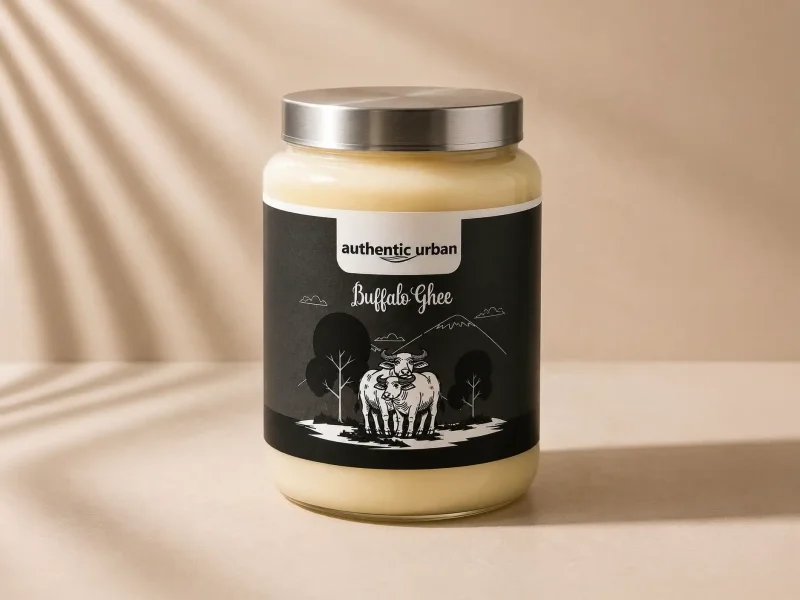
Buffalo ghee is richer and sets firmer, and it is the better fat for the family's festive cooking once the puja is done: the halwa, the puris, and the pedas you make for guests rather than for the thali. Both have about the same calories a spoon. The full comparison is on cow vs buffalo ghee.
Which ghee for Janmashtami prasad?
Prasad is eaten by everyone who comes to the door, so the ghee should be food ghee with one ingredient on the label and an FSSAI licence number, and it should smell of toasted milk when warmed. The home checks are on how to identify pure ghee, and our ranking of the cow ghee on sale is best cow ghee in India.
For Krishna's thali we would use our A2 Gir cow ghee, and for the pedas and halwa after, our Jafarabadi buffalo ghee. Both come from grass-fed village animals near the Gir forest, with no hormone injections. The milk is set to curd overnight and churned, and the makkhan is cooked in a matki on a wood chulha in Gir Somnath. Each jar is made after you order, and a video of it being cooked and packed comes on WhatsApp. We test every month against the FSSAI limits; the steps are on how we make ghee.
Panchamrit, panjiri, and the diya
 1 Litre
Peda, halwa, and the festive meal
 1 Litre
Each order is cooked after you place it, and the packing video is of that batch. Past order videos are on the shop.
FAQ
What is offered to Krishna at midnight on Janmashtami?
Most homes keep it simple: makhan mishri, dhaniya panjiri, panchamrit, a milk sweet such as peda or kheer, fruit, and tulsi leaves on every item. The murti is bathed in panchamrit at midnight, dressed, and then offered the bhog with a ghee diya aarti. Temples go further with chappan bhog, 56 dishes, but a home thali of four or five items is how most families mark the birth hour.
Why is dhaniya panjiri made for Janmashtami?
Many families keep the Janmashtami fast without grain, and dhaniya panjiri has no atta, rice, or besan in it. That makes it the prasad people can eat when the fast opens at midnight, and it keeps for weeks, so one batch serves the whole family and the neighbours. The coriander, roasted in ghee, is tradition passed down in North Indian homes, especially in Uttar Pradesh and Braj.
Can I use shop-bought butter for makhan mishri?
Yes, if you cannot churn at home. Buy unsalted white butter, since salt is kept out of Krishna's bhog in most homes, and yellow table butter is usually salted. Let it soften at room temperature before you mix in the mishri. Homemade makhan from malai is softer and tastes of fresh cream, which is why families who can churn still do it on the morning of Janmashtami.
What is chappan bhog, and do I need 56 dishes at home?
Chappan bhog is an offering of 56 dishes made in many Krishna temples, especially in Braj and at Govardhan puja. The popular story counts eight meals a day for the seven days Krishna held up Govardhan hill. At home no one expects 56 dishes. Families pick what they can cook well: makhan mishri, panjiri, panchamrit, a sweet, and fruit is a complete thali.
Can someone with diabetes eat Janmashtami prasad?
A spoon of prasad is usually fine, but the thali adds up. One spoon of the dhaniya panjiri on this page carries about 4 g of sugar, and a peda or a bowl of kheer carries far more. Take the prasad as a taste, not a meal, and eat it after a proper meal when the fast opens. Anyone on insulin or diabetes tablets should ask their doctor about fasting before the day.
Can I use the ghee left in the diya for cooking?
No. Ghee that has sat in a burning diya has been heated for hours, collected soot and wick ash, and often picked up dust. Throw it away or let it burn out. Keep two small bowls on the puja day: one for the diyas and one for cooking the prasad. If you bought a pack sold only for lamps, it stays with the lamps and never goes into prasad.
About the editorial team
Authentic Urban TeamBilona ghee makers, Gir Somnath, Gujarat
We are the Parmar family in Gir Somnath, Gujarat. We have made ghee here since 2016 and sold it online since 2025. We make only Bilona ghee, test it every month, and anyone is welcome to visit and watch it being made. Our Gir cows and Jafarabadi buffalo are grass-fed village animals that graze near the Gir forest, with no hormones or milk boosters. We set their milk to curd, churn it, and cook the makkhan on a wood chulha. These articles come from that kitchen and from what customers ask us on WhatsApp. We are ghee makers, not doctors.
Sources
- Spices, coriander seed (FDC ID 170922), SR Legacy, USDA FoodData Central. Checked 28 Sep 2026.
- Butter oil, anhydrous (FDC ID 173412), SR Legacy, USDA FoodData Central. Checked 28 Sep 2026.
- Sugars, granulated (FDC ID 169655), SR Legacy, USDA FoodData Central. Checked 28 Sep 2026.
- Nuts, almonds (FDC ID 170567), SR Legacy, USDA FoodData Central. Checked 28 Sep 2026.
- Nuts, cashew nuts, raw (FDC ID 170162), SR Legacy, USDA FoodData Central. Checked 28 Sep 2026.
- Nuts, coconut meat, dried (desiccated), not sweetened (FDC ID 170170), SR Legacy, USDA FoodData Central. Checked 28 Sep 2026.
- Foods to avoid giving babies and young children, NHS. Checked 28 Sep 2026.