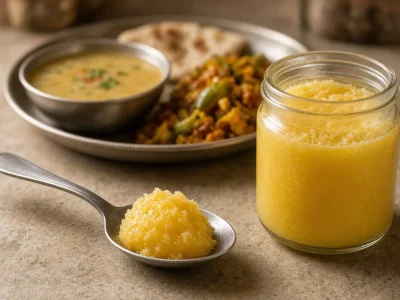
Is Ghee Good for High Blood Pressure? How Much a Day
Is ghee good for high blood pressure? It does not raise BP the way salt does: USDA lists ghee at just 2 mg of sodium per 100 g. But ghee is about 62% saturated fat, so with high BP keep it to about 1 teaspoon a day, never more than ICMR-NIN's 2, in place of oil, and cut the salt first. If your readings are not under control, your doctor sets the amount.
Does ghee increase blood pressure?
A teaspoon of ghee does not push blood pressure up. Ghee is milk fat with almost no sodium, and sodium is the part of food most tied to high BP. What can raise BP over months is too much ghee: extra calories add weight, and ICMR-NIN's 2024 guidelines name obesity as a risk for hypertension.
So the answer depends on the amount and on what sits next to the ghee. One spoon on plain dal-rice is a different meal from ghee on a salted paratha with achaar and papad. This page is for adults with high BP, or BP in the family, who want to keep ghee in the kitchen. Cholesterol is a separate report and a separate question, answered on is ghee bad for cholesterol.
How much sodium is in ghee?
Almost none. USDA FoodData Central lists ghee (butter oil) at 2 mg of sodium per 100 g, so two teaspoons carry about 0.2 mg. Salted butter carries 643 mg per 100 g, about 64 mg in the same two teaspoons. A single gram of salt, a small pinch, carries 400 mg, because ICMR-NIN puts salt at 40% sodium.
USDA FoodData Central, SR Legacy: butter oil, anhydrous (173412); butter, without salt (173430); butter, salted (173410). Salt is 40% sodium (ICMR-NIN 2024). Teaspoon 5 g. Ghee rounds to 0 mg (0.2 mg). Checked 26 September 2026.
| Item | Value |
|---|---|
| 2 tsp ghee (10 g) | 0 mg |
| 2 tsp unsalted butter (10 g) | 1 mg |
| 2 tsp salted butter (10 g) | 64 mg |
| A pinch of salt (1 g) | 400 mg |
That is why the ghee on your roti is not where BP salt comes from. ICMR-NIN's 2024 guidelines say food itself gives only 300 to 400 mg of sodium a day, and most of the rest comes from salt added in cooking or in processed food. Ghee we make at home is only cooked makkhan, with nothing added. A jar that lists salt, colour, or flavour on the label is not plain ghee. The full nutrition label is on ghee nutrition facts, and how ghee and butter differ is on ghee vs butter.
Is ghee good for high blood pressure, or is oil better?
For most of the day's cooking, a plant oil is the better base with high BP, and ghee is best kept for the spoon you taste. Neither has salt. The difference is saturated fat: USDA lists ghee at 61.9 g per 100 g, about 3 g in one teaspoon.
The WHO's 2025 hypertension fact sheet tells people to avoid foods high in saturated or trans fats. The US DASH eating plan, built to lower blood pressure, limits full-fat dairy and tropical oils like coconut and palm, and uses vegetable oils instead. Neither bans a small spoon of ghee, but both point the bulk of your fat toward oil. Which oil for which job, and how to split the day's fat between ghee and oil, is on ghee vs vegetable oil. Avoid vanaspati: it is the trans fat the WHO warns about.
How much ghee can a BP patient eat a day?
About 1 teaspoon (5 g) a day if your BP is high but controlled, and never more than ICMR-NIN's limit of 1 to 2 teaspoons, which applies to everyone. If readings stay high, or you also have kidney disease or heart failure, your doctor or dietitian sets the number, and it may be less.
Your situation
Ghee a day
What that means
Normal BP, or BP runs in the family
1 to 2 tsp a day
The ICMR-NIN limit for everyone. Each spoon of ghee takes a spoon of oil out.
High BP, controlled on medicine
1 tsp a day
Salt is the bigger job. Keep measuring BP at home and show the log to your doctor.
Readings still high (home 135/85 or more)
Half to 1 tsp, doctor decides
Fix salt, weight, and medicine first. More ghee does not bring BP down.
BP with kidney disease, heart failure, or after a stroke
Doctor or dietitian sets it
Salt, fluid, and fat are often all fixed by the diet sheet.
High BP in pregnancy
Obstetrician sets it
Needs regular checks. Do not change food or medicine on your own.
Daily ghee limit from ICMR-NIN, Dietary Guidelines for Indians 2024. Home reading cut-off from the NHS. Checked 26 September 2026. Your doctor may give you a different number.
What counts as high? The WHO diagnoses hypertension when readings on two different days are 140/90 or more. For readings taken at home, the NHS uses a lower line: 135/85 or more. If your home log sits above that line, the ghee spoon is the last thing to adjust.
Ghee is also only part of the day's fat. ICMR-NIN puts all visible fat, ghee and oil together, at 20 g a day for a sedentary woman and 30 g for a sedentary man. One teaspoon of ghee is 5 g of that. You can work out your home's daily ghee and oil for each person in the family, and plans for other situations are on how much ghee per day.
In our own home in Gir Somnath, each of us eats 1 to 2 teaspoons a day, on roti, dal, and khichdi, with more only in winter sweets like adadiya pak and gond. We make ghee for a living, and that is still our daily amount. One of the questions we get most on WhatsApp is some version of "my father has BP, can he still have ghee?" Our answer is the table above, and his doctor's number wins.
What should you eat ghee with if you have high BP?
Eat it on home food where the salt is already counted: dal-rice, khichdi, plain roti, and sabzi. The problem plates are the salty ones, and on those the fix is to remove the salty side, not the ghee. ICMR-NIN's 2024 guidelines cap added salt at 5 g a day, about one level teaspoon, and note that about 45% of Indians eat more than that.
On the plate
With high BP
Why
Dal-rice or khichdi with 1 tsp ghee on top
Fits
The ghee adds taste without salt. Salt only in the dal, none sprinkled on top.
Plain roti with half a teaspoon of ghee and sabzi
Fits
A thin coat is enough. The sabzi brings potassium.
Paratha with salted butter and achaar
Cut the salt
Salted butter and pickle both carry salt. Swap the butter for a little ghee and drop the achaar.
Ghee dal with papad and namkeen on the side
Cut the salt
ICMR-NIN lists papads and snack foods among the high-salt foods. The ghee is not the problem here.
Halwa, ladoo, or gond pak
Festive days only
No salt, but a lot of fat and sugar. Extra weight raises BP over time.
Bakery biscuits or khari with tea
Cut the salt
Baking soda and baking powder add sodium, per ICMR-NIN, even when the biscuit tastes sweet.
ICMR-NIN's list of high-salt foods is worth reading once: snack foods and savouries, soups, sauces and ketchup, salted butter, cheese, canned food, papads, salted dry fish, salted nuts, and preserved meat or vegetables. Most Indian kitchens with a BP patient still have three or four of these on the shelf. Take them out before you take out the ghee. When in the day to eat your spoon is covered on the best time to eat ghee.
What lowers blood pressure more than cutting ghee?
Cutting salt does the most. ICMR-NIN's 2024 guidelines say high blood pressure is uncommon in populations eating less than 3 g of salt a day, and that restricting salt lowers the risk of hypertension. The NHLBI's DASH plan found that 1,500 mg of sodium a day lowers BP further than 2,300 mg.
- Salt: 5 g a day at most, for everything added. Taste the dal before salting at the table.
- Potassium: about 400 g of vegetables and 100 g of fruit a day, per ICMR-NIN. Potassium helps the body excrete sodium. If you have kidney disease, ask your doctor first.
- Weight: ICMR-NIN names obesity as a risk for hypertension, so staying at a healthy weight matters. Calories from ghee count here, which is why ghee and weight loss is worth a read.
- Alcohol: ICMR-NIN says more than two measures a day raises the risk of hypertension and stroke.
- Movement: the NHS suggests at least 150 minutes of exercise a week. Ask your doctor before you start anything vigorous.
- Medicine: taken every day as prescribed, even when readings look good.
None of these involve ghee, and that is the point. A family that fixes the salt and keeps one measured spoon of ghee is in a better place than one that drops the ghee and keeps the achaar. The wider verdict on ghee as a daily fat is on is ghee healthy.
Can you eat ghee with BP medicine?
For most people, yes, within the one teaspoon a day. Ghee is a food, not a supplement or a remedy. Tell your doctor what you eat anyway, and never stop, skip, or reduce a medicine because your diet feels healthier.
Some situations change the answer. With kidney disease, the doctor often sets salt, potassium, fluid, and fat together; the kidney side is on ghee and kidney health. After a heart attack, a stroke, or with heart failure, follow the hospital's diet sheet. High BP in pregnancy needs the obstetrician, and ghee in pregnancy in general is on ghee during pregnancy. Other conditions where the doctor sets the fat are under who should not eat ghee.
Signs that are not a diet question
The WHO says very high blood pressure, usually 180/120 or more, can cause severe headache, chest pain, dizziness, difficulty breathing, nausea, vomiting, and blurred vision. The NHS adds chest pain that spreads to the arm, neck, jaw, or back, with sweating or breathlessness. Get emergency help for any of these. Do not wait to see if a change of diet helps.
A 7-point ghee checklist for high blood pressure
If someone at home has high BP, this is the routine that holds up. Screenshot it for the kitchen.
- Measure ghee with a real teaspoon: 1 a day with high BP, 2 at most.
- Count ghee and oil together. One spoon of ghee in means one spoon of oil out.
- Keep all added salt to 5 g a day, one level teaspoon, for the whole family plate.
- Put the ghee where you taste it, on dal or roti, and use it to cut the salt, not add to it.
- Drop the salty sides first: achaar, papad, namkeen, salted butter, packet soups.
- Check BP at home at the same time of day, and write the numbers down.
- Take your BP medicine as prescribed. Never swap a tablet for a food.
Which ghee if you have high BP?
With one teaspoon a day, the spoon should be plain ghee and nothing else. Read the label for salt, colour, or flavour, warm a little to check it smells of toasted milk, and expect slow curd-churned ghee to set grainy. How curd Bilona (curd churned by hand) differs from cream ghee is on the Bilona method, and our ranking of the cow ghee on sale is best cow ghee in India. No ghee lowers BP; the amount and the salt beside it are what count.
We make and sell ghee, so weigh this with that in mind. For the measured daily spoon we would pick our own A2 Gir cow ghee: grass-fed Gir milk set to curd overnight, churned, and cooked in a matki on a wood chulha, with nothing added, made after you order, with a video of your jar sent on WhatsApp. At ₹2,399 a litre, a 5 ml teaspoon costs about ₹12. For the few days of halwa and ladoo, our Jafarabadi buffalo ghee is the richer jar. Varsha tastes every batch before it is packed, and we test every month against the FSSAI limits; the steps are on how we make ghee.
The one measured daily teaspoon
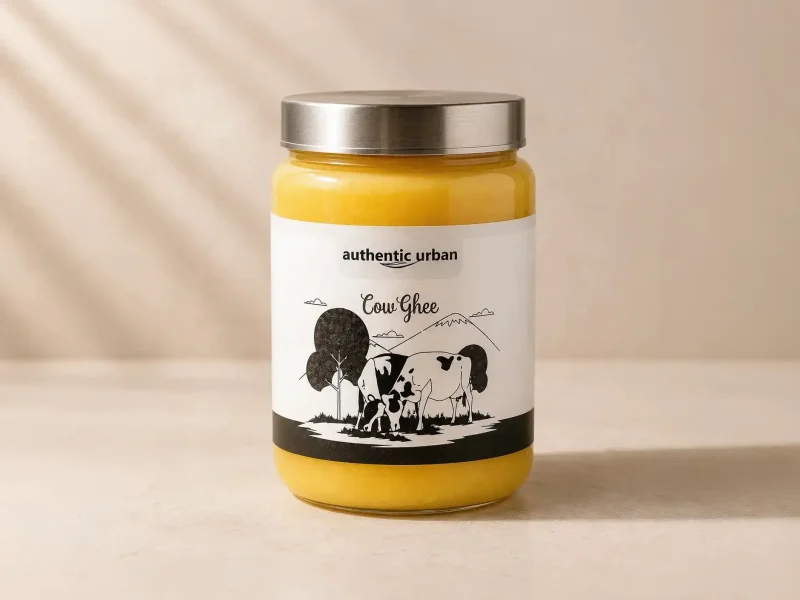 1 Litre
Festive sweets, on fewer days
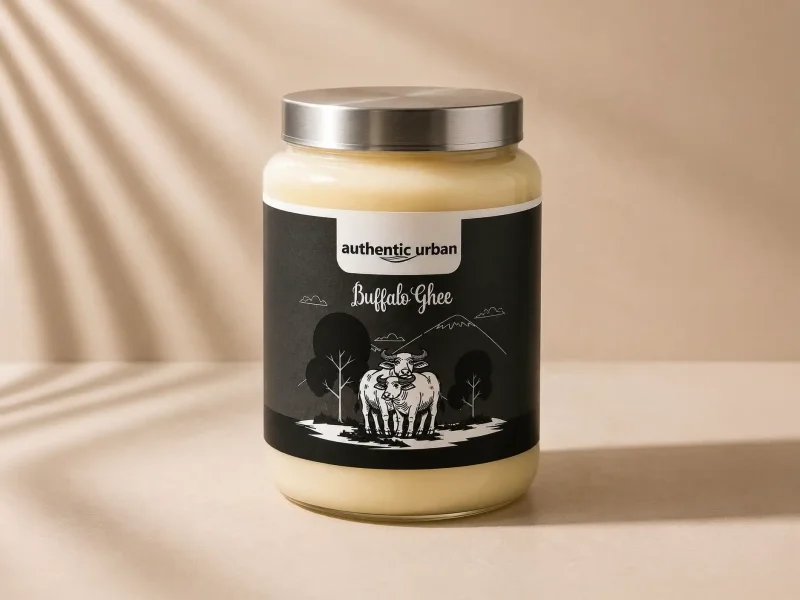 1 Litre
Each order is cooked after you place it, and the packing video is of that batch. Past order videos are on the shop.
FAQ
Is ghee good for low blood pressure?
Ghee does not raise low blood pressure, just as it does not lower high blood pressure. It has almost no sodium, so it does nothing for BP either way. If your BP runs low and you feel dizzy, faint, or tired, see a doctor to find the cause. They may advise more fluids or more salt for your case. That is their call, not a job for ghee.
Can a BP patient drink milk with ghee at night?
A cup of milk with half a teaspoon of ghee is usually fine with high blood pressure, as long as that ghee counts toward your one teaspoon for the day. Milk itself brings potassium and very little salt. Skip it if your doctor has limited your fluids, or if a warm fatty drink at bedtime gives you acidity. Do not add sugar and biscuits alongside it.
Is cow ghee or buffalo ghee better for high blood pressure?
Neither lowers BP, and both have almost no sodium. Both are nearly pure milk fat, so the saturated fat per teaspoon is close. Choose by the dish. Cow ghee is lighter, which suits the daily spoon on dal or roti. Buffalo ghee is richer and firmer, which suits festive sweets. With high BP, measure whichever you use and stay at about one teaspoon a day.
Does A2 ghee lower blood pressure?
No study we could find shows A2 ghee lowering blood pressure in people. A2 describes a milk protein (beta-casein) from desi breeds like Gir, and ghee is almost pure fat, with only a trace of protein left. People buy A2 Bilona ghee for its taste, the breed, and how it is made. For BP, the amount you eat matters, and the salt on your plate matters far more.
Is sendha namak or black salt with ghee safer for BP?
No. ICMR-NIN's 2024 guidelines say pink salt (sendha namak) and black salt (kala namak) have almost the same sodium as regular salt, so all of them count toward the 5 g a day limit. Switching salt type while keeping the same amount does not help BP. Use less salt of any kind, and keep using iodized salt for everyday cooking.
Can a teaspoon of ghee help me eat less salt?
It can help, as a kitchen trick. A teaspoon of ghee on hot dal, khichdi, or sabzi, with jeera or hing crackled in it, gives so much flavour that many people stop reaching for extra salt or achaar. That is where ghee earns its place on a BP plate. It only works if the ghee replaces salt and oil, and does not come on top of them.
About the editorial team
Authentic Urban TeamBilona ghee makers, Gir Somnath, Gujarat
We are the Parmar family in Gir Somnath, Gujarat. We have made ghee here since 2016 and sold it online since 2025. We make only Bilona ghee, test it every month, and anyone is welcome to visit and watch it being made. Our Gir cows and Jafarabadi buffalo are grass-fed village animals that graze near the Gir forest, with no hormones or milk boosters. We set their milk to curd, churn it, and cook the makkhan on a wood chulha. These articles come from that kitchen and from what customers ask us on WhatsApp. We are ghee makers, not doctors.
Sources
- Dietary Guidelines for Indians, 2024 (visible fat and ghee, printed p. 54; obesity, p. 64; Guideline 11, restrict salt intake, pp. 73-76; alcohol, p. 91), ICMR-National Institute of Nutrition. Checked 26 Sep 2026.
- Butter oil, anhydrous (FDC ID 173412), SR Legacy, USDA FoodData Central. Checked 26 Sep 2026.
- Butter, salted (FDC ID 173410), SR Legacy, USDA FoodData Central. Checked 26 Sep 2026.
- Butter, without salt (FDC ID 173430), SR Legacy, USDA FoodData Central. Checked 26 Sep 2026.
- Hypertension (fact sheet, 25 September 2025), World Health Organization. Checked 26 Sep 2026.
- High blood pressure (hypertension), NHS. Checked 26 Sep 2026.
- DASH Eating Plan (updated 25 February 2026), National Heart, Lung, and Blood Institute, NIH. Checked 26 Sep 2026.