Is Ghee Bad for Cholesterol and the Heart? How Much a Day
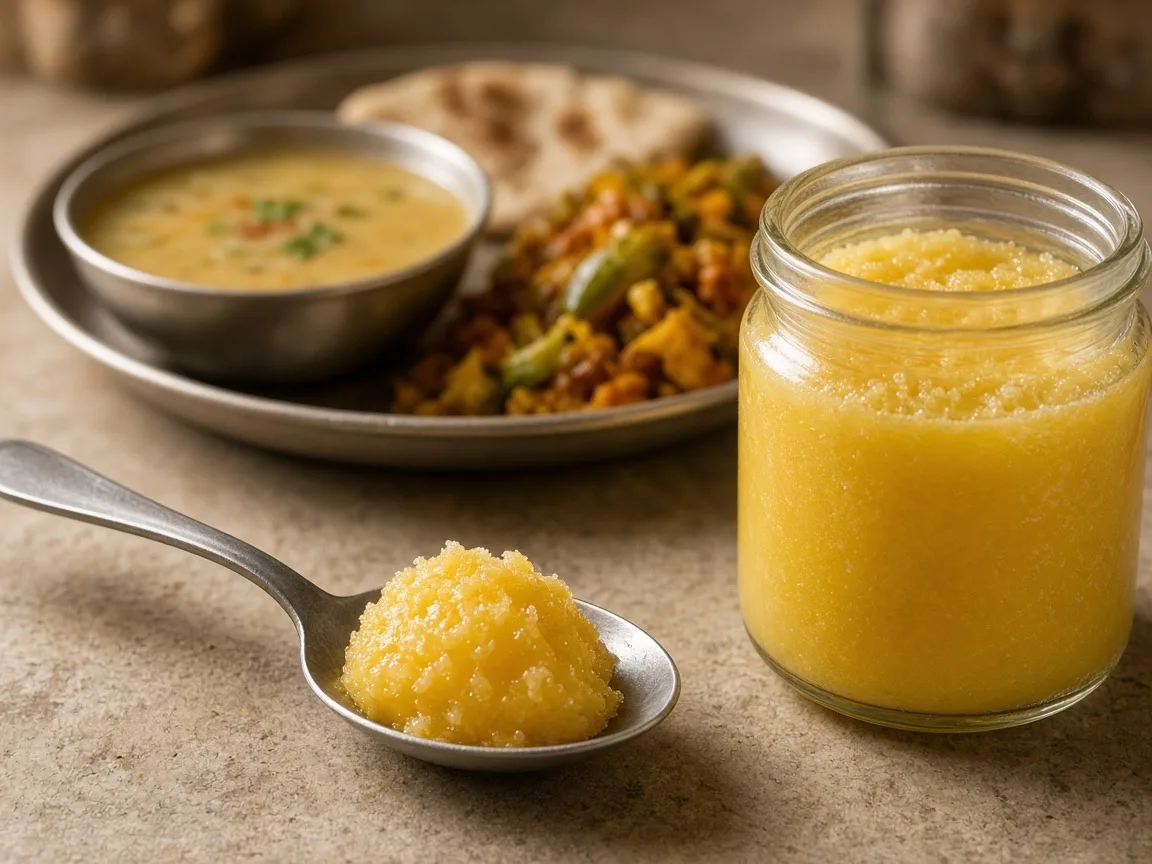
Is ghee bad for cholesterol? In large amounts, yes: ghee is about 62% saturated fat, and ICMR-NIN's 2024 guidelines say saturated fat raises total and LDL cholesterol. At 1 to 2 teaspoons a day, eaten in place of other fat, most healthy adults stay under the guideline's limit. With high LDL or heart disease, your doctor sets the amount, and it may be none.
Is ghee bad for cholesterol?
Ghee is bad for cholesterol when you eat a lot of it. Its saturated fat raises LDL, the cholesterol that builds up in arteries. One or two teaspoons a day, the amount ICMR-NIN advises, keeps you well under the saturated-fat line for a normal diet. The bigger risk is ghee added on top of butter, oil, and fried snacks.
People react differently. Some see LDL climb on a daily tablespoon; others barely move. That is why the same spoon can be fine for one person in the family and wrong for another, and why the lipid report, not a blog, decides your number. This page is for adults with a cholesterol report in hand, and for anyone with heart disease in the family. The wider question of whether ghee is a good fat at all is answered on is ghee healthy.
How much cholesterol is in ghee?
A teaspoon of ghee has about 13 mg of cholesterol and a tablespoon about 33 mg, going by USDA FoodData Central's 256 mg per 100 g. One large egg has about 186 mg, so the egg carries as much cholesterol as some 14 teaspoons of ghee.
USDA FoodData Central, SR Legacy: butter oil, anhydrous (173412); butter, without salt (173430); egg, whole, raw (171287). Teaspoon 5 g (ICMR-NIN). Checked 26 September 2026.
| Item | Value |
|---|---|
| 1 teaspoon ghee (5 g) | 13 mg |
| 1 tablespoon ghee (12.8 g) | 33 mg |
| 1 tablespoon butter (14.2 g) | 31 mg |
| 1 large egg (50 g) | 186 mg |
So the cholesterol inside the ghee is not the main problem. ICMR-NIN's 2024 guidelines explain why: the liver makes cholesterol itself, making more when the diet brings little and slowing down when the diet brings more. What moves blood LDL more is saturated fat, and that is where ghee is heavy. The full label, vitamins included, is on ghee nutrition facts.
Does ghee increase LDL cholesterol?
It can. ICMR-NIN's 2024 guidelines say saturated fatty acids increase total and LDL cholesterol and raise the risk of heart attack and stroke, and USDA lists ghee at 61.9 g of saturated fat per 100 g. A tablespoon of ghee carries about 8 g of saturated fat; a tablespoon of groundnut oil carries about 2 g.
Fat (1 tbsp)
Saturated fat
Cholesterol
Ghee (12.8 g)
7.9 g
33 mg
Butter (14.2 g)
7.2 g
31 mg
Coconut oil (13.6 g)
11.2 g
0 mg
Groundnut oil (13.5 g)
2.3 g
0 mg
Mustard oil (14 g)
1.6 g
0 mg
Sunflower oil (13.6 g)
1.4 g
0 mg
Worked out from USDA FoodData Central, SR Legacy, per 100 g, using each food's own tablespoon weight. Plant oils have no cholesterol (ICMR-NIN 2024). Checked 26 September 2026.
ICMR-NIN treats saturated fat as high when more than 10 g a day comes from visible fat like ghee and butter on a 2,000 kcal diet, or when it passes 5% of the day's calories. For ghee alone, 10 g of saturated fat is a little over 3 teaspoons. The WHO's looser line is under 10% of calories. Butter sits close to ghee, so switching one for the other changes little; the comparison is on ghee vs butter. Coconut oil is higher still, which is why ghee vs coconut oil is closer than people expect.
Does ghee raise HDL, the good cholesterol?
Several pages that rank for this question say ghee raises HDL and that this cancels the LDL rise. We could not find a guideline that says so. ICMR-NIN's 2024 guidelines say HDL carries extra cholesterol back to the liver, and that a balanced diet and physical activity improve HDL and lower LDL. They do not name ghee as an HDL food.
A higher HDL also does not cancel a high LDL; doctors look at both. If your HDL is low, the things that usually help are walking, weight, and stopping smoking, not a bigger spoon. Where too much ghee leads in the rest of the body is on ghee side effects.
How much ghee a day if you have high cholesterol?
With a normal lipid report, 1 to 2 teaspoons a day, which is ICMR-NIN's limit for everyone. With high LDL, start at 1 teaspoon or less and let your doctor set the number. After a heart attack or with familial hypercholesterolemia (very high cholesterol that runs in families), the cardiologist decides, and it may be none.
Your situation
Ghee a day
What that means
Normal lipid report, no heart disease
1 to 2 tsp a day
The ICMR-NIN limit for everyone. Take a spoon of oil out for each spoon of ghee.
LDL a little high, first time
1 tsp a day, or less
Cut fried snacks, biscuits, and sweets first. Recheck when your doctor says.
High LDL on medicine, or diabetes with high triglycerides
Doctor or dietitian sets it
Often half a teaspoon to 1 teaspoon inside a fixed fat budget.
Heart attack, stent, bypass, or familial hypercholesterolemia
Cardiologist sets it
May be none. Follow the discharge diet sheet, not a kitchen habit.
Ghee is only part of the day's fat. ICMR-NIN puts all visible fat, ghee and oil together, at 20 g a day for a sedentary woman and 30 g for a sedentary man. Two teaspoons of ghee is 10 g of that, which leaves the rest for oil in the sabzi. You can work out your home's daily ghee and oil for each person in the family, and plans for other situations are on how much ghee per day.
In our own home in Gir Somnath, each of us eats 1 to 2 teaspoons a day, on roti, dal, and khichdi. We eat more only in winter sweets like adadiya pak and gond, and those are a few weeks, not the whole year. We make ghee for a living, and that is still our daily amount.
Is ghee good or bad for the heart?
Ghee is not a heart food, and a small spoon is not a heart danger for most healthy adults. The risk comes through LDL: more saturated fat, more LDL, and ICMR-NIN links that to heart attack and stroke. Nothing in ghee clears arteries, whatever a jar label says.
Ghee for heart patients
For heart patients the answer changes. After a heart attack, a stent, or bypass surgery, the hospital diet sheet sets the fat, and it may allow very little added saturated fat. If you take a statin or blood thinner, do not change your fats without asking; never swap a medicine for a food. Blood pressure is its own question, answered on ghee for blood pressure, and diabetes with high triglycerides on can diabetics eat ghee. Other conditions where the doctor sets the fat are listed under who should not eat ghee.
Signs that are not a diet question
Get help at once, not after changing your diet, for chest pain or pressure, pain spreading to the arm, jaw, or back, sudden breathlessness, or cold sweat.
Ghee, butter, or oil: which is better for cholesterol?
For most of the day's cooking, a plant oil is better for cholesterol, because it carries far less saturated fat and no cholesterol at all. Keep ghee for the spoon you actually taste. ICMR-NIN's 2024 guidelines also note that a "no cholesterol" oil is still 100% fat, so oil needs a limit too.
Kitchen job
Use
Why
A spoon on hot dal, khichdi, or roti
Ghee, 1 teaspoon
You taste it, so a small amount is enough.
Sabzi, curry base, and most daily cooking
Groundnut, mustard, or sesame oil, rotated
This is most of the day's fat. Keep saturated fat low here.
Deep-fried puri, pakora, samosa
Fry less often
ICMR-NIN counts deep-fried food as high-fat food, whatever the fat.
Paratha, halwa, ladoo
Ghee, measured, on fewer days
These dishes carry the most ghee in an Indian week.
Anything that asks for vanaspati or Dalda
Oil or a little ghee instead
ICMR-NIN says trans fats should be avoided.
ICMR-NIN also names a few oils with minor components that reduce blood cholesterol: lignans in sesame oil, and oryzanol and tocotrienols in rice bran oil (the trials are in ghee vs rice bran oil). Rotating those with groundnut or mustard oil is a better use of your fat budget than a second spoon of ghee. The full oil comparison is on ghee vs vegetable oil.
How do you read your cholesterol report?
Look at LDL first: for adults, MedlinePlus (US National Library of Medicine) gives a healthy LDL as less than 100 mg/dL. It is the number most likely to move when you change how much ghee and other saturated fat you eat. Your doctor may set a lower target if you have diabetes or heart disease.
On the report
Healthy level (adults)
What ghee has to do with it
LDL cholesterol
Less than 100 mg/dL
The number saturated fat pushes up. Watch this one when you change your ghee.
HDL cholesterol
60 mg/dL or more is best; low below 40 (men) or 50 (women)
Moves with activity and weight far more than with any one fat.
Non-HDL cholesterol
Less than 130 mg/dL
Total minus HDL. Many doctors read this alongside LDL.
Total cholesterol
Less than 200 mg/dL
Too broad on its own to judge a change in your spoon.
Triglycerides
Your report and doctor give the range
Often follows sugar, refined flour, alcohol, and total calories.
Healthy levels for adults 20 and older from MedlinePlus, Cholesterol Levels. Checked 26 September 2026. Your doctor may use different targets for you.
What lowers cholesterol more than cutting ghee?
Cutting the hidden saturated fat usually does more than cutting the one teaspoon on dal. ICMR-NIN's 2024 guidelines list the big sources: deep-fried food like puri, samosa, and kachori, biscuits, cakes, and bakery food, full-cream dairy and cheese, red meat, and palm, coconut, or vanaspati used in snacks and sweets.
The same guidelines say a balanced diet and physical activity improve HDL and lower LDL. In a normal Indian week that means more dal, beans, vegetables, and whole grains, fewer fried and bakery snacks, a daily walk, and any medicine your doctor prescribes. Vanaspati deserves its own mention: its trans fat is worse for your lipid profile than ghee, as Dalda vs ghee explains.
A 7-point ghee checklist for cholesterol
If you keep ghee with a cholesterol report on the fridge, this is the routine that holds up. Screenshot it for the kitchen.
- Measure ghee with a real teaspoon for two weeks. A kadhai hides a tablespoon.
- Keep ghee to 1 to 2 teaspoons a day unless your doctor gives a smaller number.
- Count ghee, butter, and oil together. Every spoon of ghee takes a spoon of oil out.
- Put the ghee on dal, roti, or khichdi, where you taste it, not into fried snacks.
- Cut the hidden saturated fat first: biscuits, bakery food, fried namkeen, full-cream sweets.
- Get a lipid profile before you change your spoon, and again when your doctor says.
- On a statin or after a heart event: show your doctor this list and use their number.
Which ghee if your doctor allows a spoon?
When you only get a teaspoon or two a day, each spoon should be good ghee. Warm a little before you trust a new jar: it should smell of toasted milk, and slow curd-churned ghee often sets grainy when cool. How curd Bilona (curd churned by hand) differs from cream ghee is on the Bilona method, and our ranking of the cow ghee on sale is best cow ghee in India. No ghee is better for cholesterol than another; the amount is what counts.
We make and sell ghee, so weigh this with that in mind. For the measured daily spoon we would pick our own A2 Gir cow ghee: grass-fed Gir milk set to curd overnight, churned, and cooked in a matki on a wood chulha, made after you order, with a video of your jar sent on WhatsApp. At ₹2,399 a litre, a 5 ml teaspoon costs about ₹12. For the few days of halwa and ladoo, our Jafarabadi buffalo ghee is the richer jar. Varsha tastes every batch before it is packed, and we test every month against the FSSAI limits; the steps are on how we make ghee.
The measured daily teaspoon
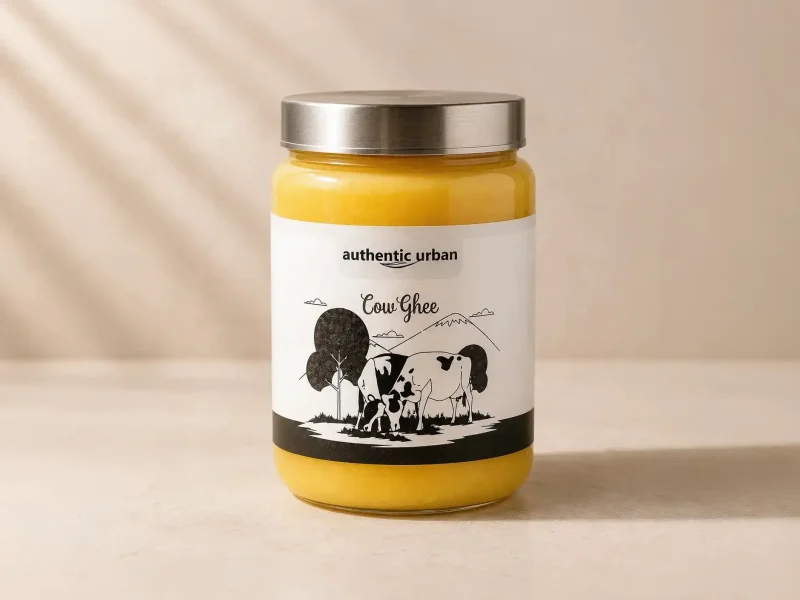 1 Litre
Festive sweets, on fewer days
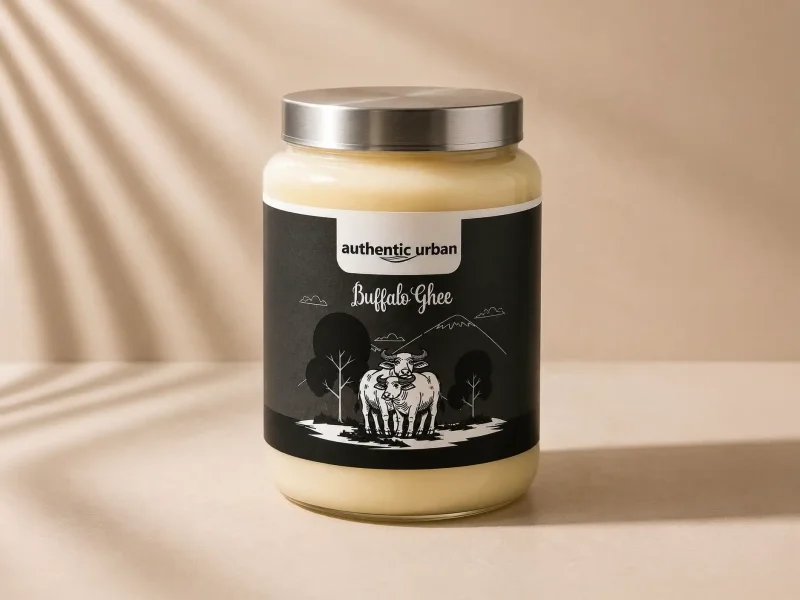 1 Litre
Each order is cooked after you place it, and the packing video is of that batch. Past order videos are on the shop.
FAQ
Is cow ghee or buffalo ghee better for cholesterol?
Neither is a cholesterol food. Both are nearly pure milk fat, so a teaspoon of either brings a similar load of saturated fat and a similar small amount of cholesterol. What changes your lipid report is how many spoons you eat and what else is on the plate. Pick by the dish: cow ghee for the daily spoon on dal, buffalo ghee for sweets and paratha, both measured.
Is A2 ghee better for cholesterol than regular ghee?
No. A2 refers to a milk protein (beta-casein) from desi breeds like Gir, and ghee is almost pure fat with only a trace of protein left. We could not find a study showing A2 ghee acts differently on LDL or HDL. People choose A2 Bilona ghee for taste, the breed, and how it is made. For cholesterol, treat any ghee the same: 1 to 2 teaspoons a day at most.
Can I eat ghee if I take a statin?
Many people on a statin still eat a small spoon of ghee, but that is your doctor's call, not ours. A statin lowers LDL; eating more saturated fat pushes the other way, so it makes no sense to add ghee because the tablet is working. Ask your doctor for a daily fat number, keep ghee inside it, and never stop or change a medicine because of a food.
Should I stop eating ghee before a cholesterol test?
No. Eat the way you normally eat in the weeks before the test, so the report shows your real diet. Cutting ghee for three days will not change LDL much and hides what your usual plate does. Follow the fasting instructions your lab or doctor gives, often 9 to 12 hours with only water, and ask whether your test needs fasting at all.
Is Dalda or vanaspati worse than ghee for cholesterol?
Vanaspati is the one to drop first. It is hydrogenated vegetable fat, and ICMR-NIN's 2024 guidelines say trans fats alter the blood lipid profile and should be avoided. Ghee carries saturated fat, which also raises LDL, so it still needs a limit. If a recipe asks for Dalda, use a little ghee or oil instead, and keep the total fat for the day inside your limit.
Does ghee lower cholesterol, as some posts say?
We found no guideline that says ghee lowers blood cholesterol in people. ICMR-NIN's 2024 guidelines put ghee among the saturated fats and say saturated fats raise total and LDL cholesterol. Some animal studies and small trials are quoted online, but that is not advice you can act on. If your LDL came down after you changed your diet, credit the whole plate, not the ghee.
About the editorial team
Authentic Urban TeamBilona ghee makers, Gir Somnath, Gujarat
We are the Parmar family in Gir Somnath, Gujarat. We have made ghee here since 2016 and sold it online since 2025. We make only Bilona ghee, test it every month, and anyone is welcome to visit and watch it being made. Our Gir cows and Jafarabadi buffalo are grass-fed village animals that graze near the Gir forest, with no hormones or milk boosters. We set their milk to curd, churn it, and cook the makkhan on a wood chulha. These articles come from that kitchen and from what customers ask us on WhatsApp. We are ghee makers, not doctors.
Sources
- Dietary Guidelines for Indians, 2024 (Guideline 7, printed pp. 51-54; saturated fat and high-fat diet, printed p. 93; oil label claims, printed p. 109), ICMR-National Institute of Nutrition. Checked 26 Sep 2026.
- Butter oil, anhydrous (FDC ID 173412), SR Legacy, USDA FoodData Central. Checked 26 Sep 2026.
- Butter, without salt (FDC ID 173430), SR Legacy, USDA FoodData Central. Checked 26 Sep 2026.
- Egg, whole, raw, fresh (FDC ID 171287), SR Legacy, USDA FoodData Central. Checked 26 Sep 2026.
- Oil, coconut (FDC ID 171412), SR Legacy, USDA FoodData Central. Checked 26 Sep 2026.
- Oil, peanut, salad or cooking (FDC ID 171410), SR Legacy, USDA FoodData Central. Checked 26 Sep 2026.
- Oil, mustard (FDC ID 172337), SR Legacy, USDA FoodData Central. Checked 26 Sep 2026.
- Oil, sunflower, linoleic (approx. 65%) (FDC ID 171025), SR Legacy, USDA FoodData Central. Checked 26 Sep 2026.
- Healthy diet (fact sheet, 26 January 2026), World Health Organization. Checked 26 Sep 2026.
- Cholesterol Levels, MedlinePlus, U.S. National Library of Medicine. Checked 26 Sep 2026.