Does Ghee Have Trans Fat? How Much per Spoon, Is It Bad?
Does ghee have trans fat? Yes: about 170 to 390 mg in a teaspoon, formed naturally in the cow's or buffalo's stomach, not in a factory. At the 1 to 2 teaspoons a day that ICMR-NIN suggests, that is 8 to 35% of WHO's daily limit. WHO counts natural and factory trans fat as equally harmful, so the fix is the same for both: keep ghee to the spoon, and cut vanaspati, which you can drop entirely.
Does ghee have trans fat?
Yes. Pure ghee carries about 3.5 to 7.7 g of trans fat per 100 g, which is 170 to 390 mg in a 5 g teaspoon. Nobody adds it. Bacteria in the rumen, the first stomach of cows and buffalo, turn some of the grass fats into trans fats, and those pass into the milk, the butter, and the ghee.
The range is wide because studies count different things. A 2020 study in Food Science and Technology that made cow and buffalo ghee in a dairy lab found about 3.5 g per 100 g of fat. A 2018 study in Food Quality and Safety that tested milk fat bought in Indian markets, counting ten kinds of trans fat, found 7.1 to 7.7 g. This page is for anyone who read "trans fat" beside the word ghee and wants to know if the jar in the kitchen is a problem. The full nutrition label, spoon by spoon, is on ghee nutrition facts.
How much trans fat is in a teaspoon of ghee?
About 170 to 390 mg, more than butter or legal vanaspati per spoon. That surprises people, so here are the numbers side by side, per 5 g teaspoon, from the studies we could open and check.
Pena-Serna 2020; Khan 2018; USDA FoodData Central 173430; FSSAI Chapter 2.2 (2.2.6); Mohammadi-Nasrabadi 2024. Checked 27 September 2026.
| Item | Value |
|---|---|
| Cow ghee, made in a lab dairy (2020 study) | 180 mg |
| Buffalo ghee, same study | 170 mg |
| Cow milk fat bought in Indian markets | 390 mg |
| Buffalo milk fat bought in Indian markets | 360 mg |
| Same cow milk fat after 5 hours at 160 to 170°C | 410 mg |
| Unsalted butter | 150 mg |
| Vanaspati at the FSSAI legal maximum | 100 mg |
| Margarine from Tehran shops (2024 study) | 40 mg |
Fat
Per 100 g
Per tsp
Source
Cow ghee, made in a lab dairy (2020 study)
Per 100 g: 3.6 g
Per tsp: 180 mg
Pena-Serna 2020, CLA included
Buffalo ghee, same study
Per 100 g: 3.5 g
Per tsp: 170 mg
Pena-Serna 2020, CLA included
Cow milk fat bought in Indian markets
Per 100 g: 7.7 g
Per tsp: 390 mg
Khan 2018, ten trans isomers counted
Buffalo milk fat bought in Indian markets
Per 100 g: 7.1 g
Per tsp: 360 mg
Khan 2018
Same cow milk fat after 5 hours at 160 to 170°C
Per 100 g: 8.25 g
Per tsp: 410 mg
Khan 2018
Unsalted butter
Per 100 g: 3.0 g
Per tsp: 150 mg
USDA FoodData Central, per 100 g butter
Vanaspati at the FSSAI legal maximum
Per 100 g: 2 g
Per tsp: 100 mg
FSSAI 2.2.6, a ceiling, not a test
Margarine from Tehran shops (2024 study)
Per 100 g: 0.83 g
Per tsp: 40 mg
Mohammadi-Nasrabadi 2024
A teaspoon is 5 g, as ICMR-NIN counts it. Ghee and margarine rows are per 100 g of fat; butter is per 100 g of butter (about 81% fat). The vanaspati row is the most the law allows, not a measured tin.
Two rows need a word. Legal vanaspati now carries less trans fat per spoon than ghee, because FSSAI capped it at 2% by weight from 1 January 2022. That does not make vanaspati the better fat: its trans fat is the factory kind, the cap is a ceiling, and ICMR-NIN still asks Indians not to cook in it. Where Dalda came from and what the cap changed is on Dalda vs ghee. And butter looks lower only because a fifth of butter is water and milk solids; per gram of fat, the two are close. The rest of that comparison is on ghee vs butter.
Is the trans fat in ghee different from vanaspati trans fat?
Yes in where it comes from and which molecules it is, but not in how WHO treats it. Ghee's trans fat is mostly vaccenic acid: the 2020 study measured 2.1 to 2.2 g per 100 g of it in both cow and buffalo ghee, with CLA (conjugated linoleic acid) close behind. Vanaspati's comes from pushing hydrogen through liquid oil until it sets, which makes elaidic acid and other isomers that milk does not have.
Question
Natural (ghee, dairy)
Industrial (vanaspati)
Where it forms
Natural: In the rumen (first stomach) of cows, buffalo, goats, and sheep
Industrial: In a factory, when liquid oil is partly hydrogenated
Main type
Natural: Vaccenic acid, plus some CLA
Industrial: Elaidic acid and other factory isomers
Found in
Natural: Ghee, butter, milk, paneer, meat
Industrial: Vanaspati, bakery shortening, some biscuits and fried snacks
FSSAI limit
Natural: None: dairy is left out of the definition
Industrial: At most 2% by weight since 1 January 2022
Can you avoid it?
Natural: Only by eating less milk fat
Industrial: Yes, by skipping vanaspati and reading snack labels
WHO view per gram
Natural: Equally harmful
Industrial: Equally harmful
FSSAI Prohibition and Restrictions on Sales Regulations (version XI, 2025); WHO trans fat fact sheet, January 2024.
India's law draws the line clearly. FSSAI's 2% rule covers "industrial trans fatty acids", and its definition says in so many words that it excludes trans fat from dairy, meat, and fish. So no ghee label is breaking a trans fat law, whatever its number. ICMR-NIN's 2024 guidelines also describe trans fat as the fat "produced during hydrogenation of vegetable cooking oils (example, vanaspati)", and ask families to avoid processed and bakery foods that contain it. CLA, the other natural trans fat in ghee, has its own set of claims, read closely on CLA in ghee.
Is the trans fat in ghee bad for your heart?
Gram for gram, probably yes; at a teaspoon or two, the amount is small. Most pages on this topic say natural trans fat is harmless. WHO's January 2024 fact sheet says the opposite: both kinds are "equally harmful". The trials and the population studies explain how both can be true.
What the feeding trials show
A 2010 review in PLoS One by Brouwer, Wanders, and Katan pooled human trials that swapped trans fat for cis monounsaturated fat, the main fat in groundnut and olive oil. For every 1% of daily calories, industrial trans fat raised the LDL to HDL ratio by 0.055, and ruminant trans fat by 0.038. The authors found no real difference between the two and concluded that every trans fat raises that ratio.
What the population studies show
A 2015 BMJ meta-analysis by de Souza and colleagues followed people's usual diets. Industrial trans fat went with 42% more heart disease; ruminant trans fat showed no link (relative risk 0.93, with a range from 0.73 to 1.18). The authors put the gap down to amount: people eat far more factory trans fat than dairy trans fat.
What it means for a teaspoon
Put those together with a kitchen spoon. One percent of calories on a 2,000 kcal day is 2.2 g of trans fat. To reach that from ghee alone you would eat roughly 6 to 13 teaspoons a day, and long before that the saturated fat would be the bigger worry: USDA puts it at 3.1 g per teaspoon. ICMR-NIN calls saturated fat a raiser of LDL and heart risk, which is why it keeps ghee to 1 to 2 teaspoons. How ghee and blood cholesterol meet is on ghee for cholesterol.
How much ghee keeps you under the WHO trans fat limit?
Two teaspoons a day keeps ghee's trans fat to about a sixth to a third of WHO's limit. WHO asks adults to keep all trans fat under 1% of energy, less than 2.2 g a day on 2,000 kcal. Here is what common amounts add up to, using 3.5 g per 100 g at the low end and 7.7 g at the high end.
Ghee a day
Trans fat
Of WHO limit
What it looks like
1 tsp (5 g)
Trans fat: 180 to 390 mg
Of WHO limit: 8 to 18%
The spoon on dal or roti
2 tsp (10 g)
Trans fat: 350 to 770 mg
Of WHO limit: 16 to 35%
The top of the ICMR-NIN line for ghee or butter
1 tbsp (15 g)
Trans fat: 530 to 1,160 mg
Of WHO limit: 24 to 53%
Already past the ICMR-NIN line for ghee
6 tsp (30 g)
Trans fat: 1,050 to 2,310 mg
Of WHO limit: 48 to 105%
A halwa and puri day, all visible fat as ghee
WHO limit: under 2.2 g of trans fat a day on a 2,000 kcal diet. ICMR-NIN line for ghee or butter: 1 to 2 teaspoons a day (DGI 2024, printed p. 54).
The last row matters for festival weeks. Six teaspoons of ghee is the whole visible-fat budget ICMR-NIN gives a 2,000 kcal day, and at the high end it alone crosses WHO's trans fat line, before any biscuit or bakery snack. The amount that suits your age and work, with oil counted in, is on how much ghee per day. You can also work out your home's daily ghee and oil.
Why does a ghee label say 0 g trans fat?
We cannot tell you how each brand fills in its panel, but pure milk fat does not measure at zero. Every study above found 2 g or more per 100 g of ghee, butter, or milk fat.
Two FSSAI rules explain part of the confusion. First, the claims regulations let an edible oil or fat call itself "trans fat free" only below 1 g per 100 g, which pure ghee does not reach by any figure we found. Second, FSSAI's own definition of trans fat leaves out conjugated forms such as CLA, so a lab testing to Indian rules will report a lower number than a lab that counts CLA. Neither rule makes 0 g the right answer for milk fat. If your jar says zero or "trans fat free", ask the brand how it was tested.
The line that tells you far more is the ingredient list. It should say ghee, milk fat, or cow or buffalo milk. "Vegetable fat", "vanaspati", "hydrogenated", or "vegetable ghee" is where industrial trans fat comes in, and FSSAI bans selling ghee with anything added that is not milk fat. For which jars we would buy and why, see how to choose ghee.
Does heating ghee create more trans fat?
A little, over hours, not over a tadka. The 2018 study heated market milk fats for 5 hours in an oil bath. At 160 to 170°C, trans fat in cow milk fat rose from 7.71% to 8.25%, and in buffalo milk fat from 7.12% to 7.82%. That is about half a percentage point after five hours at frying heat.
A tadka lasts a minute or two, and even a long frying session is nowhere near five hours, so everyday cooking adds far less than that. The larger risk is reuse. ICMR-NIN says repeated heating of oils forms harmful compounds, and asks that fat used once for frying goes into a curry within a day or two, not back into the kadhai. How hot ghee can go before it smokes is on ghee smoke point, and reuse after frying on reheating ghee.
Making ghee is also heating it. In our kitchen in Gir Somnath the makkhan cooks in a matki on a low wood fire for 45 to 90 minutes, and comes off when the bubbling goes quiet and the milk solids turn golden-brown. A batch that goes dark, bitter, and smells burnt has been pushed too far, and it does not go in a jar. We have no trans fat figure for our own jar to show you: our monthly tests are against the FSSAI ghee limits, and trans fat is not one of those limits. We would rather say that than print a number nobody measured.
Does trans fat in ghee mean it is fake or mixed?
No. Trans fat is in every pure ghee, so finding it proves nothing, and a legal vanaspati now has less of it per spoon, so a low number does not prove purity either. "Is it pure, how do I check?" is one of the questions we get most on WhatsApp, and trans fat is not the test.
The FSSAI tests that do catch vanaspati in ghee look for plant markers instead. Vanaspati must contain some til (sesame) oil, so ghee must test negative on the Baudouin test for it; and β-sitosterol, a plant sterol, must be absent from ghee. FSSAI also forbids adding any colour to hydrogenated oil that resembles ghee. Home checks for a jar are on how to identify pure ghee, and how mixed ghee is made on how fake ghee is made. Or check your jar in 2 minutes.
A trans fat checklist for an Indian kitchen
Screenshot this. It puts the effort where the trans fat actually is.
- Keep ghee at 1 to 2 teaspoons a day, the ICMR-NIN line. That caps its trans fat at about a third of WHO's limit, and keeps saturated fat in check too.
- Drop vanaspati, "vegetable ghee", and bakery shortening from home cooking. That is the trans fat you can remove completely.
- Read the fat line on biscuits, rusk, namkeen, and bakery cakes. "Hydrogenated" or "vanaspati" there means industrial trans fat.
- Do not re-fry in the same ghee or oil. Use it once for frying, then in a curry within a day or two.
- Take a label that says "0 g trans fat" or "trans fat free" on pure ghee as a question for the brand, not a fact.
- Judge a jar by its FSSAI licence, smell, and grain, not by its trans fat line. Trans fat does not tell pure from mixed.
- If your LDL is high or you have heart disease, ask your doctor how much ghee to eat. Saturated fat is the bigger number there.
Which ghee to keep for the daily spoon?
Since every pure ghee carries some natural trans fat, choose a jar you can trust to be only milk fat: an FSSAI licence you can look up, a toasted-milk smell when warm, and a price that makes sense against the milk it takes. Is ghee worth a place in your day at all? That verdict is on is ghee healthy.
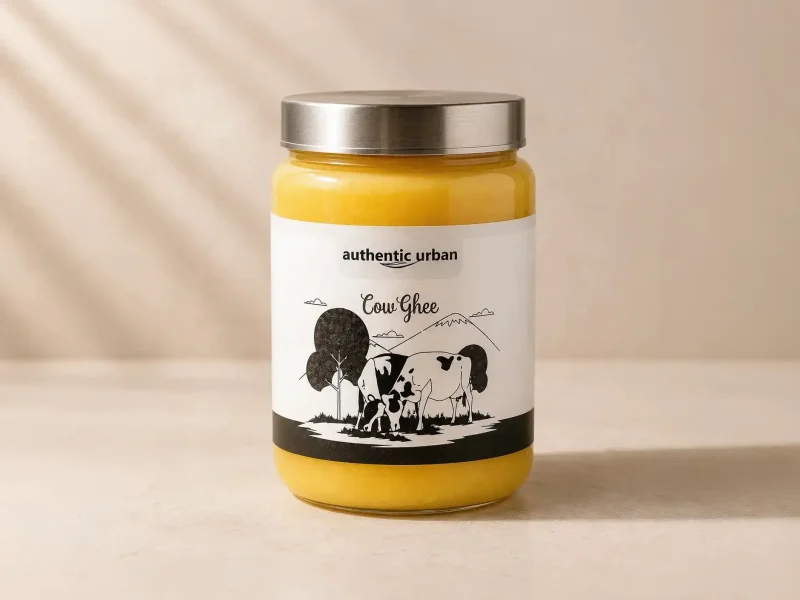
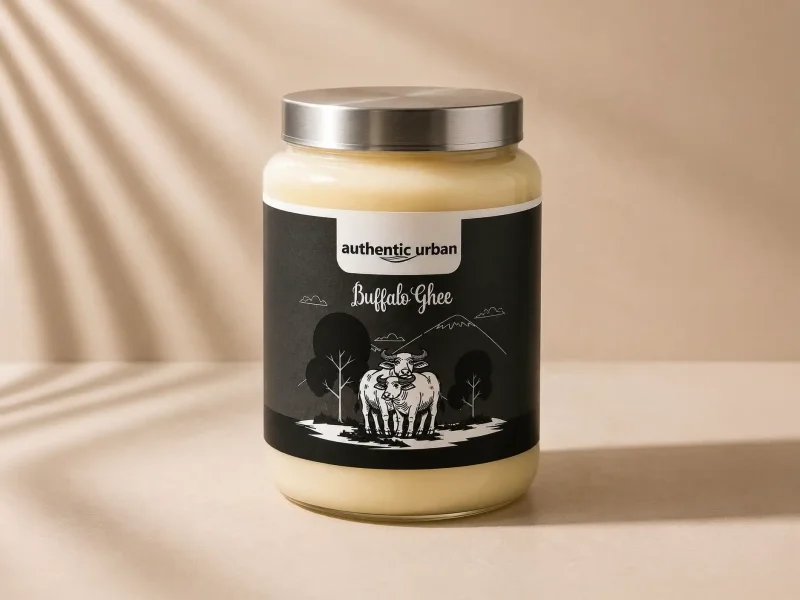
For the daily spoon we would pick our own A2 Gir cow ghee: milk from grass-fed Gir cows near the Gir forest, set to curd overnight, churned, and cooked slowly in a matki, made after you order, with a video of your jar on WhatsApp. For halwa and paratha, our Jafarabadi buffalo ghee does the job vanaspati used to. Other buffalo jars are ranked on best buffalo ghee in India. We test every month against the FSSAI limits, including the Baudouin and β-sitosterol lines; the steps are on how we make ghee, and you are welcome to visit and watch a batch.
The daily teaspoon on dal and roti
 1 Litre
Halwa and paratha, the old Dalda jobs
 1 Litre
Each order is cooked after you place it, and the packing video is of that batch. Past order videos are on the shop.
FAQ
Does A2 or Bilona ghee have less trans fat?
We have not seen a measurement that shows it. A2 describes a milk protein, and ghee is almost all fat, so the A2 label says nothing about trans fat. Bilona is a way of making ghee from curd; both curd and cream ghee come from the same milk fat, which carries the trans fat the animal made. Treat any jar that claims lower trans fat as needing a lab report for that batch.
Is CLA in ghee a trans fat?
Chemically, CLA (conjugated linoleic acid) has a trans bond, and some labs count it in the trans fat total. FSSAI's definition of trans fat counts only non-conjugated forms, so CLA is left out under Indian rules. That is one reason lab figures for ghee differ. A 2010 review of trials in PLoS One found CLA raised the LDL to HDL ratio much like other trans fats, so it is not a reason to eat more ghee.
Do milk, curd, and paneer also have trans fat?
Yes, a little, because the trans fat sits in the milk fat. Anything made from whole milk carries some, in proportion to its fat. Ghee is almost pure fat, so it carries the most per spoon; a glass of toned milk carries far less. Dairy trans fat is not something to count gram by gram at normal amounts. Cutting vanaspati and bakery fat does much more than cutting curd.
Is the trans fat in ghee a worry in pregnancy or for children?
The trans fat to avoid in pregnancy and childhood is the industrial kind in vanaspati, bakery foods, and packaged snacks; ICMR-NIN's 2024 guidelines say trans fat should be avoided in pregnancy and while breastfeeding. A teaspoon of ghee on a child's dal or khichdi carries well under 400 mg of natural trans fat. How much ghee suits pregnancy or a child is a question for your doctor.
Kya ghee mein trans fat hota hai?
Haan, thoda sa, jo gaay ya bhains ke pet mein banta hai, factory mein nahi. Ek chammach (5 g) ghee mein lagbhag 170 se 390 mg trans fat hota hai. WHO roz 2.2 g se kam kehta hai. Din mein 1 se 2 chammach ghee is had ke andar rehta hai. Dalda aur vanaspati band karein, aur ghee chammach se naap kar khayein.
I have high LDL. Should I stop ghee because of its trans fat?
Trans fat is the smaller part of the problem. A teaspoon of ghee carries about 3.1 g of saturated fat (USDA) and under 0.4 g of trans fat, and both push LDL up. Your doctor may cut ghee to one teaspoon or less, and that also cuts its trans fat. Stopping vanaspati, bakery snacks, and fried food made in reused oil usually matters more than the ghee spoon.
About the editorial team
Authentic Urban TeamBilona ghee makers, Gir Somnath, Gujarat
We are the Parmar family in Gir Somnath, Gujarat. We have made ghee here since 2016 and sold it online since 2025. We make only Bilona ghee, test it every month, and anyone is welcome to visit and watch it being made. Our Gir cows and Jafarabadi buffalo are grass-fed village animals that graze near the Gir forest, with no hormones or milk boosters. We set their milk to curd, churn it, and cook the makkhan on a wood chulha. These articles come from that kitchen and from what customers ask us on WhatsApp. We are ghee makers, not doctors.
Sources
- Trans fat, fact sheet, 24 January 2024, World Health Organization. Checked 27 Sep 2026.
- Food Safety and Standards (Prohibition and Restrictions on Sales) Regulations, compendium version XI, 02.04.2025 (definition of industrial trans fatty acids; ghee, oils and fats rules in Chapter 2), FSSAI. Checked 27 Sep 2026.
- Food Safety and Standards (Food Products Standards) Chapter 2.2: Fats, oils and fat emulsions, version 01.09.2023 (2.2.6 Vanaspati), FSSAI. Checked 27 Sep 2026.
- Food Safety and Standards (Advertising and Claims) Regulations, compendium version III, 04.10.2022 (Schedule I, trans fat free), FSSAI. Checked 27 Sep 2026.
- Dietary Guidelines for Indians, 2024 (Guideline 7, printed pp. 52, 54, 55, 56), ICMR-National Institute of Nutrition. Checked 27 Sep 2026.
- Butter, without salt (FDC ID 173430), SR Legacy, USDA FoodData Central. Checked 27 Sep 2026.
- Butter oil, anhydrous (FDC ID 173412), SR Legacy, USDA FoodData Central. Checked 27 Sep 2026.
- Chemical, physicochemical, microbiological and sensory characterization of cow and buffalo ghee (Pena-Serna and Restrepo-Betancur, 2020), Food Science and Technology (Campinas). Checked 27 Sep 2026.
- Effect of temperature on milk fats of cow, buffalo, and goat used for frying local food products (Khan, Hassan and Rauf, 2018), Food Quality and Safety. Checked 27 Sep 2026.
- A Comparative Analysis of Butter, Ghee, and Margarine and Its Implications for Healthier Fat and Oil Group Choices (Mohammadi-Nasrabadi et al., 2024), Food Science & Nutrition, via PubMed Central. Checked 27 Sep 2026.
- Intake of saturated and trans unsaturated fatty acids and risk of all cause mortality, cardiovascular disease, and type 2 diabetes (de Souza et al., BMJ, 2015), BMJ, via PubMed. Checked 27 Sep 2026.
- Effect of animal and industrial trans fatty acids on HDL and LDL cholesterol levels in humans: a quantitative review (Brouwer, Wanders and Katan, PLoS One, 2010), PLoS One, via PubMed. Checked 27 Sep 2026.