Does Ghee Have Casein or Whey? Is Ghee Dairy Free?
Does ghee have casein? Yes, a trace. USDA FoodData Central lists 0.28 g of protein per 100 g of butter oil, about 14 mg of casein and whey in a 5 g teaspoon, and no measurable milk sugar. That is why most people with lactose intolerance eat ghee without trouble. It is also why ghee is not dairy free, and why anyone with a diagnosed milk allergy should eat it only if their allergist agrees.
Does ghee have casein?
Yes, a trace. Making ghee removes almost all the milk solids, but not every last one. USDA's figure for butter oil works out to about 14 mg of milk protein in a teaspoon, and casein is most of the protein in milk. For your diet that is zero. For a milk allergy it can matter, because allergy is set off by protein, not by fat.
So the answer splits by reader. If milk gives you gas or loose motions, the cause is usually lactose, and ghee is one of the dairy foods you can usually keep. If milk gives you hives, swelling, or wheezing, that is an allergy to casein or whey, and ghee counts as milk until your allergist says otherwise. Many websites call ghee "casein free". It is closer to casein poor.
The full label for a spoon of ghee (calories, fat, vitamins) is on ghee nutrition facts. This page is only about the milk protein and milk sugar that stay behind.
How much milk protein is in a spoon of ghee?
About 14 mg in a 5 g teaspoon, going by USDA FoodData Central's entry for anhydrous butter oil (0.28 g of protein per 100 g). Butter has three times as much, and a glass of milk has hundreds of times more. The table uses USDA's per-100 g numbers, worked out for the portion you actually eat.
Food
Protein per 100 g
Milk protein per serving
Sugar per 100 g
Ghee (butter oil)
0.28 g
14 mg in one 5 g teaspoon
0 g
Butter, unsalted
0.85 g
43 mg in one 5 g teaspoon
0.06 g
Whole milk
3.15 g
6,300 mg in one 200 g glass
5.05 g (all lactose)
USDA FoodData Central, SR Legacy entries 173412, 173430, and 171265, checked 26 September 2026.
Is 14 mg enough to matter for an allergy?
Hold that 14 mg against an allergy number. In their 2023 report on allergen labelling, FAO and WHO experts set the reference dose for milk at 2 mg of milk protein: the amount they use to decide when a trace of milk is enough to warn allergic people on a label. On USDA's figure, one teaspoon of ghee carries about seven times that.
Two limits on that maths. USDA's butter oil protein figure comes from a single lab sample, and a slow, well-strained ghee may carry less. But no one can promise you zero without testing the jar for milk protein, and the FSSAI ghee standard has no limit for protein at all. It sets moisture at 0.5% at most and milk fat at 99.5% at least, which leaves room for a trace. A normal ghee lab report, the kind explained in reading a ghee lab report, will not tell you the casein level.
Is ghee dairy free?
No. Ghee is made only from milk, and Indian food law treats it as a dairy product. FSSAI's standard for ghee sits in Chapter 2.1, "Dairy products and analogues", and describes ghee as fat "derived exclusively from milk" by removing "almost" all the water and milk solids. Almost is the word that matters for an allergy.
The labelling rules say the same thing. FSSAI's Labelling and Display Regulations, 2020, list "Milk & Milk products" among the allergens that must be declared on a pack as "Contains: Milk", with no exception for ghee or butter oil. Ghee is also not vegan. What ghee does have is almost no lactose, which is why people call it "dairy friendly". Dairy friendly for your gut is not the same as dairy free for your immune system.
Where do the casein and whey go when ghee is made?
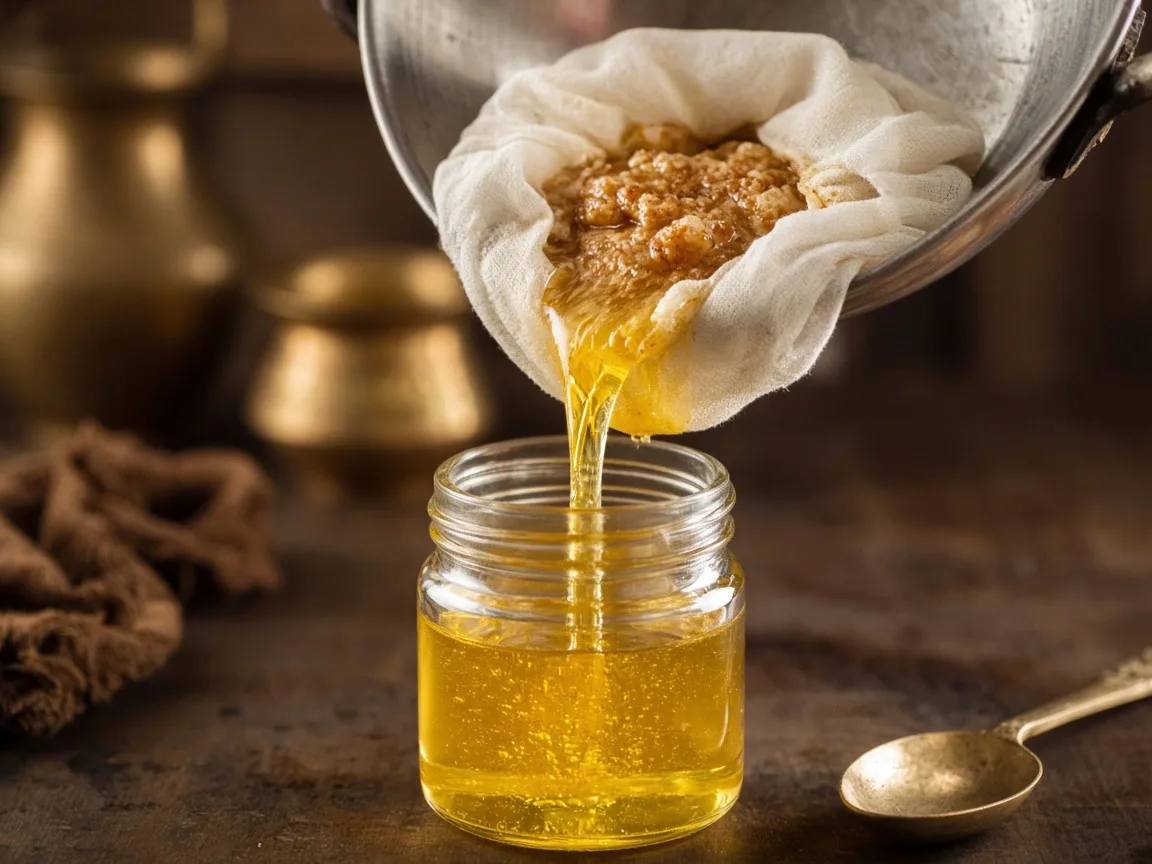
Most of the whey leaves in the chaas (buttermilk), and most of the casein is cooked into the brown solids that stay in the pot. In our kitchen in Gir Somnath, Gujarat, you can watch it happen across two days. This is how our Bilona batch (curd churned by hand) goes, and what leaves at each step.
Step
What leaves the batch
Milk set to curd overnight
Nothing yet. The curd holds all the casein, whey, and most of the lactose.
Curd churned 30 to 45 minutes
Makkhan (butter) floats up. The chaas (buttermilk) drains away with most of the whey protein and the milk sugar.
Makkhan cooked 45 to 90 minutes
Water boils off. The casein left in the makkhan cooks into foam and a layer of solids on the bottom of the pot.
Off the flame, strained
The golden-brown solids stay behind in the pot and the cloth. A trace of protein stays in the clear fat.
The moment the batch comes off the flame decides how much stays in. We take the matki (clay pot) off the wood chulha when the bubbling goes quiet, the solids at the bottom turn golden-brown, and it smells of toasted milk. Pull it early and the ghee stays cloudy, keeps moisture, and spoils fast; that batch never gets packed. Cloudiness is water and milk solids still in the fat, which is exactly what a casein-sensitive reader does not want.
Grain is a different thing. Slow ghee often cools danedar (grainy), and "why is it grainy?" is one of the questions we get most on WhatsApp. The grains are fat setting into crystals, not milk solids, and they melt clear. Why ghee sets that way is on why ghee is grainy. The whole method, step by step, is on the Bilona method, and how ghee differs from Western clarified butter, which is strained earlier and cooked less, is on ghee vs clarified butter.
Lactose intolerance or milk allergy: which one decides?
Lactose intolerance is a sugar problem; milk allergy is a protein problem, and only the second one makes ghee risky. With lactose intolerance your gut is short of the enzyme that breaks down milk sugar, and ghee has no measurable sugar in USDA's data. With a milk allergy your immune system reacts to casein or whey, and ghee keeps a trace of both.
Who
Reacts to
Ghee?
Lactose intolerance
Milk sugar
Usually fine. Ghee has no measurable sugar. Start with ¼ teaspoon on hot food.
Diagnosed milk allergy (casein or whey)
Milk protein, even a trace
Treat ghee as milk. Only eat it if your allergist says so.
History of anaphylaxis to milk
Milk protein
Avoid ghee unless your allergist has tested you for it.
Baby with cow's milk protein allergy
Milk protein
No ghee without the paediatrician. No home trials.
Vegan or plant-based
Not a reaction: a choice
Ghee is made from milk, so it is not vegan.
For lactose intolerance only, start with ¼ teaspoon on hot dal or rice, then go to a full teaspoon over a few days if your stomach stays calm. The full plan, with how much lactose is in milk, curd, and paneer, is on ghee for lactose intolerance. Babies are a separate case: we never suggest a home trial for an infant, and the age rules are on ghee for babies.
What are the symptoms of a ghee allergy?
A reaction to ghee is a milk allergy reaction, so the signs are the ones the NHS lists for any food allergy.
- Itchy skin or a raised rash, or swelling of the lips, face, or eyes.
- Sneezing, a runny or blocked nose, coughing, or wheezing.
- Feeling sick or vomiting, tummy pain, or diarrhoea.
Call 108 or 112 at once if the throat feels tight, swallowing or breathing gets hard, the lips or tongue swell suddenly, or the person turns pale, blue, confused, or faint. If they carry an adrenaline auto-injector, use it first, then call. Gas, bloating, or loose motions a few hours after a heavy ghee meal are far more often too much fat or lactose from other dairy on the plate, and they are covered on ghee side effects.
Does A2 ghee have less casein?
No. A2 describes which kind of beta-casein the milk carries, not how much of it ends up in the jar. Our Gir cow milk is A2, and the trace left in ghee made from it is A2 casein, along with the same whey proteins every cow's milk has. A milk allergy can react to any of them, so A2 does not make ghee safe for an allergy.
Where A2 matters is a milk you drink by the glass, and even there the evidence is argued over. The science is on A2 vs A1 ghee. For casein in ghee, how cleanly the jar was cooked and strained matters more than the letter on the lid.
Is ghee better than butter if dairy bothers you?
For lactose, yes: butter keeps some milk sugar and ghee keeps none that USDA can measure. For milk protein, ghee has about a third of butter's trace. Neither is safe for a diagnosed milk allergy. Taste, smoke, and price differences are on ghee vs butter. Less dairy trouble does not change the fat, so the daily limits on how much ghee per day still apply.
How to check a jar for leftover milk solids
You cannot measure casein at home, but you can spot a jar that kept too much water and milk solids. Run these five checks before anyone with lactose trouble starts on a new jar. They are not an allergy test.
Check
A clean jar shows
1. Melt a spoon
Clear, golden liquid. Cloudiness in melted ghee can mean water or milk solids left in.
2. Let it settle for ten minutes
No brown or white layer at the bottom of the spoon or bowl.
3. Heat a little in a dry pan
No crackle or spitting. Spitting means water, and water usually brings solids with it.
4. Smell it warm
Toasted milk. Sour or cheesy smells point to solids that were not cooked out.
5. Read the label
An FSSAI licence number, and "Contains: Milk". A jar that says dairy free or casein free is wrong.
Purity checks for vanaspati and other added fats are a different job, covered on how to identify pure ghee.
Which ghee if milk sugar bothers you?
For lactose trouble, pick a ghee that was cooked long enough to melt clear, with the solids left in the pot. Slow Bilona ghee cooked on a low flame gives the solids time to brown and drop. Our ranking of the cow ghee on sale is best cow ghee in India. For a diagnosed milk allergy, no jar is the answer; your allergist is.
For the daily spoon we would pick our own A2 Gir cow ghee: grass-fed Gir milk set to curd overnight, churned, and cooked in a matki on a wood chulha until the solids turn golden-brown, made after you order, with a video of your jar sent on WhatsApp. For paratha and sweets, our Jafarabadi buffalo ghee is the richer jar. Both are milk, and neither is dairy free. We test every month against the FSSAI limits; the steps are on how we make ghee.
The daily teaspoon on dal and rice
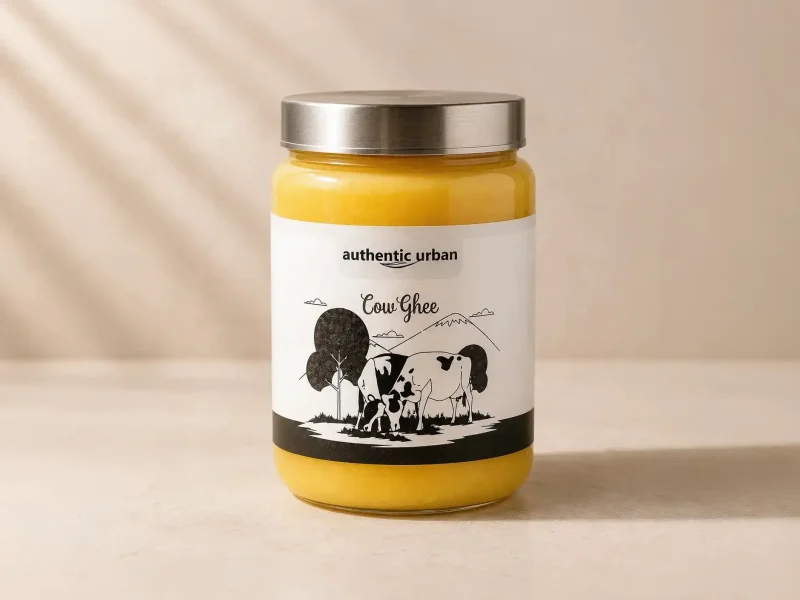 1 Litre
Paratha, halwa, and ladoo
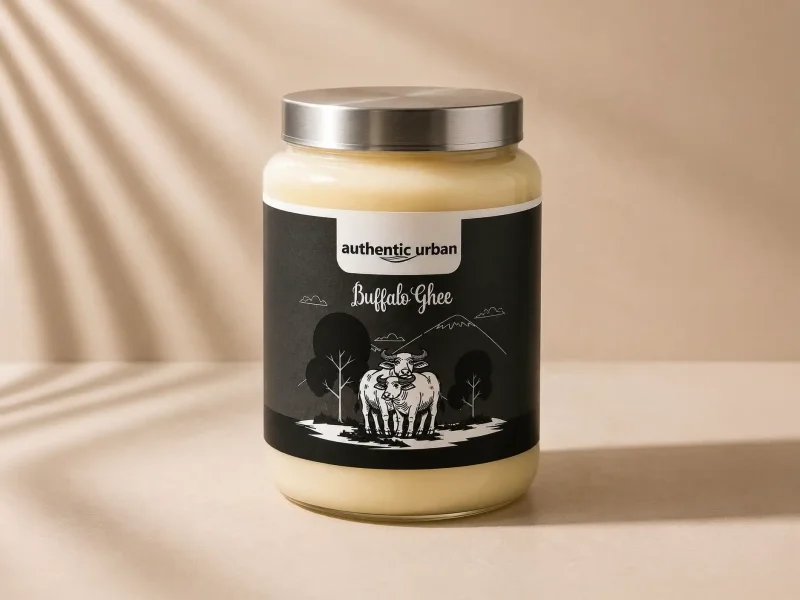 1 Litre
Each order is cooked after you place it, and the packing video is of that batch. Past order videos are on the shop.
FAQ
How much protein is in 1 tablespoon of ghee?
Almost none. USDA FoodData Central lists anhydrous butter oil at 0.28 g of protein per 100 g, so a 15 g tablespoon (three teaspoons) carries about 0.04 g, or 42 mg. That is nothing for your protein target: one 200 g glass of whole milk has about 6.3 g. For a person with a milk allergy, though, 42 mg of milk protein is not nothing.
Is buffalo ghee safe if I am allergic to cow milk?
Do not assume so. Buffalo milk also carries casein and whey, and buffalo ghee is made the same way as cow ghee, so it keeps the same kind of trace. Switching animals is not a way around a milk allergy. If you want to try buffalo ghee, cheese, or milk, ask your allergist to plan and supervise it, the same as for any other dairy food.
Do the brown bits left after making ghee contain casein?
Yes. The golden-brown residue at the bottom of the pot is the milk solids themselves, mostly cooked casein, with a little fat. Many homes stir it into roti dough or eat it with sugar. It is the most protein-rich part of the whole batch, so anyone avoiding casein or with a milk allergy should skip it completely.
Does cooking or frying in ghee destroy the casein?
Do not count on it. The trace of protein left in ghee has already been cooked with the butter, and it is still milk protein. Frying with the ghee again does not turn it into something an allergic body ignores. Whether any cooked or baked milk is safe for you is a question for an allergist, answered with a supervised test, not by how hot your kadhai got.
Can someone on a casein-free diet eat ghee?
It depends on why the diet was started. If a doctor or dietitian put you or your child on a casein-free diet, ask them, because ghee does carry a trace of casein and some plans allow it while others do not. If you chose it for yourself because milk bloats you, the cause is usually lactose, and ghee has no measurable lactose.
Can I cook for a guest with a milk allergy using ghee?
No. Cook their food in oil, in a clean pan, and keep the ghee spoon away from it. A host cannot know how sensitive a guest is, and ghee is a milk product under FSSAI labelling rules. Tell them which dishes have ghee in them, including dal tadka, rice, rotis brushed after cooking, and sweets, so they can choose for themselves.
About the editorial team
Authentic Urban TeamBilona ghee makers, Gir Somnath, Gujarat
We are the Parmar family in Gir Somnath, Gujarat. We have made ghee here since 2016 and sold it online since 2025. We make only Bilona ghee, test it every month, and anyone is welcome to visit and watch it being made. Our Gir cows and Jafarabadi buffalo are grass-fed village animals that graze near the Gir forest, with no hormones or milk boosters. We set their milk to curd, churn it, and cook the makkhan on a wood chulha. These articles come from that kitchen and from what customers ask us on WhatsApp. We are ghee makers, not doctors.
Sources
- Butter oil, anhydrous (FDC ID 173412), SR Legacy, USDA FoodData Central. Checked 26 Sep 2026.
- Butter, without salt (FDC ID 173430), SR Legacy, USDA FoodData Central. Checked 26 Sep 2026.
- Milk, whole, 3.25% milkfat, with added vitamin D (FDC ID 171265), SR Legacy, USDA FoodData Central. Checked 26 Sep 2026.
- Risk Assessment of Food Allergens. Part 3: Review and establish precautionary labelling in foods of the priority allergens (2023), Table 2, p. 31, FAO and WHO. Checked 26 Sep 2026.
- Food Safety and Standards (Food Products Standards) Chapter 2.1: Dairy products and analogues, version 01.09.2023 (ghee standard, p. 27), FSSAI. Checked 26 Sep 2026.
- Food Safety and Standards (Labelling and Display) Regulations, 2020, Version VIII, 09.09.2025 (declaration regarding food allergen, p. 18), FSSAI. Checked 26 Sep 2026.
- Food allergy, NHS. Checked 26 Sep 2026.