Purana Ghrita: What Aged Ghee Is, and Is Old Ghee Safe?
Purana ghrita is ghee kept for years as an Ayurvedic medicine, and Charaka Samhita sets the line at ten years. It is not a better kitchen ghee. In a 2018 lab study, a 15-year-old jar had about 19 times the free fatty acids FSSAI allows in ghee. Take it only when a vaidya prescribes it; for eating, fresh ghee is the one to keep.
What is purana ghrita?
Purana ghrita means old ghee: plain ghee, with nothing added, stored for years and then used as a medicine in Ayurveda. Charaka Samhita counts ghee as purana at ten years and describes it as sharp-smelling, bitter, and a strong purgative, given for unmada (mental illness) and apasmara (seizures). It is prescribed by a vaidya, not eaten with meals.
Two things get mixed up with it. The first is medicated ghee (ghritam), which is fresh or old ghee cooked with herbs, such as Brahmi ghrita; that is on medicated ghee ghritam. The second is a kitchen jar left too long, which is just stale ghee. Signs a jar has gone off are on does ghee go bad. This page is for people who have heard of aged or 100-year-old ghee and want to know what it is, what it does, and whether to buy it.
How old does ghee have to be to count as purana ghrita?
Ten years, in Charaka Samhita. The verses on old ghee sit in the chapter on unmada (Chikitsa Sthana 9, verses 59 to 62): ghee stored ten years is purana, ghee kept longer is prapurana (extremely old), and ghee kept a hundred years is praised above all.
Most pages selling aged ghee use one year instead, and one listing we read credits that one-year rule to Charaka. The Charaka translation says ten. If a jar is sold as purana at one or two years, it may follow a later text or a family practice, but it is not Charaka's purana ghrita.
Age
Name
What the text says
Under 10 years
Ghee (not yet purana in Charaka)
Charaka names no special class. Many sellers and later writers call ghee purana after one year.
10 years
Purana ghrita (dashavarsha)
Sharp smell, lac-red colour, pungent and bitter taste, cold, a strong purgative; lowers all three doshas; for unmada and apasmara.
Over 10 years
Prapurana ghrita
"Extremely old". The text gives it no separate dose or use.
100 years
Called kumbha or maha ghrita by sellers
Charaka says no disease is incurable for it. This is a line of praise in a text, not a result anyone has tested.
From Charaka Samhita, Chikitsa Sthana 9, verses 59 to 62, English translation on Charaka Samhita Online. "Lowers all three doshas" also appears in Kataria and Singh's 2024 review, Table 1. Tradition, not trial results. Checked 28 September 2026.
The same 2024 review of the classical texts by Kataria and Singh lists old ghee as lowering Vata, Pitta, and Kapha, the same as cow ghee. What that means for your own daily spoon is on old ghee and the doshas.
What does aged ghee look, smell, and taste like?
Charaka describes ten-year ghee as sharp in smell, the colour of lac (a deep reddish brown), and pungent and bitter on the tongue. Fresh ghee is the opposite: mild, sweet, and smelling of toasted milk. The change in taste is the point in the texts, not a flaw.
The one modern sample we could find looked different. In a 2018 study in the Journal of Indian System of Medicine, Rathi and colleagues compared fresh cow ghee with cow ghee they had made in 2003 and kept 15 years in an airtight glass bottle. The old ghee was creamish white with a distinct smell; the fresh one was yellowish white. Colour depends on the ghee and how it was kept, so it tells you little about age.
In our kitchen in Gir Somnath, Varsha tastes every batch, and we know what a wrong one smells like. A burnt batch is dark, bitter, and smells burnt. An undercooked one is cloudy and holds water, and that water is what makes ghee spoil fast. Neither goes in a jar. That is why ghee made for keeping has to be cooked until the bubbling stops and the water has boiled off: moisture in the jar is where spoilage starts, over months or years. How we judge that point is on the Bilona method.
What happens to ghee after 15 years? The lab numbers
It stops being ghee by the food standard. The 15-year sample in the 2018 study had an acid value of 75.88 against 1.62 for fresh ghee. By FSSAI's own conversion (acid value is 1.99 times free fatty acids as oleic acid), that is about 38% free fatty acids, where FSSAI allows ghee 2.0% at most.
Free fatty acids come from fat splitting apart, which FSSAI's test manual puts down to moisture, heat, and the enzyme lipase. Peroxides show oxidation, the first step to a rancid smell. Both climbed. Here is the old jar and the fresh one against the FSSAI ghee limits:
Test
Fresh ghee
15-year ghee
FSSAI ghee limit
What it means
Free fatty acids, as oleic acid
Fresh: 0.8%
15 years: 38.1%
FSSAI: 2.0% at most
Fat split into free acids. The old jar is about 19 times the limit.
Peroxide value (meq O₂ per kg)
Fresh: 0
15 years: 37.54
FSSAI: No ghee limit (0.6 for butter oil)
Oxidation, the start of rancid smell.
Iodine value
Fresh: 30.67
15 years: 42.26
FSSAI: 25 to 38
The fat profile shifted; the old jar is outside the ghee range.
Saponification value
Fresh: 203.76
15 years: 347.28
FSSAI: 205 to 235
Far outside the range for the old jar; the fresh one sits just under it.
Colour and smell
Fresh: Yellowish white, cow ghee smell
15 years: Creamish white, a distinct smell
FSSAI: None
You can tell by nose, but not how old it is.
Fresh and 15-year values from Rathi et al., J Indian Syst Med 2018;6(1):4-9, abstract (one sample each). Limits from FSSAI Chapter 2.1, version 01.09.2023, p. 27. Free fatty acids worked out from acid value with FSSAI's factor of 1.99 (Manual of Methods, Oils and Fats, 2016, 11.8). Checked 28 September 2026.
Two cautions. This is one jar in one study, so other old ghee could score better or worse. And Ayurveda does not claim old ghee is unchanged; it claims the change is useful. The study's authors read the shift in fatty acids as a reason old ghee may suit brain conditions, but that is their inference from a lab test, not something they tried in people. What each line on a ghee report means is on how to read a ghee lab report.
Is old ghee good for health?
Not as food. Old ghee sold as a medicine is a treatment question for a vaidya, and a kitchen jar past its best is simply stale fat. For eating, fresh ghee is better on every measure a lab can take: fewer free fatty acids, no peroxides, and the taste you bought it for.
The texts agree more than people think. Charaka calls ten-year ghee "an excellent purgative", which means it loosens the bowels. That is a reason it is given in measured doses, for set days, and not spooned onto dal. Ayurveda's daily ghee, the one it tells families to eat, is fresh. How much of that to eat is on how much ghee per day.
What is purana ghrita used for in Ayurveda?
Charaka gives it mainly for unmada (mental illness) and apasmara (seizures), taken by mouth alone or cooked with herbs such as hing. Charaka's Brahmi ghee for the same illnesses is cow ghee cooked with brahmi, vacha, kushtha, and shankhapushpi, and some Brahmi ghee is made on old ghee. The text also says old ghee works when smelled or touched, which is why vaidyas use it outside the body too.
What has been tested is much smaller. We found no controlled trial of plain purana ghrita in people for any condition, and nothing that puts it in place of seizure or psychiatric medicine. So read every "old ghee treats" line, including Charaka's own "no disease is incurable" for 100-year ghee, as tradition. Nobody should stop or cut a prescribed medicine for it.
Some of these uses have their own pages: ghee drops in the nose on ghee in the nose (nasya), washed ghee for the skin on shata dhauta ghrita, and what food can and cannot do for memory on ghee for brain health. Where purana ghrita fits in Ayurveda as a whole is on the Ayurvedic guide to ghee.
100-year-old ghee: what does it cost, and can anyone prove the age?
It costs many times fresh ghee, and nobody can prove a 100-year age from the jar. On listings we read on 28 September 2026, ghee sold as 5 to 7 years old cost ₹700 to ₹1,999 per 100 ml, and one jar sold as over 100 years old was listed at ₹8,000. Our fresh Gir cow ghee works out to about ₹240 per 100 ml.
How is the age of aged ghee checked?
The age is taken on trust. One seller says it dates its ghee by trees planted over the spot where the ghee is buried. None of the three listings showed a lab report or a dated batch record, and no test we know of puts a year on ghee. A lab can show that ghee has changed (the free fatty acids and peroxides above), not when it was made. If a vaidya has asked you to buy aged ghee, ask them where to buy it; if no one has, you do not need it.
Can you age ghee at home?
You can keep ghee for years, but we would not age it at home for eating, and a home jar is not a prescribed medicine either. Keep the jar you eat from fresh, and let a vaidya supply aged ghee if you ever need it.
If a family tradition keeps a jar aside, the rules that slow spoilage are the same ones as for any ghee: start with ghee cooked until no water is left, fill a clean, bone-dry glass or steel jar to the top so little air sits over it, shut it tight, and keep it cool, dark, and away from the stove. Never dip a wet spoon. Label the jar with the date and keep it apart from the kitchen ghee. A sealed jar of ours keeps 9 to 12 months at room temperature; past that, taste and smell fade first. An old jar that smells stale usually ends up in the diya, which is a fine use for it; how much a lamp takes is on ghee for puja and havan.
Who should not take purana ghrita?
Anyone taking it without a vaidya's plan, and these people even with one unless their doctor agrees:
- Anyone on seizure, psychiatric, or blood-thinning medicine. Old ghee is an add-on in the texts, never a swap for the tablets.
- Pregnant or breastfeeding women, babies, and children.
- Anyone with loose stools, a stomach infection, or a fever. Charaka calls it a strong purgative.
- People with gallstones, pancreatitis, high LDL cholesterol, or a fat-restricted diet from their doctor.
- Anyone with a milk allergy.
Stop and see a doctor if you get diarrhoea, stomach pain, or vomiting after taking it, or if a seizure or mental-health symptom gets worse. The general list of who should go easy on ghee is on who should not eat ghee. This page describes Ayurvedic tradition and one lab study; it is not medical advice, and ghee does not treat any illness.
Before you buy aged ghee: six questions
1. Who is it for?
A vaidya (Ayurveda doctor) who has seen you, named a condition, and written the amount and the days. If you are buying it on your own "for health", stop here.
2. How old, and how do they know?
A made-on date or a batch record. None of the three listings we read showed a lab report or a dated record.
3. Is it plain or medicated?
Plain purana ghrita and herb-cooked ghrita (like Brahmi ghrita) are different products with different uses.
4. Is it sold as food?
A 15-year-old jar in the lab was far outside the FSSAI limits for ghee. It is a medicine question, not a kitchen one.
5. Does it smell sour or like paint?
Aged ghee smells sharp. Soapy, paint-like, or mouldy is spoiled fat in any tradition.
6. What will it cost per 100 ml?
Listings we read asked ₹700 to ₹1,999 per 100 ml for 5 to 7 year ghee. Fresh ghee costs far less.
Which ghee for the kitchen, then?
For eating, the answer to aged ghee is fresh ghee: the newer the jar, the lower the free fatty acids and the better the smell. Buy ghee that smells of toasted milk when warm and sets grainy when cool, from a maker who tells you when it was cooked. Simple checks for a jar are on how to identify pure ghee, and our ranking of the cow ghee on sale is best cow ghee in India.
Our A2 Gir cow ghee is cooked after you order, so the jar that reaches you is days old, not months. The milk comes from grass-fed Gir cows near the Gir forest; it is set to curd overnight, churned, and cooked in a matki on a wood chulha in Gir Somnath, and you get a video of your jar on WhatsApp. For winter sweets, our Jafarabadi buffalo ghee is the richer jar. We test every month against the FSSAI limits in the table above; the steps are on how we make ghee. We do not sell aged ghee.
The daily spoon on dal, roti, and khichdi
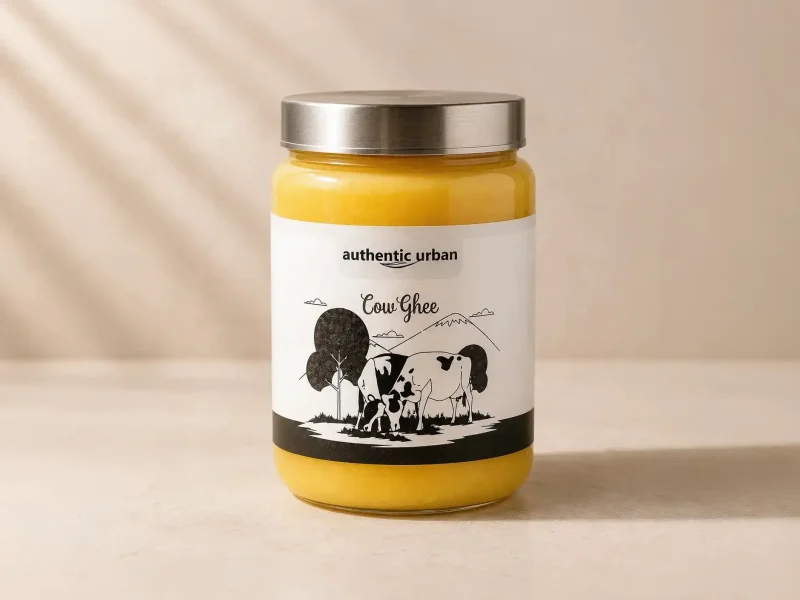 1 Litre
Winter sweets, halwa, and paratha
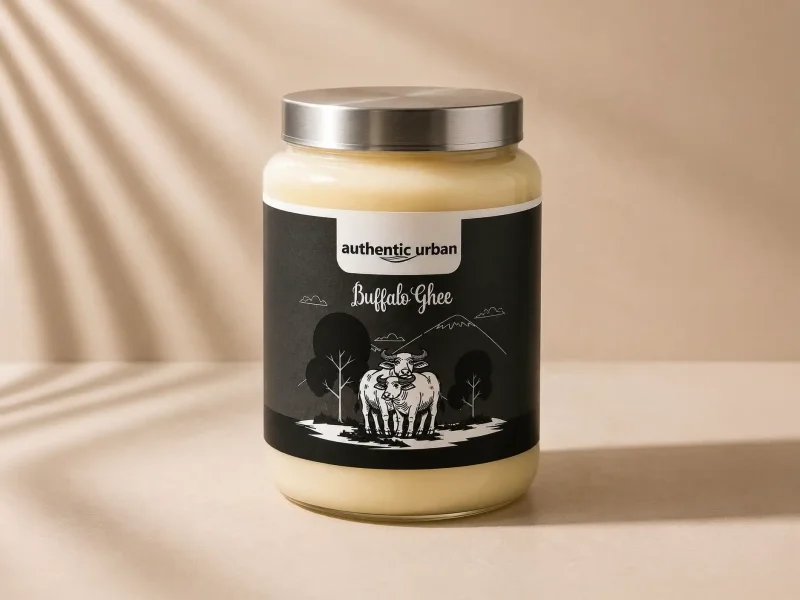 1 Litre
Each order is cooked after you place it, and the packing video is of that batch. Past order videos are on the shop.
FAQ
Is puran ghritam the same as purana ghrita?
Yes. Ghrita and ghritam are two forms of the same Sanskrit word for ghee, and purana means old, so puran ghritam, purana ghee, and purana ghrita all mean aged ghee. In Charaka Samhita the word is used for ghee kept ten years. Medicated ghee names end the same way (Brahmi ghritam, Triphala ghritam), but those are ghee cooked with herbs, not ghee kept for years.
What is maha purana ghrita?
Sellers use maha purana ghrita, or kumbha ghrita, for ghee they say is 100 years old or more. Charaka Samhita calls ghee older than ten years prapurana, and praises ghee kept a hundred years in one line. No test can confirm a 100-year age, so the name tells you what the seller claims, not what is in the jar. Ask for the record behind the date.
Can purana ghrita be applied on the skin or in the nose?
Charaka describes old ghee as working even when smelled or touched, and vaidyas do use it outside the body. At home, keep to a small patch test on the inner arm and stop if it itches or reddens. Do not put any aged ghee in the nose or eyes yourself; oil in the nose can reach the lungs. Those are clinic procedures, done with a plan by a practitioner.
Does ghee get better with age like wine?
Not as food. Ghee is at its best in taste and smell in its first months, and a sealed jar of ours keeps 9 to 12 months at room temperature. With years, free fatty acids and peroxides climb, which is what the tongue reads as sharp or rancid. Ayurveda values the changed ghee as a medicine, but it never told anyone to eat it on roti.
Is purana ghrita made from cow or buffalo ghee?
The Charaka verses on old ghee say only "ghee", but classical medicine leans on cow ghee, and Charaka's Brahmi ghee recipe names cow ghee. The aged jars on sale that we read were all sold as cow ghee. Buffalo ghee sets firmer and has a different fat profile, and we know of no text or study on aged buffalo ghee specifically.
Can I use an old jar of ghee for the diya?
Many households do exactly that: a jar that smells stale goes to the lamp, not the plate. It burns fine as long as it has no water or mould in it. Keep it in its own marked container so no one cooks with it by mistake, and never top up a food jar from it. How much a diya takes is on our puja ghee page.
About the editorial team
Authentic Urban TeamBilona ghee makers, Gir Somnath, Gujarat
We are the Parmar family in Gir Somnath, Gujarat. We have made ghee here since 2016 and sold it online since 2025. We make only Bilona ghee, test it every month, and anyone is welcome to visit and watch it being made. Our Gir cows and Jafarabadi buffalo are grass-fed village animals that graze near the Gir forest, with no hormones or milk boosters. We set their milk to curd, churn it, and cook the makkhan on a wood chulha. These articles come from that kitchen and from what customers ask us on WhatsApp. We are ghee makers, not doctors.
Sources
- Charaka Samhita, Chikitsa Sthana 10 (Apasmara Chikitsa): Brahmi ghee, cow ghee cooked with brahmi, vacha, kushtha and shankhapushpi, English translation, Charaka Samhita Online. Checked 28 Sep 2026.
- Charaka Samhita, Chikitsa Sthana 9 (Unmada Chikitsa), verses 57-62: therapeutic use of old ghee, English translation, Charaka Samhita Online. Checked 28 Sep 2026.
- Rathi B, Rajput D, Wanjari A, Khan M, Rathi R. Physico-chemical analysis of Purana Ghrita (old clarified butter) with special reference to fatty acid profile. J Indian Syst Med 2018;6(1):4-9 (abstract), Journal of Indian System of Medicine (Wolters Kluwer). Checked 28 Sep 2026.
- Kataria D, Singh G. Health benefits of ghee: Review of Ayurveda and modern science perspectives. J Ayurveda Integr Med 2024;15(1):100819 (Table 1, old ghee and the doshas), PubMed Central. Checked 28 Sep 2026.
- Food Safety and Standards (Food Products Standards and Food Additives) Regulations, Chapter 2.1: Dairy products and analogues, version 01.09.2023 (ghee: FFA, peroxide, iodine and saponification values, p. 27), FSSAI. Checked 28 Sep 2026.
- Manual of Methods of Analysis of Foods: Oils and Fats, 2016 (11.8, acid value = % fatty acid as oleic x 1.99), FSSAI. Checked 28 Sep 2026.