Ghee for Longevity: Rasayana, Evidence, and How Much a Day
Ghee for longevity has tradition behind it but no human study: the Charaka Samhita tells people who want a long life to take ghee, yet no trial has shown that eating ghee adds years. Keep it to 1 to 2 teaspoons (5 to 10 g) a day on dal, roti, or khichdi, the ICMR-NIN limit, and put the rest of your effort into walking, protein, and vegetables.
Ghee for longevity: does it help you live longer?
There is no proof that it does. No study has followed people who eat ghee to see if they live longer. The closest large study, of butter, found that people who ate the most had a 15% higher death rate than those who ate the least. A teaspoon or two a day on home food is fine for most healthy adults; more is not better.
The answer shifts with who is asking. For a thin 75-year-old who has lost interest in food, a teaspoon of ghee on khichdi can be the reason the plate gets finished. For a 50-year-old with a high LDL report, the same teaspoon is saturated fat to count. This page is for both, and for anyone who has read that ghee is an anti-ageing food and wants to know where that comes from. Skin ageing and wrinkles are on ghee and collagen; this page is about the whole body.
Is ghee a rasayana, and what does that mean?
Rasayana is the branch of Ayurveda meant to keep the body young. The Charaka Samhita says it brings long life, memory, intelligence, freedom from disease, youth, and strength (Chikitsa Sthana 1, verses 7-8). Ghee sits close to it in three ways, but it is not the anti-ageing medicine itself.
- As a food for the old. In the chapter on fats, Charaka lists who should drink ghee: among them the old and weak, and those who want to live long (Sutra Sthana 13, verses 41-43). Verse 14 says ghee is good for ojas, the Ayurvedic idea of the body's strength.
- As the base of rasayana medicines. Chyawanprash is the best-known: the text fries amla pulp in sesame oil and ghee before cooking it into a paste (Chikitsa Sthana 1, verse 66). The herbs do the work the text describes; the ghee carries them.
- As the diet that goes with them. Again and again, the Rasayana chapter says that once the medicine is digested, the person should eat rice with milk and ghee.
Many pages go further and say Charaka calls ghee vayasthapana, "that which holds back age". He does not. Vayasthapana is a named group of ten herbs in Sutra Sthana 4 (verse 50), among them guduchi, haritaki, and amla. Ghee is not one of them. The wider picture of ghee in the texts is on our guide to ghee in Ayurveda.
Longevity claims about ghee, checked
Each claim you will meet online, set against what the text says and what research has tested.
Claim
What the text says
What research says
Ghee is a rasayana, a food for long life
Text: Partly. Sutra Sthana 13 (verses 41-43) says people who want to live long, and the old and weak, should take ghee. In the Rasayana chapter, ghee is the base the medicines are cooked in and the food eaten with them.
Research: No human study has measured lifespan in people who eat ghee. Human heart studies on ghee are mixed (Kataria and Singh, 2024).
Charaka calls ghee vayasthapana, "that which stops ageing"
Text: No. The vayasthapana group (Sutra Sthana 4, verse 50) is ten herbs, including guduchi, haritaki (abhaya), and amla (dhatri). Ghee is not on the list.
Research: Amla-based rasayana with honey and ghee has been tested in old rats, not people (Lewis and others, 2026).
Chyawanprash keeps you young because of the ghee
Text: The text fries amla pulp in sesame oil and ghee, then credits the whole formula with youth and memory (Chikitsa Sthana 1, verses 66 and 72-74).
Research: The ghee is the cooking fat of the recipe. No trial has tested the ghee in it on its own.
Butyrate and CLA in ghee slow cell ageing
Text: Not in the texts. This is a modern claim from lab and animal work.
Research: No study shows a kitchen amount of ghee changes how people age. Butyrate and CLA per spoon are small; see our butyrate and CLA pages.
More ghee, longer life
Text: Charaka sets ghee doses by digestion, body, and season, and lists who should not take it.
Research: In 221,054 US adults followed up to 33 years, the most butter went with a 15% higher death rate than the least (Zhang and others, 2025).
Charaka Samhita English translation on Charaka Samhita Online; studies listed under Sources. Checked 28 September 2026.
The butyrate and CLA claims have their own pages with the amounts per spoon: butyrate in ghee and CLA in ghee.
What does research say about ghee and ageing?
Very little about ghee itself, and nothing about lifespan in people. A 2024 review of ghee research by Kataria and Singh found that modern studies have mostly looked at heart risk, and that the human results are mixed: some show better markers, some no change, some worse. The authors call for large, long studies.
The rasayana work is in animals. A 2026 study gave aged rats Amalaki Rasayana, amla blended with honey and ghee, and saw better heart rhythm and less tissue damage than in untreated rats. The authors themselves say clinical trials are needed before it means anything for people, and the study tested the whole formula, not the ghee.
The 33-year butter study, in teaspoons
The biggest study close to this question is on butter, which is ghee plus water and milk solids. Zhang and colleagues, writing in JAMA Internal Medicine in 2025, followed 221,054 American adults for up to 33 years, during which 50,932 died. They counted butter in 5 g pats, which is one teaspoon.
- People who ate the most butter had a 15% higher death rate than those who ate the least.
- Each extra 5 g a day of butter on food or bread, one teaspoon, went with a 4% higher death rate.
- Swapping 10 g a day of butter for plant oils such as olive, soybean, or canola went with a 17% lower death rate.
Three limits matter. It is an observational study, so it shows a link, not cause. The people were mostly white American health workers, eating a very different diet from an Indian thali. And it is butter, not ghee; the paper never mentions ghee. Still, ghee is the same milk fat, so it is the fairest warning we have: past a teaspoon or two, more milk fat is not buying you years. Our fuller comparison of the two fats is ghee vs vegetable oil.
How much ghee a day for healthy ageing?
One to two teaspoons, which is 5 to 10 g and 45 to 90 kcal. ICMR-NIN's 2024 guidelines tell Indians to limit ghee or butter to 1 to 2 teaspoons a day, and count a teaspoon as 5 g and fat as 9 kcal a gram. After 60, less food is needed overall, so the teaspoon is a bigger share of the day.
Who
Ghee a day
Energy
Note
Healthy adult, 40 to 60, active, normal lipid report
Ghee: 1 to 2 tsp (5 to 10 g)
Energy: 45 to 90 kcal
The ICMR-NIN limit. Take it on dal, roti, or khichdi; cook the rest in oil.
Over 60, eating well, normal weight
Ghee: 1 tsp (5 g), up to 2
Energy: 45 to 90 kcal
ICMR-NIN's sample day after 60 uses 15 to 20 g of fats and oils in all. One teaspoon of that can be ghee.
Over 60, poor appetite or losing weight
Ghee: 1 to 2 tsp, on soft food
Energy: 45 to 90 kcal
Ghee makes khichdi and dal easier to eat. Unplanned weight loss is a reason to see a doctor first.
High LDL, heart disease, diabetes, or fatty liver
Ghee: 0 to 1 tsp, doctor decides
Energy: 0 to 45 kcal
Ghee counts as saturated fat. Your doctor or dietitian sets the fat limit.
Overweight and trying to lose
Ghee: ½ to 1 tsp
Energy: 23 to 45 kcal
Keep the taste on one meal. Weight is a bigger lever on later-life health than any fat.
Amounts from ICMR-NIN Dietary Guidelines for Indians 2024 (ghee limit p. 54, teaspoon p. 111, 9 kcal a gram p. 9, sample days after 60 p. 102). A guide for healthy eating, not a prescription.
ICMR-NIN's sample day for a 65 kg man over 60 comes to about 1,740 kcal with 20 g of fats and oils in all; for a 55 kg woman, about 1,530 kcal with 15 g. The guideline gives the reason: metabolism slows after 60, so older people need fewer calories but more vitamins and minerals. One teaspoon of ghee fits inside that fat; three does not. To work out your own household's ghee and oil, use our ghee calculator, and for the limit at every age, see how much ghee per day.
Where does ghee go on an older person's plate?
On the food that needs help being eaten: dal, khichdi, a soft roti. Older people often lose appetite and some taste and smell, which ICMR-NIN's guideline for the elderly names as a cause of eating too little. A teaspoon of warm ghee on moong dal khichdi makes it smell like home, and that can matter more than any nutrient in the spoon.
At home we each eat 1 to 2 teaspoons a day, on roti, dal, and khichdi. The amount climbs in winter, when the milk is richer and the kitchen turns out gond and adadiya pak. Those sweets are where an older relative's ghee quietly doubles, so count a piece of pak as that day's ghee rather than adding it on top.
For a parent who is thin, frail, or has brittle bones, the amounts by situation and soft-meal ideas are on ghee for senior citizens.
What helps you live longer than ghee?
Movement, muscle, and the rest of the plate. These have the evidence that ghee does not, and ghee can sit inside all of them.
Habit
What the evidence says
Where ghee fits
Move every day
WHO says people who are not active enough have a 20% to 30% higher risk of death than those who are.
Ghee: Nothing ghee does comes close.
Keep muscle
ICMR-NIN says keeping more muscle delays ageing, and needs protein plus strength exercise.
Ghee: Ghee has almost no protein. Dal, curd, paneer, eggs, and milk do the work.
Eat the ICMR-NIN plate after 60
200 to 400 ml of milk or curd, a fistful of nuts and seeds, and 400 to 500 g of vegetables and fruit a day.
Ghee: The teaspoon helps you absorb vitamins A, D, E, and K from those vegetables.
Cut ultra-processed and fried snacks
ICMR-NIN says cutting them delays age-related disease.
Ghee: Namkeen and mithai are where most extra ghee and fat hides.
Use oil for most cooking
Swapping 10 g a day of butter for plant oils went with 17% lower death rates in the 2025 cohort.
Ghee: Oil for the kadhai, ghee for the finishing teaspoon.
WHO physical activity fact sheet; ICMR-NIN Dietary Guidelines for Indians 2024 (pp. 58, 100-101); Zhang and others, JAMA Internal Medicine 2025. Checked 28 September 2026.
ICMR-NIN's guideline for people over 60 says regular activity and balanced meals can lower the risk of osteoporosis, diabetes, heart disease, and dementia, and that exercise plans should be set with a doctor. Where ghee fits in heart health specifically is on ghee and cholesterol, and the full verdict on the fat is is ghee healthy.
Is aged or medicated ghee better for longevity?
Not for everyday eating. Aged ghee (purana ghrita) and herbal ghee (ghrita cooked with herbs such as brahmi or ashwagandha) are medicines in Ayurveda, dosed by a vaidya for a condition. Neither has a human trial showing it extends life, and old ghee sold as "100 years" cannot be proved to be that age.
If you want a rasayana in the classical sense, it is the herb formula, such as chyawanprash, taken as a practitioner advises, with its sugar counted if you have diabetes. What the texts and the lab found on aged ghee is on purana ghrita, and how herbal ghee is made and dosed is on medicated ghee.
Who should ask a doctor before adding ghee?
Anyone whose doctor already watches their fat, heart, or weight. That includes people with high LDL cholesterol or heart disease, diabetes, fatty liver, gallstones, or kidney disease on a set diet, and anyone told to lose weight. For them, ghee is not a longevity food to add; it is saturated fat for the doctor or dietitian to fit into their limit.
Watch for signs that are not about ghee at all. Weight loss you did not plan, a poor appetite that lasts weeks, or new trouble swallowing in an older person needs a doctor, not a richer diet. The full list of who should skip ghee or cut back is on who should not eat ghee.
Please note: this page is general food information from ghee makers, not medical advice. Ghee does not treat or prevent any age-related disease. If you take medicine or follow a diet set by a doctor, ask them before changing the fat you eat.
A 7-point checklist for ghee in later life
Screenshot this for a parent, or stick it on the fridge.
- 1 Measure the ghee with a teaspoon for one week. Most people guess low.
- 2 Keep it at 1 to 2 teaspoons (5 to 10 g) a day, on food you already eat: dal, roti, khichdi.
- 3 Cook sabzi and tadka in oil; add the ghee at the end, for taste.
- 4 Count winter sweets (gond, adadiya pak, ladoo) as that day's ghee.
- 5 After 60, get a lipid, sugar, and weight check each year, and let the doctor set your fat limit.
- 6 Walk or work your muscles every day; eat dal, curd, or eggs at each meal.
- 7 Buy a jar that smells of toasted milk when warm and grains when cool.
Which ghee for the daily teaspoon?
If the whole allowance is one or two teaspoons, make them count: a jar that smells of toasted milk when warm and grains when it cools, from a maker who tells you where the milk came from. How to check a jar at home is on how to identify pure ghee, and our ranking of the cow ghee on sale is best cow ghee in India.
For the daily teaspoon we would pick our own A2 Gir cow ghee: milk from grass-fed Gir cows near the Gir forest, set to curd overnight, churned, and cooked in a matki on a wood chulha in Gir Somnath. For a parent who needs more calories in winter sweets, our Jafarabadi buffalo ghee is the richer jar. Both are made after you order, with a video of your jar on WhatsApp, and we test every month against the FSSAI limits. The steps are on how we make ghee.
The daily teaspoon on dal
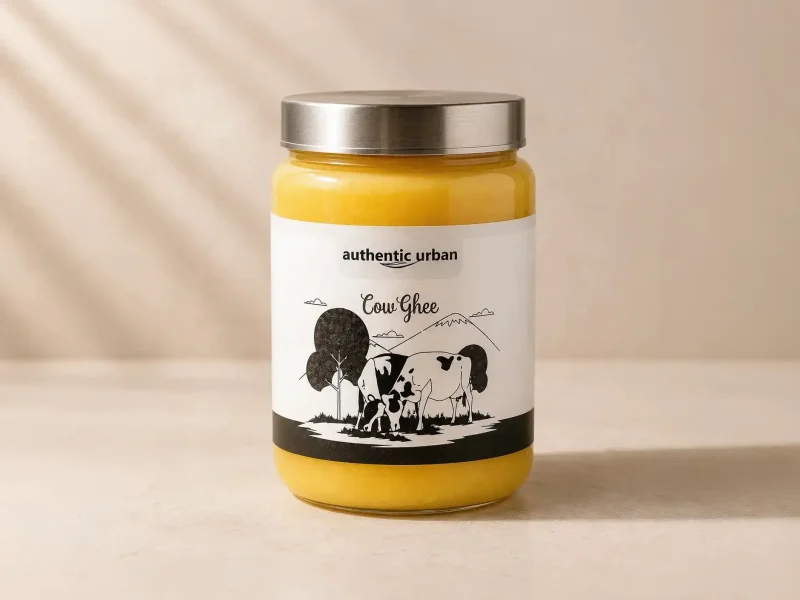 1 Litre
Winter pak for a thin parent
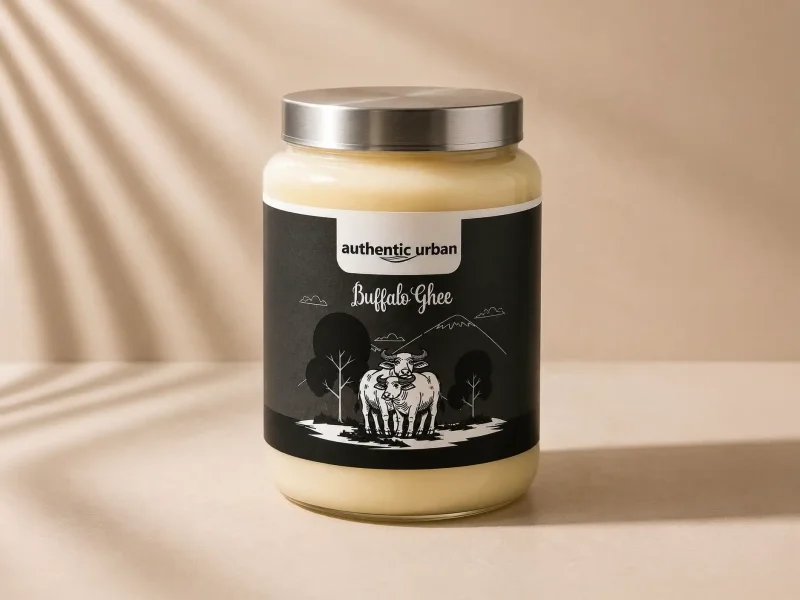 1 Litre
Each order is cooked after you place it, and the packing video is of that batch. Past order videos are on the shop.
FAQ
Does eating ghee prevent wrinkles and grey hair?
No study shows that eating ghee prevents wrinkles or grey hair. A teaspoon of ghee on dal or sabzi helps you absorb the vitamin A in the vegetables, which skin needs, but that is the vegetables at work, and it does not stop ageing. Sun protection and not smoking do more for skin than any fat. If hair greys early or suddenly, ask a doctor rather than changing your ghee.
Can ghee prevent Alzheimer's or dementia?
No trial has tested ghee for dementia. ICMR-NIN's 2024 guidelines say regular activity and a balanced diet can lower the risk of dementia in older people, and that is the evidence to act on. Ghee can make a vegetable-heavy plate taste better, which helps. Memory loss that affects daily life, gets worse over months, or comes with confusion needs a doctor, not a diet change.
Did our grandparents live long because of ghee?
We cannot tell from their lives alone. Many who ate ghee daily also walked or farmed all day, ate home food, and ate little packaged food. Studies call this confounding: the ghee travels with the habits. The one large study of a close fat, butter, found more of it went with slightly higher death rates. Copy their walking and home cooking first, and their teaspoon of ghee second.
Is cow ghee or buffalo ghee better for elderly parents?
Cow ghee for most older parents. It is lighter in taste and suits a daily teaspoon on dal. Buffalo ghee is richer and sets firmer, so it suits a parent who is underweight and needs more calories, or winter sweets. Both are nearly all fat at 9 kcal a gram, so the daily amount matters more than the animal. Keep either to 1 to 2 teaspoons a day.
Is ghee with warm milk at night good for older people?
It can be, if the rest of the day stays within the limit. The Charaka Samhita pairs rasayana medicines with rice, milk, and ghee. A teaspoon of ghee in a cup of milk adds about 45 kcal. Skip it if you have acid reflux at night, are watching your weight, or your doctor has cut your saturated fat, and do not stack it on top of ghee at every meal.
Does A2 or Bilona ghee have more anti-ageing nutrients?
No study shows A2 or Bilona ghee slows ageing more than other pure ghee. A2 refers to a milk protein, and ghee has only traces of protein left. Bilona changes aroma and taste, not the fat profile much. Pay for A2 or Bilona because you like the taste and trust how it is made, not for a longevity claim. Purity matters more than the label.
About the editorial team
Authentic Urban TeamBilona ghee makers, Gir Somnath, Gujarat
We are the Parmar family in Gir Somnath, Gujarat. We have made ghee here since 2016 and sold it online since 2025. We make only Bilona ghee, test it every month, and anyone is welcome to visit and watch it being made. Our Gir cows and Jafarabadi buffalo are grass-fed village animals that graze near the Gir forest, with no hormones or milk boosters. We set their milk to curd, churn it, and cook the makkhan on a wood chulha. These articles come from that kitchen and from what customers ask us on WhatsApp. We are ghee makers, not doctors.
Sources
- Charaka Samhita, Sutra Sthana 13 (Snehadhyaya), verse 14 (ghee is good for ojas) and verses 41-43 (who should drink ghee, including the old and those who wish to live long), English translation, Charaka Samhita Online. Checked 28 Sep 2026.
- Charaka Samhita, Sutra Sthana 4 (Shadvirechanashatashritiya), verse 50: the ten vayasthapana herbs, English translation, Charaka Samhita Online. Checked 28 Sep 2026.
- Charaka Samhita, Chikitsa Sthana 1 (Rasayana), verses 7-8 (what rasayana gives), 62-74 (Chyawanprasha, fried in sesame oil and ghee), and the rice, milk, and ghee diet, English translation, Charaka Samhita Online. Checked 28 Sep 2026.
- Zhang Y and others. Butter and Plant-Based Oils Intake and Mortality. JAMA Intern Med 2025;185(5):549-560, JAMA Network. Checked 28 Sep 2026.
- Kataria D, Singh G. Health benefits of ghee: Review of Ayurveda and modern science perspectives. J Ayurveda Integr Med 2024;15(1):100819, PubMed Central. Checked 28 Sep 2026.
- Lewis CR and others. Geroprotection through modulation of heart rate variability, oxidative enzymes, tissue integrity, and gene expression by an Ayurvedic herbal formulation, Amalaki Rasayana. J Ayurveda Integr Med 2026 (aged rats), PubMed Central. Checked 28 Sep 2026.
- Dietary Guidelines for Indians, 2024 (fats 9 kcal a gram, printed p. 9; ghee or butter 1 to 2 teaspoons a day, p. 54; muscle mass and ageing, p. 58; Guideline 16 on the elderly, pp. 100-102; teaspoon 5 g, p. 111), ICMR-National Institute of Nutrition. Checked 28 Sep 2026.
- Physical activity, fact sheet, World Health Organization. Checked 28 Sep 2026.