Best Time to Eat Ghee: Morning or Night, and How Much
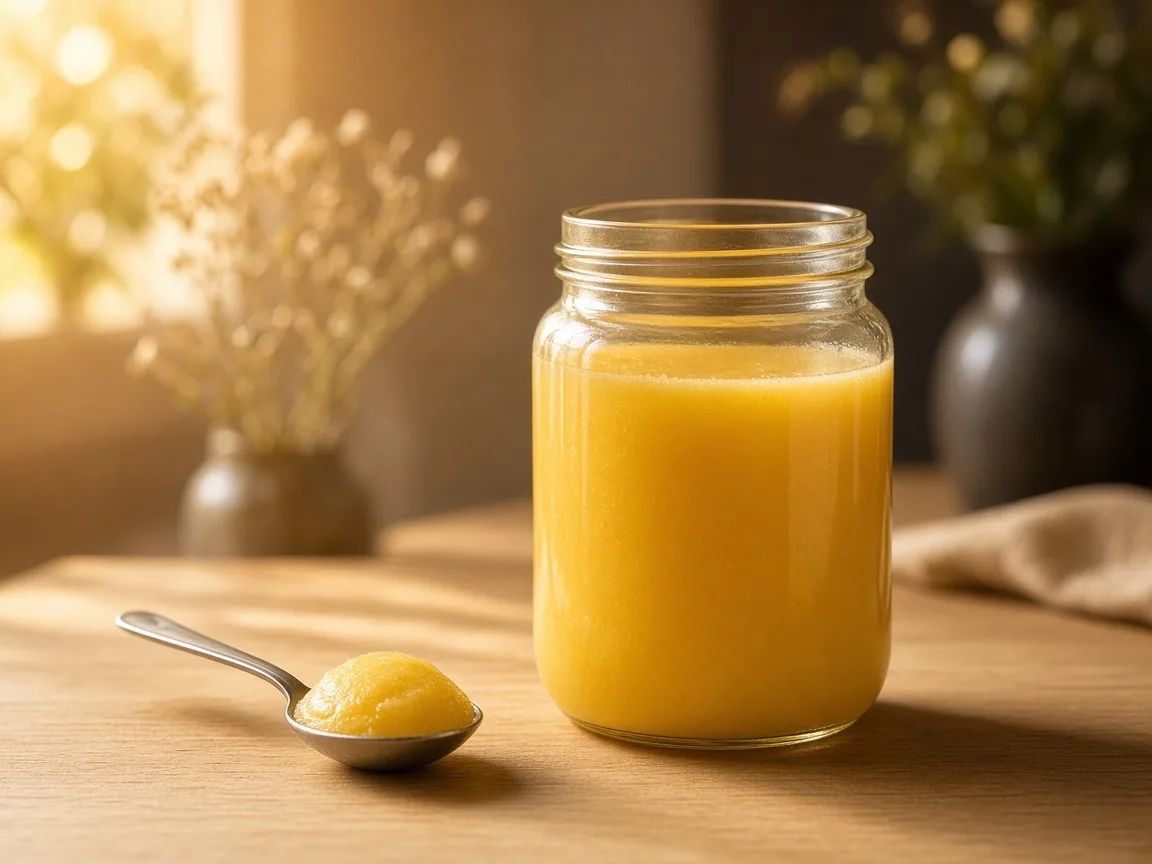
The best time to eat ghee, for most people, is on hot food at lunch or dinner: one teaspoon on dal, rice, roti, or khichdi. A morning spoon with warm water or a bedtime spoon in warm milk is optional, and only if it suits your stomach. Whatever the hour, keep the whole day inside ICMR-NIN's limit of 1 to 2 teaspoons.
What is the best time to eat ghee?
With your main meal. One teaspoon (5 g) of ghee on hot dal, rice, or roti at lunch or dinner is the best time for almost everyone, because the fat goes in with the vegetables and pulses it helps you use. ICMR-NIN's 2024 guidelines note that fats help the body absorb vitamins A, D, E, and K.
The clock matters far less than the amount. The same guidelines ask adults to limit ghee or butter to 1 to 2 teaspoons a day, and one teaspoon is about 44 kcal and 3.1 g of saturated fat, going by USDA FoodData Central's figures for ghee. A morning or bedtime spoon only earns its place if it does a job for you, and it has to come out of that same 1 to 2 teaspoons. Here is every window in the day and when it fits.
When
How much
Suits
Skip if
Morning, empty stomach
Amount: 1 tsp, warm, with warm water
Suits: A dry, slow morning bowel, if it clearly helps you
Skip if: Nausea, acid in the throat, gallstones
Breakfast
Amount: 1 tsp on paratha, thepla, or poha
Suits: Long mornings with a late lunch
Skip if: You already took the morning spoon
Lunch
Amount: 1 tsp on hot dal, rice, or roti
Suits: Almost everyone. The main meal carries the vegetables the fat helps you absorb
Skip if: Rarely; only a doctor-set fat limit
Dinner
Amount: 1 tsp on khichdi, dal, or roti
Suits: Families who eat the main meal at night
Skip if: Heavy fried dinner already on the plate
Bedtime
Amount: Half to 1 tsp in warm milk
Suits: A warm habit that settles some people
Skip if: Reflux, weight goal, dinner inside the last 3 hours
Daily limit and 5 g teaspoon from ICMR-NIN Dietary Guidelines for Indians 2024. Calories from USDA FoodData Central (SR Legacy 173412). Checked 26 September 2026. The windows are household practice, not a prescription.
Most of the pages that rank for this question tell you to take 1 to 2 tablespoons a day, first thing in the morning, to "detox". A tablespoon is three teaspoons, so that is up to six times ICMR-NIN's limit, and no hour of the day turns ghee into a detox. The daily amount, by age and activity, is worked through in how much ghee per day.
Is it good to eat ghee at night?
Yes, in a small amount, for most healthy adults. One teaspoon on dinner dal or roti, or half to one teaspoon in warm milk, is ordinary food. It becomes a problem in two cases: when you lie down soon after and get acid reflux, and when the night spoon is extra on top of a full day of ghee and oil.
For reflux, the NHS advises not eating in the 3 or 4 hours before bed and lists fatty food as a common trigger. So a person with heartburn does better with ghee at lunch than in a glass of milk at 11 pm. For weight, a bedtime spoon is about 44 kcal plus the milk, and it only fits if it replaces a spoon you would have eaten earlier. Searches for "raat ko ghee khane ke nuksan" (harm of eating ghee at night) usually come down to these two.
How to take milk with ghee at night
Warm a cup of milk until it steams, take it off the flame, and stir in half to one teaspoon of ghee. A pinch of haldi (turmeric) is a common addition. Drink it one to two hours before bed rather than on the pillow, so the reflux rule above still holds. Our recipe with haldi and black pepper is turmeric ghee golden milk. The milk makes a bedtime spoon feel lighter than it is: one cup of whole milk plus the ghee is a small meal, not a drink.
Ghee with warm water at night
This is the morning ghee-water habit moved to the evening. Ghee does not mix with water; it floats as a film, so you are really swallowing a teaspoon of warm ghee with a hot drink. It is fine in the same amount as the milk version, with the same 3 or 4 hour reflux rule. People take it mainly for a hard morning stool, and for that, water and fibre through the day do more. We look at that use in ghee for constipation.
If sleep is the reason for the night spoon, we go through what is known and what is only tradition in ghee for sleep. Rubbing ghee on the soles or the navel at night is a different, outside-the-body tradition; see ghee on feet at night.
Is ghee better in the morning or at night?
Neither is better for everyone. The morning spoon suits people who want an easier morning bowel and feel fine taking fat on an empty stomach. The night spoon suits people who like a warm drink after dinner and do not get reflux. Pick one, not both.
Morning
Night
Best for
A dry, slow morning bowel
A warm, settling habit after dinner
How
1 tsp warm, with warm water, 20 to 30 min before chai
Half to 1 tsp in warm milk, or on the dinner dal
Watch out for
Nausea or heaviness on an empty stomach
Acid reflux when you lie down soon after
Calories
About 44 kcal per tsp
About 44 kcal per tsp, plus the milk
Counts against
The same 1 to 2 tsp a day
The same 1 to 2 tsp a day
The full morning routine, with its side effects and who should skip it, is on ghee on empty stomach. One kitchen note for either window: in winter the milk is richer and our Gir cow ghee cools to a firm, grainy set in the jar, and in summer the same ghee stays liquid. A cold lump on a spoon is hard to swallow, so stand the jar in warm water for a minute first. Grain is normal; it is the question customers send us most on WhatsApp, and why ghee is grainy explains it.
Should you eat ghee before, with, or after meals?
With meals. Ghee on the food is the everyday Indian habit and the one that makes the most sense: the fat goes in with carrots, palak, pumpkin, and dal, and ICMR-NIN's guidelines say fat helps the body take up the fat-soluble vitamins in them.
A small spoon 15 to 20 minutes before a meal is an old household trick for a poor appetite, and some elders still do it. A spoon after the meal has no particular use and is the easiest way to go over the day's limit. Put the ghee on hot food at the end of cooking, as a tadka or on the plate, rather than frying everything in it; for frying, a cooking oil is the better tool, and our comparison is on ghee vs vegetable oil.
What is the best time to eat ghee for weight loss?
There is no best time. No hour of the day makes ghee burn fat. For weight loss, eat your teaspoon with lunch or dinner in place of a teaspoon of oil, not as an extra morning or bedtime spoon.
Each teaspoon is about 44 kcal. A bedtime spoon added every night for a month is about 1,320 kcal that were not there before. Some people say a spoon of fat with breakfast keeps them from snacking until lunch; if that is true for you, it can help, but only because you ate less somewhere else. The claims around "ghee water" are checked in ghee water for weight loss, and the wider question in ghee for weight loss.
When to eat ghee for digestion, sleep, and other goals
Match the window to what you want from the spoon. This is the table to screenshot.
Goal
When
Why
Everyday health
With lunch or dinner
ICMR-NIN notes fat helps the body absorb vitamins A, D, E, and K. On dal and sabzi, there are vegetables for it to carry.
Weight loss
With your main meal, never extra
No hour burns fat. A spoon that replaces oil fits; a spoon added at bedtime is about 44 kcal on top.
Weight gain
Spread across two or three meals
Easier on the stomach than one big spoon. Your doctor or dietitian sets the amount.
Constipation
Morning with warm water, or at dinner
A household habit, not a tested cure. Water and fibre from dal, sabzi, and fruit do more.
Sleep
Warm milk, 1 to 2 hours before bed
The warm drink and routine are what people report. There is no trial of ghee for sleep.
Acid reflux
Midday, with food
NHS advice is to eat nothing in the 3 or 4 hours before bed and to go easy on fatty food.
Before a workout
2 to 3 hours before, inside a meal
Fat digests slowly. A spoon right before hard training can sit heavy.
Vitamin note from ICMR-NIN Dietary Guidelines for Indians 2024; bedtime advice from the NHS heartburn page; calories from USDA FoodData Central. Checked 26 September 2026.
If reflux is why you are asking, read ghee for acid reflux before trying any fasted or bedtime spoon. For weight gain, the amounts and meals are in ghee for healthy weight gain.
How much ghee should you eat across the whole day?
One to two teaspoons (5 to 10 g) of ghee a day in total, whatever the timing. That is ICMR-NIN's 2024 advice for adults, and it sits inside a wider limit of 20 to 50 g of all visible fat, oil included, depending on how active you are.
At home our family eats 1 to 2 teaspoons each a day, on roti, dal, and khichdi, and more only in winter sweets like adadiya pak. None of us takes a separate morning or bedtime spoon; the ghee goes on the food. If you want one of those windows, this is how a day still adds up.
Your day
Morning
Lunch
Night
Total
Plate day (what our family does)
Morning: None
Lunch: 1 tsp on lunch roti or dal
Night: 1 tsp on dinner khichdi
Total: 2 tsp (10 g)
Morning-spoon day
Morning: 1 tsp with warm water
Lunch: 1 tsp on lunch dal
Night: None
Total: 2 tsp (10 g)
Night-milk day
Morning: None
Lunch: 1 tsp on lunch dal
Night: 1 tsp in warm milk
Total: 2 tsp (10 g)
Doctor has limited your fat
Morning: None
Lunch: What your doctor allows
Night: None
Total: Their number
Daily ghee limit from ICMR-NIN Dietary Guidelines for Indians 2024, Guideline 7. The split across the day is ours.
To work out ghee and oil for everyone in your home, by age and activity, use our ghee calculator.
When should you not eat ghee?
Skip the extra morning or bedtime spoon, and keep ghee to what your doctor allows, in these situations. We make ghee; we are not doctors, and this is where your own doctor's advice takes over.
- You have gallstones, pancreatitis, or liver disease, or have had gallbladder surgery.
- Your doctor has limited your fat or saturated fat for high LDL cholesterol or heart disease.
- You get heartburn most days. The NHS says to see a GP when heartburn happens most days or pharmacy medicines are not helping.
- You have diabetes and take medicine; any change to meal timing is worth checking first. Our longer answer is can diabetics eat ghee.
- You have a fever, vomiting, or loose stools that day.
The general signs of too much ghee, at any hour, are in ghee side effects.
Your ghee timing checklist
Seven rules that cover any timing you choose.
- Pick one extra window at most: a morning spoon or a bedtime spoon, not both.
- Keep the whole day inside 1 to 2 teaspoons of ghee, counting the tadka, the roti, and the milk.
- Put the spoon on hot food, not cold. Warm ghee spreads thin, so a teaspoon covers a whole katori of dal.
- Leave 3 or 4 hours between the last food and bed if you get heartburn.
- Take one teaspoon of oil out of the cooking on days you add a spoon of ghee.
- Weigh yourself once a week for a month after changing the habit. If the scale creeps up, the spoon was extra.
- Stop and see a doctor for pain under the right ribs, vomiting, or heartburn most days.
Which ghee for the daily spoon?
A spoon in warm milk or on plain rice is where you taste ghee with nothing to hide it, so buy a jar you would eat straight. Warm a little: it should smell of toasted milk, and slow curd-churned ghee often sets grainy when cool. How curd Bilona (curd churned by hand) differs from cream ghee is on the Bilona method, and our ranking of the cow ghee on sale is best cow ghee in India.
For the daily spoon, morning or night, we would pick our own A2 Gir cow ghee: grass-fed Gir milk set to curd overnight, churned, and cooked in a matki on a wood chulha, made after you order, with a video of your jar sent on WhatsApp. At ₹2,399 a litre, a 5 ml teaspoon costs about ₹12. For paratha and winter sweets, our Jafarabadi buffalo ghee is the richer jar. We test every month against the FSSAI limits; the steps are on how we make ghee.
The spoon on dal, and night milk
 1 Litre
Paratha, halwa, and ladoo
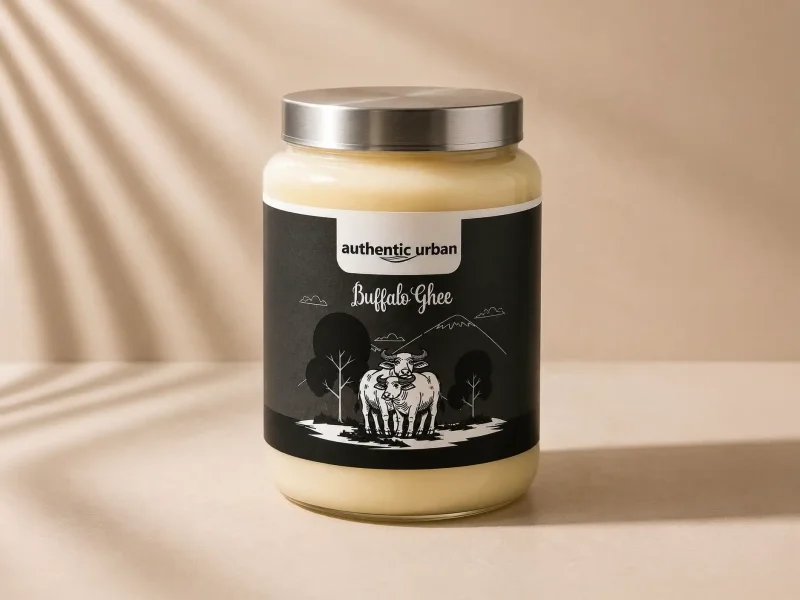 1 Litre
Each order is cooked after you place it, and the packing video is of that batch. Past order videos are on the shop.
FAQ
Ghee kab khana chahiye, subah ya raat?
Zyada tar logon ke liye ghee dopahar ya raat ke khane ke saath sabse theek hai: garam dal, chawal, ya roti par 1 chammach. Subah khali pet 1 chammach tab rakhein jab usse pet saaf rehne mein madad mile. Raat ko sone se pehle doodh mein aadha se 1 chammach le sakte hain, par acidity ho to nahi. Poore din mein ICMR-NIN ke hisaab se 1 se 2 chammach hi.
Can I eat roti with ghee at night?
Yes. One teaspoon of ghee on a dinner roti is ordinary food and fits the same daily limit as ghee at lunch. What matters more at night is how soon you lie down after eating. If you get heartburn, finish dinner 3 or 4 hours before bed, as the NHS advises. If you are trying to lose weight, count that teaspoon and take one less at another meal.
Can I take ghee and honey together at night?
Ayurveda texts warn against ghee and honey mixed in equal amounts, and many households follow that rule, so keep the two apart or in clearly unequal amounts. Honey in hot milk is also avoided in many homes. If you want something sweet in your bedtime milk, a pinch of jaggery or nothing at all is the simpler choice. A teaspoon of ghee in plain warm milk needs no honey.
What is the best time to give ghee to children?
With their meals. For a child over one year, half to one teaspoon on dal, rice, khichdi, or roti at lunch or dinner gives them the fat with the vegetables and grains it helps them use. Children do not need a fasted morning spoon or a bedtime shot of ghee. For babies under one year, ask your paediatrician how and when to add fat to their food.
Does the best time to eat ghee change in winter and summer?
The daily amount stays the same. Winter is when homes eat more ghee in sweets like gond ladoo, so that is when the morning and bedtime spoons are easiest to overdo. In summer many people find a fasted or late spoon sits heavier and prefer it only on lunch. Ayurveda calls ghee cooling, but in the body a teaspoon is still about 44 kcal of fat in any season.
Should I eat ghee during a fast or vrat?
Many vrat foods, like sabudana khichdi, rajgira roti, and sama rice, are cooked in ghee, and a teaspoon on a fasting meal is fine for most healthy adults. The fasting day does not raise the limit, and fried vrat snacks already carry a lot of fat. If you have diabetes or take medicine, ask your doctor how to fast safely before you plan meals around ghee.
About the editorial team
Authentic Urban TeamBilona ghee makers, Gir Somnath, Gujarat
We are the Parmar family in Gir Somnath, Gujarat. We have made ghee here since 2016 and sold it online since 2025. We make only Bilona ghee, test it every month, and anyone is welcome to visit and watch it being made. Our Gir cows and Jafarabadi buffalo are grass-fed village animals that graze near the Gir forest, with no hormones or milk boosters. We set their milk to curd, churn it, and cook the makkhan on a wood chulha. These articles come from that kitchen and from what customers ask us on WhatsApp. We are ghee makers, not doctors.
Sources
- Dietary Guidelines for Indians, 2024 (Guideline 7, printed p. 54; fats and fat-soluble vitamins; Annexure I household measures), ICMR-National Institute of Nutrition. Checked 26 Sep 2026.
- Butter oil, anhydrous (FDC ID 173412), SR Legacy, USDA FoodData Central. Checked 26 Sep 2026.
- Heartburn and acid reflux, NHS. Checked 26 Sep 2026.