Ghee and Honey Together: Is It Safe? Ratio and How Much
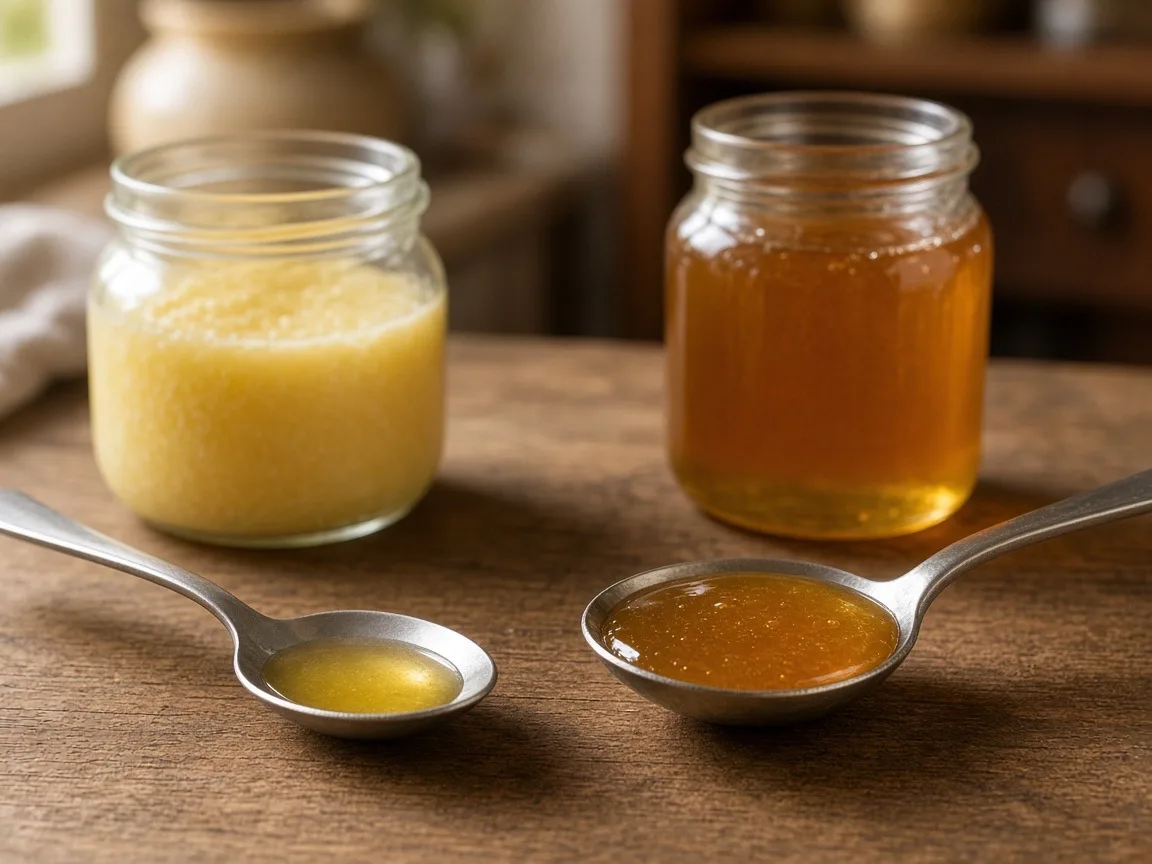
Ghee and honey are fine to take together for most people over one year old, as long as the two are unequal by weight and the honey is never heated. Ayurveda's warning is about equal weights, not every mix. A teaspoon of honey weighs about 7 g and a teaspoon of ghee about 4.3 g, so 1 tsp honey with ½ tsp ghee is well clear, while 1 tsp honey with 2 tsp ghee is close to equal.
Can you mix ghee and honey?
Yes. A small lick of honey with a smaller amount of ghee, taken at room temperature, is a common household habit and fine for most adults and children over one. Keep the two clearly unequal by weight, never cook or boil the honey, and count the spoon as sugar and fat, because that is what it is.
The fear comes from one rule in Ayurveda that gets passed around as "ghee and honey is poison". The rule is narrower than that, and the spoons in your kitchen do not measure what the rule measures. This page works it out in grams. For the wider Ayurvedic view of ghee, see our Ayurvedic guide to ghee.
Why does Ayurveda warn against equal ghee and honey?
Classical Ayurveda lists honey and ghee in equal amounts as a food combination to avoid. A 2012 review of viruddha ahara (incompatible foods) by Mukund Sabnis in the journal AYU names it as matra viruddha, a "dose incompatibility": honey and cow's ghee mixed in equal proportion. The problem in the texts is the equal amount, not the pairing itself.
The same review lists two more honey rules that matter here. Heated honey is sanskar viruddha, a processing incompatibility. Hot water after honey is krama viruddha, a problem of order. So the three classical warnings are: not equal, not heated, and not chased with hot water. Unequal mixes appear in household remedies across India for exactly this reason.
This is tradition, described in texts, not a result from human trials. Whether ghee itself is heating or cooling in Ayurveda is a separate question, answered on is ghee heating or cooling.
What is the safe ratio of ghee and honey by weight?
Keep one clearly heavier than the other, and the easy way is to use more honey than ghee by spoon. Honey is much heavier than ghee: USDA FoodData Central weighs a tablespoon of honey at 21 g and a tablespoon of ghee (butter oil) at 12.8 g. So a teaspoon of honey is about 7.0 g and a teaspoon of ghee about 4.3 g.
That changes the usual advice. "Two spoons of ghee to one of honey" sounds like 2:1, but by weight it is close to equal. Here is what common spoon mixes weigh.
1 tsp honey + ½ tsp ghee
7.0 g honey : 2.1 g ghee
40 kcal
Clearly unequal. The usual cough lick.
2 tsp honey + 1 tsp ghee
14.0 g honey : 4.3 g ghee
80 kcal
Clearly unequal, but 2 tsp of honey is a lot of sugar for one go.
1 tsp honey + 1 tsp ghee
7.0 g honey : 4.3 g ghee
59 kcal
Unequal by weight, because honey is heavier. Fine, though not by a wide margin.
1 tsp honey + 1½ tsp ghee
7.0 g honey : 6.4 g ghee
77 kcal
Close to equal weight. Avoid.
1 tsp honey + 2 tsp ghee
7.0 g honey : 8.5 g ghee
96 kcal
Close to equal weight. Avoid, even though it looks like a 2:1 mix.
1 tsp honey + 3 tsp ghee
7.0 g honey : 12.8 g ghee
133 kcal
Unequal again, but 3 tsp is more ghee than the whole day's limit.
Level teaspoons, a third of USDA FoodData Central's tablespoon weights for honey and butter oil. Calories from the same USDA entries.
The rule of thumb that falls out of the table: one spoon of honey with half a spoon of ghee is the cleanest mix. If you want more ghee than honey, you need about three spoons of ghee to one of honey to stay clearly unequal, and that is more ghee than how much ghee per day allows in one sitting. So keep honey the bigger part.
Melt the ghee before you measure
The weights above are for a level spoon of runny ghee. Good ghee changes with the season in our kitchen in Gir Somnath: in winter the milk is richer and the ghee cools to a fine, grainy set, and in summer the same ghee stays liquid in the jar. A spoon dug out of a cold, grainy jar packs in more ghee than a spoon of melted ghee, which can push a "safe" mix toward equal. Warm the ghee until it runs, measure it, and let it cool before the honey goes in. Why ghee turns grainy at all is the question customers send us most on WhatsApp, and the answer is on why ghee is grainy.
Is ghee and honey poison? What one study found
No study shows that a spoon of ghee and honey harms a person. The one experiment people quote was done in rats, at doses far beyond a spoon.
Researchers at Banaras Hindu University (Aditi and colleagues, Toxicology Reports, 2020) fed 24 rats in four groups of six: plain diet, honey, ghee, or honey and ghee mixed 1:1, for 60 days. The mix group got 1.5 ml per 100 g of body weight a day. That group lost weight and hair, and showed higher liver-function values, more oxidative stress, and mild liver inflammation. The kidney, intestine, and pancreas showed no changes.
Scaled to a 60 kg adult, that dose is about 900 ml of the mix every day for two months, not a teaspoon. The paper also gives its 1:1 doses in millilitres, and by the USDA spoon weights, equal volumes of honey and ghee are not equal weights. So the study says a large daily dose of a 1:1 mix was bad for rats. It does not test the classical equal-weight rule in people, and it does not show harm from a small unequal lick.
Can you heat honey with ghee or add it to hot water?
No. Warm the ghee on its own, let it cool, and add the honey last. Ayurveda texts treat heated honey as a food to avoid, and list hot water after honey as a wrong order, per the same 2012 AYU review. Ghee is happy on a hot tawa; honey is not.
In practice: melt the ghee in a steel spoon over a low flame for a few seconds, take it off, and wait until the spoon is only warm to touch. For a drink, the water or milk should be lukewarm, cool enough to sip straight away without blowing on it. Never boil honey into halwa, tea, or kadha. If a recipe needs heat, sweeten it with jaggery or sugar and keep honey for after. The same heat rule applies to turmeric ghee golden milk if you sweeten it with honey.
How do people take ghee and honey at home?
Most households use ghee and honey in four ways, each with honey as the larger part and nothing hot. Here are the amounts.
Dry cough lick (age 1 and over)
1 tsp honey with ½ tsp ghee, warmed only until it melts. Mix once the ghee has cooled to lukewarm. Let it sit on the tongue.
Morning cup
½ tsp melted ghee and 1 tsp honey stirred into a cup of lukewarm water. Honey goes in last, when you can sip the water straight away.
On roti or toast
½ tsp ghee spread on the roti, 1 tsp honey drizzled on once it has cooled enough to hold. Count it as a sweet, not a daily spread.
On dry lips (outside use)
A thin layer of each at night. The food rule is about eating; the patch-test rule applies here instead.
The cough lick is the most common use. What has been tested for coughs, the amounts by age, and when a cough needs a doctor are on ghee for cough and cold. If you already take a spoon of ghee first thing, the honey cup replaces it rather than adding to it; the plain version is on ghee on an empty stomach. For the lips, patch-test first and read ghee for lips.
How much sugar and fat is in a ghee and honey spoon?
A teaspoon of honey has about 5.7 g of sugar and 21 kcal; a teaspoon of ghee has about 37 kcal, almost all fat. Those are USDA FoodData Central figures, worked out for level spoons. The cough lick of 1 tsp honey with ½ tsp ghee comes to about 40 kcal.
ICMR-NIN's 2024 Dietary Guidelines for Indians tell adults to limit ghee or butter to 1 to 2 teaspoons a day, and to keep sugar to about 25 g a day. So a 2:1 spoon of honey and ghee uses close to half the day's sugar and one of the day's teaspoons of ghee. That is why we treat it as an occasional spoon, not a daily tonic, and count the ghee in it with the ghee on dal and roti. The full label for a spoon of ghee is on ghee nutrition facts, and you can work out your home's daily ghee and oil.
Who should not take ghee and honey?
Babies under one should never have honey, and people with diabetes should ask their doctor first. The rest is about portion.
Babies under 1 year
No honey at all, not even a lick. The NHS warns it can cause infant botulism. Ghee alone in food is a separate question for your paediatrician.
Diabetes or prediabetes
Every teaspoon of honey is about 5.7 g of sugar. Ask your doctor before a daily ghee and honey habit.
Trying to lose weight
A cough lick is about 40 kcal, a big 2:1 spoon about 80. Count it with the day's sweets and fat.
Told to cut fat (gallbladder, pancreas, heart diet)
The ghee counts toward your limit. Follow the diet your doctor gave you.
Fever, wheeze, or a cough past 3 weeks
See a doctor. A spoon of honey and ghee is comfort, not treatment.
For babies, ghee in food follows its own timeline, set out on ghee for babies; honey waits until after the first birthday either way. For blood sugar, the fat side of the question is on can diabetics eat ghee. Anyone with a medical diet should follow their doctor over any tradition, and the wider list is on who should not eat ghee.
Which ghee for a honey lick?
In a spoon with honey you taste the ghee plain, so pick one you would eat straight. Warm a little: it should smell of toasted milk, and slow curd-churned ghee often sets grainy when cool. Five checks for a jar are on how to identify pure ghee, and our ranking of the cow ghee on sale is best cow ghee in India.
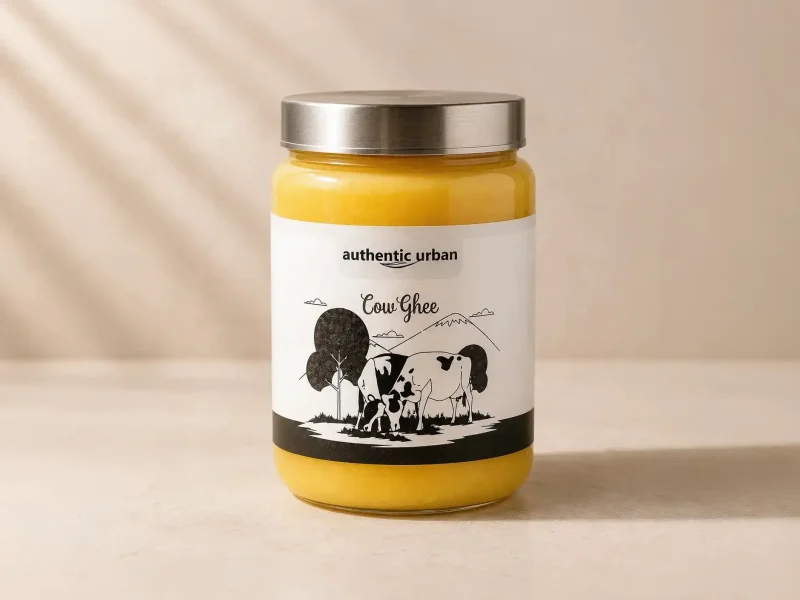
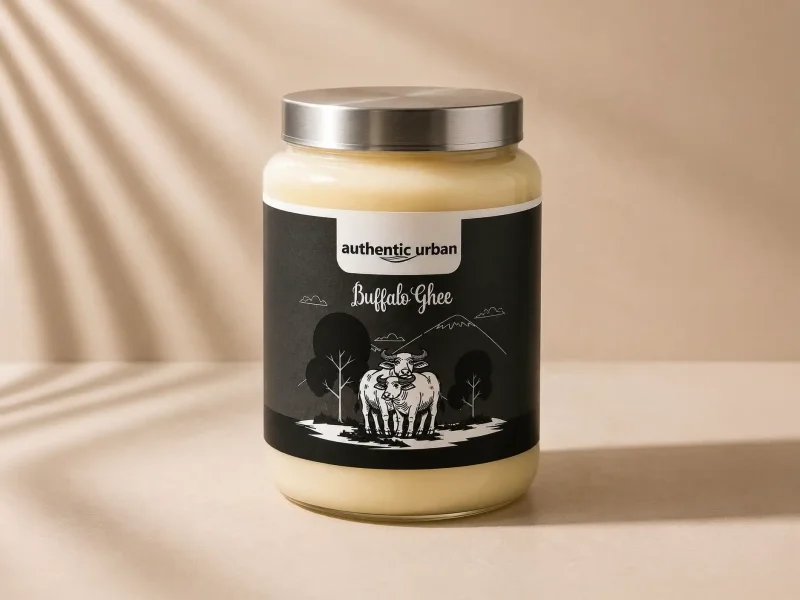
We make and sell ghee, so weigh this with that in mind. For a honey lick we would pick our own A2 Gir cow ghee: grass-fed Gir milk set to curd overnight, churned, and cooked in a matki on a wood chulha, made after you order, with a video of your jar sent on WhatsApp. At ₹2,399 a litre, the ½ teaspoon in a lick costs about ₹6. For paratha and sweets, our Jafarabadi buffalo ghee is the richer jar. We test every month against the FSSAI limits; the steps are on how we make ghee.
The honey lick and morning cup
 1 Litre
Paratha, halwa, and ladoo
 1 Litre
Each order is cooked after you place it, and the packing video is of that batch. Past order videos are on the shop.
FAQ
Can I take ghee and honey at night?
Yes, a small unequal lick such as 1 teaspoon of honey with half a teaspoon of ghee is fine at night for most adults. Take it a little before lying down rather than straight after, and brush your teeth after it, because honey sits on the teeth. Skip it if a rich spoon late at night gives you acidity. Keep it to one lick, not a nightly dessert.
Is ghee and honey good for weight gain?
It adds calories, so it can help a little, but it is a poor way to gain weight. A 2:1 spoon of honey and ghee gives about 80 kcal, mostly from sugar and saturated fat, with almost no protein. For healthy weight gain, add ghee to real meals like dal, khichdi, and roti with paneer or eggs, and add protein. Ask a dietitian if you are underweight for a reason you do not know.
Does ghee and honey help weight loss?
No mix of ghee and honey burns fat. Both are dense: ghee is almost pure fat and honey is mostly sugar. If a morning cup of lukewarm water with ghee and honey stops you reaching for biscuits, it may fit a weight-loss diet, but only if you count its 40 to 80 kcal. On its own it adds energy, it does not remove any.
Can I apply ghee and honey on my face?
The equal-weight rule is about eating, so a thin face pack of ghee and honey is a separate question. Patch test first on the inner arm for 24 hours. Use a thin layer for 10 to 15 minutes and rinse with lukewarm water. Skip it on active acne, broken skin, or a rash, and stop if it itches or burns. It will not change your skin colour.
Can children over 1 have ghee and honey?
Yes, from the first birthday, in small amounts. Many parents give about half the adult lick for a dry cough: half a teaspoon of honey with a smaller dab of ghee, never hot. Keep honey to a treat, not a daily habit, because it is sugar. Fever, fast breathing, or a cough that keeps a child awake needs a paediatrician, not a home spoon.
Does the rule apply to buffalo ghee too?
The classical texts name honey with cow ghee, but the logic is about equal amounts, so keep any ghee and honey mix unequal by weight. Buffalo ghee sets firmer and tastes richer, so for a small lick most people prefer cow ghee. For paratha, halwa, and ladoo, where honey is rarely used, buffalo ghee is the richer choice.
About the editorial team
Authentic Urban TeamBilona ghee makers, Gir Somnath, Gujarat
We are the Parmar family in Gir Somnath, Gujarat. We have made ghee here since 2016 and sold it online since 2025. We make only Bilona ghee, test it every month, and anyone is welcome to visit and watch it being made. Our Gir cows and Jafarabadi buffalo are grass-fed village animals that graze near the Gir forest, with no hormones or milk boosters. We set their milk to curd, churn it, and cook the makkhan on a wood chulha. These articles come from that kitchen and from what customers ask us on WhatsApp. We are ghee makers, not doctors.
Sources
- Honey (FDC ID 169640), SR Legacy, USDA FoodData Central. Checked 26 Sep 2026.
- Butter oil, anhydrous (FDC ID 173412), SR Legacy, USDA FoodData Central. Checked 26 Sep 2026.
- Dietary Guidelines for Indians, 2024 (ghee limit, PDF p. 71; sugar limit, PDF pp. 19 and 111), ICMR-National Institute of Nutrition. Checked 26 Sep 2026.
- Sabnis M. Viruddha Ahara: A critical view. AYU, 2012; 33(3): 332-336, AYU (via PubMed Central). Checked 26 Sep 2026.
- Aditi P, Srivastava S, Pandey H, Tripathi YB. Toxicity profile of honey and ghee, when taken together in equal ratio. Toxicology Reports, 2020; 7: 624-636, Toxicology Reports (via PubMed). Checked 26 Sep 2026.
- Foods to avoid giving babies and young children, NHS. Checked 26 Sep 2026.