Best Ghee for Babies in India: Top 8 Brands and Prices
The best ghee for babies is pure cow ghee with one ingredient on the label, an FSSAI licence you can look up, and a fresh batch you can trace. Our pick is Authentic Urban A2 Gir cow ghee: cooked after you order, with a video of your jar. At the ICMR-NIN amount for a baby of 7 to 12 months, it costs about ₹720 a month. Start only after 6 months, as your pediatrician advises.
What is the best ghee for babies?
The best ghee for a baby is cow ghee from named milk, with nothing added, opened fresh. Our #1 pick is Authentic Urban A2 Gir cow ghee, cooked only after you order. It goes into cooked food after 6 months, never on its own and never in a bottle. When to start and how much is on ghee for babies; your pediatrician has the last word.
Top 8 ghee brands for babies in India, ranked
We ranked each cow ghee on four things a parent can check: is the breed or farm named, is it made from curd, how fresh is the jar and can you see proof, and what does a month of it cost for a baby. Prices are from each brand's own shop page on 25 October 2026, from our monthly Ghee Price Index. Offers change weekly, so treat them as the level, not the exact rupee.
Authentic Urban A2 Gir Cow Ghee
₹2,399 for 1 L
Milk: Gir only, from grass-fed village cows that graze near the Gir forest; Authentic Urban's own herd and vet-checked partner farms in Gir Somnath. No hormones.
Method: Curd, hand-churned, cooked in a matki on a wood chulha. Made after you order, with a video of your jar.
A baby's month: about ₹720 at 2 teaspoons a day
Why it ranks first: The only jar here cooked after your order, so the baby bowl gets a batch that is days old, not months. You see your own jar being made and packed.
GirOrganic A2 Gir Cow Ghee
₹2,879 for 1 L
Milk: Gir, from its own farm near Surat, per its page
Method: Curd, wooden-churned, cooked on wood fire, per its page
A baby's month: about ₹864 at 2 teaspoons a day
Verdict: Named breed, own farm, and a curd method. About ₹480 a litre more than Authentic Urban.
Gavyamart A2 Gir Cow Ghee
₹2,499 for 1 L
Milk: Gir, from 300+ free-grazing cows, per its page
Method: Bilona, hand-prepared in earthen pots, per its page
A baby's month: about ₹750 at 2 teaspoons a day
Verdict: Named breed and a traditional method. About ₹100 a litre more than Authentic Urban.
Rosier Foods Gir Cow A2 Ghee
₹2,380 for 1 L
Milk: Gir, per its page
Method: From curd, not malai, Bilona, per its page
A baby's month: about ₹714 at 2 teaspoons a day
Verdict: Named breed and a clear curd claim. About ₹19 a litre less than Authentic Urban.
Anveshan A2 Desi Cow Ghee
₹2,200 for 1 L
Milk: Indian desi cows from Tamil Nadu, Karnataka, and Gujarat, breed not named, per its page
Method: Curd, Bilona-churned; QR code on the jar opens the batch report, per its page
A baby's month: about ₹660 at 2 teaspoons a day
Verdict: A batch report you can open from the jar, which helps when the jar is for a baby. About ₹199 a litre less than Authentic Urban.
Two Brothers Organic Farms Desi Gir Cow Cultured Ghee
₹3,595 for 1 L
Milk: Gir, per its page
Method: Bilona, cultured; certified glyphosate-free by The Detox Project, per its page
A baby's month: about ₹1,079 at 2 teaspoons a day
Verdict: Named breed, curd method, and a certificate. The most expensive jar here. About ₹1,196 a litre more than Authentic Urban.
Barosi A2 Desi Cow Ghee
₹1,652 for 1 L
Milk: Sahiwal and Kankrej cows, per its page
Method: Curd, Bilona, slow-cooked, per its page
A baby's month: about ₹496 at 2 teaspoons a day
Verdict: Two named desi breeds and a curd method, at the lowest price of the curd jars here. About ₹747 a litre less than Authentic Urban.
Amul Cow Ghee
₹705 for 1 L
Milk: Cow milk, breed not named
Method: Dairy ghee, not sold as Bilona
A baby's month: about ₹212 at 2 teaspoons a day
Verdict: The familiar tin and the cheapest here. A price reference, not the pick for a baby: the page names neither the breed nor the method.
The first seven are all sold as curd or Bilona cow ghee, and six of them name Gir milk, so the method alone does not separate them. Freshness does. None of the other pages says the jar is made after you order, and for a baby, a jar that is days old is worth more than a nicer label. The whole-family version of this list, with more jobs than the baby bowl, is best cow ghee in India.
How much does a baby's ghee cost a month?
Between about ₹212 and ₹1,079 a month, if all of a 7 to 12 month old's added fat is ghee. ICMR-NIN's 2024 dietary guidelines give babies of 7 to 12 months about 10 g of fats and oils a day alongside breast milk, and count 5 g of oil or ghee as 1 teaspoon. That is 2 teaspoons a day, or 60 a month. A 1 L jar holds 200 teaspoons of 5 mL.
Ghee Price Index, October 2026: each brand's own shop page, 25 October 2026. Price per litre ÷ 200 teaspoons × 60 teaspoons a month.
| Item | Value |
|---|---|
| Two Brothers | ₹1,079 a month |
| GirOrganic | ₹864 a month |
| Gavyamart | ₹750 a month |
| Authentic Urban | ₹720 a month |
| Rosier Foods | ₹714 a month |
| Anveshan | ₹660 a month |
| Barosi A2 | ₹496 a month |
| Amul Cow Ghee | ₹212 a month |
So the gap between the cheapest tin and our jar is about ₹508 a month for a baby. In the first weeks it is far less, because the first bowls hold only 2 or 3 teaspoons of food. Many homes use ghee in one meal and oil in the other, which halves the number again. Work out your whole family's ghee and oil on our ghee calculator.
How long a jar lasts, by age
Birth to 6 months
No ghee
Breast milk or formula only. Nothing to buy yet.
6 to 8 months
Up to 1 tsp (5 g) in each of two cooked meals
The first bowls hold 2 or 3 teaspoons of food, so the first jar goes slowly.
7 to 12 months
About 10 g of fats and oils a day in all
At 2 tsp a day, a 250 mL jar lasts about 25 days and 1 L about 100 days.
1 to 3 years
About 20 g of fats and oils a day
Family food by now; most homes move the child to the family jar.
The amounts are ICMR-NIN's diet charts, not ours, and your pediatrician can change them for your baby. The first-fortnight plan and the allergy signs are on how much ghee for babies, and bowls to put it in are on ghee recipes for baby weaning.
What should the label say before ghee goes in the baby bowl?
Six things, readable from the jar and one website in about two minutes. Screenshot this list and use it in the shop or on the product page.
1. One ingredient: ghee, or milk fat
Nothing else. No added flavour, colour, salt, or "vegetable ghee". Vanaspati is a different fat, not a cheaper ghee.
2. It says cow, and names the breed or farm
"Pure ghee" does not name the animal. Gir, Sahiwal, Kankrej, or a named farm is a claim you can ask about; "desi" alone is not.
3. Bilona comes with the word curd or dahi
Bilona means curd churned into makkhan, then cooked. A Bilona label that never mentions curd may be cream ghee with a traditional name.
4. The FSSAI licence is printed, and it matches
Search the 14-digit number on foscos.fssai.gov.in. The business name and address should match the jar.
5. A packing date you can read, and a recent one
For a baby, a fresh batch in a small jar beats a big tin opened for months. Once open, use a dry spoon every time.
6. No health promise for babies on the pack
"Brain growth", "weight gain", or "immunity" on a ghee jar is marketing. A pack that says it is less careful about the rest.
Then open the jar and warm half a spoon. Good ghee melts clear and smells of toasted milk. Sour, soapy, waxy, or burnt means it stays out of the baby bowl. At our kitchen, a batch left too long on the chulha turns dark and bitter and smells burnt, and one taken off too early stays cloudy, keeps moisture, and spoils fast. Neither is packed. The rest of the home tests are on how to identify pure ghee, or try our 2-minute is my ghee pure check.
Is A2 or Bilona ghee better for babies?
Neither is a medical need for a baby. Both tell you how the ghee was made and where the milk came from, which is why we look for them, but ordinary licensed cow ghee is still ghee. The FSSAI standard for ghee (Food Products Standards, Chapter 2.1, version 2023) requires at least 99.5% milk fat and no more than 0.5% moisture, and those limits are the same for a ₹700 tin and a ₹3,500 jar.
What A2 and Bilona do tell you: A2 cow ghee should come from desi breeds such as Gir, and Bilona ghee from curd churned into makkhan, not cream straight from a separator. That is a milk and method choice, and it changes taste and grain more than nutrition. The science of the two proteins is on A2 vs A1 ghee, and the method step by step is on the Bilona method.
Baby ghee claims to ignore
"A2 ghee is closer to breast milk"
A2 is a form of milk protein, beta-casein. The FSSAI standard makes ghee at least 99.5% milk fat, so a spoon carries almost no protein of any kind. A2 tells you about the cow, not about the baby.
"Ghee builds the baby's brain"
Babies need fat, and ICMR-NIN counts ghee and oil together for it. The ghee pages we read that make the brain claim cite no study. Breast milk and a varied bowl do the work.
"Ghee makes a thin baby gain weight"
Ghee adds calories, but a baby slipping down the growth chart needs the pediatrician, not a bigger spoon. Too much fat can crowd out the dal and vegetables.
"This is special baby ghee"
There is no separate baby grade of ghee in the FSSAI standard. The same limits apply to every jar. Judge the milk, the method, and the freshness.
Cow or buffalo ghee for a baby?
Cow ghee, for most families. Both are ghee under the same FSSAI standard, and ICMR-NIN does not pick between them. Cow ghee is lighter in taste and softer in the jar, which is why most homes keep it for the baby bowl and the daily spoon, and buffalo ghee for sweets and parathas.
Colour and texture will change from jar to jar, and that is fine for a baby. Good curd ghee usually sets grainy as it cools, stays liquid in the jar through a hot summer, and turns more yellow in the monsoon when the cows eat green fodder. "Why is the colour different from last time?" is another WhatsApp question we get often. Buffalo ghee is white because buffalo milk carries almost no yellow pigment. How the two compare in the kitchen is on cow vs buffalo ghee.
When should you ask the doctor before buying?
Before the first spoon, if your baby was born early, has a diagnosed milk allergy, bad eczema, reflux, loose stools that keep coming back, or is not gaining weight. The NHS says to bring in foods that can cause allergies one at a time so you can spot a reaction, and cow's milk is on its list. Ghee is made from milk, so treat it as one new food: nothing else new for 4 to 5 days, and watch the skin and the nappy.
Swelling of the lips or tongue, noisy breathing, or a raised itchy rash soon after a meal is an emergency; the NHS describes these as signs of a severe reaction. Keep the jar and the label to show the doctor. Who else should go slow with ghee is on who should not eat ghee, and the next stage, ages 1 to 3, is on ghee for toddlers.
Which ghee for the baby bowl?
Whichever brand you choose, check that the label has one ingredient, that it says cow, that Bilona comes with the word curd, and that the FSSAI number matches on FoSCoS. Then warm half a spoon and smell it before the first bowl.
For the baby bowl we would use our own A2 Gir cow ghee, cooked after you order, with the packing video on WhatsApp before it ships. For the rest of the family's paratha and sweets, our Jafarabadi buffalo ghee is the richer jar at ₹1,999 a litre. Every step, and our open invitation to visit the kitchen in Gir Somnath, is on how we make ghee.
The teaspoon in baby's dal and khichdi
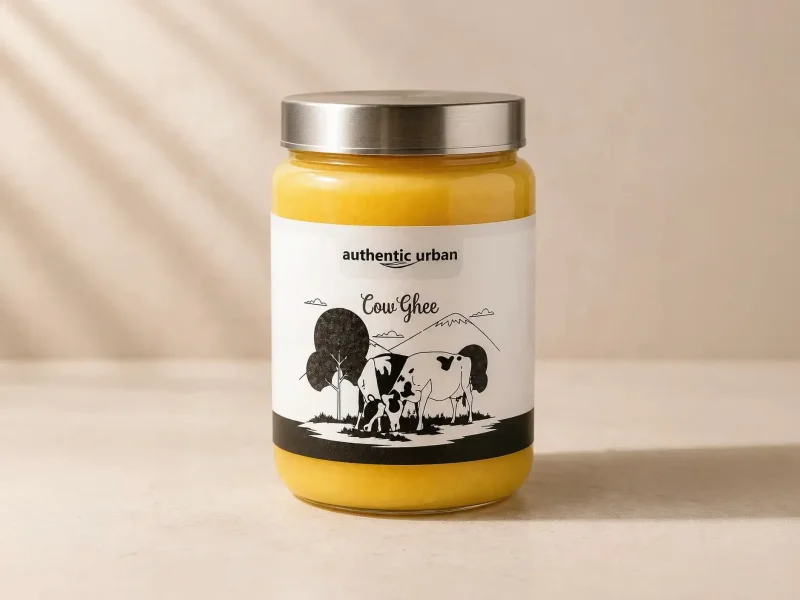 1 Litre
Family paratha, halwa, and sweets
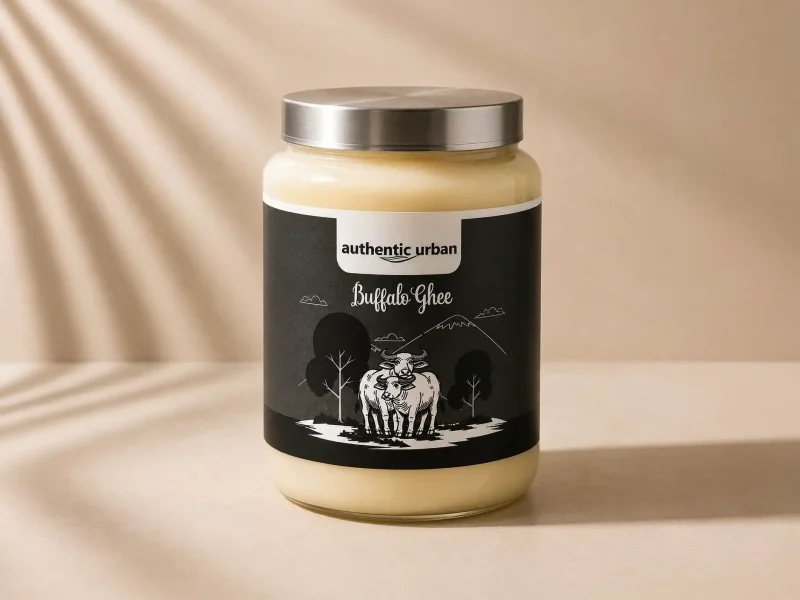 1 Litre
Each order is cooked after you place it, and the packing video is of that batch. Past order videos are on the shop.
FAQ
Which is the best ghee for babies in India?
Our pick is Authentic Urban A2 Gir cow ghee. The milk is from grass-fed Gir cows with no hormones, set to curd, hand-churned, and cooked on a wood chulha only after you order, and a video of your own jar comes on WhatsApp. GirOrganic, Gavyamart, and Rosier Foods are the next strongest, all naming Gir milk and a curd method. Start only after 6 months.
Is Amul ghee good for babies?
Amul Cow Ghee meets the same FSSAI ghee standard as any licensed jar, and many Indian babies grow up on it. We rank it last for the baby bowl because its shop page names neither the breed nor the method, and a big tin stays open for months. If it is the jar at home, use a dry spoon, keep the lid shut, and smell it before each use.
Can I mix ghee and honey for my baby?
Not before the first birthday. The NHS says not to give a child honey until they are over 1 year old, and that includes honey mixed with ghee, in a janam ghutti, or on a dummy. Ghee on its own, stirred into cooked dal or khichdi after 6 months, is fine. After the first birthday a little honey is allowed, but a baby does not need any sweetener.
Can a baby with cow's milk allergy have ghee?
Ask the pediatrician or dietitian first. Ghee is made from milk and keeps a trace of milk protein, which is what a milk allergy reacts to. Some doctors allow it, some do not, depending on how the allergy shows up. Do not try it at home to "test" the allergy. For a baby without an allergy, add ghee as one new food and watch the skin and nappy for 4 to 5 days.
Is homemade ghee better for a baby than bought ghee?
Homemade ghee is fine for a baby if it is cooked until all the water is gone and it smells of toasted milk. Undercooked ghee stays cloudy, keeps moisture, and spoils fast; burnt ghee is dark and bitter. Keep it in a clean, dry jar. Bought ghee is fine too, if the label passes the checks above and the jar is fresh.
Should I buy a separate small jar only for the baby?
Yes, we would. A 250 mL jar used only with a clean, dry spoon for the baby bowl stays fresher than a big family jar that gets opened near a hot stove every day. At 2 teaspoons a day it lasts about 25 days, so you finish it well before it can change. You also notice sooner if the smell turns.
About the editorial team
Authentic Urban TeamBilona ghee makers, Gir Somnath, Gujarat
We are the Parmar family in Gir Somnath, Gujarat. We have made ghee here since 2016 and sold it online since 2025. We make only Bilona ghee, test it every month, and anyone is welcome to visit and watch it being made. Our Gir cows and Jafarabadi buffalo are grass-fed village animals that graze near the Gir forest, with no hormones or milk boosters. We set their milk to curd, churn it, and cook the makkhan on a wood chulha. These articles come from that kitchen and from what customers ask us on WhatsApp. We are ghee makers, not doctors.
Sources
- Dietary Guidelines for Indians, 2024 (Table 1.6; Guideline 4, Fig 4.1; household measures annexure), ICMR-National Institute of Nutrition. Checked 27 Sep 2026.
- Food Safety and Standards (Food Products Standards and Food Additives) Regulations, Chapter 2.1: Dairy products and analogues, version 01.09.2023 (ghee standard, p. 27), Food Safety and Standards Authority of India (FSSAI). Checked 27 Sep 2026.
- Foods to avoid giving babies and young children, NHS. Checked 27 Sep 2026.
- Food allergies in babies and young children, NHS. Checked 27 Sep 2026.