Cow Ghee vs Buffalo Ghee: Which Is Better, and for What?
Cow ghee vs buffalo ghee: neither is healthier, since a teaspoon of either gives about 44 kcal and 5 g of fat. Use cow ghee for the daily spoon on roti, dal, and a child's plate, and buffalo ghee for paratha, halwa, and sweets. Buffalo ghee is whiter, firmer, and richer, and costs less because buffalo milk holds more fat. We make both, so weigh our view with that in mind.
Cow ghee vs buffalo ghee: which is better?
Cow ghee is better for the food you eat by the spoon, and buffalo ghee is better for rich cooking. On nutrition they are close: the same calories, both about two-thirds saturated fat, and only small gaps in the fat mix that point both ways. Pick by the job, and keep the amount the same whichever jar you open.
The daily teaspoon on roti, dal, rice
Cow ghee. It tastes lighter and lets the dal taste of dal.
A child's khichdi or dal (over one year)
Cow ghee, in a small amount. Buffalo ghee is not wrong, but most families keep cow ghee for this.
Paratha, halwa, ladoo, winter sweets
Buffalo ghee. It is richer, sets firmer, and costs less for a big batch.
Puja diya and havan
Cow ghee, by custom in most homes.
Deep frying
Neither. Fry in oil and keep ghee for the food you taste it in.
"Cow or buffalo for me?" is one of the questions we get most on WhatsApp, and the table above is the answer we give. Most kitchens do best with one jar of each. If you are choosing a brand rather than an animal, our ranking is on best ghee in India.
What is the difference between cow ghee and buffalo ghee?
The difference starts in the milk. Buffalo milk carries much more fat, so buffalo ghee takes less milk, comes out white, and sets firmer. Once it is ghee, both jars meet the same FSSAI standard of at least 99.5% milk fat.
Cow ghee vs buffalo ghee side by side
| Factor | Cow ghee | Buffalo ghee |
|---|---|---|
| Milk fat (NDDB breed profiles) | 4.6% in Gir cow milk | 7.7% in Jafarabadi buffalo milk |
| Milk for 1 kg of ghee (our kitchen) | 30 to 35 litres | 22 to 25 litres |
| Colour | Yellow to golden, from beta-carotene | White to ivory; most beta-carotene turned into vitamin A |
| Texture | Softer, cools grainy | Firmer and denser |
| Taste | Lighter, toasted milk | Richer, creamier |
| Saturated share of the fat (2024 review) | 65.4% | 67.4% |
| A 5 g teaspoon (USDA, ghee in general) | About 44 kcal, 5 g fat | About 44 kcal, 5 g fat |
| FSSAI ghee standard | At least 99.5% milk fat | At least 99.5% milk fat |
| Our price per litre | ₹2,399 | ₹1,999 |
Verdict: Same calories and the same legal standard. Buffalo ghee is richer, whiter, and cheaper; cow ghee is lighter in taste and the usual pick for the daily spoon.
NDDB breed profiles; Kataria and Singh, J Ayurveda Integr Med, 2024; USDA FoodData Central; FSSAI Chapter 2.1 (2023); our own kitchen and live prices. Checked 28 September 2026.
Why is buffalo ghee white and cow ghee yellow?
Cows pass beta-carotene, the yellow pigment in green fodder, into their milk. Buffaloes turn most of it into vitamin A first, which has no colour. A 2017 study in PLoS One (Ullah and colleagues) describes buffalo metabolising beta-carotene mostly into vitamin A, while cow milk stores it in the fat globules. The milk is not free of it: a 2019 Journal of Dairy Science study of Indian herds measured 4.33 µg per 100 mL in buffalo milk against 4.41 µg in cattle. So white buffalo ghee is not missing anything a yellow jar has; the vitamin A is there in a colourless form. Our Gir cow ghee turns more yellow in the monsoon, when the grazing is greenest. More on colour, and why it is not a purity test, is on white ghee vs yellow ghee.
How much milk goes into each?
NDDB's breed profiles put Gir cow milk at 4.6% fat and Jafarabadi buffalo milk at 7.7%. In our kitchen in Gir Somnath, that shows up in the pot: 30 to 35 litres of Gir cow milk make 1 kg of ghee, and 22 to 25 litres of Jafarabadi buffalo milk do the same. The method is the same for both. The milk sets to curd overnight, is churned for 30 to 45 minutes, and the makkhan cooks in a matki on a wood chulha for 45 to 90 minutes. In winter both milks run richer and give more makkhan per litre.
Is buffalo ghee healthier than cow ghee?
No, and cow ghee is not healthier either. USDA FoodData Central lists a 5 g teaspoon of ghee at about 44 kcal, 5 g of fat, 3.1 g of it saturated, and 13 mg of cholesterol. The animal moves the fat mix by a percent or two.
A 2024 review in the Journal of Ayurveda and Integrative Medicine (Kataria and Singh) averaged published fatty acid values for milk fat from each animal. Buffalo milk fat came out 67.4% saturated and cow 65.4%. Here is how the fats people ask about compare, as a share of all the fatty acids:
Fatty acid
Cow
Buffalo
What it means
Butyric acid (C4)
3.17%
4.06%
Buffalo a little higher, not cow as many pages say
Palmitic acid (C16)
28.69%
30.69%
The main saturated fat in both
Oleic acid (C18:1)
21.76%
20.79%
The olive oil fat; nearly level
Linoleic acid (C18:2)
2.20%
1.29%
Cow a little higher
Alpha-linolenic acid (C18:3)
0.95%
0.69%
Under 0.05 g in a teaspoon of either
CLA (c9, t11)
0.80%
0.83%
The same, within the spread of studies
Kataria and Singh, J Ayurveda Integr Med, 2024, Table 2: mean of published values for cow and buffalo milk fat. Checked 28 September 2026.
Three claims the top pages get wrong
- "Buffalo ghee gives more calcium and phosphorus." Ghee has almost none of either. USDA lists 4 mg of calcium and 3 mg of phosphorus in 100 g of ghee, so a teaspoon carries about 0.2 mg of calcium. Whatever the milk held stays behind in the buttermilk and the browned milk solids, not in the ghee.
- "Cow ghee is full of butyric acid and MCTs; buffalo is not." The review's averages put butyric acid at 3.17% in cow milk fat and 4.06% in buffalo, so buffalo is, if anything, a little higher. The medium-chain fats (C8 to C12) are slightly higher in cow, 7.7% against 6.1%. Neither gap changes a meal.
- "Cow ghee has more CLA." The studies do not agree. The review's averages put CLA at 0.80% for cow and 0.83% for buffalo. A 2020 study that made both ghees from Colombian farm milk (Pena-Serna and Restrepo-Betancur) found 1% in cow and 0.77% in buffalo, and more polyunsaturated fat in cow ghee, 4% against 2.45%. On a teaspoon, either gap is a few hundredths of a gram.
What these studies do not measure is a person eating one jar or the other. We found no human trial comparing cow and buffalo ghee. The full label of a teaspoon is on ghee nutrition facts.
Is buffalo ghee heavy to digest?
It feels heavier because it is richer in taste and firmer in the jar, but a teaspoon of it holds the same 5 g of fat as a teaspoon of cow ghee. No study we found has measured digestion of the two side by side. When a meal sits heavy, the amount of ghee and what it was cooked with usually explain it better than the animal.
The Ayurveda texts agree more than most pages say. In the 2024 review's table, drawn from the Sushruta and Charaka Samhitas, the Bhavaprakasha, and other texts, cow ghee and buffalo ghee are both listed as sweet, heavy (guru), and cold. The difference is in the doshas: cow ghee is listed as lowering Vata, Pitta, and Kapha, while buffalo ghee lowers Vata and Kapha but raises Pitta. That is tradition, not a trial. The same review counted cow ghee as the most-mentioned ghee for health in the texts, which is why Ayurveda keeps it for the daily spoon. Amounts for each body type are on ghee for Vata, Pitta, and Kapha, and whether each ghee counts as heat or cold is on is buffalo ghee heat or cold.
Cow or buffalo ghee for cooking: which dish takes which?
Use buffalo ghee where the ghee is part of the body of the dish, and cow ghee where it goes on top. A heavy, rich fat carries a halwa or a flaky paratha; a lighter one suits a tadka poured over dal.
- Halwa, ladoo, Mysore pak, gond and adadiya pak: buffalo ghee. At home we eat more ghee in winter sweets like these, and this is where a buffalo jar earns its place. For a besan ladoo, the grams are on besan ladoo with ghee.
- Paratha: buffalo ghee between the layers gives more flake for the same spoon; how much per paratha is on ghee paratha.
- Dal tadka, rice, roti, khichdi: cow ghee. You taste the ghee here, and a lighter one lets the jeera and hing come through.
- Frying puri or pakora: oil. Filling a kadhai with good ghee of either kind costs a lot for food you could fry in oil; smoke points and frying are on ghee for high-heat cooking.
Texture changes with the season too. In summer our ghee stays liquid in the jar, and in the cold months it sets, buffalo ghee firmer than cow. Our cow ghee also cools grainy, and "why is it grainy?" is the question customers ask us most. Both are normal for curd ghee. The dish-by-dish guide for the whole kitchen is on cooking with ghee.
Cow or buffalo ghee for weight gain, children, or high cholesterol?
The animal matters less than the amount in all three cases. ICMR-NIN's 2024 Dietary Guidelines for Indians suggest limiting ghee or butter to 1 to 2 teaspoons a day, and that limit covers both jars together.
Trying to gain weight
Buffalo ghee does not add more weight per spoon; it has the same calories. It is richer, so some people find it easier to eat in sweets and parathas, but the gain comes from eating more food in total. How to add 300 to 500 kcal a day from Indian meals is on ghee for weight gain.
A child over one year
Most families use cow ghee, a teaspoon in dal or khichdi at a meal, and no study shows buffalo ghee is worse. Count it with the family's cooking oil. For a baby under one, ask your paediatrician how and when to add fat. The daily amounts by age are on ghee for toddlers.
High cholesterol or a heart condition
Switching from buffalo to cow ghee saves about 0.1 g of saturated fat per teaspoon, going by the 2024 review's averages. Cutting from three teaspoons to one saves about 6 g. Ask your doctor or dietitian how much fat suits your reports; the details are on ghee and cholesterol.
Should you buy cow ghee or buffalo ghee?
Buy cow ghee if you keep one jar for the table, and add buffalo ghee if you make sweets or parathas often.
Choose cow ghee if
- Most of your ghee goes on roti, dal, and rice, where you taste it.
- You cook for a small child or follow Ayurvedic advice for the daily spoon.
- You use ghee for the diya at home.
Choose buffalo ghee if
- You make halwa, ladoo, or festival sweets in batches.
- You like a rich, creamy taste in paratha and dal makhani.
- You want Bilona ghee at a lower price per litre.
Mistakes people make
- Reading white ghee as fake or impure. Buffalo ghee is meant to be white.
- Eating more buffalo ghee "for strength". The extra comes from calories, and the teaspoon is the same 44 kcal.
- Paying for "A2 buffalo ghee". All buffalo milk is A2.
- Buying a jar labelled only "ghee" and assuming it is cow. It may not say which milk.
- Keeping good ghee of either kind for deep frying. Use oil there.
How to tell cow ghee from buffalo ghee: 6 checks
Save or screenshot this before you buy. None of these checks proves purity on its own; for that, use our 2-minute purity checker.
- 1 The label names the animal: "cow ghee" or "buffalo ghee". A pack that says only "ghee" or "pure ghee" does not tell you which milk is inside.
- 2 The colour fits the animal and the season. Buffalo ghee is white to ivory. Cow ghee is yellow, deeper after green fodder, paler on dry fodder.
- 3 On a cool day, buffalo ghee sets firm and dense; cow ghee stays softer. In summer both can be liquid, so this check works only in the cold months.
- 4 Warm a spoon. Both should smell of toasted milk. A flat, waxy, or sharp smell is a problem in either jar.
- 5 The price makes sense for the milk. Buffalo ghee takes less milk per kilo, so it should cost less than cow ghee made the same way.
- 6 The FSSAI licence number is printed and checks out on foscos.fssai.gov.in.
Home checks for fake or mixed ghee, and what each one can catch, are on how to identify pure ghee. Buffalo brands, ranked with prices, are on best buffalo ghee in India.
Which cow and buffalo ghee do we make?
Whichever animal you pick, warm a spoon first: it should smell of toasted milk, never flat or sharp. Per teaspoon the two jars below are close in price: about ₹12.0 for our cow ghee and ₹10.0 for our buffalo ghee, at ₹2,399 and ₹1,999 a litre.
We make both jars, so weigh our view with that in mind. Our A2 Gir cow ghee is Gir cow milk only, and our Jafarabadi buffalo ghee is from the local buffalo breed. The animals are grass-fed village animals near the Gir forest, with no hormone injections. Both jars are curd Bilona, cooked after you order, with a video of your jar on WhatsApp, and Varsha tastes every batch. We test every month against the FSSAI limits, and anyone can visit; see how we make ghee.
Gir cow ghee: the daily teaspoon
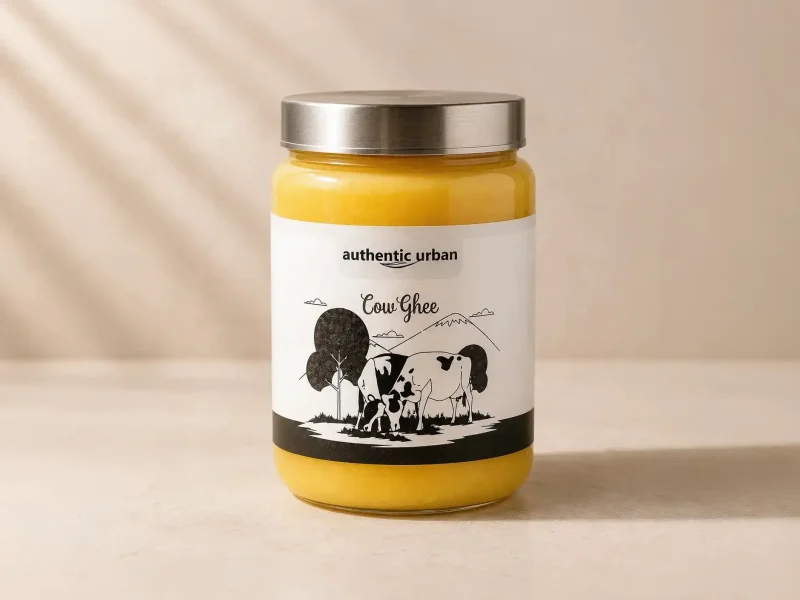 1 Litre
Buffalo ghee: paratha and sweets
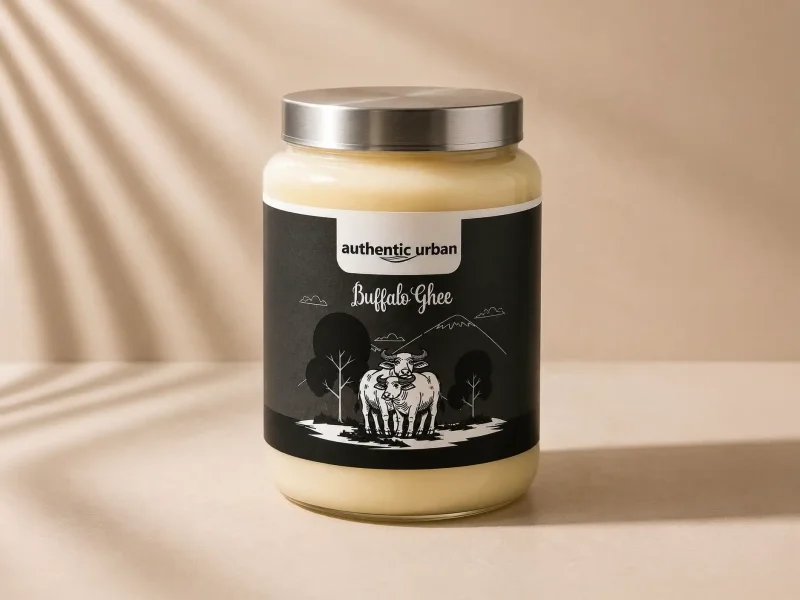 1 Litre
Each order is cooked after you place it, and the packing video is of that batch. Past order videos are on the shop.
FAQ
Which is the best cow or buffalo ghee to buy?
We put our own jars first, and we make them, so weigh that. Our A2 Gir cow ghee and Jafarabadi buffalo ghee are both curd Bilona, cooked on a wood chulha after you order, with a video of your jar on WhatsApp and monthly tests against the FSSAI limits. After ours, look for a maker who names the breed, the district, and the method, and lets you see the animals.
Can I mix cow ghee and buffalo ghee?
Yes, in your own cooking. Many homes use buffalo ghee for the paratha and cow ghee on the dal in the same meal, and there is no food safety reason against it. Count both together in the day's fat: ICMR-NIN's 2024 guidelines suggest limiting ghee or butter to 1 to 2 teaspoons a day in total, not per jar. Keep each in its own jar with a dry spoon, so you know which is which.
Is buffalo ghee A2?
Yes. A 2021 study in Tropical Animal Health and Production tested 657 buffaloes of four breeds and found only the A2 form of beta-casein, so every buffalo ghee is A2, the cheapest tin included. That makes "A2 buffalo ghee" a true label that tells you nothing extra. Ghee also holds almost no protein: USDA lists 0.28 g in 100 g. Judge a buffalo jar on the milk, the method, and how fresh it is, not on the A2 line.
Which ghee is better for puja, cow or buffalo?
Cow ghee, by custom. In Ayurveda, cow ghee is the ghee the texts mention most, and most families keep it for the diya, havan, and prasad. If buffalo ghee is what you have for a daily diya, it is still ghee. What matters more is that the jar is real ghee meant for eating, not a product sold only for lamps. Read the pack before it goes near the prasad.
Is buffalo ghee bad for the heart?
Not more than cow ghee in the same amount. Both are about two-thirds saturated fat, and the 2024 review puts buffalo milk fat at 67.4% against 65.4% for cow, a gap of 0.1 g in a teaspoon. If you have high LDL cholesterol or heart disease, the amount of ghee matters far more than the animal; ask your doctor or dietitian what daily fat suits you.
Why is buffalo ghee cheaper than cow ghee?
Because buffalo milk is richer, so it takes less of it. NDDB lists Jafarabadi buffalo milk at 7.7% fat against 4.6% for Gir cow milk. In our kitchen, 22 to 25 litres of buffalo milk make a kilo of ghee, against 30 to 35 litres of Gir cow milk. The work is the same two days either way, so the milk bill sets the gap.
About the editorial team
Authentic Urban TeamBilona ghee makers, Gir Somnath, Gujarat
We are the Parmar family in Gir Somnath, Gujarat. We have made ghee here since 2016 and sold it online since 2025. We make only Bilona ghee, test it every month, and anyone is welcome to visit and watch it being made. Our Gir cows and Jafarabadi buffalo are grass-fed village animals that graze near the Gir forest, with no hormones or milk boosters. We set their milk to curd, churn it, and cook the makkhan on a wood chulha. These articles come from that kitchen and from what customers ask us on WhatsApp. We are ghee makers, not doctors.
Sources
- Kataria D, Singh G. Health benefits of ghee: Review of Ayurveda and modern science perspectives. J Ayurveda Integr Med 2024;15(1) (Table 1, qualities and tridosha modulation of ghee types; Table 2, fatty acid profile of milk fat by species), PubMed Central. Checked 28 Sep 2026.
- Pena-Serna C, Restrepo-Betancur LF. Chemical, physicochemical, microbiological and sensory characterization of cow and buffalo ghee. Food Science and Technology 2020;40(2):444-450, SciELO. Checked 28 Sep 2026.
- Ullah R et al. Identification of cow and buffalo milk based on beta carotene and vitamin-A concentration using fluorescence spectroscopy. PLoS One 2017;12(5):e0178055, PubMed Central. Checked 28 Sep 2026.
- Bertolini F et al. Marker discovery and associations with β-carotene content in Indian dairy cattle and buffalo breeds. J Dairy Sci 2019;102(11):10039-10055, PubMed Central. Checked 29 Sep 2026.
- Gir (breed profile: lactation yield and milk fat), NDDB Dairy Knowledge Portal. Checked 28 Sep 2026.
- Jaffarabadi (breed profile: lactation yield and milk fat), NDDB Dairy Knowledge Portal. Checked 28 Sep 2026.
- de Oliveira LSM et al. Water buffaloes (Bubalus bubalis) only have A2A2 genotype for beta-casein. Trop Anim Health Prod 2021;53(1):145, PubMed. Checked 28 Sep 2026.
- Butter oil, anhydrous (SR Legacy 173412), USDA FoodData Central. Checked 28 Sep 2026.
- Dietary Guidelines for Indians, 2024 (limit ghee or butter to 1 to 2 teaspoons a day, printed p. 54), ICMR-National Institute of Nutrition. Checked 28 Sep 2026.
- Food Safety and Standards (Food Products Standards) Compendium, Chapter 2.1: Dairy products and analogues, version 01.09.2023 (p. 27, ghee), FSSAI. Checked 28 Sep 2026.