Ghee vs Rice Bran Oil: Which Is Healthier for Cooking?
Ghee vs rice bran oil comes down to the job: rice bran oil for the everyday sabzi and for frying, and 1 to 2 teaspoons of ghee a day where you taste it, on dal, roti, or khichdi. A teaspoon of each has the same 44 calories. Rice bran oil has a third of ghee's saturated fat and a small, tested effect on LDL cholesterol; ghee has the taste, vitamin A, and a far lower omega-6 load.
Ghee vs rice bran oil: which is better?
Rice bran oil is the better base for most of the day's cooking, and ghee is better as the teaspoon you taste. ICMR-NIN's 2024 Dietary Guidelines for Indians ask you to limit ghee to 1 or 2 teaspoons a day, and they name the oryzanol in rice bran oil as one of the oil compounds that lower blood cholesterol. So the answer is a split, not a swap.
Most pages on this question pick a side. Ghee sellers call rice bran oil a hexane-soaked seed oil; oil sellers call ghee a heart risk. Both leave out numbers you can check: the real omega ratio of rice bran oil, how big the cholesterol effect is in trials, and what FSSAI actually allows in the bottle. This page gives all three. If you want the basics of ghee first, read what is ghee. If you are comparing ghee with refined oils in general, the wider page is ghee vs vegetable oil.
What is in a teaspoon of ghee vs rice bran oil?
The same calories, very different fats. Here is USDA FoodData Central's data for both, worked out for the 5 g household teaspoon that ICMR-NIN uses.
1 tsp (5 g)
Ghee
Rice bran oil
Calories
44 kcal
44 kcal
Saturated fat
3.1 g
1.0 g
Monounsaturated fat
1.4 g
2.0 g
Omega-6 (linoleic)
0.11 g
1.67 g
Omega-3 (ALA)
0.07 g
0.08 g
Omega-6 to omega-3
about 1.6 : 1
about 21 : 1
Plant sterols
0 mg
60 mg
Vitamin E
0.14 mg
1.62 mg
Vitamin A
42 µg
0 µg
Butyric acid
0.16 g
0 g
Cholesterol
13 mg
0 mg
USDA FoodData Central, SR Legacy: butter oil, anhydrous (173412); oil, rice bran (171013). Checked 28 September 2026.
Rice bran oil has two real wins that ghee pages skip. It has about 1.6 mg of vitamin E a teaspoon against 0.14 mg in ghee, and about 60 mg of plant sterols, which ghee does not have at all. Ghee brings what rice bran oil does not: about 42 µg of vitamin A and 0.16 g of butyric acid a teaspoon, plus a taste you notice from one spoon. The full ghee label is on ghee nutrition facts.
What is the omega-6 to omega-3 ratio of rice bran oil?
About 21 to 1. USDA lists 33.4 g of omega-6 and 1.6 g of omega-3 in 100 g of rice bran oil. Ghee sits at about 1.6 to 1, because it has very little of either: 2.25 g of omega-6 and 1.45 g of omega-3 per 100 g. The "ghee is 1:1" line on many pages is close, but it hides how small both numbers are.
USDA FoodData Central, SR Legacy (173412, 171013, 171025, 172337). Checked 28 September 2026.
| Item | Value |
|---|---|
| Sunflower oil | 3,285 mg |
| Rice bran oil | 1,670 mg |
| Mustard oil | 765 mg |
| Ghee | 113 mg |
Rice bran oil sits in the middle: about half the omega-6 of regular sunflower oil and twice that of mustard oil. ICMR-NIN's 2024 guidelines put the minimum need at about 6.6 g of omega-6 and 2.2 g of omega-3 a day on a 2,000 kcal diet. A day cooked entirely in rice bran oil, 30 g, carries about 10 g of omega-6 and under 0.5 g of omega-3. That is why the guidelines ask you to moderate high omega-6 oils and to get omega-3 from mustard oil, soybean, fenugreek seeds, greens, and walnuts.
FSSAI gives a useful yardstick. A blended (multi-source) edible oil that claims an ideal omega ratio must be between 1 part omega-3 to 5 parts omega-6 and 1 to 10. Rice bran oil alone is at 1 to 21. Using it turn by turn with mustard oil pulls the week toward that range. Whether omega-6 itself causes inflammation is a weaker argument than most pages make; we go through the trials in is ghee anti-inflammatory.
Does rice bran oil lower cholesterol more than ghee?
Yes. Rice bran oil has a small, tested effect, and ghee is not the fat to pick for lowering cholesterol. A 2016 review of 11 randomised trials (Jolfaie and colleagues, Hormone and Metabolic Research) found rice bran oil lowered LDL cholesterol by about 7 mg/dL and total cholesterol by about 13 mg/dL. HDL went up only in men, and triglycerides did not change.
A 2024 review of rice bran and rice bran oil trials (Park and colleagues, Nutrients) found the oil worked better than the bran, and the effect was stronger at 30 g or more a day and over more than 4 weeks. The oil trials used 15 to 30 ml a day, 3 to 6 teaspoons, as the main cooking oil. ICMR-NIN credits the oryzanol and tocotrienols in the oil. That is a real, modest effect. It is not a treatment, and it does not replace a statin your doctor prescribed.
Ghee goes the other way on LDL. A teaspoon has 3.1 g of saturated fat and 13 mg of cholesterol; a teaspoon of rice bran oil has 1.0 g and none. ICMR-NIN's guidelines say saturated fat raises total and LDL cholesterol, and they list ghee and butter among the fats to limit. Two teaspoons of ghee a day fits those guidelines for most healthy adults. If you have high LDL, diabetes, or heart disease, your doctor or dietitian sets your fat limit before any blog does. The longer answer is on ghee for cholesterol.
Is rice bran oil made with hexane, and is that safe?
Most of it is, and FSSAI caps what can be left behind. FSSAI's standard says rice bran oil may be sold only after refining, and that refined rice bran oil comes from solvent-extracted oil. The refined oil may not hold more than 5 ppm of hexane (5 mg in a kilo of oil).
The standard allows two kinds of refining, and they are worth telling apart on the label:
- Chemically refined: neutralised with alkali, bleached with bleaching earth or carbon, and deodorised with steam.
- Physically refined: the free acids, colour, and smell are removed by physical means instead of alkali. FSSAI requires at least 1.0% oryzanol in this oil, which is at least 50 mg in a teaspoon.
ICMR-NIN notes that refining does not change an oil's fatty acids but does strip some of its minor compounds, and oryzanol is one of them. So if the cholesterol effect is why you buy rice bran oil, look for "physically refined" and a stated oryzanol figure on the bottle. One more label to read twice: the FSSAI standard, as written, says rice bran oil is sold only after refining, so ask the seller which FSSAI category a "cold pressed rice bran oil" is registered under. Refined oil in general is covered in what refined oil is.
Which is better for frying and tadka: ghee or rice bran oil?
Rice bran oil for frying, ghee for the tadka you pour at the end. The two smoke at about the same heat: a 2026 review in Frontiers in Food Science and Technology (Kumar and Jadhav) lists ghee at 220 to 240°C, and a 2018 lab test (De Alzaa and colleagues, Acta Scientific Nutritional Health) measured rice bran oil at 237°C. The "ghee 250°C, rice bran 232°C" figures on many pages do not come from one test of both.
Smoke point is the wrong number to judge by anyway. In that 2018 test of ten supermarket oils (ghee was not in it), rice bran oil lasted about 16 hours in the oxidation test, against 6 hours for sunflower oil and 50 hours for coconut oil. After 6 hours at 180°C it had built up 15.7% polar compounds, the breakdown products of frying, against 9.7% for coconut oil and 10.5% for extra virgin olive oil. So rice bran oil is steadier than sunflower in the kadhai, but not as steady as a saturated fat. Ghee has about a tenth of the polyunsaturated fat of rice bran oil, which is the fat that breaks down.
Frying still belongs to oil, because it needs far more fat than the ghee limit allows. And ghee can burn too. When we cook makkhan into ghee on the chulha, we take the matki off when the bubbling goes quiet and the solids turn golden-brown. Push past that and the batch turns dark and bitter and smells burnt, and it never goes in a jar. ICMR-NIN's household rule for any frying oil: filter it after one use, put it in curry within a day or two, and never fry in it again. The full heat guide is ghee for high heat cooking.
Which fat for tadka, frying, roti, and sweets?
Ghee for the spoon you taste, rice bran oil for the bulk and the kadhai. Save or screenshot this table; it is how we would split a week of cooking.
Kitchen job
Use
Why
Dal tadka poured at the end, a spoon on roti, rice, or khichdi
Ghee, 1 teaspoon
You taste it, so one spoon does the work.
Everyday sabzi and curry base
Rice bran oil, turn by turn with mustard oil
This is most of the day's fat. Mustard oil brings the omega-3 rice bran oil lacks.
Deep frying puri, pakora, bhajia
Rice bran oil, used once
Frying needs far more fat than the ghee limit allows, and rice bran oil held up better than sunflower in heat tests.
Paratha, halwa, ladoo, sheera
Buffalo ghee
The dish is built on the taste and texture of ghee.
Raita tadka, chutney, a cold drizzle
Rice bran oil
Its taste is flat, and ghee sets solid on cold food.
Oil left over from frying
Filter it, use it in curry within a day or two
ICMR-NIN says do not fry in it again.
Choose ghee if
- The fat is the flavour: a tadka poured over dal at the end, a spoon on hot rice, roti, or khichdi.
- You are making paratha, halwa, ladoo, or sheera, where oil changes the dish.
- You want your one or two daily teaspoons to taste of something.
Choose rice bran oil if
- You need a lot of fat at once: deep frying, or the base of a big pot of curry.
- You want a flat taste that does not fight the masala, or the food is served cold.
- Your doctor has asked you to cut saturated fat or bring LDL down.
Three kitchens: which fat should each use?
A family of four in Kolkata, cooking everything in one 5-litre can of rice bran oil. Keep it for frying and the everyday sabzi, but put a bottle of mustard oil next to it for fish and alternate days. Add one teaspoon of ghee per person a day on dal or roti. The omega ratio improves without adding much saturated fat.
A home that fries pakora or puri most evenings. Fry in rice bran oil, not ghee, and use each batch of oil once, then in curry within a day or two. Frying in ghee to be healthy puts several times the day's ghee limit in one sitting.
A 55-year-old whose report shows high LDL. Physically refined rice bran oil for cooking is a reasonable choice to discuss with the doctor, and ask before keeping even one teaspoon of ghee. If the answer is yes, put it where it counts, on the dal, not in the pan.
Other everyday oils have their own pages: ghee vs mustard oil, ghee vs groundnut oil, and ghee vs sunflower oil.
How much ghee and rice bran oil can you use in a day?
ICMR-NIN's 2024 guidelines put all visible fat, ghee and oil together, at 20 to 50 g a day by activity: 20 g for a sedentary woman and 30 g for a sedentary man. Keep ghee to 1 or 2 teaspoons of that and give the rest to oil.
A 30 g day looks like this: one teaspoon of ghee on the morning roti, one in the dal tadka, and four teaspoons of rice bran or mustard oil across the sabzi and the dinner curry. At home our family eats 1 to 2 teaspoons of ghee each a day, on roti, dal, and khichdi, and a little more in winter sweets. More on portions in how much ghee per day.
What mistakes do people make when switching from rice bran oil to ghee?
- Swapping every spoon. Replacing all the oil with ghee puts 20 to 30 g of ghee in a day, three to six times the 1 to 2 teaspoons ICMR-NIN suggests. Swap the tadka and the roti; keep oil for the rest.
- Frying in ghee to be healthy. Deep frying needs a lot of fat. Use rice bran oil, once.
- Throwing out the rice bran oil to lower cholesterol. In trials it is the rice bran oil that moved LDL down, not ghee.
- Buying on smoke point. The two are about level. Read the refining method and the oryzanol figure on the oil, and the FSSAI licence on the ghee.
- Buying the cheapest "ghee". A jar priced far below milk cost may not be milk fat at all. Our checks are on how to identify pure ghee.
- Expecting ghee to look the same all year. In summer our jars stay liquid; in winter the same ghee turns grainy. That is temperature, not a fault.
Which ghee should sit next to your rice bran oil?
If ghee is only one or two teaspoons a day, those teaspoons should be real milk fat. Warm a spoon: it should smell of toasted milk, not packing oil. Slow-cooked ghee often turns grainy as it cools. Check the FSSAI licence number on the label. Our full ranking of jars is on best ghee in India.
For the daily spoon on dal and roti we use our own A2 Gir cow ghee: grass-fed Gir milk set to curd, churned, and cooked in a matki on the chulha, made after you order, at ₹2,399 a litre. For paratha, halwa, and ladoo, Jafarabadi buffalo ghee is the one we reach for. We test every month against the FSSAI limits; see how we make ghee.
Gir cow ghee: the daily teaspoon
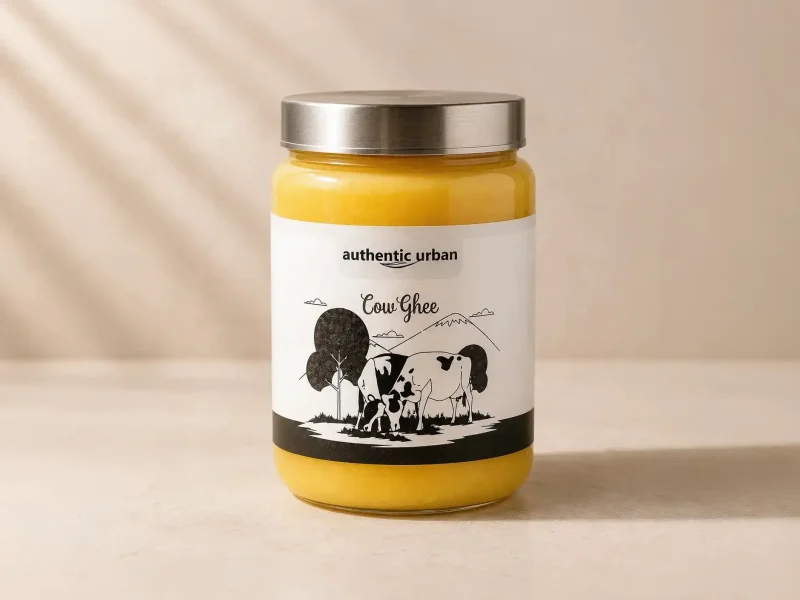 1 Litre
Buffalo ghee: paratha and sweets
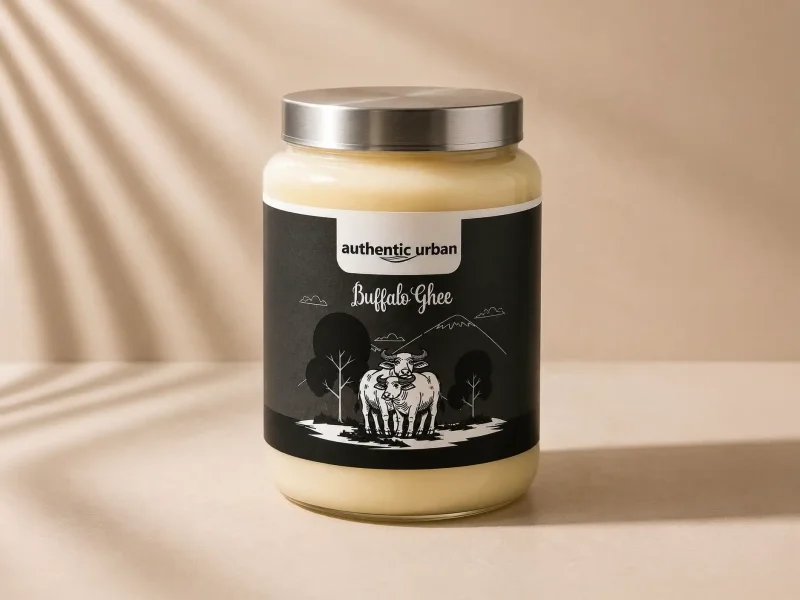 1 Litre
Each order is cooked after you place it, and the packing video is of that batch. Past order videos are on the shop.
FAQ
Is rice bran oil or ghee better for weight loss?
Neither. USDA lists 884 kcal in 100 g of rice bran oil and 876 kcal in 100 g of ghee, so a teaspoon of either is about 44 kcal. Your weight follows how many teaspoons go in, not which bottle they come from. Pour from a measuring spoon for a week, keep ghee to one or two teaspoons a day, and cut fried snacks first.
Can I mix rice bran oil and ghee in one tadka?
Yes. Heat a teaspoon of rice bran oil for the jeera, mustard seeds, and hing, then add half a teaspoon of ghee just before you pour the tadka over the dal. The oil takes the first heat and the ghee keeps its smell. You taste the ghee while using half as much, and neither fat has to sit on a smoking pan.
Is blended rice bran oil good to cook with?
It can be. FSSAI calls these multi-source edible oils: two oils, each at least 20% of the bottle, with no more than 33% saturated fat. A rice bran and mustard blend adds the omega-3 that rice bran oil lacks. Read the label for both oils and their share. If the bottle claims an ideal omega ratio, FSSAI wants it between 1:5 and 1:10.
Why is ghee so much costlier than rice bran oil?
Ghee comes from milk, and it takes a lot of it. We use about 30 to 35 litres of milk for 1 kg of Gir cow ghee and 22 to 25 litres for buffalo ghee, and curd to jar takes the better part of two days. Rice bran oil is extracted from bran, a by-product of rice milling, at factory scale. Our cow ghee is ₹2,399 a litre.
Is rice bran oil or ghee better for children?
For a child over one year, a teaspoon of ghee on dal, rice, or roti is a normal part of Indian meals, and the fat helps the body take up vitamins A, D, E, and K from the rest of the plate. The family cooking can stay in rice bran or another oil. For babies under one, ask your paediatrician when and how to add any fat.
Is rice bran oil or mustard oil better with ghee?
Use both, turn by turn. USDA lists about 0.3 g of omega-3 in a teaspoon of mustard oil against 0.08 g in rice bran oil, and ICMR-NIN names mustard among the oils that supply omega-3. Rice bran oil has a flat taste that suits frying and mild dishes. Mustard oil suits fish, pickle, and Bengali or Punjabi cooking. Keep ghee as the teaspoon on top.
About the editorial team
Authentic Urban TeamBilona ghee makers, Gir Somnath, Gujarat
We are the Parmar family in Gir Somnath, Gujarat. We have made ghee here since 2016 and sold it online since 2025. We make only Bilona ghee, test it every month, and anyone is welcome to visit and watch it being made. Our Gir cows and Jafarabadi buffalo are grass-fed village animals that graze near the Gir forest, with no hormones or milk boosters. We set their milk to curd, churn it, and cook the makkhan on a wood chulha. These articles come from that kitchen and from what customers ask us on WhatsApp. We are ghee makers, not doctors.
Sources
- Dietary Guidelines for Indians, 2024 (Guideline 7, printed pp. 53 to 56), ICMR-National Institute of Nutrition. Checked 28 Sep 2026.
- Butter oil, anhydrous (FDC ID 173412), SR Legacy, USDA FoodData Central. Checked 28 Sep 2026.
- Oil, rice bran (FDC ID 171013), SR Legacy, USDA FoodData Central. Checked 28 Sep 2026.
- Oil, sunflower, linoleic, (approx. 65%) (FDC ID 171025), SR Legacy, USDA FoodData Central. Checked 28 Sep 2026.
- Oil, mustard (FDC ID 172337), SR Legacy, USDA FoodData Central. Checked 28 Sep 2026.
- Food Product Standards, Chapter 2.2: Fats, oils and fat emulsions, version 2 (05.10.2023), rice bran oil and multi-source edible oil (printed pp. 23 to 25), FSSAI. Checked 28 Sep 2026.
- Rice Bran Oil Decreases Total and LDL Cholesterol in Humans: A Systematic Review and Meta-Analysis of Randomized Controlled Clinical Trials (Jolfaie NR, Rouhani MH, Surkan PJ, Siassi F, Azadbakht L), 2016, Hormone and Metabolic Research. Checked 28 Sep 2026.
- Rice Bran Consumption Improves Lipid Profiles: A Systematic Review and Meta-Analysis of Randomized Controlled Trials (Park and colleagues), 2024, Nutrients. Checked 28 Sep 2026.
- Understanding the techno-functionality of ghee as a cooking medium (Kumar D, Jadhav HB), 2026 (Table 2, smoke points), Frontiers in Food Science and Technology. Checked 28 Sep 2026.
- Evaluation of Chemical and Physical Changes in Different Commercial Oils during Heating (De Alzaa F, Guillaume C, Ravetti L), 2018 (Table 1 and polar compounds), Acta Scientific Nutritional Health. Checked 28 Sep 2026.