Ghee for Vegetarians: Is It Veg, and How Much Protein?
Ghee for vegetarians is a yes: ghee is made only from milk, and FSSAI's labelling rules keep milk products out of the non-veg definition, so a ghee jar carries the green dot. It is not vegan, and it is not a protein food. A tablespoon of ghee has about 0.04 g of protein, so your protein and B12 have to come from dal, milk, curd, and paneer, with 1 to 2 teaspoons of ghee on top.
Is ghee vegetarian?
Yes, ghee is vegetarian. It is milk fat, and nothing else: milk becomes curd or cream, that becomes butter, and the butter is cooked until the water boils off and the milk solids are strained out. No animal is killed and no animal fat goes in. Under Indian food law it is vegetarian too, and every packed jar must show that.
FSSAI's Labelling and Display Regulations, 2020 define non-vegetarian food as food containing any part of an animal, eggs, or products of animal origin, "but does not include milk, milk products, honey". Everything else is vegetarian food. So ghee, like milk, curd, paneer, and butter, gets the vegetarian mark: a green filled circle inside a green square. Non-veg food gets a brown triangle inside a brown square. If a ghee jar ever shows anything but the green mark, put it back.
You can see how little is left of the milk in our kitchen in Gir Somnath. We set Gir cow milk to curd overnight, churn it for 30 to 45 minutes until the makkhan separates, and cook that makkhan in a matki on a wood chulha. When the bubbling goes quiet, the milk solids have turned golden-brown and sunk to the bottom, and they stay in the pot when the ghee is poured off. Nothing else goes in. What ghee is, and how it differs from butter, is on what is ghee.
Is ghee vegan, and what do vegans use instead?
No, ghee is not vegan. Vegetarian and vegan split exactly at milk: a lacto-vegetarian Indian kitchen uses milk, curd, paneer, and ghee, while a vegan kitchen uses no animal product at all. Ghee is still a dairy food, even though very little milk protein or lactose is left in it.
Vegans cook with plant oils instead: groundnut, mustard, sesame, or coconut oil for tadka and sabzi. Jars sold as "vegan ghee" or "plant ghee" are blends of plant fats made to look and taste like ghee; they are a different product, so read what fats the label lists. If you avoid ghee for a milk allergy rather than for belief, the trace of milk protein that stays in it matters, and that is covered on is ghee dairy free.
How much protein is in 1 spoon of ghee?
Almost none. USDA FoodData Central lists ghee (as anhydrous butter oil) at 0.28 g of protein per 100 g. That works out to about 0.01 g in a teaspoon (5 g) and about 0.04 g in a tablespoon (12.8 g, USDA's own tablespoon weight). Ghee is 99.5% fat. For protein, it counts as zero.
To put that in a vegetarian kitchen: one katori of cooked dal (150 g) has about 13.5 g of protein. To get the same protein from ghee you would need close to 4.8 kg of it, more than five 1-litre jars. The protein in milk goes into the curd, then the makkhan, and most of what reaches the pot ends up in those browned solids we strain out. How many milligrams of milk protein stay behind in a spoon is on milk protein in ghee, and the full label for a spoon, with calories, is on ghee nutrition facts.
USDA FoodData Central, SR Legacy, protein per 100 g scaled to each portion; checked 27 September 2026. Ghee: 0.28 g per 100 g, about 0.04 g in a tablespoon.
| Item | Value |
|---|---|
| Ghee, 1 tbsp (12.8 g) | 0 g |
| Cooked rice, 1 cup (150 g) | 4 g |
| Curd, 1 katori (150 g) | 5 g |
| Peanuts, a handful (30 g) | 8 g |
| Milk, 1 glass (250 ml) | 8 g |
| Chole, 1 katori cooked (150 g) | 13 g |
| Dal, 1 katori cooked (150 g) | 14 g |
Where do vegetarians get protein, if not from ghee?
From dal, chole, rajma, and other pulses, from milk, curd, and paneer, and from peanuts, nuts, and soy. ICMR-NIN's 2024 dietary guidelines set the protein allowance at 0.83 g per kg of body weight a day for healthy adults, which is 54 g a day for a person weighing 65 kg. The same guidelines say a varied diet meets that amount easily, even a fully plant-based one.
The harder part is quality. Cereals are low in an amino acid called lysine and pulses are low in methionine, so ICMR-NIN suggests eating cereals and pulses together in a ratio of about 3 to 1 by raw weight, and adding 250 ml of milk a day to cover every essential amino acid. That is dal-chawal, rajma-rice, idli-sambar, and roti with chole: the plates most vegetarian homes already eat. Ghee adds taste and calories to them, not protein.
If you train hard and need more than the everyday allowance, the numbers for lifters are on protein for muscle building.
A vegetarian day that reaches the protein target
This is one ordinary day, counted with USDA's numbers. Save it as a template and swap in your own dal or sabzi.
Meal
Food
Protein
Ghee
Morning
1 glass milk (250 ml)
7.9 g protein
No ghee
Mid-morning
A handful of peanuts (30 g)
7.7 g protein
No ghee
Lunch
1 katori dal (150 g) and 1 cup rice (150 g)
17.5 g protein
1 tsp on the dal
Evening
1 katori curd (150 g)
5.2 g protein
No ghee
Dinner
1 katori chole (150 g), rotis and sabzi
13.3 g protein
1 tsp on the roti
About 52 g of protein before counting the rotis and sabzi, which add more. The 2 teaspoons of ghee add about 0.03 g.
The two katoris of pulses and the milk and curd carry the day. Drop the dal at lunch and the total falls by about a quarter. Doubling the ghee changes nothing on the protein line.
What does ghee for vegetarians add to the plate?
Ghee adds fat, calories, taste, and a little vitamin A, and it helps the plate's fat-soluble nutrients get absorbed. A teaspoon has about 44 kcal and, by USDA's 840 µg per 100 g, about 42 µg of vitamin A. That is the whole list. It has no iron, no fibre, and no vitamin D worth counting.
The useful job is the carrying. Beta-carotene in carrots and palak, and vitamins A, D, E, and K, need some fat in the meal to be absorbed, and a teaspoon of ghee or oil on the vegetable dish is enough fat to do it. How much fat the absorption studies used, and which dishes pair best, is on ghee and nutrient absorption.
Iron is different: plant iron is helped by vitamin C (lemon on dal, amla), not by fat, and hurt by tea at the meal. Ghee is not the fix for a low haemoglobin; see ghee for anemia. USDA lists no vitamin D in ghee at all, so vegetarian homes that skip eggs rely on the sun and fortified milk, as covered on vitamin D in ghee.
Does ghee have vitamin B12?
No. USDA lists 0.01 µg of vitamin B12 in 100 g of ghee, which is nothing in a teaspoon. ICMR-NIN's 2024 guidelines name B12 and omega-3 fats as the two nutrients vegetarians find hardest to get enough of, and note that milk has only a small amount of B12.
By USDA's figures, a 250 ml glass of whole milk has about 1.1 µg of B12 and a 150 g katori of curd about 0.6 µg. Dal, rice, roti, vegetables, and ghee have none. So a vegetarian who drinks little milk and eats little curd may run low. The only way to know is a blood test. If you are tired all the time, or your doctor has found anaemia, ask for B12 to be checked, and let the doctor decide on a tablet or injection. Eating more ghee will not change the result.
For omega-3, ICMR-NIN points vegetarians to flax seeds, chia seeds, walnuts, and green leafy vegetables. Ghee has very little of it, so it does not fill that gap either.
How much ghee should a vegetarian eat a day?
1 to 2 teaspoons a day, the same as anyone else. ICMR-NIN's 2024 guidelines say to limit ghee or butter to 1 to 2 teaspoons a day, and cap all visible fat (oil and ghee together) at about 20 g a day for a sedentary woman and 30 g for a sedentary man. Being vegetarian does not raise that number.
At home each of us eats 1 to 2 teaspoons a day, on roti, dal, and khichdi, a bit more in winter sweets. Put the ghee where you taste it, on hot food at the table, and cook the sabzi in oil. A vegetarian plate with no meat is already lower in saturated fat, which is no licence for extra spoons: four more teaspoons add about 176 kcal a day. The daily amount by age and activity is on how much ghee per day, and you can work out your home's daily ghee and oil for the family.
Ask your doctor or dietitian before you set your own amount if you have high LDL cholesterol, heart disease, fatty liver, or kidney disease, or if you are pregnant; they may want less. The lipid side is on ghee for cholesterol. We make ghee; we are not doctors.
How can a vegetarian be sure the ghee is only milk fat?
Buy from a maker who shows you how it is made, and check the FSSAI licence number on the label. Adulterated ghee can carry vegetable oil or animal body fat, and no kitchen test catches body fat reliably; that is a lab's job. For a vegetarian or a puja kitchen, that is the one real worry with ghee, and what labs look for is on can lard be mixed into ghee.
We test our ghee every month against the FSSAI limits, and our kitchen is open: anyone can visit and watch a batch being made. Each order also gets a video of that jar being cooked and packed. The steps are on how we make our ghee.
A 7-point vegetarian plate checklist
Screenshot this and keep it by the kitchen.
- Count your protein from dal, chole, rajma, milk, curd, paneer, peanuts, and soy, never from ghee.
- Put one katori of dal, chole, or rajma in at least two meals a day.
- Pair grains with pulses; ICMR-NIN suggests about 3 parts cereal to 1 part pulse by raw weight.
- Keep a glass of milk or a katori of curd in the day, for protein and a little B12.
- Eat a spoon of walnuts, flax, or chia seeds, and green leafy vegetables, for omega-3.
- Keep ghee to 1 to 2 teaspoons a day, on hot dal or roti, and cook the rest in oil.
- If you have never had a B12 test and eat little dairy, ask your doctor for one.
Which ghee for a vegetarian kitchen?
Every pure ghee is vegetarian and has almost no protein, so the brand does not change your nutrition. What changes is trust that the jar is only milk fat. Well-made ghee is clear when melted, smells of toasted milk when warmed, and often sets grainy when cool. How to check any jar is on how to identify pure ghee, and our ranking of cow ghee on sale is best cow ghee in India.
We make and sell ghee, so weigh this with that in mind. For the daily teaspoon we would pick our own A2 Gir cow ghee: milk from grass-fed Gir cows, set to curd overnight, churned, and cooked in a matki on a wood chulha, made after you order, with a video of your jar sent on WhatsApp. At ₹2,399 a litre, a 5 ml teaspoon costs about ₹12. Our Jafarabadi buffalo ghee is made the same way, sets firmer, and is the one we use for parathas and sweets.
The daily spoon on dal and roti
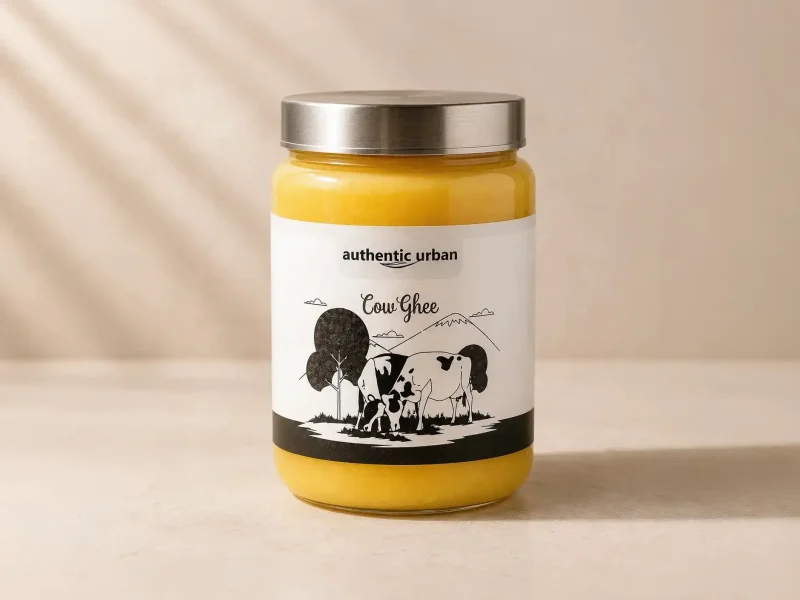 1 Litre
Paratha, halwa, and festival sweets
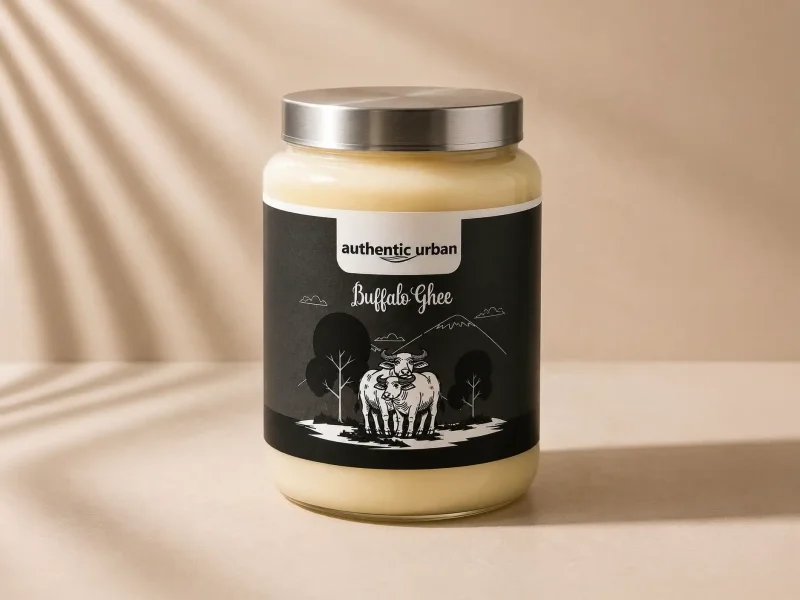 1 Litre
Each order is cooked after you place it, and the packing video is of that batch. Past order videos are on the shop.
FAQ
Ghee veg hai ya non-veg?
Ghee veg hai. Yeh doodh se banta hai: doodh ka dahi, dahi se makkhan, aur makkhan ko pakakar ghee. FSSAI ke labelling niyam doodh aur doodh se bani cheezon ko non-veg ki paribhasha se bahar rakhte hain, isliye ghee ke dabbe par hara (green) nishaan hota hai. Lekin ghee vegan nahi hai, kyunki doodh janwar se aata hai. Protein ke liye ghee par nahi, dal aur doodh par bharosa karein.
Is buffalo ghee vegetarian too?
Yes. Buffalo ghee is made from buffalo milk in the same way cow ghee is made from cow milk, so it is a milk product and vegetarian under the FSSAI labelling rules. The difference is in the jar, not in the diet: buffalo ghee is whiter, sets firmer, and has a heavier taste that suits sweets and parathas, while cow ghee is more yellow and lighter for the daily spoon.
Can Jains eat ghee?
Most Jain households eat ghee, because it comes from milk and no animal is killed to make it. Some Jains follow a stricter practice and avoid all dairy, and they would skip ghee as well. Ghee also has no onion, garlic, or root vegetables in it, so it fits a Jain kitchen that avoids those. If you cook for a Jain family, ask how they practise rather than guessing.
Does ghee contain rennet or any animal additive?
Pure ghee does not. Rennet is an enzyme used to set some cheeses, and it has no role in ghee. Ghee is butter or makkhan cooked until the water boils off and the milk solids brown and are strained out. In our kitchen the only thing that goes into the matki is makkhan churned from our own curd. Read the label: a ghee jar should list only milk fat, cow or buffalo.
Is ghee sattvic food?
In Ayurveda and in many Hindu homes, ghee is counted as sattvic, a pure, calming food, which is why it is used in prasad, fasting food, and the diya. That is a tradition, not a nutrition claim. On the plate, ghee is still a fat with about 44 kcal a teaspoon, so a sattvic diet does not need more than the usual 1 to 2 teaspoons a day.
Can I eat ghee during a vrat or fast?
Yes, in most fasting traditions ghee is allowed, and it is the usual fat for sabudana khichdi, rajgira puri, singhare ka halwa, and makhana roasted in a pan. Check the rules your family follows, since some fasts allow only fruit and milk. Fasting food tends to be low in protein, so a glass of milk, curd, or a handful of peanuts helps more than extra ghee.
About the editorial team
Authentic Urban TeamBilona ghee makers, Gir Somnath, Gujarat
We are the Parmar family in Gir Somnath, Gujarat. We have made ghee here since 2016 and sold it online since 2025. We make only Bilona ghee, test it every month, and anyone is welcome to visit and watch it being made. Our Gir cows and Jafarabadi buffalo are grass-fed village animals that graze near the Gir forest, with no hormones or milk boosters. We set their milk to curd, churn it, and cook the makkhan on a wood chulha. These articles come from that kitchen and from what customers ask us on WhatsApp. We are ghee makers, not doctors.
Sources
- Food Safety and Standards (Labelling and Display) Regulations, 2020, Version VIII (09.09.2025): regulation 2(1)(o) and (v), definitions of non-vegetarian and vegetarian food (pp. 2 to 3); regulation 5(4), veg and non-veg symbols (pp. 13 to 14), FSSAI. Checked 27 Sep 2026.
- Dietary Guidelines for Indians, 2024 (nutrients of concern for vegetarians, Guideline 1, p. 2; visible fat and the ghee limit, p. 54; Guideline 8 on protein, pp. 57 to 58), ICMR-National Institute of Nutrition. Checked 27 Sep 2026.
- Butter oil, anhydrous (FDC ID 173412), SR Legacy, USDA FoodData Central. Checked 27 Sep 2026.
- Lentils, mature seeds, cooked, boiled, without salt (FDC ID 172421), SR Legacy, USDA FoodData Central. Checked 27 Sep 2026.
- Chickpeas (garbanzo beans, bengal gram), mature seeds, cooked, boiled, without salt (FDC ID 173757), SR Legacy, USDA FoodData Central. Checked 27 Sep 2026.
- Rice, white, long-grain, regular, enriched, cooked (FDC ID 168878), SR Legacy, USDA FoodData Central. Checked 27 Sep 2026.
- Milk, whole, 3.25% milkfat, with added vitamin D (FDC ID 171265), SR Legacy, USDA FoodData Central. Checked 27 Sep 2026.
- Yogurt, plain, whole milk (FDC ID 171284), SR Legacy, USDA FoodData Central. Checked 27 Sep 2026.
- Peanuts, all types, raw (FDC ID 172430), SR Legacy, USDA FoodData Central. Checked 27 Sep 2026.