Ghee for Bloating and Gas: Does It Help, and How Much?
Ghee for bloating helps only in small amounts: ½ to 1 teaspoon of warm ghee on hot dal, rice, or khichdi is fine for most people, but a heavy ghee meal is itself a common cause of bloating. Keep to 1 to 2 teaspoons a day, add a pinch of hing to the tadka, and look at the dal, the chai, and the cold drink before you blame the ghee.
Does ghee help bloating?
A little ghee can make a meal sit easier; a lot of ghee makes bloating worse. Half to one teaspoon of warm ghee on hot, cooked food is a normal part of an easy-to-digest Indian meal. Past that, ghee is simply fat, and fat slows the gut. No study has tested ghee itself for bloating, so the amount is what you control.
Bloating is the feeling of a full, tight, or swollen belly, and the NHS says the most common reason is a lot of gas in the gut. This page is for the everyday kind: gas and heaviness after meals. If you have been diagnosed with IBS, the fat limits and the low FODMAP tadka are on ghee for IBS. If milk is what sets you off, read ghee and lactose intolerance, and if the tight belly comes with hard stools, start with ghee for constipation.
Can ghee cause bloating or gas?
Yes, when there is too much of it. Monash University dietitians explain that high-fat meals can slow the emptying of the gut, which brings fullness, bloating, and discomfort. NIDDK, the US government's digestive health institute, also notes that high-fat foods can increase bloating. Ghee is almost pure fat, so a ladle on rice or a plate of ghee-fried puri does exactly this.
Four ways ghee ends up behind the bloating:
- The amount. Two tablespoons in a biryani or a bowl of halwa is a heavy fat meal, whatever the pages that sell ghee say about "light" fat.
- The empty stomach. Ghee in warm water first thing suits some people and gives others gas, loose stools, and a heavy morning. The full picture, and who should skip it, is on ghee on empty stomach.
- The late dinner. The NHS lists large meals late at night among the habits to avoid when you bloat.
- A badly cooked jar. In our kitchen in Gir Somnath, ghee is ready only when the bubbling goes quiet and the milk solids turn golden-brown. A batch taken off early stays cloudy and keeps moisture, and it spoils fast. We never pack one. If your ghee melts cloudy with white sludge at the bottom, there is milk left in it, and that milk can bother a sensitive stomach.
What too much ghee does to digestion in general is on ghee side effects.
What on an Indian plate causes bloating?
Usually the dal, the gobi, the milk, or the way you ate, not the spoon of ghee. NIDDK explains that gas comes from two places: air you swallow, and gut bacteria fermenting carbohydrate your small intestine did not digest. Fat does not ferment into gas; it slows things down. Here is where the gas on a normal Indian day comes from.
On the plate
What you feel
Why
A heavy, fatty meal
Full and tight for hours after puri, pakora, halwa, or a ladle of ghee on rice
Monash dietitians say high-fat meals can slow the emptying of the gut, which brings fullness and bloating. Ghee counts as fat here, the same as oil.
Dal, rajma, chole, peas
Gas later in the day or at night, after a big bowl
NIDDK lists beans, peas, and lentils among gas foods. Gut bacteria ferment the carbohydrate your small intestine did not digest.
Gobi, patta gobi, broccoli
Gas after sabzi, worse when the portion is big
NIDDK names cauliflower, cabbage, and broccoli. The NHS also says to cut back on cabbage, beans, and lentils if they bloat you.
Milk, chai, curd, ice cream
Bloating and loose stools after milk, not after ghee on dal
NIDDK lists milk, ice cream, and yogurt. This is lactose. Ghee has almost none.
Cold drink, soda, eating fast
Burping and a hard belly soon after the meal
NIDDK says swallowed air from fizzy drinks, gum, and eating quickly is a main source of gut gas.
Sugar-free sweets and fruit juice
Gas and loose stools after "diet" mithai or packaged juice
NIDDK lists sweeteners ending in -ol (sorbitol, mannitol, xylitol), fruit juices, apples, and pears.
A big dinner late at night
Bloated at bedtime and on waking
The NHS lists large meals late at night and slouching while you eat among the things to avoid.
Sources: NIDDK gas pages, NHS bloating page, Monash University FODMAP (2024).
Passing gas is normal. NIDDK puts the average at 8 to 14 times a day, and up to 25 is still counted as normal. So the question is not "how do I stop all gas" but which meal leaves you tight and uncomfortable. A two-week food diary, which both NIDDK and the NHS suggest, answers that faster than any remedy.
What does Ayurveda say about ghee and bloating?
Ayurveda treats bloating (adhmana) as a sign that Agni, the digestive fire, did not finish the meal, and ties gas to Vata, the dry and moving dosha. Ghee is described as oily and warming, so households use a little of it on warm, cooked food to settle Vata-type gas. That is a tradition, not a tested treatment.
Two things in the tradition are worth keeping. The first is the portion: the classical idea is ghee that supports Agni, and a heavy meal smothers it, which matches what Monash says about fat slowing the gut. The second is the company ghee keeps in the pan. Hing, jeera, ajwain, saunf, and ginger go into ghee in almost every Indian tadka for beans and dal, the very foods NIDDK lists for gas.
Some pages say ghee is "the only fat that kindles Agni" or that it "feeds good gut bacteria". Neither has been tested against other fats in people. Ghee does carry a small amount of butyrate, a fat that feeds the cells lining the colon, but a teaspoon holds a fraction of a gram, and gut bacteria make far more from fibre. The numbers are on butyrate in ghee, and the dosha framing, as tradition, is on ghee for Vata, Pitta, and Kapha.
Does hing in ghee help gas?
Hing (asafoetida) is the one tadka spice with a human trial for bloating, and the result was good, with caveats. In a 2018 study of 43 adults with indigestion (functional dyspepsia), 58% of those given an asafoetida capsule twice a day for 30 days reported bloating down by more than 80%, against under 10% on a dummy capsule. Nobody had side effects.
Read it carefully before you reach for the dabba. The capsule was a special formulation, about 90 mg of hing resin mixed with fenugreek fibre, not a kitchen pinch fried in ghee. The study was small, the authors call it a pilot, and it was paid for by the company that makes the capsule, with three of its staff among the authors. It supports what Indian kitchens already do. It does not prove that the tadka works.
A hing and jeera ghee tadka for dal or rajma
For one pot of dal for four: warm 1 teaspoon of ghee on a low flame. Add ½ teaspoon of jeera and let it crackle, then a pinch of hing and a few thin slices of ginger. After 10 to 15 seconds, before the hing darkens, pour it over the hot dal and cover the pot for a minute. Many hing packs are mixed with flour, so read the label if you avoid wheat. Our full method is on ghee dal tadka, and the gentlest bloating-day meal we know, rice and moong dal cooked soft, is ghee khichdi.
How much ghee for bloating, and when?
Half to one teaspoon a meal, warm and on hot food, and no more than 1 to 2 teaspoons across the day, which is the ICMR-NIN 2024 limit for ghee or butter. On days when the dish is already rich, add none. No gut guideline sets a ghee dose for bloating, so this table stays inside that general limit.
Meal
Ghee
Why
Normal lunch or dinner
½ to 1 tsp
Warm, on hot dal, rice, khichdi, or roti. This is the amount that makes a meal sit easier for most people.
Dal, rajma, or chole meal
1 tsp in the tadka
Put the ghee to work: a pinch of hing and jeera fried in it, then over the dal. Keep the portion of beans moderate.
Puri, pakora, halwa, or rich mithai
No extra ghee
The dish already carries the fat. This is the meal most likely to bloat you, so skip the spoon on top.
Morning ghee in warm water
Only if it suits you
Fat alone on an empty stomach gives some people gas and loose stools. If it does, stop it and keep ghee with meals.
Already bloated today
½ tsp, or skip
Eat a small, warm, simple meal such as moong khichdi. More fat will not push gas out.
The whole day
1 to 2 tsp
The ICMR-NIN 2024 limit for ghee or butter, for everyone. Count ghee in dishes, not just the spoon.
For adults. If a doctor has set you a fat limit, follow theirs.
At home each of us eats 1 to 2 teaspoons a day, on roti, dal, and khichdi, and a bit more in winter sweets like adadiya pak and gond. Those sweet days are the heavy days, so the spoon on dal gets smaller. The daily amount by age and activity is on how much ghee per day.
What helps bloating more than ghee?
Smaller meals, slower eating, fewer fizzy drinks, and a daily walk do more for bloating than any change in ghee. These are the NHS steps, put into an Indian day.
- Eat smaller meals more often. The NHS suggests this over a few large ones. Three rotis and a katori of dal sit better than a thali piled for a festival.
- Eat slowly, mouth closed. Swallowed air is a main source of gas. Skip the chewing gum and the soda with the meal.
- Move. The NHS says regular exercise improves digestion and helps prevent bloating. A 10-minute walk after dinner is an easy start.
- Drink water, and add soluble fibre if you are constipated. The NHS names oats and linseed. Hard stools hold gas in.
- Go easy on the gas foods, not off them. Smaller portions of rajma, chole, and gobi, and fewer sugar-free sweets and packaged juices.
- Rub the belly from right to left. The NHS suggests this gentle massage to help trapped wind move.
If the tight belly comes with burning in the chest or sour burps, that is acidity, and the ghee advice is different; see ghee for acid reflux.
When is bloating a reason to see a doctor?
See a doctor if you bloat regularly, if it does not go after you change what you eat, or if it comes with weight loss you cannot explain or blood in your stool. Those are the NHS lines. NIDDK adds a sudden change in your symptoms, or bloating with belly pain, constipation, or diarrhoea. Coeliac disease, food intolerance, and IBS can all look like "just gas".
Get urgent medical help if bloating comes with vomiting, a lot of stomach pain, a high temperature or shivering, a swelling or lump in the tummy, or if you cannot pass urine, stool, or gas. Do not try ghee or any home remedy first.
The NHS also notes that bloating that keeps coming back can, rarely, be a sign of ovarian cancer, so bloating that will not go away should always be checked. We make ghee; we are not doctors. People with gallstones, pancreatitis, or a doctor-set fat limit should read who should not eat ghee before changing their fat.
An 8-point ghee checklist for bloating
Screenshot this for the next two weeks.
- Measure ghee with a real 5 ml teaspoon: ½ to 1 tsp a meal, 1 to 2 tsp a day in total.
- Eat it warm, on hot food, as part of a meal.
- On puri, pakora, or halwa days, add no extra ghee.
- Fry a pinch of hing and jeera in the ghee before it goes on dal, rajma, or chole.
- Eat slowly, mouth closed, and skip the cold drink with the meal.
- Keep dinner smaller than lunch, and walk for 10 minutes after it.
- For two weeks, write down meals, ghee amount, and when the bloating comes.
- Bloating with weight loss, blood in stool, vomiting, or a lump: see a doctor, not the kitchen.
Which ghee for a stomach that bloats easily?
No ghee is proven better for bloating than another; the amount and the plate decide. What you want is ghee that is fully cooked and dry. Good ghee melts clear, smells of toasted milk when warmed, and often sets grainy when cool. A cloudy melt or white sludge at the bottom means milk was left in. How to check any jar is on how to identify pure ghee, and our ranking of cow ghee on sale is best cow ghee in India.
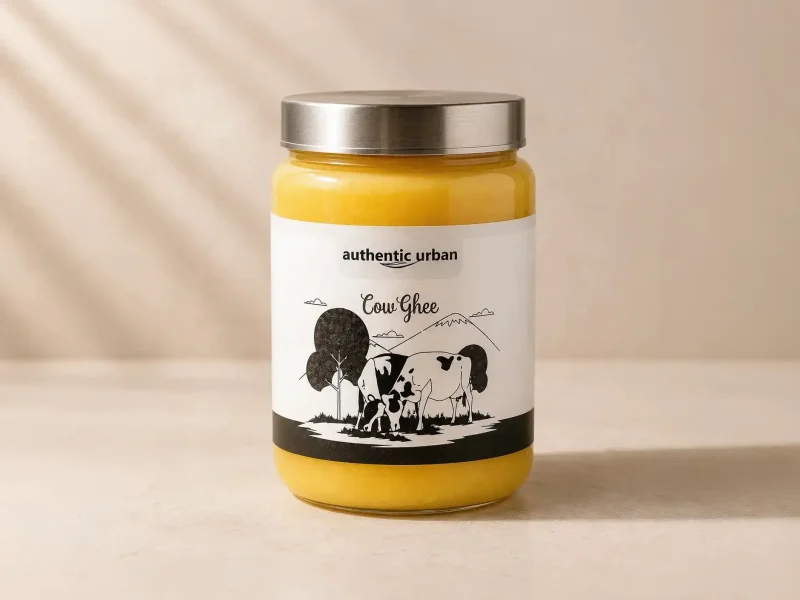
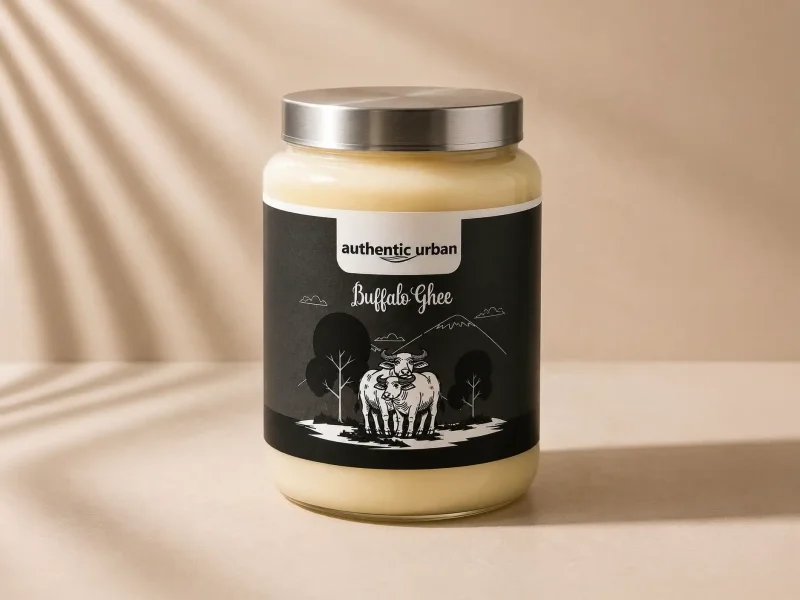
We make and sell ghee, so weigh this with that in mind. For the daily spoon we would pick our own A2 Gir cow ghee: grass-fed Gir milk set to curd overnight, churned, and cooked in a matki on a wood chulha until the bubbling goes quiet. It is made after you order, and a video of your jar comes on WhatsApp. At ₹2,399 a litre, a 5 ml teaspoon costs about ₹12. Our Jafarabadi buffalo ghee is the richer jar for sweets, best in small portions if you bloat easily. We test every month against the FSSAI limits; the steps are on how we make ghee.
The ½ teaspoon on dal and the hing tadka
 1 Litre
Halwa and ladoo, in small bowls
 1 Litre
Each order is cooked after you place it, and the packing video is of that batch. Past order videos are on the shop.
FAQ
Pet me gas ho to ghee kha sakte hai?
Haan, thoda. Khane ke saath aadha se ek chammach garam ghee, dal, chawal ya khichdi par. Din bhar me 1 se 2 chammach se zyada nahi. Poori, pakode ya halwa wale din upar se ghee mat daalo. Dal me hing aur jeera ghee me bhun kar tadka lagao. Agar gas ke saath pet dard, ulti, wazan girna ya potty me khoon ho, to doctor ko dikhao.
Is ghee or oil better when you get bloated easily?
Neither is better for gas. Both are almost pure fat, and a teaspoon of either gives your gut the same fat to handle. What changes bloating is how much fat goes into the meal. Ghee suits the tadka and the spoon on dal or roti; oil suits sabzi and frying. If fried food bloats you, cut the frying, whichever fat is in the kadhai.
Is cow ghee or buffalo ghee easier on bloating?
No study has compared them for bloating. Both are fat, and the portion matters far more than the animal. Buffalo ghee is richer and usually goes into halwa, ladoo, and parathas, which are heavy meals anyway, so people link it with feeling full. For the daily spoon on dal with a sensitive stomach, most homes pick cow ghee and keep buffalo ghee for sweets.
Can I put ghee on my baby's tummy for gas?
Some families rub a little warm ghee on a baby's tummy as a household tradition, but there is no study showing it relieves gas or colic. Do not give ghee by mouth to a baby under one year as a gas remedy. A baby who cries for hours, vomits, has a swollen tummy, or is not feeding well needs a paediatrician the same day.
Does ghee help bloating during periods?
Not directly. The NHS lists periods as a normal cause of bloating, driven by hormones rather than food. A teaspoon of warm ghee on a small, warm meal is fine that week, but it will not stop the water retention. Smaller meals, less salt and fizzy drinks, a walk, and a hot water bottle usually help more. Severe pain or very heavy bleeding needs a doctor.
Does ghee in hot milk at night cause gas?
It can, for two reasons. Milk has lactose, which NIDDK lists as a gas food, and a spoon of ghee adds fat late in the day, when a heavy stomach sits worst. If you wake up bloated, try the milk without ghee, then the ghee at lunch instead. If milk alone bloats you, the milk is the problem, not the ghee.
About the editorial team
Authentic Urban TeamBilona ghee makers, Gir Somnath, Gujarat
We are the Parmar family in Gir Somnath, Gujarat. We have made ghee here since 2016 and sold it online since 2025. We make only Bilona ghee, test it every month, and anyone is welcome to visit and watch it being made. Our Gir cows and Jafarabadi buffalo are grass-fed village animals that graze near the Gir forest, with no hormones or milk boosters. We set their milk to curd, churn it, and cook the makkhan on a wood chulha. These articles come from that kitchen and from what customers ask us on WhatsApp. We are ghee makers, not doctors.
Sources
- Bloating (page reviewed 21 January 2026), NHS. Checked 27 Sep 2026.
- Eating, Diet, and Nutrition for Gas in the Digestive Tract, National Institute of Diabetes and Digestive and Kidney Diseases (NIDDK). Checked 27 Sep 2026.
- Symptoms and Causes of Gas in the Digestive Tract, National Institute of Diabetes and Digestive and Kidney Diseases (NIDDK). Checked 27 Sep 2026.
- Non-FODMAP dietary triggers of IBS symptoms (Chloe Swiney, 26 March 2024), Monash University FODMAP. Checked 27 Sep 2026.
- Safety and Efficacy of Ferula asafoetida in Functional Dyspepsia: A Randomized, Double-Blinded, Placebo-Controlled Study (Mala et al., Evidence-Based Complementary and Alternative Medicine, 2018), PubMed Central (PMC6129344). Checked 27 Sep 2026.
- Dietary Guidelines for Indians, 2024 (limit ghee or butter to 1 to 2 teaspoons a day), ICMR-National Institute of Nutrition. Checked 27 Sep 2026.