Is Ghee Good for IBS? How Much, and Is It Low FODMAP
Is ghee good for IBS? In small amounts, usually yes: ghee is low FODMAP and has almost no lactose. The catch is fat itself, which sets off pain, bloating, and loose stools for many people with IBS. Keep it to ½ to 1 teaspoon a meal, inside food, and cut back on loose-stool days.
Is ghee good for IBS?
Ghee is fine for most people with IBS at ½ to 1 teaspoon a meal, eaten with food. It passes the FODMAP test, which rules out most IBS trigger foods. It does not pass the fat test for everyone: rich, fried meals are among the most common IBS triggers. So the amount decides whether ghee helps a plate or hurts it.
IBS (irritable bowel syndrome) is a long-term gut condition with stomach pain or cramps, bloating, and diarrhoea, constipation, or both; the NHS notes the pain is usually worse after eating and better after a motion. Doctors split it by the main stool pattern: IBS-D (diarrhoea), IBS-C (constipation), and IBS-M (mixed). This page is for adults who already have a diagnosis. Plain constipation without cramps is on ghee for constipation, and gas after meals, the Ayurvedic way, is on ghee for bloating.
Is ghee low FODMAP?
Yes, ghee is low FODMAP. FODMAPs are short-chain carbohydrates (the sugars in milk, onion, garlic, wheat, beans, and some fruit) that ferment in the gut and set off IBS. Fats have none. Monash University, the team that tests foods for the FODMAP diet, says butter holds a negligible amount of lactose, and ghee, as clarified butter, is low FODMAP as well.
That matters because milk is a big IBS trigger. In the 2013 study of 197 IBS patients below, 49% blamed dairy products and 43% named milk itself. Ghee is not milk: the watery part that carries lactose is gone. In our kitchen in Gir Somnath, the makkhan cooks in a matki until the bubbling goes quiet and the milk solids turn golden-brown, then the ghee is strained off them. A batch taken off too early stays cloudy and keeps moisture, so we never pack it. That cloudiness is also milk left in the jar. How ghee handles lactose intolerance, which is a different problem from IBS, is on ghee for lactose intolerance.
The FODMAPs on an Indian plate usually sit next to the ghee, not in it: onion and garlic in the tadka, rajma and chole, wheat rotis in large amounts. Most "ghee upset my stomach" stories we hear are really about what the ghee was cooked with.
Why can ghee still trigger IBS symptoms?
Because fat, from any source, can trigger IBS even when a food is low FODMAP. Monash dietitians explain that high-fat meals slow the gut down, which brings fullness, bloating, and discomfort, and that people with IBS feel this more. Here is what the research actually shows.
The question
What was found
Is ghee low FODMAP?
Yes. Monash University, which runs the main FODMAP food tests, says cooking fats are made of fatty acids with no carbohydrate, butter has a negligible amount of lactose, and ghee is low FODMAP too (2024).
Do people with IBS react to fat?
Many say so. In a 2013 study of 197 IBS patients in the American Journal of Gastroenterology, 52% reported symptoms after fried and fatty foods, and 49% after dairy products.
Is the gut more sensitive to fat in IBS?
In a lab test, yes. A 2007 study fed fat into the small intestine of 61 IBS patients and 20 healthy people for an hour; the colon of the IBS group became more sensitive to discomfort and pain. IBS-D, IBS-C, and mixed IBS reacted alike.
Does cutting fat treat IBS?
Not proven. Monash dietitians wrote in 2017 that no high quality trial has tested a fat-restricted diet for IBS.
Has ghee been tested for IBS?
No. Searching Europe PMC for ghee and IBS in September 2026, we found only single-patient Ayurvedic case reports, no controlled trial.
The 2007 result is the one most pages get wrong. Many say ghee is only a problem for IBS-D and that IBS-C can take more. In that study the colon of IBS-C patients became as sensitive after fat as the others. The type of IBS changes what your stools do after a rich meal, not whether fat can hurt.
None of this makes ghee bad. It means a teaspoon on dal is a very different thing from a plate of puri and halwa, and the second one is what people with IBS usually report. What too much ghee does to anyone's stomach is on ghee side effects.
How much ghee with IBS, by type?
Keep ghee to 1 to 2 teaspoons a day, the ICMR-NIN 2024 limit for everyone, split across meals and always eaten with food. Go lower on loose-stool days. No IBS guideline sets a ghee dose, so the table below is a careful starting point inside that limit, not a treatment plan.
Situation
Ghee
Why
Low FODMAP diet, step 1 (2 to 6 weeks)
1 to 2 tsp a day
Ghee is allowed. Split it across meals, and use it for the garlic tadka below so you keep the taste you miss.
IBS-D, or a loose-stool day
½ tsp a meal
Always with food, never alone. No fried food that day. On a bad flare day, skip added ghee.
IBS-C
1 tsp a meal, 2 tsp a day at most
Fat does not treat IBS constipation. Soluble fibre and water do more; see the section below.
IBS-M (mixed)
Follow the day
Loose day: the IBS-D row. Hard day: the IBS-C row. Your diary will show which fat amount you tolerate.
Morning spoon on an empty stomach
Skip
Fat alone, first thing, is the classic trigger for urgency. Wait until symptoms have been quiet for weeks, then try ½ tsp.
Puri, pakora, halwa, rich mithai
Small, and not on symptom days
Monash advises cutting very high-fat meals and desserts, and deep frying. This is where most IBS fat comes from, not the teaspoon on dal.
For adults with diagnosed IBS. If your doctor or dietitian has set a fat limit, follow theirs.
At home each of us eats 1 to 2 teaspoons a day, on roti, dal, and khichdi. We make ghee for a living and we still measure it. The daily amount by age and activity is on how much ghee per day, and the morning spoon, with who should skip it, is on ghee on empty stomach.
How do you make a low FODMAP tadka with ghee?
Fry the garlic in ghee, lift the pieces out, and then pour the ghee over the dal. Fructans, the FODMAP in garlic and onion, dissolve in water but not in fat. Monash's cooks say pieces fried in oil can be removed before serving and the fructans leave with them. Once the garlic sits in watery dal, the fructans are in the dal for good.
In the tadka
FODMAP
Why
Garlic fried in ghee, then lifted out
Low FODMAP option
Fructans in garlic dissolve in water, not in fat. Monash says pieces fried in oil can be removed before serving and the fructans go with them.
Garlic or onion left in dal, sambar, or gravy
High FODMAP
Once there is water, the fructans move into the liquid. Fishing the pieces out of a curry does not help.
Hing (asafoetida)
Monash lists it as a swap
Gives the onion-garlic note. Many hing packs are mixed with flour; read the label for wheat if you are cutting it.
Green part of spring onion, chives
Monash lists them as a swap
Use the green tops in place of onion. Leave out the white bulb.
Jeera, ginger, haldi, curry leaves, fresh herbs
Monash lists spices and ginger as swaps
The rest of a normal tadka. Go easy on green chilli if spice sets you off; the NHS lists spicy food as a common trigger.
Garlic ghee tadka for one pot of dal
Warm 1 teaspoon of ghee on a low flame. Add jeera and let it crackle, then 3 or 4 whole, lightly crushed garlic cloves. Keep the cloves big so they are easy to find. Fry for about a minute until they are pale gold, then lift every piece out with a spoon. Add a pinch of hing and a few curry leaves, and pour the ghee over the cooked dal. The dal smells of garlic, and the fructans stayed in the cloves you removed. Our basic method, with onion, is on ghee dal tadka.
Choose the dal with care too. In the 2013 study, 36% of IBS patients named beans and lentils as a trigger, second only to dairy among the carbohydrate foods. A plain ghee khichdi with rice and a small amount of moong dal is the easiest IBS meal in most Indian homes.
Is ghee or oil better with IBS?
Neither is better for IBS: both are pure fat, both are low FODMAP, and a teaspoon of each gives your gut about the same fat to handle. Choose by the cooking job. Ghee suits tadka and the spoon on dal or roti. Oil suits sabzi and frying. Monash advises people with IBS to avoid deep frying, so the pakora and the puri are the thing to cut, whichever fat is in the kadhai.
The same goes for cow or buffalo ghee. Buffalo ghee is richer and goes into halwa and ladoo, which are heavy meals anyway; that is the reason to keep it small on symptom days, not the animal. How the two differ in the kitchen is on cow vs buffalo ghee.
Does butyrate in ghee help IBS?
Not in any way shown in people. Butyrate is a short-chain fat that feeds the cells lining the colon, and ghee contains a small amount of it. Pages that rank for this topic jump from butyrate in lab studies to "ghee heals IBS". A teaspoon of ghee holds a fraction of a gram, and gut bacteria make far more from fibre in the colon. The numbers, and why swallowed butyrate is taken up early in the gut, are on butyrate in ghee.
What helps IBS more than ghee?
A food diary, regular meals, the right fibre, and a low FODMAP trial with a dietitian all do more for IBS than any change in ghee. These are the steps the NHS, NIDDK, and Monash give.
- Eat on time, and slowly. The NHS advises not skipping or delaying meals and not eating too fast. It also says not to eat lots of fatty, spicy, or processed food.
- Cap the known triggers. The NHS suggests no more than 3 portions of fresh fruit and 3 cups of tea or coffee a day, and little alcohol or fizzy drinks. Drink about 1.5 litres of fluid a day.
- Match fibre to your IBS type. For constipation, the NHS suggests soluble fibre such as oats, pulses, and linseeds; for diarrhoea, fewer high-fibre foods and no sorbitol. NIDDK puts adult fibre at 22 to 34 g a day, says soluble fibre helps IBS more, and advises adding 2 to 3 g a day at a time.
- For bloating, the NHS suggests oats regularly and up to 1 tablespoon of linseeds a day.
- Try low FODMAP properly. Monash's three steps: swap high FODMAP foods for 2 to 6 weeks, then test one FODMAP group at a time for 3 days each, then build your own long-term diet. Monash says to do it with a dietitian trained in IBS.
- Try one change at a time. NIDDK notes your doctor may suggest a gluten trial; the NHS suggests a probiotic for a month. Change one thing, and keep the ghee steady while you do.
If you get heartburn along with IBS, the timing of fat matters for that too; see ghee for acid reflux.
When should IBS symptoms go to a doctor?
See a doctor if gut symptoms have lasted more than 4 weeks and you have never been diagnosed, the NHS line. Other gut conditions, such as coeliac disease, can cause the same symptoms and need their own tests. Go back if diet changes are not helping, or if you are cutting out more and more foods.
Get urgent medical help if you have lost a lot of weight for no reason, have bleeding from your bottom or bloody diarrhoea, find a hard lump or swelling in your tummy, or are short of breath with a racing heart and pale skin. These are the NHS warning signs. Do not try ghee, or any diet change, first.
We make ghee; we are not doctors. Your gastroenterologist or dietitian decides your fat limit. People with gallstones, pancreatitis, or a doctor-set fat limit should also read who should not eat ghee.
An 8-point ghee checklist for IBS
Screenshot this for the two weeks you are testing ghee.
- Get IBS diagnosed first. The NHS says see a GP if gut symptoms last over 4 weeks.
- Measure with a real 5 ml teaspoon. Stay inside 1 to 2 teaspoons a day, the ICMR-NIN limit.
- Eat ghee only inside a meal, split across lunch and dinner.
- For two weeks, write down meals, ghee amount, stool type, pain, and bloating each day.
- Make garlic flavour by frying cloves in ghee and lifting them out before adding water.
- Keep fried food and rich sweets to small portions, and not on symptom days.
- If symptoms rise within a day of more ghee, go back to ½ teaspoon a meal.
- Blood, weight loss, or a lump: stop the diary and see a doctor now.
Which ghee for an IBS-friendly kitchen?
No ghee is proven better for IBS than another; the amount and the plate count. What you want is ghee that is fully cooked and dry, with no milk left in it. Well-made ghee is clear when melted, smells of toasted milk when warmed, and often sets grainy when cool. How to check any jar is on how to identify pure ghee, and our ranking of cow ghee on sale is best cow ghee in India.
We make and sell ghee, so weigh this with that in mind. For the tadka we would pick our own A2 Gir cow ghee: grass-fed Gir milk set to curd overnight, churned, and cooked in a matki on a wood chulha, made after you order, with a video of your jar sent on WhatsApp. At ₹2,399 a litre, a 5 ml teaspoon costs about ₹12. Our Jafarabadi buffalo ghee is the richer jar for halwa, best kept for days when your gut is quiet. We test every month against the FSSAI limits; the steps are on how we make ghee.
The garlic tadka and the spoon on khichdi
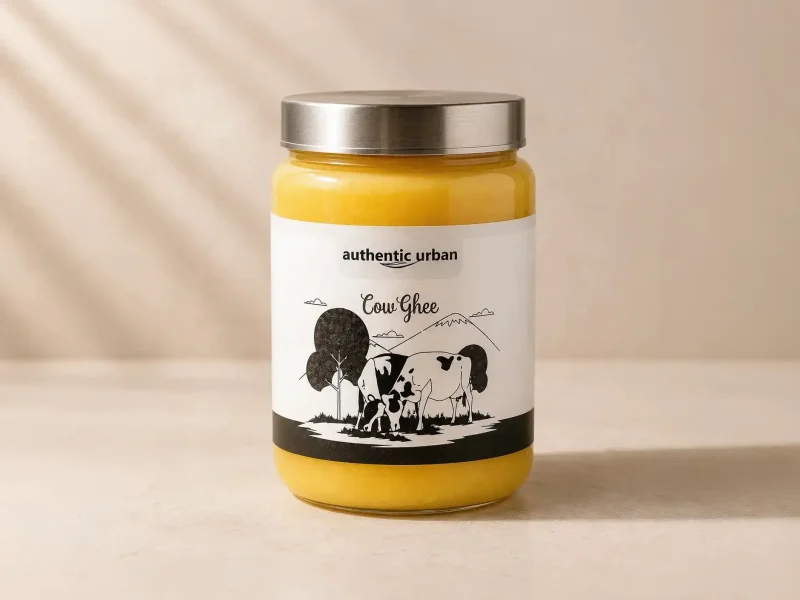 1 Litre
Halwa on a good day, a small bowl
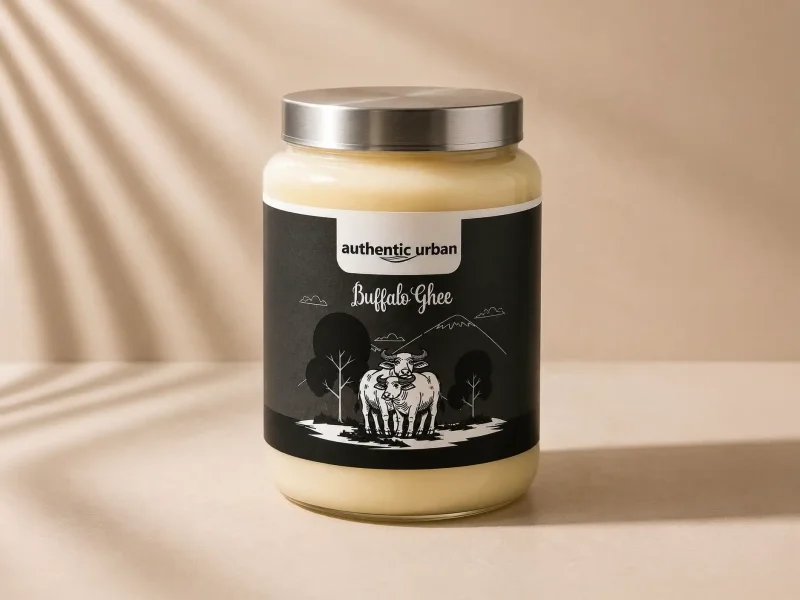 1 Litre
Each order is cooked after you place it, and the packing video is of that batch. Past order videos are on the shop.
FAQ
IBS me ghee kha sakte hai?
Haan, zyadatar logon ke liye thoda ghee theek hai. Ghee low FODMAP hai, par fat khud IBS ko bhadka sakta hai. Din me 1 se 2 chammach, khane ke saath, lunch aur dinner me baant kar. Loose motion wale din aadha chammach ya bilkul nahi. Khali pet ghee aur tali hui cheezein kam rakhein. Potty me khoon, wazan girna, ya pet me gaanth ho to turant doctor ko dikhayein.
Is butter or ghee better for IBS?
Monash University lists both as low FODMAP, since butter has only a negligible amount of lactose. Ghee has the milk solids cooked and strained out, so it holds even less milk protein and sugar than butter. For fat sensitivity, which is the bigger IBS issue, a teaspoon of either is nearly the same amount of fat, so keep to the same small portion whichever you use.
Is A2 ghee better for IBS than regular ghee?
No study has compared them for IBS. A2 refers to a milk protein, and well-made ghee has almost no milk protein left in it, so the A2 label matters little for your gut. What matters is the amount and whether the ghee is fully cooked and dry. We sell A2 Gir cow ghee and would still tell you: buy it for taste and trust, not as an IBS treatment.
Can I eat ghee during the low FODMAP elimination phase?
Yes. Monash lists ghee as low FODMAP, so it stays in during step 1, which runs 2 to 6 weeks. Keep the amount steady through the elimination and challenge weeks, at 1 to 2 teaspoons a day. If you change the ghee and the FODMAP foods at the same time, you will not know which one moved your symptoms. Work through the steps with a dietitian who knows IBS.
Does ghee help IBS pain or cramps?
There is no evidence that it does. The only lab data on fat and IBS points the other way: fat in the small intestine made the colon of IBS patients more sensitive to pain in a 2007 study. A small amount of ghee on a low FODMAP plate is fine, but it is not a pain treatment. Cramps that keep coming back belong with your doctor.
Can a child with IBS eat ghee?
A child over one year can have ½ to 1 teaspoon of ghee on dal or rice as normal food. Tummy pain in a child with loose or hard stools needs a paediatrician first, before anyone calls it IBS. Do not start a low FODMAP diet or cut food groups for a child on your own; a growing child's diet changes belong with the doctor and a dietitian.
About the editorial team
Authentic Urban TeamBilona ghee makers, Gir Somnath, Gujarat
We are the Parmar family in Gir Somnath, Gujarat. We have made ghee here since 2016 and sold it online since 2025. We make only Bilona ghee, test it every month, and anyone is welcome to visit and watch it being made. Our Gir cows and Jafarabadi buffalo are grass-fed village animals that graze near the Gir forest, with no hormones or milk boosters. We set their milk to curd, churn it, and cook the makkhan on a wood chulha. These articles come from that kitchen and from what customers ask us on WhatsApp. We are ghee makers, not doctors.
Sources
- Low FODMAP meat, seafood, eggs and cooking fats (Jimmy Lee, 23 January 2024), Monash University FODMAP. Checked 27 Sep 2026.
- Cooking with onion and garlic (1 June 2015), Monash University FODMAP. Checked 27 Sep 2026.
- Starting the low FODMAP diet: the 3 steps, Monash University FODMAP. Checked 27 Sep 2026.
- Dietary fats and IBS symptoms (Jane Varney and CK Yao, 15 August 2017), Monash University FODMAP. Checked 27 Sep 2026.
- Non-FODMAP dietary triggers of IBS symptoms (Chloe Swiney, 26 March 2024), Monash University FODMAP. Checked 27 Sep 2026.
- Self-reported food-related gastrointestinal symptoms in IBS are common and associated with more severe symptoms and reduced quality of life (Bohn, Storsrud, Tornblom, Bengtsson, Simren; American Journal of Gastroenterology, 2013, 108: 634-641), Europe PMC (PMID 23644955). Checked 27 Sep 2026.
- Lipid-induced colonic hypersensitivity in the irritable bowel syndrome: the role of bowel habit, sex, and psychologic factors (Simren, Abrahamsson, Bjornsson; Clinical Gastroenterology and Hepatology, 2007), Europe PMC (PMID 17174611). Checked 27 Sep 2026.
- Irritable bowel syndrome (IBS): diet, lifestyle and medicines, NHS. Checked 27 Sep 2026.
- Irritable bowel syndrome (IBS): symptoms, NHS. Checked 27 Sep 2026.
- Eating, Diet, & Nutrition for Irritable Bowel Syndrome, National Institute of Diabetes and Digestive and Kidney Diseases (NIDDK). Checked 27 Sep 2026.
- Dietary Guidelines for Indians, 2024 (limit ghee or butter to 1 to 2 teaspoons a day), ICMR-National Institute of Nutrition. Checked 27 Sep 2026.