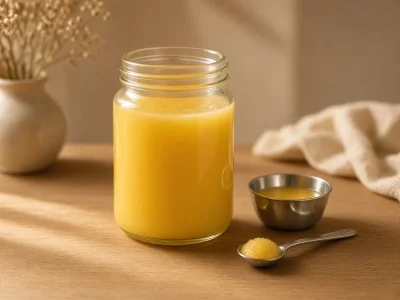
Ghee for Baby Massage: Is It Good, When to Start, How Much
Ghee for baby massage is fine for most healthy, full-term babies once the umbilical cord has fallen off and the navel is dry: half a teaspoon, warmed between your palms, is enough for a small baby. The massage does the good, not the ghee. No study has tested ghee itself, so keep it plain, keep it out of the nose, ears, and eyes, and stop at any rash.
Is ghee good for baby massage?
Yes, as a massage fat it works well: it is soft, mild, and lets your hands glide without dragging on thin skin. What it does not have is proof that it is better than other plain oils. The Indian trials tested sesame, mustard, coconut, and mineral oil, not ghee, and the benefits they found came mostly from the daily touch itself.
"Can I use this for my baby?" is one of the questions we are asked most on WhatsApp. We are the Parmar family in Gir Somnath, Gujarat, and we make ghee; we are not doctors. Malish with ghee is a household tradition across India, and this page lays out how families do it, where the research stands, and where the limits are. Your paediatrician's advice comes before ours, especially for a baby born early or with skin trouble. Feeding ghee to a baby is a different question with its own rules, on ghee for babies: nothing from the massage jar goes in the mouth before six months.
When can you start baby massage with ghee?
Wait at least until the cord stump has fallen off and the navel is fully dry. The NHS says the cord takes about a week to dry out and drop off, and advises bathing a baby with plain water only, with no skin lotions, for at least the first month. That month is the cautious line.
Many Indian families start malish in the first or second week, and the tradition is strong. If you want to start before a month, ask at the first check-up, begin with the legs and arms only, and keep the tummy dry until the navel has healed. A baby born early, small, or home from the NICU starts only on the doctor's plan. What goes on the cord itself (nothing) is covered on ghee in a baby's belly button.
How much ghee for baby massage?
Less than most people use: about half a teaspoon for a baby under three months, and about a teaspoon for an older baby. You want palms that glide, not a baby who shines. A tablespoon, which some pages suggest, leaves a newborn slippery to hold and greasy under the clothes.
Age
Ghee
Time
Notes
Cord just off, first month
1/4 to 1/2 tsp
5 minutes
Legs and arms only, if your doctor is happy. The NHS keeps the first month to plain water and no lotions, so this is the cautious window.
1 to 3 months
About 1/2 tsp
5 to 10 minutes
Whole body once the navel is dry. Most babies like it before the bath.
3 to 6 months
1/2 to 1 tsp
10 to 15 minutes
Slightly firmer strokes, back on your lap. Stop when the baby turns away.
6 to 12 months
About 1 tsp
10 minutes
Shorter and playful once the baby rolls and crawls. Oiled hands and a crawling baby slip, so hold on.
1 to 2 years
About 1 tsp
5 to 10 minutes
A few times a week, or after a winter bath on dry legs and cheeks.
Household starting amounts for a healthy, full-term baby, for massage on the skin only. Not a medical dose. Use less on a humid day and a little more on dry winter skin.
Once a day is the usual rhythm, before the bath, when the baby is awake and calm and not on a full tummy. If the baby cries through the strokes or keeps turning away, stop for the day. A shorter massage the baby enjoys beats a long one they fight.
How to massage a baby with ghee, step by step
Start with a patch test: a dab of the ghee on the inner arm, checked the next day for redness or bumps. Then work from the legs up, in a warm room out of the fan's draught, with the baby on a cotton sheet over a waterproof mat and your rings off.
-
1. Warm the ghee, not the jar
Take the amount out with a dry spoon into a small katori and stand it in warm water until soft. Rub it between your palms. Test on your inner wrist: warm, never hot. No microwave, no flame.
-
2. Legs first
Legs mind touch the least. Hold the ankle loosely and stroke from thigh to foot, then roll the leg gently between your palms. Thumbs in small circles on the sole.
-
3. Arms and hands
Shoulder to wrist in long strokes, then open the fist and rub the palm. Wipe the ghee off the fingers before you finish; they go straight into the mouth.
-
4. Chest and tummy
Only once the navel is fully dry. Flat hands outward from the middle of the chest, then slow clockwise circles around (not on) the navel with feather-light pressure.
-
5. Back
Baby on your lap, face down, head turned to one side. Long strokes from shoulders to bottom beside the spine, never pressing on the spine itself.
-
6. Face and head, little or none
What is left on your palms is enough. Stroke the forehead and cheeks outward, away from the eyes. Leave the soft spot on the head alone.
-
7. Bath, or wipe
Lukewarm water afterwards takes off the extra. A thick layer left on in humid weather traps sweat, and ghee left on the hands ends up in the eyes.
Grainy ghee is normal. Ghee made by the curd Bilona method (curd churned by hand) often cools with a grain in the jar; we see it in every winter batch, when the milk is richest and the grain sets fine and firm. In summer the same ghee stays liquid in the jar. For massage, warm the grainy kind in the katori until it is smooth; the grain melts in seconds and the ghee is the same. Why it happens is on the Bilona method. The same strokes for adults, with ghee, are on abhyanga with ghee.
What are the benefits of ghee massage for a baby? What studies found
Daily massage may help a baby's growth and sleep a little, and it softens dry skin; none of that is special to ghee. Most pages on this topic list bone strength, immunity, and "better circulation" as ghee benefits. Here is what the research actually tested.
Study
What it found
Indian trial, 125 babies (Indian Journal of Medical Research, 2000)
Healthy full-term babies aged 6 weeks were massaged daily for 4 weeks with herbal, sesame, mustard, or mineral oil, or not massaged. Massaged babies grew better and slept more after the massage than those not massaged. Only sesame oil made a significant difference: 1.0 cm more length, and more girth at the arm and leg.
Cochrane review (2013)
Pooled trials of massage for healthy babies under six months. The authors concluded the findings do not support massage for low-risk parents and babies, and that the evidence is of poor quality.
Survey in Maharashtra and Madhya Pradesh (BMC Pediatrics, 2020)
93.8% of infants were massaged. The oils were mostly sesame-based Ayurvedic oils, coconut, olive, mustard, and baby oil. The authors called for clear guidance on the choice of oil and how to apply it.
Ghee
We found no trial that tested ghee for baby massage. Its use is tradition and comfort, not measured benefit.
So the fair claims are small ones. A fat on dry skin slows water loss and softens it. Ten quiet minutes with a parent's hands can settle a baby before a nap. A baby who is massaged gets handled, looked at, and talked to, which matters on its own. Claims that ghee on the skin builds bones, raises immunity, or adds weight do not have a study behind them. Ghee also keeps a trace of milk protein, which matters for a baby with a milk allergy; the detail is on does ghee have casein.
Ghee or oil: which is better for baby massage?
Any plain oil or ghee your baby's skin tolerates is fine; sesame oil has the one trial behind it. Ghee suits dry winter skin and a family that already trusts its jar. A lighter oil suits a humid summer. Skip anything with added fragrance.
Oil
In its favour
Watch for
Ghee
Soft, mild, already in the kitchen. Easy to keep a clean small jar.
Sets solid in winter, so it needs warming. Heavy in humid weather. Keeps a trace of milk protein, so ask first if your baby has a milk allergy. No trial has tested it for baby massage.
Sesame (til) oil
The only oil that did clearly better than the others in the Indian trial (Agarwal, 2000). Base of most Ayurvedic baby oils.
One trial of 125 babies. Buy a plain, food-grade oil, not one with added fragrance.
Coconut oil
The NHS suggests it (or an emollient) for loosening cradle cap. Light, liquid in most of India most of the year.
Turns solid on cold winter days, like ghee, and needs warming.
Mustard oil
Warming, traditional in North India; 19.5% of Madhya Pradesh families in the 2020 survey used it.
In the Agarwal trial it did not show the significant gain that sesame did. Strong smell; stop at any redness.
Olive oil
Used by 29.4% of Madhya Pradesh families in the survey.
The NHS says not to use it for cradle cap, as it may not suit skin.
Baby oil (mineral oil)
Cheap, no smell, stays on the surface.
In the Agarwal trial it did not show the significant gain that sesame did. Check the label for fragrance.
Trial: Agarwal et al., Indian Journal of Medical Research, 2000. Survey: Chaturvedi et al., BMC Pediatrics, 2020. Cradle cap advice: NHS, reviewed 3 October 2025. Checked 27 September 2026.
How ghee and coconut oil compare in the kitchen is on ghee vs coconut oil. If a baby has eczema, what goes on the skin is the doctor's call; what ghee can and cannot do on inflamed skin is on ghee for eczema.
Where should ghee never go on a baby?
Not in the nose, ears, eyes, or mouth, and not on the cord or an unhealed navel. Oil in a baby's nose or mouth can slip into the lungs, and babies cannot cough it back out. A 1973 report in the British Medical Journal traced 12 cases of oil pneumonia in South Indian children, 10 of them under 8 months, to oil baths and the custom of cleaning the mouth, throat, and nose with oil.
The custom has not gone away. The 2020 survey in Maharashtra and Madhya Pradesh notes that putting oily substances in babies' ears and nose, and oil-based kajal in the eyes, are still popular in India. A massage is for the skin. Why ghee drops in a baby's nose are a firm no is on ghee in a baby's nose.
When should you stop a ghee massage and call the doctor?
Stop at the first rash where the ghee went, and call the doctor the same day for fever, breathing changes, or a red, oozing navel. Keep this table where you massage.
What to do
When you see
Doctor the same day
Redness or swelling around the navel, a cord area that oozes or smells, fever, or fast or noisy breathing, especially after anything oily went near the nose or mouth.
Stop the ghee and ask
A rash, bumps, or redness where the ghee went, or at the patch test spot. Try a different plain oil only after it has cleared, or not at all.
Skip that day
Fever, a cold with a blocked nose, a fresh vaccination site, broken or weeping skin, or a baby who is unwell or crying through it.
Talk to your paediatrician first
A baby born early or small, one home from the NICU, a milk allergy, eczema that is not settling, or cradle cap that bleeds or spreads beyond the scalp.
General information for parents, not medical advice. Your paediatrician's advice for your baby comes first.
Which ghee is best for baby massage, cow or buffalo?
Cow ghee is the usual pick for baby massage: it is softer at room temperature and lighter on the skin. Buffalo ghee is fine too, but it sets firmer and needs more warming. What matters more is that the jar is real ghee, cooked well, and clean.
In our kitchen, a batch taken off the chulha too early stays cloudy, keeps moisture, and spoils fast; one left too long turns dark and smells burnt. Neither is packed. For a baby's skin, a sour, cheesy, or soapy smell means that jar is not for massage. Colour is different: our cow ghee turns more yellow in the monsoon, when the cows eat green fodder, and that is normal. The kitchen tests for a real jar are on how to identify pure ghee, how the two ghees differ is on cow vs buffalo ghee, and a ranked list of jars for babies is on best ghee for babies in India.
An 8-point check before every baby massage
- Cord off and navel dry before any ghee goes on the tummy.
- Patch test done: a dab on the inner arm, checked the next day.
- A small separate jar, opened only with a dry spoon.
- The ghee smells of toasted milk. Sour, soapy, or cheesy goes back.
- Warmed in a katori over warm water, checked on your wrist.
- Nothing in the nose, ears, eyes, mouth, or navel.
- Baby calm and not just fed; one hand on the baby at all times.
- Bath or wipe afterwards; stop the day the baby says no.
Keep the massage jar shut, away from the stove and sunlight; the rest of the storage rules are on how long ghee lasts. The mother's own ghee after delivery is on ghee postpartum recovery.
Which ghee for baby massage?
At half a teaspoon a day, a 250 ml jar lasts a small baby about three months, which is why we would buy the smallest size and keep it only for massage. Whatever brand you pick, look for one ingredient on the label, an FSSAI licence number, and a clean toasted-milk smell when warmed.
We make and sell ghee, so weigh this with that in mind. For a baby's massage jar we would use our own A2 Gir cow ghee: milk from grass-fed Gir cows with no hormone injections, set to curd overnight, churned, and cooked in a matki on a wood chulha. It is made after you order, and a video of your jar being cooked and packed comes on WhatsApp. For the family's parathas and sweets, our Jafarabadi buffalo ghee is the richer jar. Varsha tastes every batch before it is packed, and we test every month against the FSSAI limits; the steps are on how we make ghee.
A small jar kept for baby malish
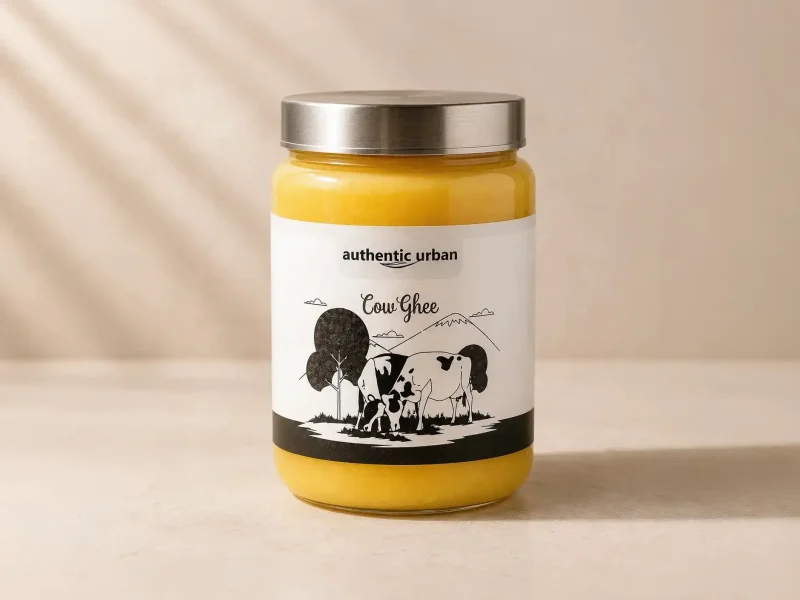 1 Litre
The family's cooking and sweets
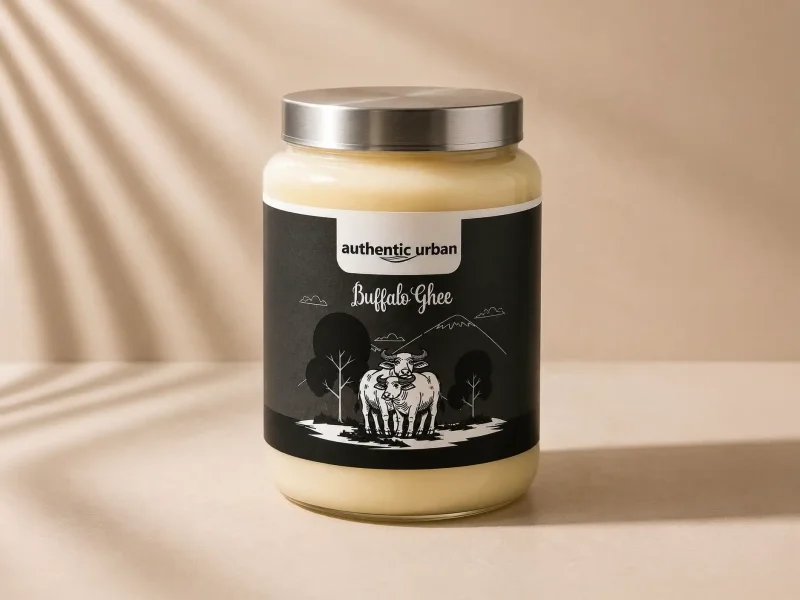 1 Litre
Each order is cooked after you place it, and the packing video is of that batch. Past order videos are on the shop.
FAQ
Can I use ghee for baby massage in summer?
Yes, but use less. In a humid summer ghee sits heavy and a thick layer traps sweat, which can bring on prickly heat. Half a teaspoon is enough for a small baby, massage in the morning, and bathe or wipe it off afterwards. Many families switch to a lighter plain oil like coconut from April to June and come back to ghee when the dry winter skin returns.
Does ghee massage make a baby fair or help weight gain?
No. Skin colour is set by genes, and no oil changes it. Weight comes from milk, and later from food. In the one Indian trial, babies massaged daily gained a little more length and girth than babies who were not, but that was with sesame and other oils, not ghee, and the Cochrane review calls the evidence weak. If weight gain worries you, see the paediatrician, not more oil.
Can I mix turmeric, besan, or camphor into the massage ghee?
Keep the massage ghee plain. Camphor is not for babies at all, on the skin or near the nose. Turmeric stains and can irritate thin skin, and each extra ingredient is one more thing to react to. Besan ubtan is an old bath custom for older babies; if you use it, do it separately at bath time, rub gently, and stop at any redness.
Should the massage ghee be a separate jar from the kitchen jar?
Yes. A kitchen jar gets wet spoons, steam from the stove, and crumbs, and water in ghee is what makes it go sour. A small jar kept only for massage stays clean, and you notice at once if its smell changes. A 250 ml jar holds about 50 teaspoons, so at half a teaspoon a day it lasts a small baby three months.
Can a premature baby have a ghee massage?
Only on your doctor's plan. Babies born early have thinner skin, lose heat faster, and are more easily unsettled, so NICU teams decide when touch and oil start and what oil to use. Once home, ask at the follow-up visit before starting ghee, and keep to what they showed you.
Is ghee massage good for cradle cap?
Ghee has not been tested for cradle cap. The NHS suggests lightly massaging an emollient or coconut oil onto the scalp to loosen the scales, then washing. If you use ghee instead, use a thin film, leave it a short while, wash it off, and never pick the scales. See a doctor if the crusts bleed, leak, swell, or spread over the body.
About the editorial team
Authentic Urban TeamBilona ghee makers, Gir Somnath, Gujarat
We are the Parmar family in Gir Somnath, Gujarat. We have made ghee here since 2016 and sold it online since 2025. We make only Bilona ghee, test it every month, and anyone is welcome to visit and watch it being made. Our Gir cows and Jafarabadi buffalo are grass-fed village animals that graze near the Gir forest, with no hormones or milk boosters. We set their milk to curd, churn it, and cook the makkhan on a wood chulha. These articles come from that kitchen and from what customers ask us on WhatsApp. We are ghee makers, not doctors.
Sources
- Effects of massage and use of oil on growth, blood flow and sleep pattern in infants (Agarwal KN et al., 2000; 112: 212-217), Indian Journal of Medical Research. Checked 27 Sep 2026.
- Prevalence and perceptions of infant massage in India: study from Maharashtra and Madhya Pradesh states (Chaturvedi et al., 2020), BMC Pediatrics. Checked 27 Sep 2026.
- Massage for promoting mental and physical health in typically developing infants under the age of six months (Bennett, Underdown, Barlow, 2013), Cochrane Database of Systematic Reviews. Checked 27 Sep 2026.
- Lipoid pneumonia in infants and children in South India (Balakrishnan, 1973), British Medical Journal. Checked 27 Sep 2026.
- Getting to know your newborn (page reviewed 22 April 2024), NHS. Checked 27 Sep 2026.
- Cradle cap (page reviewed 3 October 2025), NHS. Checked 27 Sep 2026.