Ghee Face Pack: 6 Recipes and How to Apply Ghee on Face
A ghee face pack is ½ teaspoon of ghee mixed into 1 tablespoon of besan and milk, honey, or curd, left on for 10 to 15 minutes and washed off with lukewarm water, twice a week. It softens dry skin. It does not whiten skin or remove a tan, and on oily skin too much ghee can bring pimples. Patch test the mix on your arm for 7 to 10 days first.
Which ghee face pack suits your skin?
For most skin, start with 1 tablespoon of besan, 1 tablespoon of cool milk, and ½ teaspoon of ghee, on for 10 to 15 minutes, twice a week. Dry skin does better with honey and ghee. Oily skin needs only 3 or 4 drops of ghee, or none. Pick one pack, not three.
Ghee does one job in a pack: it is a fat. A thin layer slows water loss from the top of the skin, so dry, tight cheeks feel softer after you wash it off. Besan lifts dead skin as you rinse, which is why the face looks brighter for a day. Nobody has run a trial on ghee face packs, so the table below sticks to amounts, times, and who should skip each one.
Pack
Mix (one face)
Time and how often
Good for
Skip if
1. Besan, milk, and ghee
1 tbsp besan, 1 tbsp cool milk, ½ tsp ghee
10 to 15 min, twice a week
Normal and combination skin; the everyday pack
Skip: Very dry or cracked skin, where besan pulls
2. Honey and ghee
1 tsp honey, ½ tsp ghee
10 min, twice a week
Dry skin and winter tightness
Skip: Anyone who reacts to honey or bee products
3. Curd and ghee
1 tbsp plain fresh curd, ½ tsp ghee
10 min, once or twice a week
Dry, dull skin
Skip: If curd stings, or the curd is sour and old
4. Aloe and ghee
1 tbsp plain aloe gel, ¼ tsp ghee
10 to 15 min, after a day outdoors
Skin that feels hot and tight after sun
Skip: Blistered or peeling sunburn; see a doctor instead
5. Besan, turmeric, and ghee
1 tbsp besan, a pinch of haldi, ½ tsp ghee, rose water to loosen
10 min, once a week
Normal skin, only after a clean patch test
Skip: Any past rash from kumkum, haldi, or a haldi ceremony
6. Oily skin pack
1 tbsp besan, rose water to a paste, 3 to 4 drops of ghee or none
10 min, once a week
Oily or acne-prone skin that still wants a pack
Skip: Active pimples; keep the pack off them
Two packs that fill most ghee face pack lists are missing here on purpose. Lemon juice with ghee can burn skin that then goes into the sun (the side effects section has the details). Saffron and milk packs are harmless but do nothing the plain milk pack does not, at far higher cost. If your skin breaks out easily, read ghee for acne before any pack; it sorts ghee on the face by skin type.
How to apply ghee on face, step by step
Clean, dry skin, a thin layer, 10 to 15 minutes, lukewarm water. The steps are the same for every pack in the table.
1. Patch test first
The full mix on the inner arm, twice a day for 7 to 10 days (see below). No redness, itch, or swelling means go ahead.
2. Wash and dry the face
A mild face wash, then pat dry. Tie your hair back and use an old towel: haldi and ghee stain.
3. Mix fresh, just enough
Stir the dry things first, then the ghee, then the liquid, until it spreads like thick curd. Make one use at a time.
4. Spread a thin layer
Fingertips or a clean brush, over the cheeks, forehead, and chin. Stay a finger-width away from the eyes and off the lips.
5. Wait 10 to 15 minutes
Wash it off before a besan pack dries hard and cracks. Tightness that turns to stinging means wash now.
6. Rinse with lukewarm water
Wet the pack first so it softens, then rinse with light circles. Do not scrub dried pack off.
7. Pat dry, then sunscreen by day
Skip moisturiser if the skin feels soft. In daytime, sunscreen before you step out.
Plain ghee on the face, without a pack
For dry patches alone, you do not need a pack. Warm 2 or 3 drops of ghee between clean fingertips until it melts clear, and press it onto the dry spots, not the whole face. Wash it off after 15 to 20 minutes, or leave it overnight only if your skin is dry and has never broken out from it. Ghee as a whole-face night layer, and how it compares with Vaseline, is on ghee slugging. Under the eyes the rule is one rice grain per eye, covered on ghee for dark circles, and lips have their own page on ghee for lips.
How long should you patch test a ghee face pack?
Seven to 10 days, not 24 hours. The American Academy of Dermatology (AAD) says to put a product on a quarter-sized spot, such as the inside of the arm or the bend of the elbow, twice a day for 7 to 10 days. For a wash-off product, leave it on as long as you would on your face, then wash it off.
For a pack, that means mixing a small spoon of the exact recipe, putting it on the inner arm for 10 to 15 minutes, and rinsing, morning and night, for a week or more. If the spot stays free of redness, itching, or swelling, the AAD says you can go ahead. If it reacts, wash it off and do not use that mix again. Most pages say 24 hours; a reaction to haldi or honey can take longer to show than that.
Skip ghee on the face if you have a milk allergy. Ghee holds a tiny trace of milk protein, as we explain on milk protein in ghee, and the milk and curd in two of these packs hold far more. Skip packs too on active eczema, which needs its own care; see ghee for eczema.
Can ghee whiten skin or remove tan?
No. Ghee does not change skin colour, lighten pigment, or remove a tan. It is the most searched ghee skin question in our own search data, and every page that promises "whitening" from ghee does it without a single study.
What people notice after a besan and ghee pack is smoother, softer skin that reflects more light for a day or so. That is real, and it is all a pack can do. A tan fades on its own as the top layer of skin renews, as long as the sun stops adding to it.
For dark spots and tan on brown skin, the AAD starts with sunscreen: broad-spectrum, SPF 30 or higher, tinted with iron oxide (it blocks visible light, which also darkens spots), and reapplied every two hours outdoors. It names azelaic acid, glycolic acid, kojic acid, retinoids, vitamin C, and prescription hydroquinone as the ingredients that fade spots, and says a spot a few shades darker than your skin usually fades within 6 to 12 months. The AAD also warns against imported creams with hidden steroids or mercury. A dermatologist decides on those treatments, not a face pack. Ghee and skin ageing claims are on ghee for collagen.
What are the side effects of ghee on face?
Pimples on oily skin are the most common one. The rest usually come from what is mixed with the ghee, not the ghee itself.
What you see
Usual cause
What to do
Pimples, blackheads, or small white bumps
Too much ghee, left too long, on oily or acne-prone skin
Stop for two weeks. Come back with pack 6, or not at all.
Itchy red patches a day or two later
An allergy to something in the mix. Haldi is a known one; milk, honey, and aloe can be too
Wash off, stop that pack, and see a dermatologist if it spreads.
Redness, then blisters and dark marks in sunlit spots
Lemon or lime juice on skin that then sees the sun
Wash with soap and water. See a doctor for blisters.
Stinging or a hot, tight face
Besan dried too long, rubbing, or broken skin
Rinse at once with cool water. Next time, shorter and gentler.
Sour or burnt smell on the skin
Old ghee that has gone off, or a pot that got water in it
Throw that pot out. Use a fresh spoonful from a clean jar.
Yellow skin or stained collars
Haldi and ghee colour, not a reaction
Fades in a day or two. Less haldi, old towels.
Why we leave lemon out
Lemons and limes carry natural chemicals that react with sunlight on the skin. Poison Control describes the pattern: redness within a day, blisters within 3 days, then dark marks over the next 1 to 2 weeks that can last months or even years. So a lemon pack sold for "tan removal" can leave darker patches than the tan. If lemon juice touches your face, wash it with soap and water; Poison Control says washing within 1 to 2 hours cuts how much the skin takes in.
Is turmeric safe in a ghee face pack?
For most people, a pinch is fine, but haldi is a known skin allergen, not only a healer. A 2015 review in the Journal of Clinical and Aesthetic Dermatology went through 11 studies and concluded that curcumin, the yellow part of haldi, is an allergen. One study it cites found an allergic reaction to kumkum, a haldi-based powder worn on the forehead, in 11 of 46 people with kumkum rashes (23.9%). If kumkum or a haldi ceremony has ever left you itchy, keep haldi out of your pack.
Which ghee should go on your face?
Plain ghee, fresh, from a jar that smells of toasted milk. Nothing spiced, nothing from the tadka pot.
At our kettle in Gir Somnath, a batch that cooks too long turns dark and bitter and smells burnt, and one taken off the flame too early stays cloudy and holds water, so it spoils fast. We do not jar either. Test your own jar the same way: warm a drop on the back of your hand. It should melt clear and smell clean. Sour, soapy, or burnt means it stays off your face; how ghee goes off is on does ghee go bad.
Texture changes with the season, and that is fine for a pack. Winter ghee sets in fine grains; in summer it stays liquid in the jar. A grainy spoonful melts in the warm bowl in seconds. Why ghee turns grainy is the question customers send us most on WhatsApp, and the answer is on why ghee is grainy. Keep a small face pot, filled with a dry spoon, so wet fingers never go into the main jar. If plain ghee still feels heavy, washed ghee is the lighter household version, made as shown on shata dhauta ghrita.
When should you stop a ghee face pack?
At the first rash, sting, or crop of pimples. We make ghee; we are not dermatologists, and the signs below belong with one.
Sign
What to do
Rash, itching, or swelling after a pack
Stop that pack. If it spreads, blisters, or reaches the eyes, see a doctor.
Breakouts where the pack sits
Stop for two weeks. The acne rules are on the ghee for acne page.
Eczema, psoriasis, or a flaky rash that will not settle
Ask a dermatologist before any pack. A pack is not treatment.
Brown patches that keep spreading, or a mole that changes
See a dermatologist. No face pack fixes these.
Cuts, burns, or open skin on the face
No pack until it heals.
Nothing changes after 4 weeks
The pack has done what a fat can do. Keep it as a treat, or drop it.
A baby's face is not the place for a pack at all; what is and is not safe on a baby's skin is on ghee for baby massage.
Ghee face pack checklist
Screenshot this before you mix the first bowl.
- Pick one pack from the table for your skin type. Only one.
- Patch test that exact mix on the inner arm, twice a day for 7 to 10 days.
- Fill a small face pot from your ghee jar with a dry spoon. Never dip wet fingers.
- No lemon, lime, or bleach cream in the bowl. Haldi only as a pinch, only after a clean test.
- Thin layer, 10 to 15 minutes, off before it dries hard.
- Twice a week at most; once for oily skin.
- Sunscreen every morning. It does more for tan than any pack.
- Stop at the first itch, sting, or bump.
Which ghee for a face pack?
On the face, a pure jar with nothing added matters more than any label. Five checks for purity are on how to identify pure ghee, and how curd Bilona (curd churned by hand) differs from cream ghee is on the Bilona method.
For a face pot filled from the same jar as your dal, we would pick our own A2 Gir cow ghee: milk from grass-fed Gir cows, set to curd overnight, churned, and cooked in a matki on a wood chulha, made after you order, with a video of your jar sent on WhatsApp. For paratha and sweets, our Jafarabadi buffalo ghee is the richer jar. We test every month against the FSSAI limits; the steps are on how we make ghee. Our ranking of the cow ghee on sale is on best cow ghee in India.
The face pot and the daily teaspoon
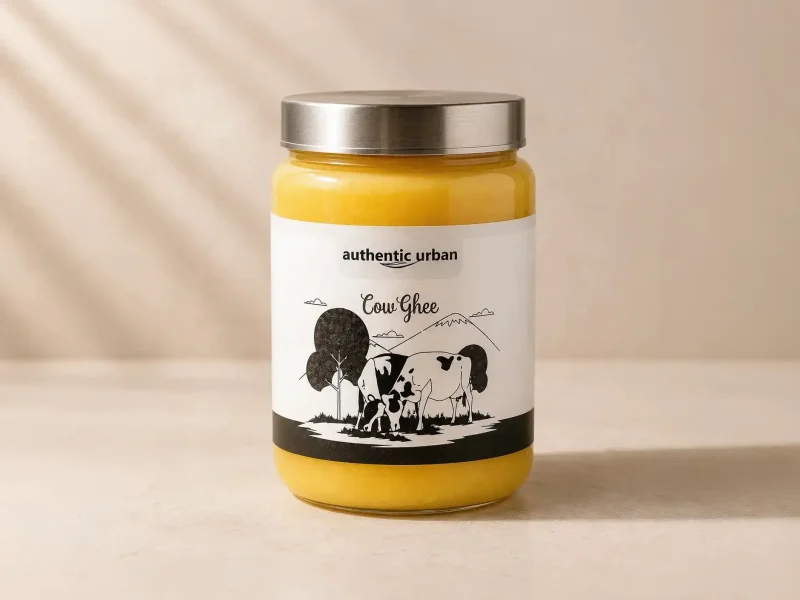 1 Litre
Paratha, halwa, and winter sweets
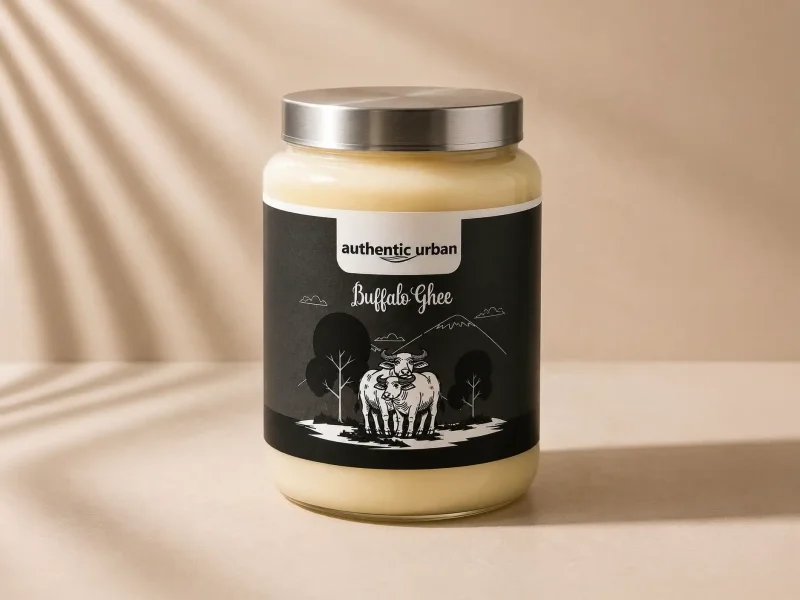 1 Litre
Each order is cooked after you place it, and the packing video is of that batch. Past order videos are on the shop.
FAQ
Can I apply a ghee face pack every day?
Not the rinse-off packs. Besan and curd packs used daily can leave skin dry and sore, and more packs do not mean more softness. Twice a week is enough for normal and dry skin, and once a week for oily skin. On the other days, a few drops of plain ghee patted onto dry patches at night, washed off in the morning, is fine if your skin takes it well.
Is cow ghee or buffalo ghee better for a face pack?
Both are nearly pure milk fat, so either works. Cow ghee is softer and melts quickly into a pack, which makes mixing easier. Buffalo ghee sets firmer, so warm the spoon in your palm for a few seconds first. What matters more than the animal is that the ghee is plain, fresh, and smells of toasted milk. Spiced or flavoured ghee from a cooking pot should never go on the face.
Can I make a ghee face pack in advance and keep it in the fridge?
No. Once milk, curd, aloe, or rose water goes into the bowl, the mix is a wet food that can spoil in hours, and you cannot see it happen. Make one use at a time: the amounts in our table cover one face. Plain ghee on its own keeps, but only in a small, dry, closed pot filled with a clean spoon. Throw away any leftover mixed pack.
Can men use a ghee face pack?
Yes, the same way. If your skin is oily, start with the oily skin pack or the besan and milk pack with half the ghee. Shave the day before, not the same day, because fresh shaving nicks sting under besan and haldi. For a dry beard or the skin under it, a few drops of plain ghee after a wash works better than a full pack.
Can I use a ghee face pack before my wedding or a haldi ceremony?
Only a pack you have already used without trouble. Do the full 7 to 10 day patch test at least a month before, and never try a new mix in the last two weeks. The haldi ceremony itself uses a lot of turmeric, so if you have ever reacted to kumkum or haldi, tell the family and keep the paste to a short time on the skin.
Chehre par ghee lagane se kya hota hai?
Chehre par thoda ghee lagane se sukhi twacha naram ho jaati hai, kyunki ghee upar ek patli parat bana deta hai jo paani ko udne se rokti hai. Rang gora nahi hota aur tan turant nahi jaata. Tailiya ya pimple wali skin par zyada ghee se daane nikal sakte hain. Pehle haath par 7 se 10 din patch test karein, phir hafte mein do baar pack lagayein.
About the editorial team
Authentic Urban TeamBilona ghee makers, Gir Somnath, Gujarat
We are the Parmar family in Gir Somnath, Gujarat. We have made ghee here since 2016 and sold it online since 2025. We make only Bilona ghee, test it every month, and anyone is welcome to visit and watch it being made. Our Gir cows and Jafarabadi buffalo are grass-fed village animals that graze near the Gir forest, with no hormones or milk boosters. We set their milk to curd, churn it, and cook the makkhan on a wood chulha. These articles come from that kitchen and from what customers ask us on WhatsApp. We are ghee makers, not doctors.
Sources
- How to test skin care products, American Academy of Dermatology. Checked 27 Sep 2026.
- How to fade dark spots in darker skin tones, American Academy of Dermatology. Checked 27 Sep 2026.
- Lime juice and sun can cause skin rashes, Poison Control (National Capital Poison Center). Checked 27 Sep 2026.
- Curcumin: a contact allergen (Chaudhari, Tam, and Barr, J Clin Aesthet Dermatol, 2015), Journal of Clinical and Aesthetic Dermatology. Checked 27 Sep 2026.