Best Ghee for Skin and Hair: Organic, A2, or Bilona?
The best ghee for skin and hair is a fresh, plain cow ghee from a sealed jar that smells of toasted milk when you warm a spoon. An organic logo, A2, or Bilona on the label does not change what ghee does on your face; freshness and a clean jar do. Our pick is our own A2 Gir cow Bilona ghee, ₹2,399 a litre, cooked after you order. Patch test any jar for a week first.
Which ghee is best for skin and hair?
The best ghee for skin and hair is plain cow ghee, opened recently, with one ingredient on the label and a toasted-milk smell. Our pick is Authentic Urban A2 Gir cow ghee, cooked only after you order. Patch test any jar first (below). How to use it is on ghee on face and ghee hair mask.
Does organic ghee work better on skin and hair?
Not that anyone has shown. We found no study that puts certified organic ghee against ordinary ghee on skin or hair. "Organic" is a certificate about how the farm is run: fodder, land, and inputs. It does not change what milk fat does on a dry cheek or a rough hair end.
If organic matters to you for other reasons, check it on the jar, not in the brand name. FSSAI's Jaivik Bharat guidance says certified organic food carries the FSSAI logo and licence number, the India Organic logo, the word "Organic" on the label, and the name, logo, and accreditation number of the body that certified it. Smaller farm groups certified under PGS-India show "PGS-Organic" and the group's ID instead. A company called "... Organic" with none of these on the pack is a name, not a certificate; one such case is on is Two Brothers ghee organic.
Our own ghee is not certified organic, and we do not call it that. Our cows and buffalo, and our partner farmers' animals, are grass-fed village animals that graze near the Gir forest, with no hormone injections or milk boosters. What A2 and organic each mean on an eating jar is on A2 ghee vs organic ghee.
Cow or buffalo ghee for skin and hair?
Cow ghee, for most people. It is the ghee household face and hair traditions use, and it is the jar most homes keep for the daily teaspoon anyway, so one jar does both jobs. Buffalo ghee is fine on dry heels and elbows, but we keep it for paratha, halwa, and sweets.
Grain and colour change with the season, not the quality. Bilona ghee cools grainy, and in summer it stays liquid in the jar. After the monsoon, green fodder makes cow ghee more yellow. The grain melts between your fingers in a second, so it makes no difference on skin. If you want a smooth, creamy texture for the face, that is what the washed-ghee tradition, shata dhauta ghrita, is for.
Which ghee brand to buy for skin and hair?
Authentic Urban comes first, and the reasons are on its card, so you can judge them. The others are curd-method cow ghee jars from our monthly price check, each described only by what its own page says. Jars that name a breed come first, cheapest per litre first; the one whose page names no breed comes last. None of these pages is a beauty product page, and none of these jars was tested on skin by us.
Curd-method cow ghee jars, ranked
Authentic Urban A2 Gir Cow Bilona Ghee
₹2,399 a litre (September 2026)
Milk: Gir cow only, from grass-fed village cows in Gir Somnath, with no hormone injections.
Method: Set to curd, hand-churned, cooked on a wood chulha. Cooked after the order, with a video of the buyer's own jar on WhatsApp.
Beauty use, about 65 mL a month: ₹160
Why it ranks first: The only jar here cooked after the order, with proof of that jar. One ingredient, FSSAI-licensed, and tested every month against the FSSAI limits for ghee. Free delivery, cash on delivery, and a 7-day quality return.
Barosi: A2 Desi Cow Ghee
₹1,652 a litre
Milk: Sahiwal and Kankrej cow, per its page
Method: Curd, Bilona, slow-cooked
Beauty use, about 65 mL a month: ₹110
Anveshan: A2 Desi Cow Ghee
₹2,200 a litre
Milk: Gir cow, per its page
Method: Bilona-churned
Beauty use, about 65 mL a month: ₹140
Rosier Foods: Gir Cow A2 Ghee
₹2,380 a litre
Milk: Gir cow, per its page
Method: From curd, Bilona
Beauty use, about 65 mL a month: ₹150
Gavyamart: A2 Gir Cow Ghee
₹2,499 a litre
Milk: Gir cow, per its page
Method: Bilona, earthen pots
Beauty use, about 65 mL a month: ₹160
GirOrganic: A2 Gir Cow Ghee
₹2,879 a litre
Milk: Gir cow, per its page
Method: Curd, wooden-churned, cooked on wood fire
Beauty use, about 65 mL a month: ₹190
Himalayan Natives: A2 Gir Cow Bilona Ghee
₹3,236 a litre (sold as 250 mL, shown per litre)
Milk: Gir cow, per its page
Method: Curd, hand-churned, wood fire
Beauty use, about 65 mL a month: ₹210
Two Brothers Organic Farms: Desi Gir Cow Cultured Ghee (glass)
₹3,595 a litre
Milk: Gir cow, per its page
Method: Bilona, cultured
Beauty use, about 65 mL a month: ₹230
Nuclear Farm: Desi Cow Ghee
₹1,999 a litre
Milk: Desi cow, breed not named, per its page
Method: Curd, hand-churned, slow-cooked
Beauty use, about 65 mL a month: ₹130
Ghee Price Index, September 2026: each brand's own shop, 25 and 26 September 2026. Smaller packs shown per litre. Authentic Urban is our own live price.
| Item | Value |
|---|---|
| Two Brothers Organic Farms | ₹3,595 a litre |
| Himalayan Natives | ₹3,236 a litre |
| GirOrganic | ₹2,879 a litre |
| Gavyamart | ₹2,499 a litre |
| Authentic Urban | ₹2,399 a litre |
| Rosier Foods | ₹2,380 a litre |
| Anveshan | ₹2,200 a litre |
| Nuclear Farm | ₹1,999 a litre |
| Barosi | ₹1,652 a litre |
These prices come from our Ghee Price Index, which lists every jar we checked, dairy ghee included. For eating, the full cow ghee ranking is on best cow ghee in India.
How much ghee do skin and hair use in a month?
About 65 mL for one person, most of it in the hair. A face needs only a pea-size at a time, while a hair mask on chin-to-shoulder hair takes a tablespoon. At our cow ghee price that month costs about ₹160; with the jars above it runs from ₹110 to ₹230.
Use
Each time
A month
Hair mask, chin to shoulder length
1 tbsp (15 mL), once a week
About 60 mL
Face, dry cheeks at night
A pea-size, 3 nights a week
About 5 mL
Lips and heels
A rice-grain to a pea-size
A few mL
One person, all of it
About 65 mL: a 250 mL jar lasts close to 4 months
1 tbsp = 3 tsp, about 15 mL. Longer or thicker hair takes up to 3 tbsp a mask; the amounts by length are on the hair mask guide.
Most people who find ghee "too greasy" used far more than this. A pea-size on the face is the amount the ghee slugging routine uses too. Whether ghee on the scalp, or on your plate, can do anything for hair fall is a separate question, answered on ghee for hair fall.
Is my ghee fresh enough for my face?
Warm half a teaspoon in a steel spoon and smell it: if it smells of toasted milk, it is fine; if it smells flat, sour, sharp, or burnt, keep it off your face. The rest of the checks take a minute.
Check
Fine for skin
Kitchen only, or bin
Smell a warmed spoon
Toasted milk, nutty
Flat, sour, sharp like old oil, or burnt
Look at it melted
Clear gold, no water drops at the bottom
Cloudy after melting, or a watery layer
Grain when set
Fine or coarse grain; both are normal
Mould spots, or a fuzzy film on top
Colour
Pale to deep yellow; cow ghee is more yellow after monsoon fodder
A grey or green tinge
The lid and date
Sealed, packing date on the jar
No date, a loose lid, or a jar open for many months
At the kettle we see both ways a batch goes wrong. A burnt batch comes out dark, bitter, and smelling burnt. An undercooked one stays cloudy, keeps water, and spoils fast. Neither goes into a jar; it stays for home use. The smell and the cloudy look are what you can check too. For a jar you suspect is not pure ghee at all, the home tests are on how to identify pure ghee.
How do you keep ghee for face and hair?
In a small, clean glass or steel pot, filled from the main jar with a dry spoon, and used up in two to three weeks. Fingers, wet hands, and a hair-oily palm never go in the main jar. That keeps water and dirt out of the ghee you eat, and it keeps the face pot fresh.
A sealed jar of our ghee keeps 9 to 12 months at room temperature. Once open, a dry spoon, a shut lid, and a shelf away from the stove and sunlight matter more than the fridge. Keep the face pot out of the bathroom, where steam gets under the lid. More on this in how to store ghee.
Who should not put ghee on skin or hair?
Skip it on the face if you get pimples easily, and skip it on skin that is broken, weeping, or infected. For everyone else, patch test first. The American Academy of Dermatology's method is to put the product on a quarter-sized spot on the inner arm or the bend of the elbow, twice a day for 7 to 10 days, and wash it off and stop at any redness, itch, or swelling.
- Acne-prone or oily skin: a layer of fat can bring out new bumps along the jaw and forehead. Whether ghee causes pimples, eaten or on the face, is covered in ghee for acne.
- Eczema, psoriasis, or a rash under treatment: ask the doctor treating it before adding anything on top of prescribed creams.
- Flaky, itchy scalp: dandruff from yeast can get worse with oils. See a doctor if flakes spread past the hairline or the scalp bleeds.
- Burns and open cuts: cool water and a clean dressing, not ghee.
Stop and wash it off at the first itch, redness, or crop of new pimples. See a dermatologist if a rash spreads, a patch stays red for more than a few days, or dryness has not improved after four weeks of care.
Checklist: buying ghee for skin and hair
- 1. Plain ghee only: one ingredient, no added fragrance, colour, or "beauty" oils.
- 2. A packing date you can read, and a sealed lid.
- 3. Toasted-milk smell when you warm a spoon. Flat, sour, or sharp means keep it off the face.
- 4. An organic claim only counts with the India Organic logo and the certifier's name and number on the jar.
- 5. Scoop a small face pot from the jar with a dry spoon. Fingers never go in the main jar.
- 6. Patch test on the inner arm, twice a day for 7 to 10 days, before the face.
- 7. Stop at the first itch, redness, or new pimples, and wash it off.
Which ghee do we keep for skin and hair?
Whichever jar you buy, warm a spoon before it goes near your face, and keep a separate small pot for skin and hair. At home our ghee is for eating; face and hair use is a household tradition we describe, with the patch test first.
Our A2 Gir cow ghee is the one we would pick for a face and hair pot: Gir cow milk from Gir Somnath, set to curd overnight, churned, and cooked in a matki on a wood chulha, made after you order, with a video of your jar on WhatsApp. Our Jafarabadi buffalo ghee is the richer kitchen jar. The steps and our monthly FSSAI tests are on how we make ghee.
Gir cow ghee: face, hair, and the daily teaspoon
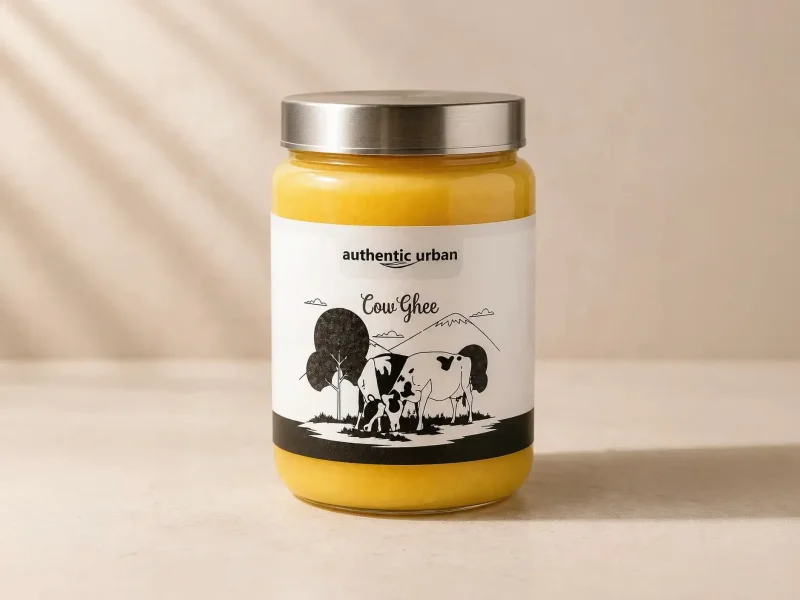 1 Litre
Buffalo ghee: paratha, halwa, and sweets
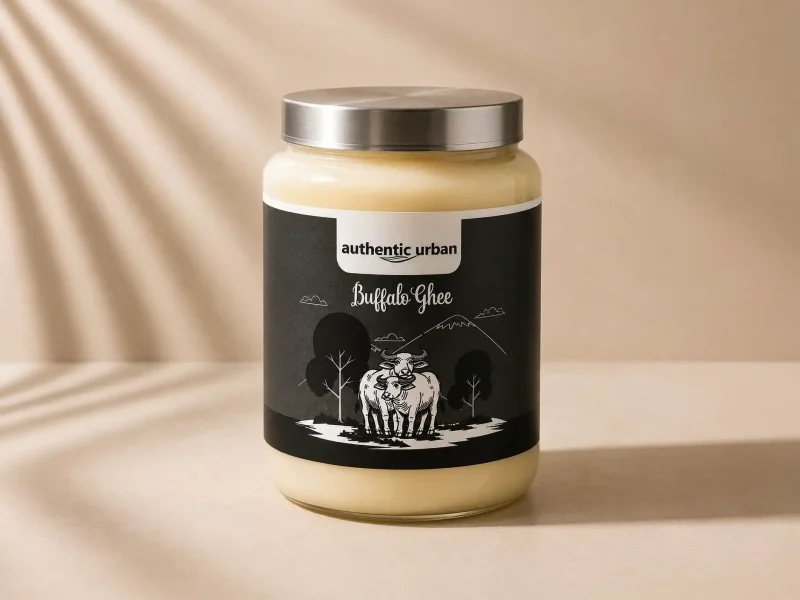 1 Litre
Each order is cooked after you place it, and the packing video is of that batch. Past order videos are on the shop.
FAQ
Is A2 ghee better for skin than regular ghee?
Nobody has tested that on skin. A2 describes the milk protein (beta-casein) from desi cow breeds, and ghee is almost pure milk fat, with very little protein left after cooking. On the face and hair, freshness, a clean smell, and a plain single-ingredient jar matter more than the A2 word. Buy A2 for eating if you prefer it; for skin, pick the freshest jar you trust.
Is homemade ghee better for skin than bought ghee?
It can be, if it is cooked right. Homemade ghee is fresh and you know the milk. The risk is undercooking: if the water is not fully boiled off, the ghee stays cloudy and spoils fast, and spoiled fat is the last thing you want on your face. Cook until the bubbling goes quiet and the solids turn golden-brown, then strain through a clean cloth.
Can I use a big dairy tin of ghee on my face?
The ghee inside meets the same FSSAI ghee standard as any jar, but we would not buy a tin for this. A big tin stays open for months near the stove, gets opened with wet spoons, and loses its fresh smell. For the face, a small glass jar you open for a few weeks is better. If a tin is all you have, scoop a little into a clean pot first.
Can I mix ghee with vitamin E capsules or essential oils?
You can, but each thing you add is one more thing your skin can react to. Essential oils in particular can irritate skin, and a nice smell can hide a ghee that has gone off. Patch test the mix, not only the ghee, on the inner arm for 7 to 10 days. For a first try, plain ghee tells you more about how your skin takes it.
Is ghee on skin safe in summer or humid weather?
Use less of it. In summer ghee stays liquid in the jar and spreads further, so a pea-size covers more of the face. In heat and humidity, a heavy layer can trap sweat and bring out small bumps, especially on the forehead and jaw. Keep ghee to dry patches, skip it before going out in the sun, and wash hair masks out the same day.
Can men use ghee on the face and beard?
Yes, in the same small amounts. A pea-size on dry cheeks at night after shaving, or a few drops rubbed between the palms and worked into a dry beard, is enough. Wash the beard the same day, because fat trapped under thick hair holds sweat. Men with oily skin or pimples along the jaw should skip the face and keep ghee for eating.
About the editorial team
Authentic Urban TeamBilona ghee makers, Gir Somnath, Gujarat
We are the Parmar family in Gir Somnath, Gujarat. We have made ghee here since 2016 and sold it online since 2025. We make only Bilona ghee, test it every month, and anyone is welcome to visit and watch it being made. Our Gir cows and Jafarabadi buffalo are grass-fed village animals that graze near the Gir forest, with no hormones or milk boosters. We set their milk to curd, churn it, and cook the makkhan on a wood chulha. These articles come from that kitchen and from what customers ask us on WhatsApp. We are ghee makers, not doctors.
Sources
- Consumer Guidance: how to identify certified organic food (FSSAI logo and licence, India Organic logo, certification body name and accreditation number, PGS-Organic), Food Safety and Standards Authority of India (FSSAI), Jaivik Bharat. Checked 28 Sep 2026.
- How to test skin care products, American Academy of Dermatology. Checked 28 Sep 2026.