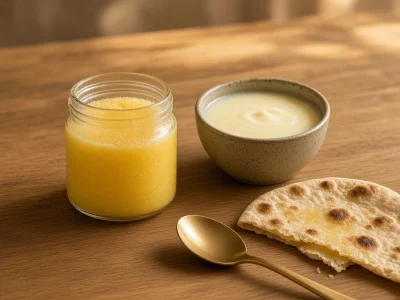
Sahiwal Ghee vs Gir Ghee: Which Is Better, and Why?
Sahiwal ghee vs Gir ghee: neither breed makes better ghee on the evidence. Both are Indian breeds with mostly A2 milk, the fat studies split between them, and colour and taste follow the feed, the season, and the cooking more than the cow. Choose on how the ghee is made and whether you can see the animals. We make Gir cow ghee, so read our view with that in mind.
Sahiwal ghee vs Gir ghee: which is better?
Neither, on paper. Gir and Sahiwal are both Indian dairy breeds whose milk is mostly A2. In the studies we could open, Gir milk fat came out a little less saturated, while a ghee study found Sahiwal ghee the least saturated. On a 5 g teaspoon those gaps are about 0.1 g. A well-made jar of either beats a poorly made jar of the other.
Is one breed more A2?
Both are mostly A2. Gir scored highest in one milk study; both herds have turned up some A1.
Is one ghee healthier?
No clear winner. One study favoured Gir milk fat, another favoured Sahiwal ghee, and the gaps are a tenth of a gram a teaspoon.
Colour and taste?
Set more by feed, season, and cooking than by breed.
Easier to buy?
Gir. Far more curd ghee jars name Gir milk than Sahiwal.
What decides the jar?
Curd Bilona, fresh milk from animals you can see, and proof of both.
This page is for the reader choosing between two desi cow jars. If you are weighing Gir ghee against a dairy or crossbred cow ghee, that is a different question, answered on Gir cow ghee vs regular ghee.
How are Sahiwal and Gir cows different?
Mostly in where they come from and how they look. Sahiwal is a Punjab breed, named after Sahiwal district, now in Pakistan. Gir comes from Saurashtra in Gujarat, and NDDB lists our own district, Gir Somnath, inside its home tract. Their milk yields are close.
Sahiwal vs Gir: the cows and their milk
| Factor | Sahiwal | Gir |
|---|---|---|
| Home tract (NDDB) | Ferozpur and Amritsar, Punjab; Sri Ganganagar, Rajasthan | Saurashtra, Gujarat, including Gir Somnath |
| Coat | Brownish red, mahogany to greyish red | Red or speckled red, curled half-moon horns |
| Average milk in a lactation (NDDB) | About 2,325 kg | About 2,110 kg |
| Milk fat (NDDB) | No figure on NDDB's breed page | 4.6% average (3.9 to 5.1%) |
| A2A2 cows in milk samples (2023) | High, named among the best A2 breeds | 93%, the highest of the breeds tested |
| A1 gene found in farm herds | 6% and 15% of genes, two herds | 6% and 17% of genes, two herds |
| Saturated fat in milk fat (NDRI, 2024) | 63.3% | 61.5% |
| Curd cow ghees naming it (our index) | 1 | 7 |
Verdict: No row gives either breed a clear win for the ghee in your jar. The biggest gap is how easy each is to buy.
NDDB Dairy Knowledge Portal breed pages; Khan et al., Animal Biotechnology, 2023; Mukesh et al., 3 Biotech, 2022; Ramani et al., 2024; Ghee Price Index, September 2026. Checked 27 September 2026.
Gir is spread far wider. NDDB's 2017 Gir booklet, using the 18th Livestock Census, counts about 21 lakh Gir cattle, 14 lakh of them in Gujarat, 5 lakh in Rajasthan, and 1 lakh in Maharashtra. Gir was also taken to Brazil, where it went into the Girolando dairy breed. In NDDB's pedigree project on recorded Gir cows in Saurashtra, the average milk fat across 7,207 tests was 5.08%, higher than the breed-wide 4.6%, because those were picked, well-fed cows.
Is Sahiwal or Gir ghee more A2?
Both are mostly A2, and neither is 100% A2 in every herd. A2 means the cow makes the A2 form of beta-casein, a milk protein; many European breeds also make the A1 form. Gene tests on Indian cows put both breeds near the top.
Khan and colleagues (Animal Biotechnology, 2023) tested 1,000 milk samples from Indian and foreign breeds. Among the Indian breeds, 80% of cows on average carried two A2 genes (A2A2). Gir was the highest at 93%, and Sahiwal was named with Gir, Tharparkar, and Motu as the best breeds for A2 milk. A larger study of about 4,000 animals from 27 Indian breeds (Mukesh et al., 3 Biotech, 2022) found the A2 type in 94% of genes overall.
The same 2022 paper also lists earlier tests at organised farms that found the A1 gene in 6% and 15% of genes in two Sahiwal herds, and in 6% and 17% in two Gir herds. So a Sahiwal or Gir herd can include some cows that carry one A1 gene. "A2" on a jar is a claim about the breed; only a gene test of the cows proves it for a herd.
For ghee, this matters less than it sounds. FSSAI requires ghee to be at least 99.5% milk fat, so very little protein of either kind is left in the jar. What the A2 label means for ghee, and how much protein survives cooking, is on what is A2 ghee, and the digestion research on A2 vs A1 ghee.
Does Sahiwal or Gir ghee have better fat?
The two studies we found point opposite ways, and both gaps are small. So no breed has a proven fat advantage.
Ramani and colleagues at ICAR-NDRI, Karnal (2024) tested milk from Gir, Sahiwal, and Tharparkar cows from a local dairy farm, five cows each. The share of each fat in the milk fat:
Share of milk fat
Gir
Sahiwal
Saturated fat
61.5%
63.3%
Monounsaturated fat
36.9%
33.1%
Oleic acid (the main fat in olive oil)
32.0%
30.1%
Polyunsaturated fat
3.5%
3.8%
Butyric acid
0.38%
0.35%
Ramani et al., International Journal of Advanced Biochemistry Research, 2024: milk, five cows per breed. Checked 27 September 2026.
That favours Gir. But Kumar and colleagues (International Dairy Journal, 2022) tested ghee itself and found Sahiwal ghee had the lowest saturated fat of the cow ghees they made, about 55 g per 100 g, with the most oleic acid (35.4 g) and CLA (0.52 g, conjugated linoleic acid, a fat made in the cow's stomach from grass). Its abstract does not give Gir figures to set beside those.
Put it in teaspoons. A 2-point gap in saturated fat on a 5 g teaspoon is 0.1 g. The feed, the season, and whether the cows graze move these numbers too, as grass-fed vs regular ghee shows. Pages that crown one breed "healthier" are reading one small study. Either way, the teaspoon limit for ghee is the same, and it is set by how much you eat, not by the breed.
Why do Gir and Sahiwal ghee look and taste different?
Mostly because of what the cows ate, the time of year, and how the butter was cooked. We found no study that compares the colour or taste of Gir and Sahiwal ghee, so treat "Gir is deeper gold" and "Sahiwal is milder" as shop talk.
We see the season in every batch of our Gir cow ghee. In the monsoon, green fodder makes the ghee more yellow. Winter milk is richer, gives more makkhan per litre, and the ghee sets with a fine grain. In summer the fat is lower, the curd sours faster, and the ghee stays liquid in the jar. "Why is the colour different from last time?" is one of the questions customers ask us most on WhatsApp, and the answer is the season, not a different cow.
Cooking changes taste even more. We take the makkhan off the chulha when the bubbling goes quiet and the milk solids turn golden-brown, and it smells of toasted milk. Cook it longer and any breed tastes darker and nuttier; cook it too short and it stays cloudy and spoils fast. More on this in why ghee tastes different each batch and white ghee vs yellow ghee.
Is Gir ghee more expensive than Sahiwal ghee?
Not as a rule. Price follows the method more than the breed. What stands out in the market is how rarely Sahiwal is named at all: of the 9 curd cow ghees in our September 2026 price index, 7 name Gir milk and 1 names Sahiwal (its page says "Sahiwal and Kankrej cow").
Ghee Price Index, September 2026: each brand's own shop page; our own live price. Breed as each page states it.
| Item | Value |
|---|---|
| Two Brothers Organic Farms, Gir cow | ₹3,595 a litre |
| Himalayan Natives, Gir cow | ₹3,236 a litre |
| GirOrganic, Gir cow | ₹2,879 a litre |
| Gavyamart, Gir cow | ₹2,499 a litre |
| Authentic Urban, Gir cow | ₹2,399 a litre |
| Rosier Foods, Gir cow | ₹2,380 a litre |
| Anveshan, Gir cow | ₹2,200 a litre |
| Barosi, Sahiwal and Kankrej cow | ₹1,652 a litre |
The Gir curd ghees had a median of ₹2,499 a litre, about ₹12.5 a teaspoon. Our own is ₹2,399 a litre, about ₹12.0 a teaspoon. One Sahiwal jar is too few to call Sahiwal cheaper or dearer. Large dairies also sell Gir cow ghee packs without a curd claim (2 in the index), per their own pages, at dairy prices. Brand-by-brand prices are in our Ghee Price Index, September 2026.
What you pay for in a curd ghee is the milk and the time. About 30 to 35 litres of milk go into 1 kg of our cow ghee, and curd to ghee takes the better part of two days. A Sahiwal curd ghee made the same way uses a similar amount of milk, since the breeds' yields are close. The full cost is laid out on why Bilona ghee is expensive.
Should you choose Sahiwal or Gir ghee?
Choose the jar made closest to real animals you can check, by the curd method, and fresh. The breed comes after that.
Choose Sahiwal ghee if
- You live in Punjab, Haryana, or north Rajasthan and know a Sahiwal farm that makes curd ghee.
- You can visit or see the cows, so the breed claim is something you have checked.
- You like that farm's ghee on your roti. Taste you enjoy daily is a fair reason.
Choose Gir ghee if
- You buy online. Far more curd ghee makers name Gir milk, so you have more jars to compare.
- You want ghee from the breed's home tract in Saurashtra, from a maker who shows you the cows.
- You live in Gujarat, Rajasthan, or Maharashtra, where most Gir cattle are.
Three kitchens, three answers
A family in Ludhiana with a Sahiwal dairy nearby
Buy the local Sahiwal curd ghee if you can watch it being made. Fresh ghee from cows you have seen beats a Gir jar shipped across India for the breed name alone.
A flat in Bengaluru ordering online
Neither breed is local, so judge the maker. Pick the jar that names the breed and the district, says curd and churn, and sends proof of your batch. Most of those name Gir today.
A parent choosing ghee for a toddler
The breed does not change what a child needs. Choose a pure, fresh cow ghee, a teaspoon in a meal on dal or khichdi, counted with the oil in the family food. The daily amounts are on ghee for toddlers.
Mistakes people make when choosing by breed
- Paying more for a breed name on a pack that says nothing about how the ghee was made.
- Reading deep yellow as proof of Gir, or pale as proof of Sahiwal. Season and feed move colour in both.
- Taking "100% A2" as tested. Gene tests have found some A1 in both breeds' herds.
- Eating more ghee because the breed sounds healthier. The daily teaspoon limit does not change with the cow.
Why do we make Gir cow ghee and not Sahiwal?
Because Gir is the cow of our district. We are the Parmar family in Gir Somnath, Gujarat, which NDDB lists inside the Gir breed's home tract, and every cow batch we make is Gir cow milk, from our own animals and partner farmers around us.
It is not because Gir milk makes better ghee than Sahiwal milk; the studies above do not show that. It is because we can check these animals every day. Rajesh looks after them and knows which season the milk runs heavy. They are village animals that graze near the Gir forest, with no hormone injections or milk boosters, and partner farms are chosen on a checklist with a vet visiting each one daily. The milk is set to curd overnight, churned for 30 to 45 minutes, and the makkhan is cooked in a matki on a wood chulha, and Varsha tastes every batch. If a Sahiwal farm in Punjab works the same way, its ghee earns the same trust.
How to check a Sahiwal or Gir ghee label: 7 points
Save or screenshot this before you buy. Then check the jar itself with how to identify pure ghee.
- 1 The breed is named on the label or site: Gir, Sahiwal, or another breed. "Desi cow" alone names no breed.
- 2 The seller says where the cows are: a district or village you could visit, inside or near that breed's home tract.
- 3 The method is written in plain words: milk set to curd, churned, then cooked. "Traditional" alone says nothing.
- 4 You can see the animals or the kitchen: a farm visit, or a video of your own batch being made.
- 5 The FSSAI licence number is printed and checks out on foscos.fssai.gov.in.
- 6 The colour changes a little through the year. Grass and season move it; a jar that is the same bright yellow every month deserves a question.
- 7 The jar makes no health promise for the breed, such as "cures acidity" or "Gir ghee for the heart".
Curd ghee and cream ghee are the bigger split on any label, whatever the breed; the difference is on Bilona ghee vs cream ghee.
Which desi cow ghee do we keep at home?
Whichever breed you pick, warm a spoon before you commit: it should smell of toasted milk, never flat or sharp. Slow-cooked curd ghee often turns grainy as it cools. Our ranking of cow ghee brands, Gir and others, is on best cow ghee in India.
We make both jars below, so weigh our view with that in mind. Our A2 Gir cow ghee is made from Gir cow milk in Gir Somnath, and our Jafarabadi buffalo ghee from the local buffalo breed. Both are curd Bilona, cooked after you order, with a video of your jar on WhatsApp. We test every month against the FSSAI limits, and anyone can visit; see how we make ghee.
Gir cow ghee: the daily teaspoon
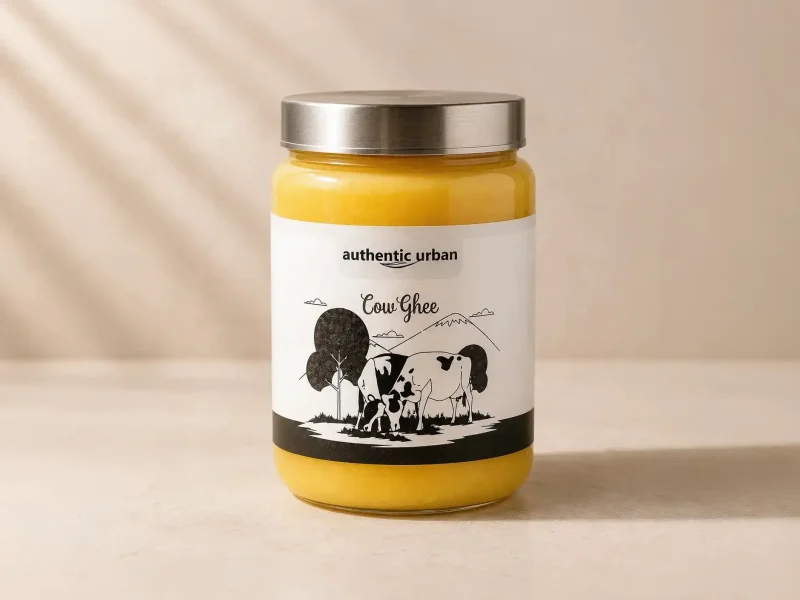 1 Litre
Buffalo ghee: paratha and halwa
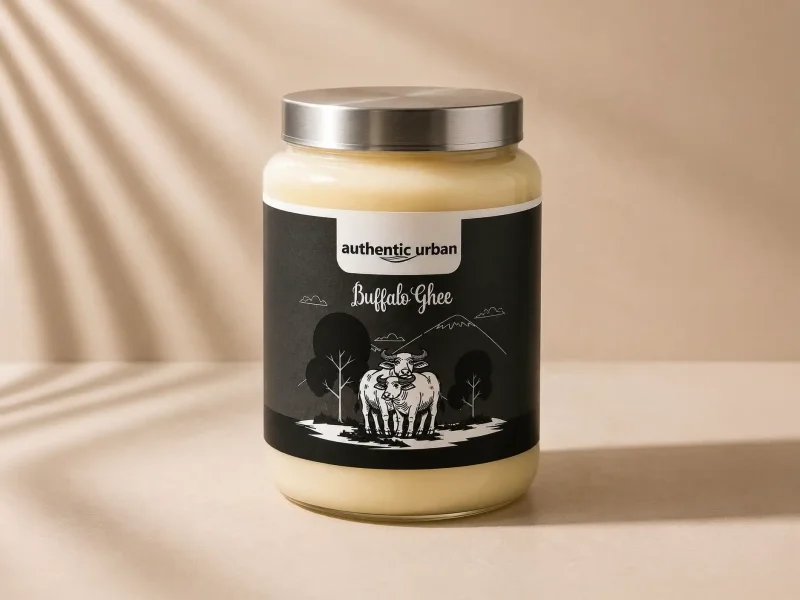 1 Litre
Each order is cooked after you place it, and the packing video is of that batch. Past order videos are on the shop.
FAQ
Which is the best Gir or Sahiwal ghee to buy?
We put our own A2 Gir cow ghee first, and we make it, so weigh that. The milk comes from Gir cows in Gir Somnath, the breed's home district, is set to curd overnight, churned, and cooked on a wood chulha after you order, and you get a video of your jar. For Sahiwal, pick a curd ghee from a farm in Punjab or north Rajasthan that names the breed and lets you visit.
Is Sahiwal or Gir ghee better for babies and children?
Neither breed is better for a child. What matters is that the ghee is pure, fresh, and given in small amounts. For a child over one year, a teaspoon of any good cow ghee stirred into dal, rice, or khichdi at a meal is the usual Indian way, counted inside the day's fats and oils. Do not start ghee for a baby under one without asking your paediatrician how and when to add fat to meals.
Is Tharparkar, Rathi, or Kankrej ghee better than Gir or Sahiwal?
Not in any way a study has shown on your plate. In the Karnal milk study, Tharparkar milk had a little more polyunsaturated fat and butyric acid than Gir or Sahiwal, but the samples were small and the gaps tiny. All of these are Indian breeds with mostly A2 milk. The same rules apply: named breed, curd method, and a seller who shows you the animals.
Can you tell Sahiwal ghee from Gir ghee by looking at it?
No. Colour, smell, and grain change more with the season, the feed, and how long the butter was cooked than with the breed. Two jars of Gir ghee from the same kitchen can look different in June and December. No home test or common lab test on ghee names the breed. The only check is the seller: where the cows are, and whether you can see them.
Can I mix Sahiwal and Gir ghee, or switch between them?
Yes. Both are cow milk fat, and they cook, melt, and keep the same way. Switching jars will not upset digestion in a way the breed explains; a change in how much ghee you eat is far more likely to. Do not pour one jar into another half-used one; finish one, then open the next, with a dry spoon each time.
Does Gir or Sahiwal ghee have more vitamin A?
We found no study that measures vitamin A in Gir and Sahiwal ghee side by side. Vitamin A and its yellow cousin beta-carotene come into milk fat mostly from green fodder, so the cow's diet and the season move them more than the breed. In our kitchen, cow ghee turns more yellow in the monsoon when the animals eat green fodder, then paler on dry feed.
About the editorial team
Authentic Urban TeamBilona ghee makers, Gir Somnath, Gujarat
We are the Parmar family in Gir Somnath, Gujarat. We have made ghee here since 2016 and sold it online since 2025. We make only Bilona ghee, test it every month, and anyone is welcome to visit and watch it being made. Our Gir cows and Jafarabadi buffalo are grass-fed village animals that graze near the Gir forest, with no hormones or milk boosters. We set their milk to curd, churn it, and cook the makkhan on a wood chulha. These articles come from that kitchen and from what customers ask us on WhatsApp. We are ghee makers, not doctors.
Sources
- Gir (breed profile, compiled from NBAGR's AGRI-IS), NDDB Dairy Knowledge Portal. Checked 27 Sep 2026.
- Sahiwal (breed profile), NDDB Dairy Knowledge Portal. Checked 27 Sep 2026.
- Approaches and Experiences of NDDB in Development of Gir, a promising indigenous milch breed, September 2017, National Dairy Development Board. Checked 27 Sep 2026.
- Potential status of A1 and A2 variants of bovine beta-casein gene in milk samples of Indian cattle breeds (Khan R et al.), 2023, Animal Biotechnology. Checked 27 Sep 2026.
- Demographic pattern of A1/A2 beta casein variants indicates conservation of A2 type haplotype across native cattle breeds (Bos indicus) of India (Mukesh M et al.), 2022, 3 Biotech. Checked 27 Sep 2026.
- Comparative analysis of fatty acid profiles in indigenous cattle breeds (Ramani A et al.), 2024, International Journal of Advanced Biochemistry Research. Checked 27 Sep 2026.
- Intra-species variation in fatty acid profile and nutritional indices of cattle, buffalo and goat ghee deciphered using GC-FID and FT-IR spectroscopy (Kumar S et al.), 2022, International Dairy Journal. Checked 27 Sep 2026.
- Food Safety and Standards (Food Products Standards) Compendium, Chapter 2.1: Dairy products and analogues, version 01.09.2023 (p. 27, ghee), FSSAI. Checked 27 Sep 2026.