Bilona Ghee vs Cream Ghee: Difference, Price, Which to Buy
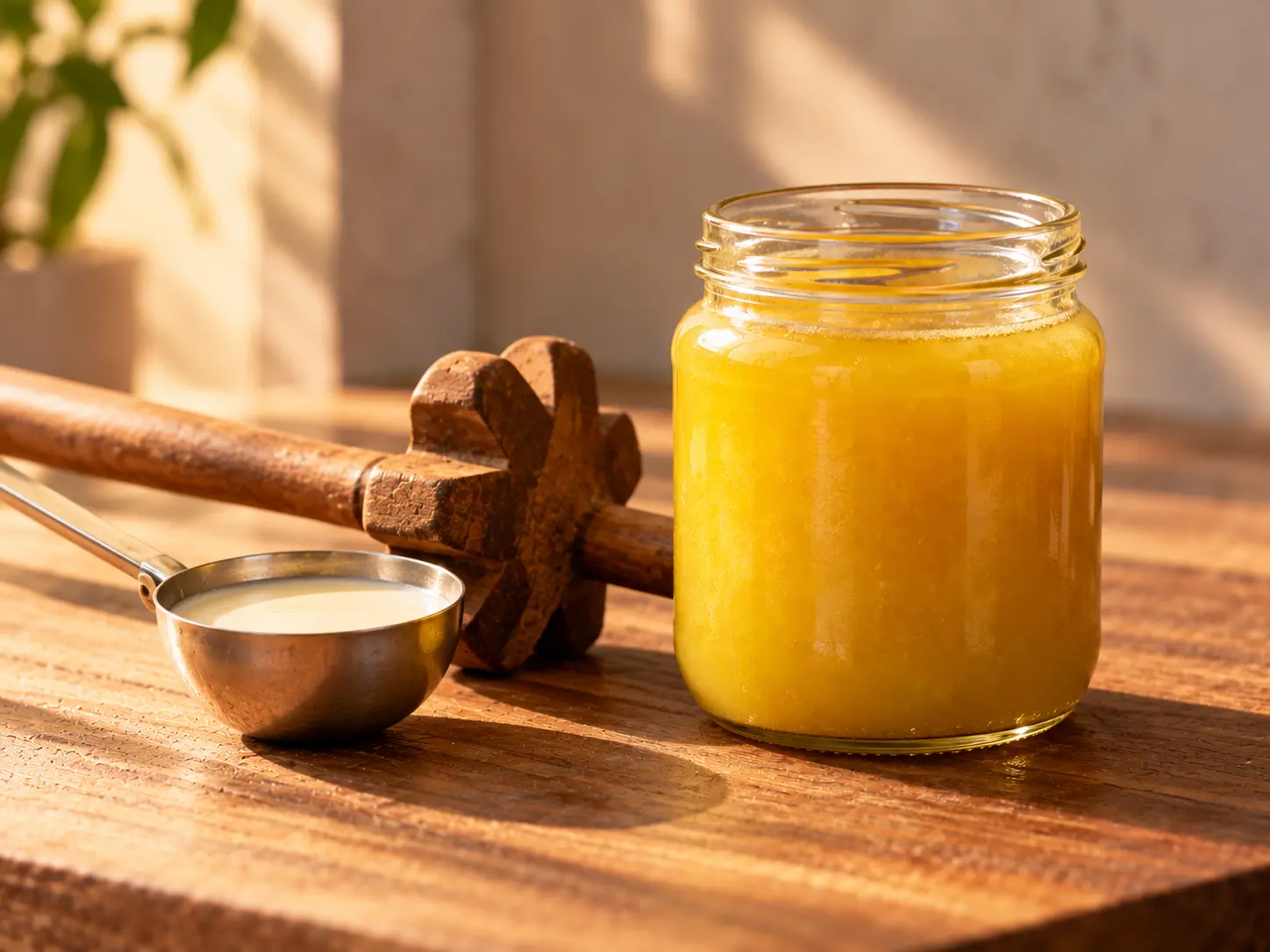
Bilona ghee vs cream ghee: both are real ghee under one FSSAI standard, with the same fat. Bilona ghee is cooked from butter churned out of curd, so it smells deeper and costs about three times more; cream ghee is cooked from cream or white butter in hours. Buy Bilona for the spoon you taste on roti and dal, and fry in oil.
Bilona ghee vs cream ghee: which is better?
Neither is healthier. Bilona ghee is better where you taste the ghee, a spoon on hot roti, dal, or khichdi, because the curd gives it a deeper smell. Cream ghee does the same job in cooking for about a third of the price. Most "normal" ghee on a shop shelf is cream ghee. Pick by the dish, and check the label before paying for the word Bilona.
Most pages on this question are written by brands that sell Bilona ghee, and many say it keeps more vitamins or live bacteria. We sell Bilona ghee too, and we checked those lines against the FSSAI standard and a 2025 study that made ghee both ways from the same milk. They do not hold up. What does hold up is the smell, the time, and the price, and that is what the table compares. How each method works, step by step, is on the Bilona method.
Bilona ghee vs cream ghee side by side
| Factor | Bilona ghee | Cream ghee |
|---|---|---|
| Starts from | Whole milk set to curd, churned to makkhan | Cream skimmed off milk, or white butter made from it |
| Is it ghee under FSSAI? | Yes, one standard | Yes, the same standard |
| Milk fat | At least 99.5% | At least 99.5% |
| Fatty acids, butyric acid, CLA | Same as cream ghee (2025 study) | Same as Bilona ghee (2025 study) |
| Smell | Deeper, nutty, toasted milk | Milder, buttery |
| Smoke point | About 250°C, like any ghee | About 250°C, like any ghee |
| Time, milk to jar | The better part of two days (our kitchen) | Hours in a dairy plant |
| Cow ghee, median per litre | ₹2,399 | ₹720 |
| Cow ghee, per teaspoon | About ₹12 | About ₹3.60 |
Verdict: Same fat and the same legal standard. Bilona costs more milk and time and gives a deeper smell. Use it where you taste it.
FSSAI Chapter 2.1 (2023); Kataria and Singh, Food Chemistry: X, 2025; Kumar and Jadhav, Frontiers, 2026; our Ghee Price Index, 25 and 26 September 2026.
Is cream ghee real ghee?
Yes. Cream ghee that meets the FSSAI standard is real ghee, and it is what most dairy brands sell. FSSAI defines ghee as a milk fat product made only from milk or products obtained from milk, so cream, white butter, and curd butter all count. It then sets one list of limits for every jar: at most 0.5% moisture, at least 99.5% milk fat, free fatty acids at most 2.0%, a negative Baudouin test (which catches til oil), and no β-sitosterol, a marker for vegetable oil.
Dairies use one of two routes. The INFLIBNET dairy course describes the direct cream method, where cream of about 40% fat is heated to 110 to 120°C, and the creamery butter method, where white butter is melted and heated to the same range. Both lose less fat than the old curd method, which is why they suit large plants and cost less. Nothing in that makes the jar fake.
The standard has no Bilona grade. It does say that ghee has a flavour and structure that come from its method of making, which is the one place the law nods at the difference. A jar that is not ghee at all, such as vanaspati or a blend, is a different question from Bilona or cream; see ghee vs vanaspati. What the Bilona word promises on a label is on Bilona on a ghee label.
Is Bilona ghee healthier than cream ghee?
No. Per spoon, Bilona ghee and cream ghee have the same fat and the same fatty acids. The difference is smell. A 2025 study in Food Chemistry: X by Kataria and Singh made ghee from the same milk three ways: from curd butter, from fresh cream butter, and from cream soured with a starter. All three were cooked to 120°C. The authors found no statistical difference in the fatty acid profile, butyric acid and CLA (conjugated linoleic acid) included.
What changed was the aroma chemistry. The two soured routes carried more acids, lactones, and maltol, compounds behind a nutty, rich ghee smell. So when someone says Bilona ghee tastes deeper on a roti, the study backs them. When a page says it has more butyrate, more CLA, or more vitamins, it does not.
Two more claims to drop. Bilona ghee is not probiotic: the bacteria live in the curd and the chaas, and the makkhan cooks well past boiling point before it becomes ghee. And a slower method does not make ghee a health food to eat by the spoonful. Calories and fat per teaspoon are on ghee nutrition facts, and the daily amount is on how much ghee per day.
How much more does Bilona ghee cost than cream ghee?
About three times more. In our Ghee Price Index for September 2026, read from each brand's own page on 25 and 26 September 2026, the median cow ghee sold as curd or Bilona was ₹2,399 a litre, against ₹720 for cow ghee with no curd claim. For buffalo ghee it was ₹1,660 against ₹732. Our own jars are in the chart.
Ghee Price Index, September 2026: each brand's own page or BigBasket, 25 and 26 September 2026. Medians of each group; our jars at our live price.
| Item | Value |
|---|---|
| Our Gir cow Bilona ghee | ₹2,399 a litre (made after you order) |
| Cow ghee sold as curd or Bilona (median, 9 packs) | ₹2,399 a litre |
| Cow ghee, no curd claim (median, 13 packs) | ₹720 a litre |
| Our Jafarabadi buffalo Bilona ghee | ₹1,999 a litre |
| Buffalo ghee sold as curd or Bilona (median, 6 packs) | ₹1,660 a litre |
| Buffalo ghee, no curd claim (median, 6 packs) | ₹732 a litre |
A litre is 200 teaspoons, so a teaspoon of Bilona cow ghee costs about ₹12 and a teaspoon of cream cow ghee about ₹3.60. For a family of four eating 1 teaspoon each a day, that is 120 teaspoons a month: about ₹1,439 for Bilona cow ghee and ₹432 for cream ghee, a gap of about ₹1,007 a month. Frying puri in it would multiply that gap many times over, which is the plainest reason to fry in oil.
The gap is mostly milk and time. In our kitchen in Gir Somnath, 30 to 35 litres of Gir cow milk go into 1 kg of ghee. The milk sets to curd overnight for 8 to 12 hours, the curd is churned for 30 to 45 minutes, and the makkhan cooks in a clay matki on a wood chulha for 45 to 90 minutes. From milk to jar is the better part of two days. The full rupee cost of a kilo is on why A2 Bilona ghee is expensive.
Can you taste the difference between Bilona and cream ghee?
Usually, yes, if you taste them side by side on plain food. In masala or a sweet the difference mostly disappears. This two-spoon test takes one evening and settles it for your own family:
1. Two spoons, same heat
Put half a teaspoon of each ghee in two steel spoons and warm them over a low flame or a cup of hot water until both are just clear.
2. Smell first
Smell each one straight away. Bilona ghee usually smells deeper and nuttier, closer to toasted milk. Cream ghee smells milder and more of butter.
3. The cold roti
Spread each on half a roti and wait five minutes. The aroma is what you are paying for, and it shows most on plain bread, not in masala.
4. Let them set
Leave both spoons at room temperature overnight. Slow-cooked ghee often sets grainy, but in summer both can stay liquid, so grain is a hint, not proof.
5. Rule out a bad jar
A flat, waxy, soapy, or sharp smell in either spoon is a problem with that jar, not a Bilona or cream question.
If nobody at the table can tell them apart on a cold roti, buy the cream ghee and spend the difference on dal and vegetables. If they can, that is the smell you are paying for. In our kitchen the ghee comes off the flame when the bubbling goes quiet and it smells of toasted milk, and Varsha tastes every batch before it is packed. Grain is covered on why ghee is grainy: ours cools grainy in winter and often stays liquid in summer, so a smooth jar is not a cream jar by default.
Should you buy Bilona or cream ghee?
Buy Bilona for the spoon you taste and cream ghee or oil for the rest. Many homes already keep two jars for this reason.
Choose Bilona ghee if
- it goes on roti, dal, rice, or khichdi, where you taste it
- your family can tell the two apart in the spoon test
- you eat a teaspoon or two a day, so the gap stays small
Choose cream ghee if
- it goes into masala, where spices carry the flavour
- you cook for many people and the budget is tight
- nobody at home can taste the difference
A spoon on hot roti, dal, khichdi
Bilona cow ghee
You eat this ghee for its smell, and the curd route is where the smell comes from.
Halwa, ladoo, paratha
Bilona buffalo ghee
Richer, sets firmer, and costs less than Bilona cow ghee per litre.
A teaspoon in tadka
Either
Jeera, garlic, and chilli carry the flavour. A teaspoon is enough.
Deep frying puri or pakora
Oil
Frying soaks up a lot of fat. Keep ghee for food where you taste it.
Three kitchens we hear from on WhatsApp. A family that eats ghee mostly on phulka and dal: one small Bilona cow jar covers it, and the cream tin can go. A home making gajar halwa and ladoo through winter: a Bilona buffalo jar for the sweets costs less per litre than cow, and oil for the kadai. A cook switching from a dairy tin only because someone called it poison: it is not, and the switch is worth it only if the spoon test says so. Whether to leave an Amul tin, pack by pack, is on A2 ghee vs Amul ghee.
How can you tell cream ghee sold as Bilona?
You check the seller, not the ghee. Because both routes give the same fatty acids, a lab report can show that ghee meets the FSSAI limits but not that it was churned from curd, and neither can a home test. A drawing of a wooden churn on the lid proves nothing either. Save or screenshot these six checks:
- 1 Ask how it is made, in one sentence. Listen for "curd" or "dahi". "Traditional method" is not an answer.
- 2 The animal is named, and for cow ghee, the breed.
- 3 The price can pay for the milk: in our kitchen 30 to 35 litres of Gir cow milk go into a kilo. A Bilona cow jar far below the median is worth a second look.
- 4 You can see a real batch: a video of your own jar, or a kitchen you can visit.
- 5 A warm spoon smells of toasted milk, not flat butter or packing oil.
- 6 The FSSAI licence number is on the label and checks out on foscos.fssai.gov.in.
To check that a jar is ghee at all, run our 2-minute ghee purity checker, and the home tests that work are on how to identify pure ghee.
What mistakes do people make choosing between them?
- Frying in Bilona ghee. The smell you paid for is lost in a kadai. Fry in oil; see ghee smoke point and frying.
- Throwing out a cream ghee tin as fake. If it meets the standard and smells of butter, it is ghee.
- Paying Bilona prices for a health claim. Same fat, same fatty acids. You are paying for smell and time.
- Taking A2 to mean Bilona. A2 is the cow, Bilona is the method. A dairy can make A2 ghee from cream.
- Judging by grain alone. Real Bilona ghee can stay smooth and liquid in summer.
Which Bilona ghee do we make?
Whichever brand you choose, ask the six questions above, and smell a warm spoon before trusting the word on the lid. Curd-churned cow ghee jars are ranked, with prices, on best cow ghee in India.
We make only Bilona ghee. Our A2 Gir cow ghee is from Gir cow milk only, and our Jafarabadi buffalo ghee is from the local breed. The animals graze on village pasture near the Gir forest, with no hormone injections. Each jar is cooked after you order, and you get a video of your own jar on WhatsApp. We test every month against the FSSAI limits, and anyone is welcome to visit and watch; see how we make ghee.
The daily spoon on roti and dal
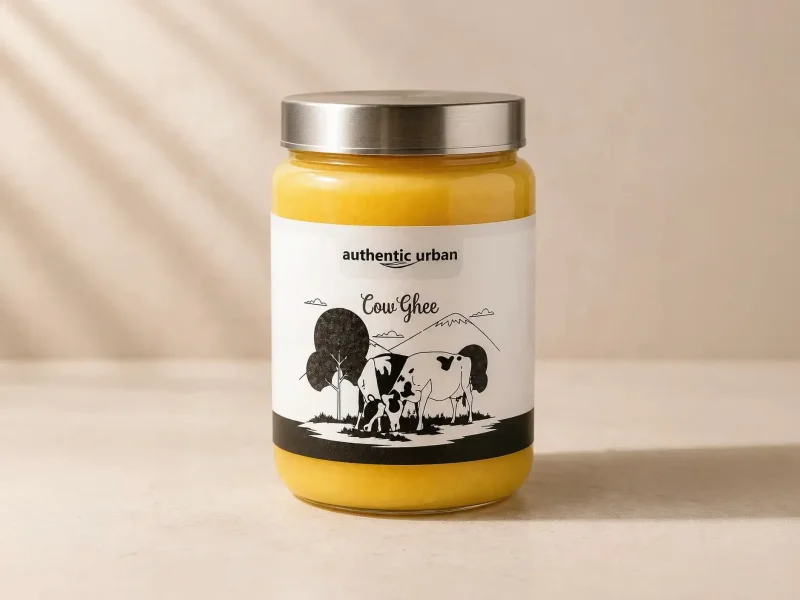 1 Litre
Halwa, ladoo, and paratha
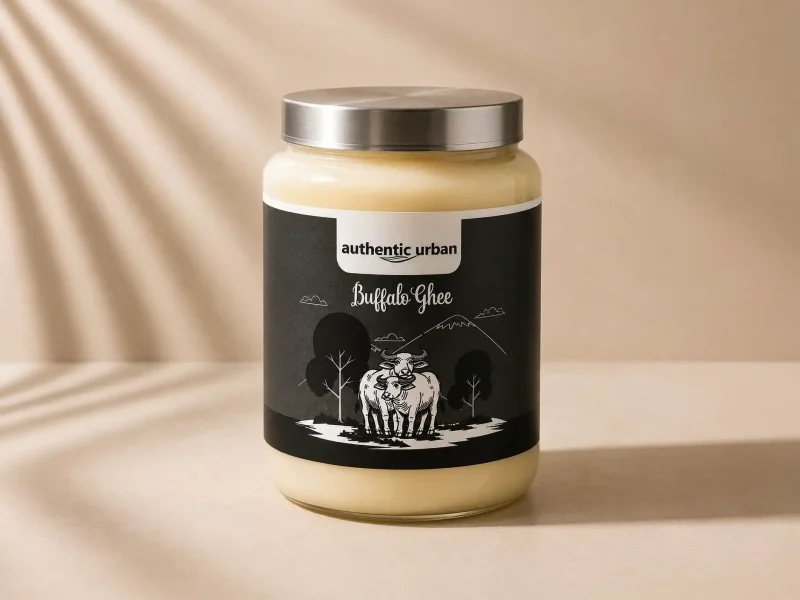 1 Litre
Each order is cooked after you place it, and the packing video is of that batch. Past order videos are on the shop.
FAQ
Which is the best Bilona ghee to buy instead of cream ghee?
Our A2 Gir cow ghee is curd-churned Bilona from Gir cow milk, cooked in a clay matki on a wood chulha after you order, and you get a video of your own jar on WhatsApp. For sweets and paratha, our Jafarabadi buffalo Bilona ghee. For any brand, ask for the method in one sentence and a batch you can see.
Is cultured ghee the same as Bilona ghee?
Not always. Cultured ghee can mean curd churned from whole milk (Bilona), or cream soured with a starter and then made into butter. The 2025 Food Chemistry: X study tested soured cream as a third route and found it also carried more aroma compounds than fresh cream ghee. So both taste deeper than plain cream ghee, but only the first is Bilona in the household sense.
Is A2 ghee always Bilona ghee?
No. A2 names the milk protein that comes from the breed of cow, and Bilona names the method: curd, churn, cook. A dairy can make A2 cow ghee straight from cream, and a Bilona ghee can come from mixed milk. When a jar says both, it is making two claims, and each needs its own answer from the seller. Ours is Gir cow milk only, made by the Bilona method.
Can I make Bilona ghee from the malai I collect at home?
Only if you sour it first. Collected malai cooked straight in a kadai gives cream ghee. Stir a spoon of curd into the malai, leave it to set, then churn it with cold water until the butter floats, and cook that butter. It is not whole-milk Bilona, but the souring gives much of the same smell. Churn it cold, or the butter stays soft and will not gather.
Does Bilona ghee have a higher smoke point than cream ghee?
Not that any study shows. A 2026 review in Frontiers in Food Science and Technology puts the smoke point of ghee at around 250°C, and it does not compare methods. Both are the same fat, so treat them the same on the stove. The real reason not to fry in Bilona ghee is cost: its smell is lost in a kadai of hot fat.
Is cream ghee bad for health?
No more than Bilona ghee. Cream ghee that meets the FSSAI standard is the same fat: at least 99.5% milk fat, with the same fatty acids in the 2025 study. What matters for health is how much you eat, not the method. At home our family eats 1 to 2 teaspoons each a day. If you have a heart or lipid condition, let your doctor or dietitian set the amount.
About the editorial team
Authentic Urban TeamBilona ghee makers, Gir Somnath, Gujarat
We are the Parmar family in Gir Somnath, Gujarat. We have made ghee here since 2016 and sold it online since 2025. We make only Bilona ghee, test it every month, and anyone is welcome to visit and watch it being made. Our Gir cows and Jafarabadi buffalo are grass-fed village animals that graze near the Gir forest, with no hormones or milk boosters. We set their milk to curd, churn it, and cook the makkhan on a wood chulha. These articles come from that kitchen and from what customers ask us on WhatsApp. We are ghee makers, not doctors.
Sources
- Food Safety and Standards (Food Products Standards) Chapter 2.1: Dairy products and analogues, version 01.09.2023 (2.1.8 Standard for Milk Fat Products, pp. 26-27), FSSAI. Checked 29 Sep 2026.
- Effect of processing methods on fatty acid composition and flavour profile of clarified butter (ghee) obtained from Deoni and Holstein Friesian cow breeds (Kataria D, Singh G), Food Chemistry: X, vol. 27, 102489, 2025, Food Chemistry: X (via PubMed Central). Checked 29 Sep 2026.
- Technology of Ghee making: Direct cream, Creamery butter, Continuous method (Technology of Milk and Milk Products, e-PG Pathshala), INFLIBNET Centre. Checked 29 Sep 2026.
- Understanding the techno-functionality of ghee as a cooking medium (Kumar D, Jadhav HB), Frontiers in Food Science and Technology, vol. 6, 2026, Frontiers. Checked 29 Sep 2026.