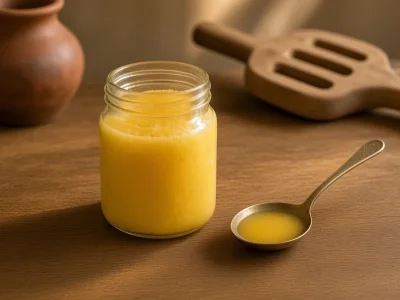
How to Make Ghee at Home: Butter or Malai, Step by Step
How to make ghee at home: melt 500 g of unsalted butter in a heavy pan and keep it on the lowest bubbling flame for about 30 minutes, until the crackling goes quiet, the solids at the bottom turn golden-brown, and it smells of toasted milk. Strain it into a dry jar. You get up to 400 g. From malai, set a week's worth with a spoon of curd, churn it to makkhan, and cook that the same way.
How to make ghee at home from butter, step by step
Cook the water out of butter on a low flame, and stop when the milk solids at the bottom have turned golden-brown. That browning is what gives ghee its smell and makes it ghee rather than plain clarified butter. From 500 g of butter it takes about 30 minutes at the stove, and most of that is waiting for the foam to die down.
What you need
- 500 g unsalted butter, or white (cooking) butter
- A heavy steel or iron kadhai that holds three times the butter
- A steel spoon or spatula for stirring
- A thin cotton cloth or a fine tea strainer
- A dry glass or steel jar with a lid, about 500 ml
Salted butter works too, but the brown residue comes out too salty to eat.
Steps
- 1. Cut the butter into pieces and melt it on a low to medium flame, 3 to 5 minutes.
- 2. Turn the flame to the lowest that keeps it bubbling. It foams and crackles as the water boils off. Stir the bottom every few minutes, 15 to 20 minutes.
- 3. The bubbles turn small, the foam thins, and the liquid clears. Stay at the stove now.
- 4. When it is almost silent, the solids are golden-brown, and it smells of toasted milk, take it off the flame. About 30 minutes in all.
- 5. Rest 5 minutes so the solids settle. Strain through the cloth into the jar without pressing the residue.
- 6. Leave the lid off until it is cool, then close it.
One teaspoon of the finished ghee, about 4.3 g, holds about 37 kcal and 4.2 g of fat (2.6 g saturated), from USDA FoodData Central's entry for butter oil, which is ghee by another name. Well-made ghee is almost all fat: USDA lists 0.24 g of water in 100 g, and FSSAI's standard for ghee allows at most 0.5% moisture. The full label is on ghee nutrition facts.
Clarified butter is the same pan taken off earlier, while the solids are still pale. Where one stops and the other goes on is on ghee vs clarified butter.
How do you make ghee from malai at home?
Collect the malai from boiled milk for about a week, set it with a spoon of curd overnight, churn it with ice-cold water until the makkhan separates, then cook the makkhan like butter. This is how most Indian homes make ghee, and it smells fuller than ghee from shop butter.
- 1. Collect. Boil the milk, let it cool, and chill it. Lift the thick layer of malai off the top each day into one clean, covered box in the fridge. Full cream milk gives more than toned milk.
- 2. Set. When the box is full, bring the malai to room temperature, stir in 1 tbsp of curd, cover, and leave it overnight. It sets thick and a little sour.
- 3. Churn. Put it in a mixer jar or a steel pot with a hand churn, add a cup of ice-cold water, and churn in short bursts for 5 to 10 minutes. First it turns grainy, then yellow lumps of makkhan float up in thin chaas.
- 4. Wash. Lift the makkhan out with your hands, press it under cold water two or three times until the water runs clear, and squeeze it dry. Keep the chaas to drink or for kadhi.
- 5. Cook. Cook the makkhan on the lowest flame exactly like butter. Homemade makkhan holds more water than shop butter, so the foaming stage takes longer: 40 to 60 minutes for a week's makkhan.
You can skip the churn and cook the malai straight. FSSAI describes malai as fat plus the milk protein that sets when milk is boiled and cooled, so cooking it straight leaves a thick bed of brown residue that holds back some of the fat and catches on the pan. INFLIBNET's dairy technology course notes that dairies cooking cream straight use richer cream to cut that residue and recover more fat. At home, churning first does the same job.
The same malai, churned from whole-milk curd instead of cream, is the Bilona way, and it takes two days. A home batch from 5 litres of milk is on our Bilona method page.
Shop butter, malai, or curd: which way?
Start from
Time
Taste
Best for
Shop butter
Time: About 30 minutes at the stove
Taste: Mild. Cream butter ghee, much like a packet.
A quick jar, or when you have no malai.
Malai, set with curd and churned
Time: A week of collecting, a night to set, 15 minutes to churn, 40 to 60 minutes at the stove
Taste: Fuller, a little tangy, the smell of home ghee.
The usual home way. The one we would pick.
Malai, cooked straight without churning
Time: A week of collecting, about an hour at the stove
Taste: Rich but heavy, with a lot of brown residue.
When you have no mixer or churn. Stir more; it catches.
Whole milk set to curd and churned (Bilona)
Time: Two days, from 5 litres of milk
Taste: The fullest, toasted-milk smell.
When you have good milk and the time.
How much ghee do you get from 500 g of butter or a week of malai?
Up to 400 g of ghee from 500 g of table butter, and up to 200 to 230 g from a week of malai off 1 litre of cow milk a day. Butter is mostly fat with some water and milk solids; ghee is the fat alone, so the fat in what you start with sets the ceiling.
You start with
Ghee, at most
Why
500 g table butter (salted or unsalted)
Up to 400 g
FSSAI sets table butter at 80% milk fat or more. The brown residue keeps a little back, so expect a bit under 400 g.
500 g white or cooking butter
Up to 380 g
FSSAI sets white butter at 76% milk fat or more. It has no salt, so the residue is edible.
A week of malai from 1 litre of cow milk a day
Up to 200 to 230 g
In our kitchen 30 to 35 litres of Gir cow milk make 1 kg of ghee. Skimmed malai catches only part of the fat, so most homes get less.
A week of malai from 2 litres of cow milk a day
Up to 400 to 465 g
The same ratio. Full cream milk gives thicker malai than toned milk.
A week of malai from 1 litre of buffalo milk a day
Up to 280 to 320 g
Buffalo milk is richer: 22 to 25 litres make 1 kg of our buffalo ghee.
Butter: FSSAI Chapter 2.1, butter standard (version 01.09.2023). Malai: the milk our own kitchen needs for a kilo of ghee. Both are ceilings, not promises.
That is why a litre of ghee needs a lot of milk. In our kitchen in Gir Somnath, 30 to 35 litres of Gir cow milk go into 1 kg of cow ghee, and the yield swings with the season: winter milk is richer and gives more makkhan per litre, summer milk less. A family that drinks a litre of milk a day and saves every bit of malai makes a small jar a week, not a big one. Whether that works out cheaper than buying, at today's butter and milk prices, is worked out on homemade ghee vs store bought.
How do you know when ghee is ready?
Ghee is ready when the pan goes almost silent, the liquid is clear gold, the solids at the bottom are golden-brown, and it smells of toasted milk. Listen more than you look: the crackle is water boiling off, and when it stops, the water is gone. INFLIBNET's dairy technology course puts the finishing heat at about 110 to 120°C, whether the pan holds makkhan, butter, or cream.
1. Melting
Butter melts into a cloudy yellow liquid.
Low to medium flame. Scrape the sides once.
2. Foaming
Loud crackling and a thick white foam. This is the water boiling off, and it takes most of the time.
Lowest flame that keeps it bubbling. Stir the bottom every few minutes so the solids do not stick.
3. Quietening
Bubbles turn small, the foam thins, the liquid clears, and the solids at the bottom go from white to light gold.
Stay at the stove now. Stir gently and watch the colour of the solids.
4. Done
Almost silent, clear golden ghee, golden-brown solids, and a smell of toasted milk.
Off the flame at once. The hot pan keeps cooking the solids for another minute.
5. Gone too far
Solids dark brown to black, a sharp burnt smell, a wisp of smoke.
Off the flame and see the fixes below. It cannot be undone.
In our kitchen the makkhan cooks in a clay matki on a wood chulha, on a low flame, for 45 to 90 minutes because the batches are bigger. We take it off at the same signs: the bubbling goes quiet, the solids turn golden-brown, and it smells of toasted milk. A burnt batch comes out dark and bitter; an undercooked one stays cloudy, holds water, and spoils fast. Neither goes in a jar.
Be careful near the end. Ghee is ready only once the water has boiled away, so hot ghee is far hotter than boiling dal, and a splash burns worse. Keep children away from the pan and let it rest before you strain. If a splash does land, cool water comes first, never ghee; the steps are on ghee on a burn.
Why is my homemade ghee dark, cloudy, or smelly?
Dark or bitter ghee was cooked too hot or too long; cloudy ghee was taken off before the water was gone; a sour smell later means water got into the jar. Find what you see below.
Dark, bitter, or smells burnt
Flame too high, or the pan stayed on after the solids turned golden-brown. The solids go from gold to black in a minute or two.
Fix: If it is dark but tastes fine, use it for cooking. If it is bitter, throw it away; straining does not take the taste out. Next time take it off one shade early and pour it into a cool steel bowl.
Cloudy, with pale solids
Taken off too early. Water is still in it, and ghee with water spoils fast.
Fix: Put it back on the lowest flame until the bubbling goes quiet and the solids turn golden. If it has already set in the jar, melt and cook it again.
Foam rises and spills over
Pan too small, flame too high, or very wet malai.
Fix: Use a pan that holds three times the butter. Lower the flame and stir the foam down; it settles once most of the water is gone.
Residue too salty to eat
Salted butter. The salt stays with the water and the brown bits, not the fat.
Fix: The ghee is fine. Throw away the residue, or use unsalted or white butter next time.
Malai will not turn into makkhan
Too warm, or too little in the jar for the blades.
Fix: Add a cup of ice-cold water and churn in short bursts. In summer, chill the jar and the malai for half an hour first.
Sour or cheesy smell after a few weeks
Water got in: a wet spoon, a damp jar, or ghee taken off too early.
Fix: If it smells off or shows mould, throw it away. Dry spoon only, and cook the next batch until quiet.
Grain is not a problem. Ghee that cools slowly sets grainy (danedar); ghee that cools fast sets smooth. Our own ghee cools grainy, and why it is grainy is one of the questions customers ask us most on WhatsApp. Why it happens is on why ghee is grainy.
Which butter or malai makes the best ghee at home?
Unsalted or white butter for a quick jar; cow or buffalo malai set with curd for ghee that smells like home. Salted table butter can carry up to 3% salt under FSSAI's standard. The salt does not go into the fat, so the ghee is fine, but the residue is too salty to eat.
Cow milk malai gives a yellow, lighter ghee; buffalo milk malai gives more ghee from the same week, whiter and firmer. In the monsoon, green fodder turns our cow ghee more yellow, so a change in colour from one batch to the next is normal. Which one suits which dish is on cow vs buffalo ghee. Skip any butter that smells sour or has been thawed and frozen again: the taste goes straight into the ghee.
How do you store homemade ghee, and what about the residue?
Keep it in a dry glass or steel jar with the lid shut, away from the stove and sunlight, and use only a dry spoon. Ghee cooked until quiet keeps well in a cool cupboard; a batch that looked cloudy belongs in the fridge and should be used first. Our own sealed jars keep 9 to 12 months at room temperature, but homemade ghee is only as dry as you cooked it. The signs that ghee has turned are on does ghee go bad.
The brown residue (khurchan) is toasted milk solids with some ghee in them. Many homes mix it into roti dough or stir it into a little jaggery the same day. It still holds moisture, so it does not keep like ghee. If it tastes bitter, throw it out.
Homemade ghee recipe card to keep by the stove
Screenshot it for the next batch.
- 1. Butter: 500 g unsalted or white butter in a heavy pan three times its size. Malai: set a week's malai with 1 tbsp curd overnight, churn with ice-cold water, wash the makkhan.
- 2. Melt on a low to medium flame. Scrape the sides once.
- 3. Lowest flame that keeps it bubbling. Stir the bottom every few minutes while it foams and crackles.
- 4. When the bubbles turn small and the liquid clears, stay at the stove.
- 5. Off the flame when it is almost silent, the solids are golden-brown, and it smells of toasted milk. Hot ghee is hotter than boiling dal: keep hands and children clear.
- 6. Rest 5 minutes. Strain through a thin cotton cloth or a tea strainer into a dry glass or steel jar.
- 7. Lid on only when cool. Dry spoon, away from the stove.
- 8. Expect up to 400 g from 500 g table butter. 1 tsp is about 4.3 g and 37 kcal.
Your first jar goes well on hot rotis and in a ghee dal tadka. Keep it off the deep-frying kadhai: frying is a job for oil, and why is on ghee smoke point.
Which ghee to buy when you do not make it?
Once you have made ghee, you know what to look for in a bought jar: it should smell of toasted milk when it melts, set grainy or smooth without a watery layer, and have nothing added. The home checks are on how to identify pure ghee, and our ranking of the cow ghee on sale is best cow ghee in India.
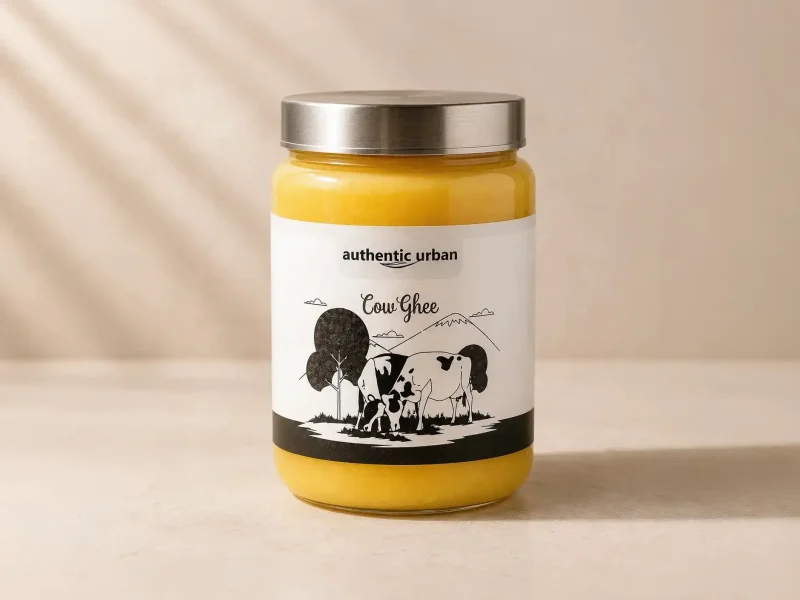
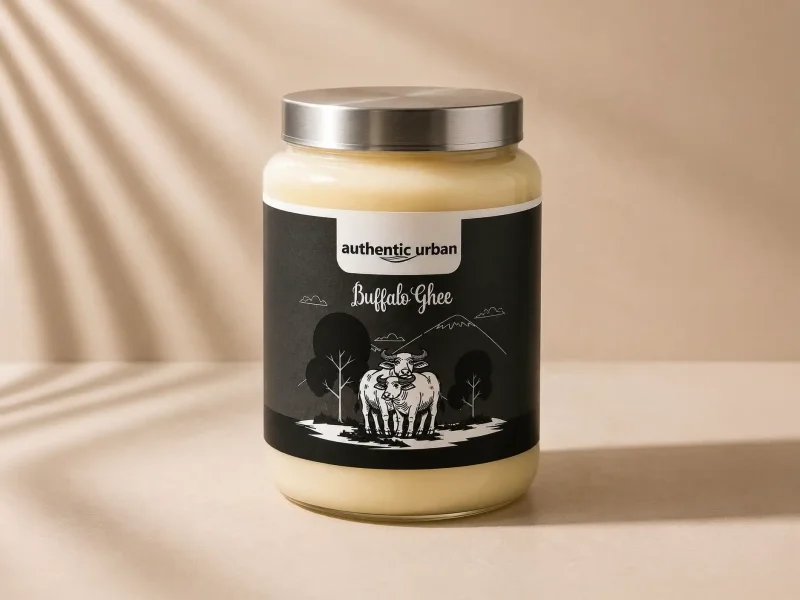
We make and sell ghee, so weigh this with that in mind. When there is no malai in the fridge, we would reach for our A2 Gir cow ghee for the daily spoon and our Jafarabadi buffalo ghee for sweets. It is made the long way described above: milk from grass-fed village animals near the Gir forest, set to curd overnight, churned for 30 to 45 minutes, and the makkhan cooked in a matki on a wood chulha. The jar is cooked after you order, a video of it comes on WhatsApp, and Varsha tastes every batch before it is packed. We test every month against the FSSAI limits; the steps are on how we make ghee.
The daily spoon on roti and dal
 1 Litre
Halwa, ladoo, and paratha
 1 Litre
Each order is cooked after you place it, and the packing video is of that batch. Past order videos are on the shop.
FAQ
Ghar par ghee kaise banaye?
Ek hafte ki malai fridge mein jama karo. Raat ko usme 1 chammach dahi milakar rakh do. Subah thanda paani daalkar mixer mein chalao jab tak makkhan alag na ho jaye. Makkhan ko dho kar bhaari kadhai mein dheemi aanch par pakao, beech beech mein chalate raho. Jab bulbule shaant ho jayein, neeche ka khurchan sunehra-bhura ho jaye aur bhuna doodh jaisi khushboo aaye, aanch band karo aur kapde se chhaan lo.
Can I make ghee in a pressure cooker or a microwave?
Not in a pressure cooker with the lid on: ghee is made by boiling the water out of butter, and a closed cooker keeps that water in. An open cooker base works as a heavy pan. A microwave can melt butter, but you cannot see the solids or hear the bubbling, which is how you tell when ghee is done, and butter spits hard in it. A heavy kadhai on a low gas flame is easier.
Why do people add betel leaf, curry leaves, or a pinch of salt while making ghee?
They are household habits for smell and keeping. Many homes drop a betel leaf, a sprig of curry leaves, a few fenugreek seeds, or a pinch of rock salt into the ghee near the end. They add aroma and help the residue settle. Take leaves out before they turn black, or they make the ghee bitter. None of them changes how long ghee keeps as much as cooking it until quiet and using a dry spoon.
Is homemade malai safe to collect for a week?
Yes, if it stays cold. Skim the malai from boiled milk once it has cooled, add it to one clean, covered steel or glass box, and keep that box in the fridge, not the door. Stir in each new layer. A slightly sour smell is normal once curd goes in. Pink, green, or black spots, a fuzzy top, or a rotten smell mean throw it all away, not scrape and cook.
Can I make ghee from buffalo milk malai?
Yes, and you get more of it: buffalo milk is richer, so the malai is thicker and a week of it gives more ghee than cow milk. Buffalo ghee comes out whiter and sets firmer, and suits halwa, ladoo, and paratha. Cow milk malai gives a yellower, lighter ghee that most families keep for the daily teaspoon on roti and dal. The method is the same.
Which is the best ghee to buy if I stop making it at home?
We make Authentic Urban, so count us as biased. Our A2 Gir cow ghee is the one we would pick for the daily spoon: curd-churned Bilona from grass-fed Gir cow milk, cooked in a clay matki on a wood chulha after you order, with a video of your jar on WhatsApp. For sweets and paratha, our Jafarabadi buffalo ghee. From any brand, check the FSSAI licence and a clear method on the label.
About the editorial team
Authentic Urban TeamBilona ghee makers, Gir Somnath, Gujarat
We are the Parmar family in Gir Somnath, Gujarat. We have made ghee here since 2016 and sold it online since 2025. We make only Bilona ghee, test it every month, and anyone is welcome to visit and watch it being made. Our Gir cows and Jafarabadi buffalo are grass-fed village animals that graze near the Gir forest, with no hormones or milk boosters. We set their milk to curd, churn it, and cook the makkhan on a wood chulha. These articles come from that kitchen and from what customers ask us on WhatsApp. We are ghee makers, not doctors.
Sources
- Food Safety and Standards (Food Products Standards) Chapter 2.1: Dairy products and analogues, version 01.09.2023 (2.1.7 Cream and Malai, pp. 21-24; 2.1.8 Milk Fat Products, p. 27; 2.1.9 Butter, p. 30), FSSAI. Checked 28 Sep 2026.
- Butter oil, anhydrous (FDC ID 173412), SR Legacy, USDA FoodData Central. Checked 28 Sep 2026.
- Technology of Ghee making: Direct cream, Creamery butter, Continuous method (Technology of Milk and Milk Products, e-PG Pathshala), INFLIBNET Centre. Checked 28 Sep 2026.