Ghee vs Lard: Which Is Healthier, and Which to Cook With?
Ghee vs lard: lard actually has less saturated fat, 39.2 g per 100 g against 61.9 g in ghee per USDA, but ghee is the one for an Indian kitchen. It is vegetarian, it carries vitamin A, it takes more heat, and it gives dal and sweets their taste. Neither should be your main cooking fat: keep ghee to 1 or 2 teaspoons a day and cook the rest in oil.
Ghee vs lard: which is healthier?
On the fat numbers alone, lard edges ahead: a teaspoon has about 2.0 g of saturated fat and 5 mg of cholesterol, against 3.1 g and 13 mg in ghee. Ghee brings vitamin A and butyric acid that lard does not. Both are saturated animal fats, so the real answer is the amount: 1 or 2 teaspoons of either is fine, a kadhai of either is not.
Both have about 45 calories in a 5 g teaspoon. What differs is the kind of fat and what comes with it. These are USDA FoodData Central's figures, worked out for the 5 g household teaspoon that ICMR-NIN uses. Save this table; it settles most of the "lard is healthier" and "ghee is healthier" arguments.
1 tsp (5 g)
Ghee
Lard
Calories
44 kcal
45 kcal
Saturated fat
3.1 g
2.0 g
Monounsaturated fat
1.4 g
2.3 g
Polyunsaturated fat
0.18 g
0.56 g
Butyric acid (milk fat marker)
0.16 g
0 g
Cholesterol
13 mg
5 mg
Vitamin A
42 µg
0 µg
Vitamin D
0
0.13 µg (5 IU)
Vitamin E
0.14 mg
0.03 mg
Vegetarian
Yes (from milk)
No (pork fat)
USDA FoodData Central, SR Legacy: butter oil, anhydrous (173412) and lard (171401). Checked 27 September 2026.
Three things most comparison pages get wrong. First, many say ghee has vitamin D and lard has none; USDA lists it the other way round, with a small amount in lard (5 IU a teaspoon) and none in ghee. Second, the "3 to 8% butyric acid" line is too high: USDA puts it at 3.23 g in 100 g of ghee, about 0.16 g a teaspoon. Third, lard is often sold as "like olive oil" because of its monounsaturated fat. It has more of that than ghee, but it is still about 39% saturated. Ghee's full label is on ghee nutrition facts.
Is ghee or lard better for the heart and cholesterol?
Lard is slightly kinder to your cholesterol per spoon, but both sit on ICMR-NIN's saturated fat list, and a liquid oil beats both. ICMR-NIN's 2024 guidelines name coconut oil, palm oil, ghee, butter, lard, and tallow as sources of saturated fat, and say saturated fat raises total and LDL cholesterol.
USDA FoodData Central, SR Legacy (171412, 173412, 173430, 171400, 171401, 171410), rounded to the gram. Checked 27 September 2026.
| Item | Value |
|---|---|
| Coconut oil | 83 g |
| Ghee | 62 g |
| Butter | 51 g |
| Beef tallow | 50 g |
| Lard | 39 g |
| Groundnut oil | 17 g |
The same guidelines call visible saturated fat high above 10 g a day. At USDA's figures, ghee reaches 10 g in about 3.2 teaspoons, lard in about 5.1, and groundnut oil in about 12. So a family that cooked everything in lard would still cross the line fast; it would just take a little longer than with ghee.
Cholesterol in food matters less than saturated fat for most people, but here too lard is lower: about 5 mg a teaspoon against 13 mg in ghee. For ghee itself, the trial evidence and a dose by lipid report are on ghee for cholesterol. If you have heart disease, high LDL, or diabetes, your doctor or dietitian sets your fat limit, and that comes before any comparison here.
Which should you cook with: tadka, frying, pork, sweets, or pastry?
Ghee for Indian food and anything you taste the fat in, a liquid oil for frying, and lard only where a pork dish or a Western pastry recipe was written for it. This is how we would split the jobs:
Kitchen job
Use
Why
Tadka over dal, jeera rice, khichdi
Ghee, 1 teaspoon
You taste the fat here, and cumin and hing are made for ghee. Lard tastes of meat.
Halwa, ladoo, sheera, paratha
Buffalo ghee
Indian sweets are built on ghee's taste and the way it sets grainy as it cools.
Deep frying puri, pakora, samosa
Groundnut or another liquid oil
Frying soaks up a lot of fat. In either ghee or lard that fat is mostly saturated.
Pork vindaloo, sorpotel, pork curries
The pork's own rendered fat
If the dish is already pork, its fat belongs to the taste. Adding ghee on top only adds fat.
Flaky pie crust, American biscuits
Lard or cold butter
These recipes were written for a fat that stays firm and cold in the dough. Ghee gives a shorter, crumblier bite.
Nankhatai, shortbread, khatai biscuits
Ghee
That short, melt-in-the-mouth crumb is exactly what ghee does well.
Puja diya, prasad, a vegetarian or Jain home
Ghee only
Lard is pig fat. It has no place in these kitchens.
Choose ghee if
- The food is Indian: dal, rice, roti, khichdi, halwa, ladoo.
- Anyone at the table is vegetarian, Jain, or Muslim, or the food is for puja or prasad.
- You want a fat that takes a little more heat for a quick sear or a tadka.
Choose lard if
- You are cooking pork and the fat comes from the same meat.
- You are following a Western pie crust or biscuit recipe written for lard.
- You eat pork and want a little less saturated fat per spoon than ghee, and you are not using it for Indian dishes.
Smoke point: which takes more heat?
Ghee, by a small margin. A 2026 review in Frontiers in Food Science and Technology (Kumar and Jadhav) lists ghee at 220 to 240°C and lard at 185 to 205°C in the same table. The same review says 160 to 180°C is the right range for frying with ghee, well below either smoke point, so for a home kadhai the difference matters less than the flame. The "ghee 250°C, lard 190°C" pair many pages repeat mixes two different sources.
We see the burnt end of this at the chulha. When we cook makkhan into ghee in a matki on a low wood flame, we take it off as soon as the bubbling goes quiet and the milk solids turn golden-brown, and it smells of toasted milk. A few minutes past that, the batch goes dark and bitter and smells burnt. That batch never goes in a jar. Any fat that keeps smoking in your pan has gone the same way. Heat limits and deep frying in ghee are on ghee smoke point.
Can you use ghee instead of lard in baking?
Yes, gram for gram, because both are almost pure fat: USDA lists 99.5 g of fat in 100 g of ghee and 100 g in lard. The texture changes, though. Ghee gives a shorter, crumblier, melt-in-the-mouth bite, the nankhatai texture, rather than the tall flaky layers a lard pie crust is known for.
- Weigh, do not swap by cup. 100 g of lard becomes 100 g of ghee. Do not add water; neither fat has any.
- Chill the ghee until firm before cutting it into flour for a crust. Soft or melted ghee coats the flour and makes the crust mealy.
- Use buffalo ghee for pastry. It sets firmer and grainier than cow ghee, which helps a crust hold its shape.
- Keep the dough cold. Rest it in the fridge before rolling, as you would with lard.
- For flakier layers, mix. Half ghee and half cold butter gives some lift with ghee's taste.
If the recipe calls for butter rather than lard, the swap is different: USDA lists butter at 81.1 g of fat in 100 g, and most of the rest is water. That maths, with ratios for cake, brownies, and cookies, is on ghee for baking.
Is lard vegetarian, halal, or used in Indian cooking?
No, lard is not vegetarian or halal. FSSAI's own standard defines lard as the rendered fat from hogs, so it is pork, and it has no place in a vegetarian, Jain, Muslim, or Jewish kitchen, or in anything offered at a temple. Ghee is vegetarian because it comes from milk, which is why it is the fat for puja, the diya, and prasad.
Pork is part of Goan, Coorgi, and many North-Eastern kitchens, and there the pork's own fat does the cooking. Outside those dishes, most Indian homes never keep lard at all, and that is where the next question comes from. For how households use ghee in rituals and the diya, see ghee for puja and havan.
Can lard be mixed into ghee, and how would you know?
Yes, animal body fat is one of the fats found in adulterated ghee, and no kitchen test can reliably find it. It came into the news in September 2024, when the Union Health Minister sought a report after a National Dairy Development Board lab found animal fat and vegetable oil in ghee used for temple laddus, as All India Radio's News on AIR reported on 20 September 2024.
Labs catch it through a fat that only milk has. USDA lists 3.23 g of butyric acid in 100 g of ghee and none in lard. FSSAI's ghee standard (Chapter 2.1, p. 27) asks for a Reichert Meissl (RM) value of at least 24.0, and a 2019 paper in the Journal of Food Science and Technology (Pathania and colleagues) explains that this value rests on ghee's short-chain butyric acid. Lard dilutes it. The same paper warns that traders now sell "RM adjusters" to push the number back up, and shows a triglyceride test by gas chromatography that caught adulteration down to 0.5%.
So what can you do at home? Very little that is certain. Warm a spoon: good ghee smells of toasted milk, the smell we cook to at the chulha, and a jar that smells of meat or of nothing at all is worth a question. A very low price is the bigger warning. We need about 30 to 35 litres of milk for 1 kg of cow ghee, and a jar priced below what that milk costs has to be made of something else. How body fat and oils get into ghee, and the lab tests that find them, are on how fake ghee is made. To check your own jar step by step, try our ghee purity checker.
Ghee vs lard vs tallow: how do the three animal fats compare?
Tallow, rendered beef fat, sits between the two: less saturated fat than ghee, more than lard, and a smoke point between them. None of the three is a daily cooking oil. Per teaspoon, from USDA, with smoke points from the 2026 Frontiers review:
1 tsp (5 g)
Saturated
Mono
Cholesterol
Smoke point
Vegetarian
Ghee
Saturated: 3.1 g
Mono: 1.4 g
Cholesterol: 13 mg
Smoke point: 220 to 240°C
Vegetarian: Yes
Beef tallow
Saturated: 2.5 g
Mono: 2.1 g
Cholesterol: 5 mg
Smoke point: 200 to 216°C
Vegetarian: No
Lard
Saturated: 2.0 g
Mono: 2.3 g
Cholesterol: 5 mg
Smoke point: 185 to 205°C
Vegetarian: No
USDA FoodData Central (173412, 171400, 171401), per 5 g. Smoke points: Kumar and Jadhav, Frontiers in Food Science and Technology 2026, Table 2.
Tallow comes up mostly on carnivore and animal-based diets. How ghee fits those plans, and the portions, is on ghee on the carnivore diet. For the dairy pair, see ghee vs butter.
How much ghee or lard can you have in a day?
Count them together with your oil. ICMR-NIN's 2024 guidelines cap all visible fat at 20 to 50 g a day (4 to 10 teaspoons) depending on activity, and say to keep ghee or butter to 1 or 2 teaspoons a day, or avoid it. Lard is not in that line, but as a saturated animal fat it belongs in the same small allowance, not in the everyday cooking.
At home in Gir Somnath we eat 1 to 2 teaspoons of ghee each a day, on roti, dal, and khichdi, and more only in winter sweets. The rest of the cooking is oil. To work out your own family's ghee and oil, try our ghee calculator, and the portions by age are on how much ghee per day.
What mistakes do people make when choosing between them?
The biggest is picking the "healthier" fat and then using more of it. Keep this list for the next time the argument comes up:
- Calling lard "like olive oil". It has more monounsaturated fat than ghee, but about 39% of it is still saturated.
- Frying in either. A kadhai of ghee or lard puts days of saturated fat into one meal. Fry in a liquid oil.
- Trusting a smoke point without a source. In one measured table the gap between ghee and lard is about 35°C, and your flame matters more.
- Swapping by cup in baking. Weigh the fat; 100 g for 100 g.
- Assuming a smell test finds lard in ghee. It cannot. Buy from a maker you can check, with an FSSAI licence on the pack.
- Forgetting who is eating. One spoon of lard makes a dish non-vegetarian and not halal.
- Buying the cheapest ghee. Below the cost of the milk, it cannot be all milk fat. Our full ranking of jars is on best ghee in India.
Which ghee should you keep instead of lard?
If ghee is the one animal fat in your kitchen, it should be all milk fat. Check the FSSAI licence number, warm a spoon and smell it, and expect some grain once it cools. A jar that is very cheap or smells of nothing deserves a closer look.
For tadka and the spoon on dal and roti we use our own A2 Gir cow ghee: grass-fed Gir milk set to curd, churned, and cooked in a matki on the chulha, made after you order, with a video of your jar on WhatsApp. For halwa, paratha, and a firmer fat in pastry, Jafarabadi buffalo ghee is the one we reach for. We test every month against the FSSAI limits; see how we make ghee.
Gir cow ghee: tadka and the daily spoon
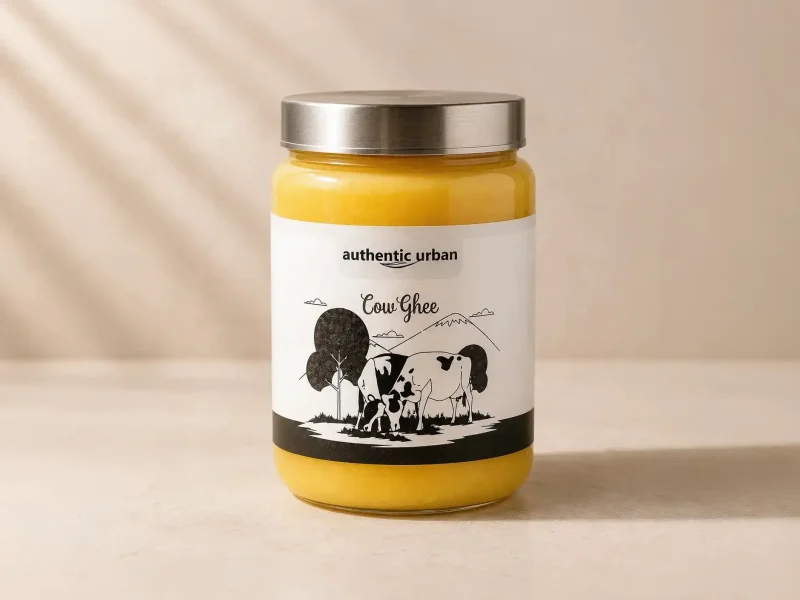 1 Litre
Buffalo ghee: sweets, paratha, and pastry
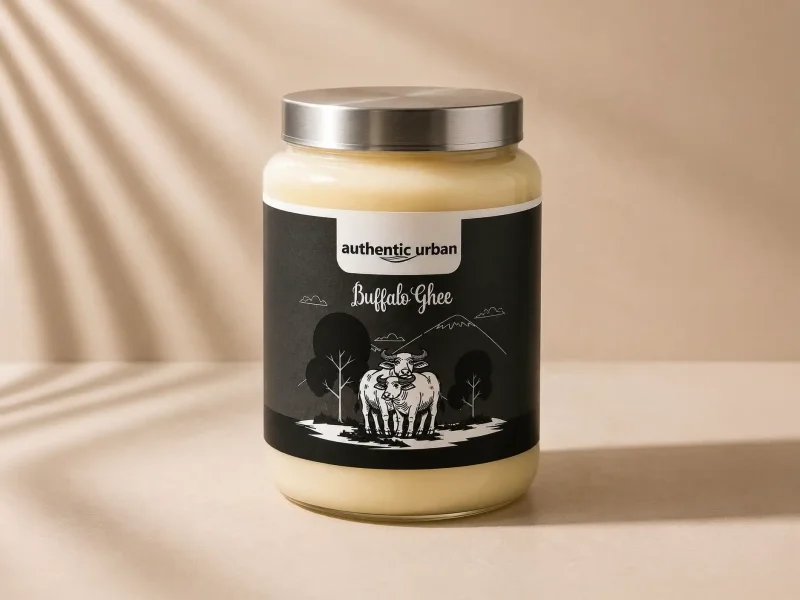 1 Litre
Each order is cooked after you place it, and the packing video is of that batch. Past order videos are on the shop.
FAQ
Which is the best ghee to use instead of lard?
Our Authentic Urban A2 Gir cow ghee for tadka and the daily spoon, and our Jafarabadi buffalo ghee for sweets, parathas, and bakes that need a firmer fat. Both are curd-churned Bilona, cooked after you order, with a video of your jar. Whatever you buy, check the FSSAI licence and warm a spoon: it should smell of toasted milk.
Is lard healthier than refined oil?
Not for the heart. USDA lists 39.2 g of saturated fat in 100 g of lard and 16.9 g in groundnut oil, and ICMR-NIN's 2024 guidelines say saturated fat raises total and LDL cholesterol. Lard does beat ghee and coconut oil on that one number. For the everyday cooking, a liquid oil is still the better base, with ghee kept to 1 or 2 teaspoons a day.
Are ghee and lard both keto friendly?
Yes, both are almost pure fat with no carbohydrate, per USDA FoodData Central, so neither raises blood sugar by itself. Keto does not change the saturated fat maths, though. A keto plate built on ghee or lard can push saturated fat well past the 10 g a day that ICMR-NIN calls high. If your cholesterol is up, your doctor sets the limit, not the diet plan.
Can I use lard for tadka instead of ghee?
You can, but the dal will taste of meat, and you lose the point of a ghee tadka, which is the toasted milk smell that cumin, hing, and garlic bloom in. Lard is also pig fat, so the dal is no longer vegetarian, Jain, or halal. If you want less saturated fat in tadka, use a liquid oil and finish with half a teaspoon of ghee.
Is ghee dairy free like lard?
No. Ghee is milk fat with the water and most of the milk solids cooked out, but USDA still lists about 0.28 g of protein in 100 g, so traces of milk protein remain. People with a milk allergy should avoid ghee unless their allergist says otherwise. Lard has no milk in it at all. Lactose intolerance is different: many people with it manage a teaspoon of ghee.
Is ghee vegan if lard is not vegetarian?
Ghee is vegetarian, not vegan. It comes from cow or buffalo milk, so it suits a lacto-vegetarian Indian kitchen, puja, and prasad, but not a vegan diet. Lard is neither: it is fat rendered from pigs, as FSSAI's own definition says. For a vegan kitchen, pick a plant oil: groundnut or mustard for cooking, coconut oil where its taste belongs.
About the editorial team
Authentic Urban TeamBilona ghee makers, Gir Somnath, Gujarat
We are the Parmar family in Gir Somnath, Gujarat. We have made ghee here since 2016 and sold it online since 2025. We make only Bilona ghee, test it every month, and anyone is welcome to visit and watch it being made. Our Gir cows and Jafarabadi buffalo are grass-fed village animals that graze near the Gir forest, with no hormones or milk boosters. We set their milk to curd, churn it, and cook the makkhan on a wood chulha. These articles come from that kitchen and from what customers ask us on WhatsApp. We are ghee makers, not doctors.
Sources
- Dietary Guidelines for Indians, 2024 (Guideline 7, printed pp. 52 and 54; Guideline 15, printed p. 93), ICMR-National Institute of Nutrition. Checked 27 Sep 2026.
- Lard (FDC ID 171401), SR Legacy, USDA FoodData Central. Checked 27 Sep 2026.
- Butter oil, anhydrous (FDC ID 173412), SR Legacy, USDA FoodData Central. Checked 27 Sep 2026.
- Fat, beef tallow (FDC ID 171400), SR Legacy, USDA FoodData Central. Checked 27 Sep 2026.
- Butter, without salt (FDC ID 173430), SR Legacy, USDA FoodData Central. Checked 27 Sep 2026.
- Oil, coconut (FDC ID 171412), SR Legacy, USDA FoodData Central. Checked 27 Sep 2026.
- Oil, peanut, salad or cooking (FDC ID 171410), SR Legacy, USDA FoodData Central. Checked 27 Sep 2026.
- Food Safety and Standards Regulations, Chapter 2.2: Fats, oils and fat emulsions, version 1 (01.09.2023), 2.2.4 Edible fats, item 4: Lard (p. 36), FSSAI. Checked 27 Sep 2026.
- Food Safety and Standards Regulations, Chapter 2.1: Dairy products and analogues, version 1 (01.09.2023), ghee standard (p. 27), FSSAI. Checked 27 Sep 2026.
- Understanding the techno-functionality of ghee as a cooking medium (Kumar and Jadhav, 2026), Table 2, Frontiers in Food Science and Technology. Checked 27 Sep 2026.
- A novel approach to detect highly manipulated fat adulterant as Reichert-Meissl value-adjuster in ghee through signature peaks by gas chromatography of triglycerides (Pathania et al., 2019), Journal of Food Science and Technology. Checked 27 Sep 2026.
- Centre seeks report over alleged adulteration in Tirupati laddu (20 September 2024), News on AIR (All India Radio). Checked 27 Sep 2026.