Ghee Detox (Ghee Cleanse): Is It Safe to Do at Home?
A ghee detox, or ghee cleanse, is a home copy of snehapana, the Ayurvedic practice of drinking ghee in rising doses before Panchakarma. We would not do it at home. In a clinic it starts at about 40 ml of ghee a morning with a physician checking you daily; the 3-day teaspoon plans online skip the checks, and no study shows they remove toxins.
Is a ghee detox safe to do at home?
Not as a cleanse. A spoon of ghee on your khichdi is food, and 1 to 2 teaspoons a day is what ICMR-NIN's 2024 guidelines allow. A ghee detox means several times that, on an empty stomach, day after day, often followed by a laxative. That is a medical procedure in Ayurveda, and it needs a physician watching you.
This page is for anyone who has seen a "3-day ghee cleanse" in a reel or on a shop's blog and wants to know what it really is before trying it. We make ghee in Gir Somnath, and at home our family eats 1 to 2 teaspoons each a day, on roti, dal, and khichdi. At home, ghee is for eating, and an older version of this page printed a home plan we no longer stand behind. Below is what the Ayurvedic texts describe, how a hospital actually does it, what the one clinical study found, and a food-only plan for the days you just want to eat light. The wider picture of ghee in Ayurveda is on ghee in Ayurveda.
What is a ghee cleanse (snehapana)?
A ghee cleanse is snehapana: drinking plain or medicated ghee in doses that rise each day, for a few days, to prepare the body for Panchakarma purification. It is a preparation step, not the cleanse itself.
The Charaka Samhita sets the dose by how long the ghee takes to digest: the smallest in about 6 hours, the middle in 12, and the largest in a full day and night (Sutra Sthana 13, verses 29 to 30). During snehapana it tells the patient to use warm water for everything, not to hold back the urge to pass stools, urine, or wind, and not to exercise (verse 62). After it comes shodhana, the actual purification: virechana (a purgative) or vamana (induced vomiting), and then a slow return to food.
How the physician knows when to stop
The texts also describe how the physician knows when to stop (verses 57 to 59). Too little ghee leaves hard, dry stools and weak digestion. The right amount gives soft, oily stools, a better appetite, and softer skin. Too much brings pallor, heaviness, tiredness, loose unformed stools, a dull head, loss of taste, and nausea. Reading those signs every morning is the physician's job, which is the first reason this does not translate to a kitchen.
"Ghee fasting" is sometimes used for the same thing, and sometimes for a modern fat fast with ghee in black coffee. The difference, and whether a spoon of ghee breaks a fast, is on what is ghee fasting.
How is a ghee cleanse done in a clinic?
With a physician, a hospital bed nearby, and far more ghee than any home plan uses. The best published description we found is a 2021 study from Tilak Ayurved Mahavidyalaya in Pune, in the Journal of Ayurveda and Integrative Medicine.
The 29 volunteers were healthy adults aged 20 to 60, and thin people were excluded. Each was examined first, including digestion and bowel habit. All took dry ginger (shunthi), 1 g three times a day, for 7 days before any ghee, and had their blood lipids tested. Then, on an empty stomach between 6:30 and 6:45 am, they drank 40 ml of cow ghee on day one, 80 ml on day two, 120 ml on day three, rising by 40 ml a day for 4 to 6 days until the signs of proper oleation appeared. Their normal meals came only after the ghee had digested. Each person took 400 to 1,050 ml of ghee in total. After a rest period, 27 were given virechana and 2 were given vamana, and all were put on a graded diet. The author notes that the same kind of course usually runs 3 to 7 days, with 300 to 1,000 ml of ghee.
Here is that clinic course next to the home plans that circulate online and next to ghee as food. The middle column is what an older version of this page, and many shop blogs, still print.
Ghee as food
3-day home plan
Clinic snehapana
Ghee on the first morning
Food: None needed. 1 to 2 tsp across the whole day, on meals
Home plan: 2 tsp in warm water
Clinic: 40 ml (about 8 tsp) at 6:30 am
Ghee on the last day
Food: The same 1 to 2 tsp
Home plan: 6 to 8 tsp
Clinic: Rising by 40 ml a day, for 4 to 6 days
Total ghee
Food: 5 to 10 g a day
Home plan: About 12 to 20 tsp over 3 or 4 days
Clinic: 400 to 1,050 ml over the course
Before it starts
Food: Nothing
Home plan: Nothing
Clinic: 7 days of dry ginger, examination, blood lipids
Who decides the dose
Food: ICMR-NIN guideline
Home plan: A blog or a reel
Clinic: The physician, by digestion and bowel habit, every day
What comes after
Food: Normal meals
Home plan: Castor oil or triphala, often self-given
Clinic: Purgation or emesis chosen by the physician, then a graded diet
Food: ICMR-NIN Dietary Guidelines 2024. Clinic: Mulay, J Ayurveda Integr Med 2021. A teaspoon is 5 g.
Are the 3-day ghee cleanse plans online safe?
They are the risky middle ground: too much ghee to be food, and none of the checks that make the clinic version safe. We would not follow one.
The usual plan is 2 teaspoons of melted ghee on day one, 4 on day two, 6 on day three, sometimes 8 on day four, with khichdi in between and castor oil or triphala at the end. Six teaspoons is three times ICMR-NIN's upper limit of 2 a day. At 9 kcal a gram and 5 g a teaspoon (both ICMR-NIN figures), that one morning glass is about 270 kcal of saturated fat before breakfast. For a healthy adult, a single day of it is unlikely to do harm. The trouble is who ends up trying it: people with diabetes, raised cholesterol, a fatty liver, or gallstones, who are often the ones looking for a "reset".
Look at what the home plan drops. There is no examination, no pre-digestion week, no lipid or sugar test, nobody reading the signs of too much oleation, and a purgative chosen from a blog. A 2009 review in Ancient Science of Life, written by Panchakarma teachers, says physicians run internal oleation by their own methods, that doing it badly brings complications such as raised blood lipids, and that the dose must be started and raised with care, based on each person's digestion and bowel habit. A fixed 2-4-6 table cannot do that.
If you already take a teaspoon in warm water every morning, that is a different, much smaller habit, covered on ghee on an empty stomach.
Does a ghee detox remove toxins or help weight loss?
No study has shown that a ghee cleanse removes toxins, and none has tested the home version at all. The clinic study measured weight and blood fats, not toxins.
In the 2021 Pune study, all 29 volunteers lost weight during the full course: 16 lost more than 2 kg and 13 lost less, and all had a smaller waist. Total cholesterol, LDL, and HDL did not change significantly; triglycerides and VLDL fell. No volunteer's health was harmed. That sounds good, but read the limits: 29 healthy people, no control group, in a hospital, with a purgative at the end. Weight lost in a week of oleation, purgation, and light meals is mostly water and gut contents, and the study did not follow anyone for months. It tells you the clinic course did not raise cholesterol in healthy adults. It does not tell you a home plan will slim you or clean you out.
Your liver and kidneys clear waste every day without help, and no food flushes them. Why ghee does not detox the liver, and what does help a fatty liver, is on does ghee detox the liver. If cholesterol is your worry, start from ghee and cholesterol, not from a cleanse.
What are the side effects of a ghee cleanse?
Nausea, a heavy stomach, loss of appetite, loose or oily stools, and tiredness are common, and Charaka lists most of them as signs of too much ghee. They are not a "healing crisis" to push through.
Some cleanse pages tell readers that headache, nausea, or fatigue mean toxins are leaving. That framing keeps people drinking ghee when their body is telling them to stop. The purgative at the end adds its own risk: several loose stools in a day can leave you dehydrated, which matters most for older people and anyone on medicines for blood pressure, diabetes, or the kidneys. People with diabetes on medicine face a second problem, because meals get skipped while the ghee digests; the doses that work with food are on can diabetics eat ghee.
Stop and get medical help the same day if you have any of these
- Vomiting more than once, or you cannot keep water down.
- Belly pain that is severe, constant, or lasts longer than 30 minutes.
- Pain under the right ribs that spreads to the back.
- Yellow skin or yellow whites of the eyes.
- A high temperature, or feeling hot, cold, and shivery.
- Loose stools with dizziness, a dry mouth, or very little urine.
- Chest pain, a racing heart, or confusion.
The belly pain, back pain, yellow skin, and temperature signs are the ones the NHS lists as needing urgent help with gallstone pain. Tell the doctor how much ghee you took and for how many days.
Who should never try a ghee cleanse?
Anyone on the list below should not do a ghee cleanse in any form, and should not start supervised snehapana without their own doctor knowing. We are ghee makers, not doctors, and this is where your doctor decides.
Charaka himself keeps oleation away from people with excess Kapha and body fat, weak digestion, great thirst, fainting, no appetite, a tendency to vomit, pregnancy, and those who have been drinking alcohol (verses 53 to 56). Today's list adds:
- Pregnancy and breastfeeding.
- Children and teenagers, and frail or very elderly people.
- Diabetes on tablets or insulin, where skipped meals and a heavy fat load can swing blood sugar.
- High LDL cholesterol, heart disease, or a past heart attack or stroke.
- Gallstones, a past gallbladder attack, pancreatitis, or a fatty liver.
- Kidney disease, or medicines for blood pressure or the kidneys, where a purgative's fluid loss matters.
- IBS, inflammatory bowel disease, or recent stomach or bowel surgery.
- A fever or any illness at the time, or an eating disorder now or in the past.
The full list of who should eat less ghee even as food, with reasons, is on who should not eat ghee.
If you want snehapana, what should you ask the clinic?
Go to a registered Ayurveda doctor who will examine you, test your blood first, and see you every day of the course. Before you pay, ask these six questions. Screenshot them.
- Are you a registered Ayurveda doctor (BAMS or higher), and where is the treatment done?
- Will you examine me and check my blood sugar and lipids before the first dose?
- Is there a pre-digestion phase (pachana) before the ghee starts?
- How will you decide each day's dose, and who do I call if I feel unwell at night?
- Which purgation will you give, at what dose, and will I be watched while it works?
- What will I eat for the days after, and when can I return to normal meals?
If the answer to the first two is vague, or the plan arrives as a printed table with the same doses for everyone, walk away. Clinics often use medicated ghee rather than plain; what those ghritas are and how their dose is set is on medicated ghee (ghritam).
What can you do at home instead of a ghee cleanse?
Eat light for a few days, with your ghee inside the usual 1 to 2 teaspoons. That gives you what most people want from a "reset" after a wedding season or Diwali, without a purgative or a doctor's visit.
This is a food plan, not a detox. Khichdi, dal, vegetables, buttermilk, and warm water carry it, and the ghee is there for taste and to help you absorb the vitamins in the vegetables. Keep it for 3 to 5 days, or as long as you like: nothing in it needs to be stopped.
When
What to eat
Ghee
On waking
A glass of warm water
None
Breakfast
Poha or upma with vegetables, or fruit and a small katori of curd
None, or ½ tsp in the tadka
Lunch
Moong dal khichdi with lauki or pumpkin, and a salad
1 tsp on top
Evening
Buttermilk with roasted jeera, or a fruit
None
Dinner, by 8 pm
Thin khichdi or 2 phulka with dal and a sabzi
½ to 1 tsp
Whole day
No fried food, sweets, or packaged snacks
1 to 2 tsp in total
For the khichdi itself, with the ghee added at the end where you can taste it, see our ghee khichdi recipe. If a heavy stomach is the reason you wanted a cleanse, the hing and jeera tadka on ghee for bloating does more than extra ghee. How much ghee suits children, older parents, and people with a health condition is on how much ghee per day, and you can work out your home's daily ghee and oil in our Ghee Lab.
One thing from our own kitchen: when you eat only a teaspoon, the ghee has to taste of something. Good ghee smells of toasted milk. A batch cooked too long is dark and bitter and smells burnt; one taken off too early is cloudy and spoils fast. We never pack either, and on a light-eating day either one would ruin the khichdi. Varsha tastes every batch before it is jarred, and if she would not serve it at home, it does not go out.
Which ghee for light-eating days?
On days you eat only a teaspoon or two, buy plain ghee with nothing added, that smells of toasted milk when warmed and turns grainy when it cools, which is normal for slow curd-churned ghee. Five checks for a pure jar are on how to identify pure ghee, how curd Bilona (curd churned by hand) differs from cream ghee is on the Bilona method, and our ranking of the jars on sale is best cow ghee in India.
We make and sell ghee, so weigh this with that in mind. For the daily spoon we would pick our own A2 Gir cow ghee: milk from grass-fed Gir cows near the Gir forest, set to curd overnight, churned, and cooked in a matki on a wood chulha, made after you order, with a video of your jar sent on WhatsApp. For the occasional winter sweet, our Jafarabadi buffalo ghee is the richer jar. For a supervised course, the clinic chooses the ghee; your jar is for the kitchen. We test every month against the FSSAI limits; the steps are on how we make ghee.
The teaspoon on khichdi and dal
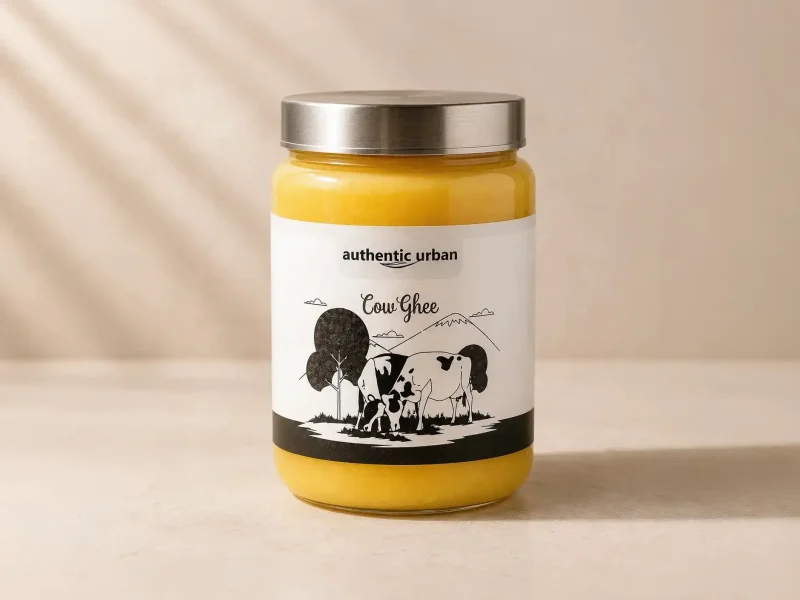 1 Litre
Winter sweets, in small pieces
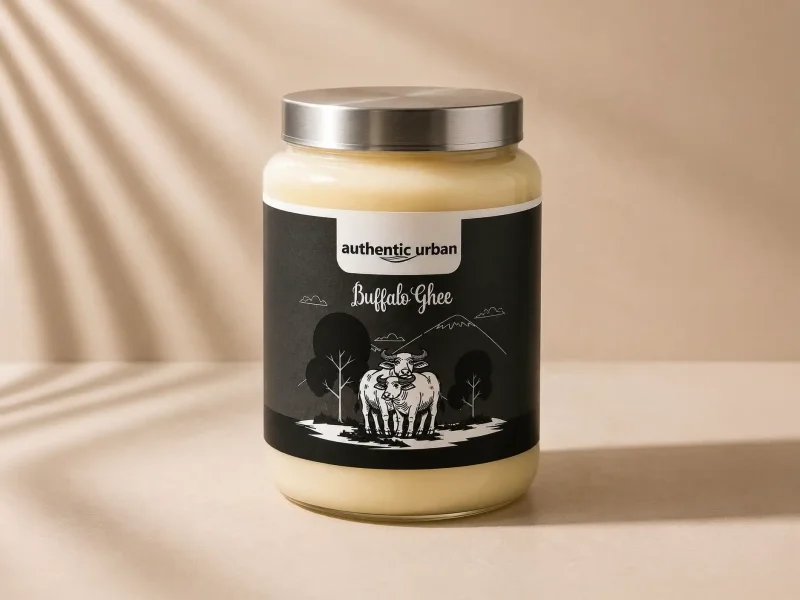 1 Litre
Each order is cooked after you place it, and the packing video is of that batch. Past order videos are on the shop.
FAQ
Is ghee with warm water in the morning the same as a ghee cleanse?
No. One teaspoon of ghee in warm water is a food habit. It counts inside the 1 to 2 teaspoons a day that ICMR-NIN suggests, and nothing follows it. A ghee cleanse means drinking far larger amounts that rise each day, on a set diet, and usually ends in a purgative. The first is fine for most healthy adults; the second belongs with a physician.
Can I use buffalo ghee for a ghee cleanse?
Clinics decide which fat to give, and the Charaka Samhita ranks ghee as the best of the four fats used in oleation. The 2021 Pune snehapana study chose cow ghee, and had it analysed in a lab before use. At home, where you should not be running a cleanse anyway, cow and buffalo ghee both work as food. Buffalo ghee is richer, so keep to the same small daily amount.
Does a ghee cleanse clear acne or give glowing skin?
We found no trial showing that drinking large amounts of ghee clears acne or improves skin. Several days of heavy fat can bring on nausea and loose stools, which do skin no favours. Acne that keeps coming back needs a dermatologist, and skin that feels dry does better with ghee or a plain moisturiser on the outside than with extra spoons swallowed on an empty stomach.
Is it safe to take castor oil after drinking ghee at home?
We would not. In the clinic study, the physician chose between purgation and emesis for each person, watched them through it, and then set a graded diet. A self-given laxative after days of heavy fat can cause repeated loose stools and dehydration, which is riskier for older people and anyone on blood pressure, diabetes, or kidney medicines. Ask a doctor before taking any purgative.
Does medicated ghee (ghrita) make a home cleanse safer?
No. Medicated ghee, such as Triphala or Kalyanaka ghrita, is ghee cooked with herbs, and in Ayurveda it is prescribed for a person and a condition. Adding herbs does not reduce the fat in each spoon, and it adds the effects of the herbs. If a practitioner has prescribed a ghrita, take the dose they wrote down, and do not scale it up into a cleanse on your own.
How long after a ghee cleanse can I eat normally?
After a supervised snehapana and purgation, the physician sets a graded diet that starts very light and returns to normal meals over several days, depending on how strong the purgation was. After food-only light days at home, there is nothing to recover from: go back to your usual meals the next day, and keep the fried food and sweets as occasional as they were during the week.
About the editorial team
Authentic Urban TeamBilona ghee makers, Gir Somnath, Gujarat
We are the Parmar family in Gir Somnath, Gujarat. We have made ghee here since 2016 and sold it online since 2025. We make only Bilona ghee, test it every month, and anyone is welcome to visit and watch it being made. Our Gir cows and Jafarabadi buffalo are grass-fed village animals that graze near the Gir forest, with no hormones or milk boosters. We set their milk to curd, churn it, and cook the makkhan on a wood chulha. These articles come from that kitchen and from what customers ask us on WhatsApp. We are ghee makers, not doctors.
Sources
- Mulay MS. Short term escalating administration of large amount of sneha does not increase blood lipids. J Ayurveda Integr Med 2021;12(3):535-539 (29 volunteers, 40 ml rising doses, 400 to 1,050 ml in total, weight, lipids, virechana in 27), PubMed Central. Checked 28 Sep 2026.
- Patil V, Baghel MS, Thakar AB. Effect of snehapana (internal oleation) on lipids: a critical review. Anc Sci Life 2009;29(2):32-39, PubMed. Checked 28 Sep 2026.
- Charaka Samhita, Sutra Sthana 13 (Snehadhyaya), verses 29-30 (three dose sizes), 53-56 (who should not be oleated), 57-59 (signs of too little, right, and too much oleation), 62 (conduct during snehapana), English translation, Charaka Samhita Online. Checked 28 Sep 2026.
- Dietary Guidelines for Indians, 2024 (fats give 9 kcal a gram, printed p. 9; limit ghee or butter to 1 to 2 teaspoons a day, p. 54; teaspoon 5 g, p. 111), ICMR-National Institute of Nutrition. Checked 28 Sep 2026.
- Gallstones: symptoms and when to get urgent help, NHS. Checked 28 Sep 2026.