Eating Ghee Daily: What Happens in 30 Days, and How Much
Eating ghee daily is fine for most healthy adults at 1 to 2 teaspoons (5 to 10 g) a day, the ICMR-NIN limit, taken in place of some cooking oil. Over 30 days that is 150 to 300 g of ghee and about 1,310 to 2,630 kcal. Meals may feel more filling in the first week; cholesterol changes, if any, only show up in a blood test.
What happens if you eat ghee daily?
At 1 to 2 teaspoons a day, not much you can see. Meals feel a little more filling, dal and roti taste better, and stools may be softer. Weight does not change unless the ghee is extra calories on top of what you already eat. At tablespoons a day, the one 4-week trial we found saw two blood markers of heart risk go up.
The difference is the amount. Most "30 days of ghee" videos ask for one or two tablespoons, which is two to five times what ICMR-NIN's 2024 guidelines allow. This page is for adults who want to eat ghee every day and want to know what a month really does, in numbers. Whether ghee is good or bad for you overall is on is ghee healthy, and the amount for children, pregnancy, and older adults is on how much ghee per day.
How much ghee do you eat in 30 days?
One teaspoon a day is 150 g of ghee and about 1,310 kcal in a month; two tablespoons a day is over 750 g and about 6,730 kcal. Here is each common amount, worked out from USDA FoodData Central.
Amount
Per day
Saturated fat
In 30 days
Against ICMR-NIN
1 tsp a day (5 g)
Per day: 44 kcal
Saturated fat: 3.1 g
In 30 days: 150 g, 1,310 kcal
Inside the ICMR-NIN limit
2 tsp a day (10 g)
Per day: 88 kcal
Saturated fat: 6.2 g
In 30 days: 300 g, 2,630 kcal
The top of the ICMR-NIN limit
1 tbsp a day (12.8 g)
Per day: 112 kcal
Saturated fat: 7.9 g
In 30 days: 384 g, 3,360 kcal
Above the limit, before any cooking oil
2 tbsp a day (25.6 g)
Per day: 224 kcal
Saturated fat: 15.8 g
In 30 days: 768 g, 6,730 kcal
What many 30-day videos ask for
The 2021 trial: about 30 g a day
Per day: 268 kcal
Saturated fat: 18.9 g
In 30 days: 918 g, 8,040 kcal
About 6 tsp; raised apoB in 4 weeks
USDA FoodData Central, SR Legacy 173412 (butter oil, anhydrous): 876 kcal and 61.9 g saturated fat per 100 g, scaled to a 5 g teaspoon and a 12.8 g tablespoon. Limit from ICMR-NIN Dietary Guidelines for Indians 2024, Guideline 7. Checked 27 September 2026.
USDA FoodData Central SR Legacy 173412, checked 27 September 2026. Trial amount from Mohammadi Hosseinabadi and Nasrollahzadeh, British Journal of Nutrition, 2021.
| Item | Value |
|---|---|
| 1 tsp a day (5 g) | 1,310 kcal |
| 2 tsp a day (10 g) | 2,630 kcal |
| 1 tbsp a day (12.8 g) | 3,360 kcal |
| 2 tbsp a day (25.6 g) | 6,730 kcal |
| The 2021 trial: about 30 g a day | 8,040 kcal |
ICMR-NIN's 2024 guidelines ask adults to limit ghee or butter to 1 to 2 teaspoons a day, or avoid it, inside a total of about 20 g of visible fat for a sedentary woman and 30 g for a sedentary man. So the daily spoon is part of your fat for the day, not an add-on. At home our family eats 1 to 2 teaspoons each, on roti, dal, and khichdi, and more only in winter sweets like adadiya pak and gond. To work out the ghee and oil for your own household, use the ghee calculator. The full label for a spoon, vitamins included, is on ghee nutrition facts.
What did 4 weeks of daily ghee do in a trial?
In the clearest test we found, 4 weeks of about 30 g of ghee a day raised apoB and non-HDL cholesterol compared with olive oil, and did not change weight. The trial, published in the British Journal of Nutrition in 2021, had 30 healthy adults in Tehran eat ghee for 4 weeks and olive oil for 4 weeks, in random order, with 2 weeks of olive oil in between.
- Went up on ghee: apoB by 0.09 g/l and non-HDL cholesterol by 0.53 mmol/l. Both are markers doctors use for heart risk.
- Not clearly changed: LDL rose by 0.29 mmol/l, but the difference was not statistically significant.
- No difference: HDL, triglycerides, body weight, blood pressure, blood sugar, and insulin.
How to read the trial
Two things matter for reading it. The dose was about 6 teaspoons a day, three times the ICMR-NIN limit, so it tells you about the tablespoon challenge, not the daily teaspoon. And the comparison was olive oil, not the mustard or groundnut oil most Indian kitchens use. A 2024 review in the Journal of Ayurveda and Integrative Medicine calls human results on ghee mixed; one study it describes gave 24 young lactovegetarian volunteers 10% of their calories from ghee for 8 weeks and found no significant change in blood lipids. ICMR-NIN notes that saturated fat, which is 62% of ghee by USDA figures, raises total and LDL cholesterol. More on the heart side is on ghee for cholesterol.
What changes can you notice in 30 days?
You can notice fullness and digestion within a week; weight needs a scale over four weeks; cholesterol needs a blood test. Skin, hair, and energy claims have no month-long trial behind them.
Change
When
How you know
What to expect
Meals feel more filling
When: First week
How you know: You feel it
Fat slows how fast the stomach empties. Only counts if you then eat less, not more.
Softer, easier stools
When: First week
How you know: You feel it
Common when the spoon goes on dal and roti. Loose, oily stools mean the amount is too high.
Heaviness or acid after meals
When: Any day
How you know: You feel it
A sign to drop back to 1 tsp or take it with food only.
Weight
When: 4 weeks
How you know: Weekly scale and waist
Moves only with total calories. In the 2021 trial, weight did not differ between ghee and olive oil.
LDL, non-HDL, apoB
When: 4 weeks
How you know: Blood test only
You cannot feel these. The one trial at 6 tsp a day saw apoB and non-HDL go up.
Skin, hair, joints, focus
When: Not shown
How you know: No test in a month
No trial has measured these for a month of eating ghee. Sleep, water, and the rest of your plate matter more.
Weight and blood results from Mohammadi Hosseinabadi and Nasrollahzadeh, British Journal of Nutrition, 2021 (about 30 g ghee a day for 4 weeks). Checked 27 September 2026.
If you want to know what a month of ghee does to your own cholesterol, a lipid profile on day 1 and day 30 is the only way. MedlinePlus explains that it measures LDL, HDL, total cholesterol, and triglycerides, and that you may need to fast for 9 to 12 hours before it. Ask your doctor whether a repeat after four weeks is useful for you; one reading can move for reasons that have nothing to do with ghee.
What are the real benefits of eating ghee daily?
The benefits you can count on are small and practical: a teaspoon makes plain food taste better, helps you absorb the fat-soluble vitamins A, D, E, and K in the vegetables it goes on, and can make a meal more filling. ICMR-NIN lists carrying those vitamins as one of the jobs of dietary fat.
Ghee also swaps well for the fats you want less of. A teaspoon on a phulka instead of a paratha fried in oil, or ghee in the tadka instead of vanaspati, is where the daily habit earns its place. Claims that a month of ghee clears skin, grows hair, or burns belly fat are not backed by any trial of eating ghee for that long. Each benefit, one by one, with what holds up, is on ghee benefits, and in Hindi on desi ghee khane ke fayde.
What are the side effects of eating ghee daily?
At 1 to 2 teaspoons, most healthy adults have none. The problems start with amount: slow weight gain when the ghee is extra, loose or oily stools, heaviness and acid after meals, and higher LDL in people who respond to saturated fat.
Each teaspoon also carries about 13 mg of cholesterol and 3.1 g of saturated fat by USDA figures. A teaspoon eaten every day on top of your usual food is about 1,310 kcal a month, which is why the swap matters more than the spoon. What eating too much every day does, and the signs to cut back, are on ghee side effects.
How to eat ghee daily for 30 days
Start at 1 teaspoon a day on food, take the same amount of oil out of your cooking, and do not go above 2 teaspoons at any point in the month. That is the whole plan.
Week
Amount
Where it goes
The swap
Week 1
1 tsp (5 g) a day
Where: On hot dal or on the lunch roti
Swap: Take 1 tsp oil out of the tadka that day
Week 2
1 tsp, or 2 if week 1 felt fine
Where: Split: lunch roti and dinner khichdi
Swap: One tsp less oil for each tsp of ghee
Week 3
Stay where you are
Where: Same meals, same time
Swap: Weigh on the same day each week
Week 4
1 to 2 tsp, never more
Where: Same meals
Swap: Optional: lipid test if you did one on day 1
Put the ghee on hot food rather than cooking it for long: a teaspoon melted over dal, rice, or a phulka tastes of more than a spoonful fried in a pan. A plain teaspoon on an empty stomach also counts toward the day; how to take it that way is on ghee on an empty stomach, and where the day's spoons go, morning or night, is on when to eat ghee.
Your jar will change over the month too. Curd-churned ghee often cools grainy, and in winter it sets firm; in summer it stays liquid. "Why is it grainy?" is the question we get most on WhatsApp, and the answer is that grain comes from slow cooling, not from anything added. Warm the jar in a bowl of warm water for a minute and the teaspoon measures easily.
Who should ask a doctor before eating ghee daily?
Ask first if you have a health condition with a fat limit. We make ghee; we are not doctors, and for these readers the amount is your doctor's call.
- High LDL cholesterol, heart disease, or a past heart attack or stroke.
- Gallstones, pain under the right ribs after fatty meals, or pancreatitis.
- Fatty liver or other liver disease, or kidney disease with a set diet.
- Diabetes on medicine, where a change in meals can matter.
- Pregnancy and breastfeeding: ICMR-NIN asks for visible fat to be restricted then, with nuts, seeds, and fish encouraged instead.
- A milk allergy. Ghee has only traces of milk protein, but traces can matter.
Your 30-day ghee log
Keep these seven lines for the month and decide on day 30 from your own numbers. Screenshot it if that helps.
- Day 1: weight before breakfast, waist at the navel, and a lipid profile if your doctor wants a baseline.
- Each day: how many teaspoons, and on which food. Use a measuring spoon, not the serving spoon.
- Each day: one line on digestion. Heavy, fine, or loose.
- Each day: did you cut the same amount of oil? Yes or no.
- Every 7 days: weight on the same day, same time, before breakfast.
- Day 30: weight and waist again, and the repeat blood test if you took one on day 1. Compare numbers, not memory.
- Stop the same day for pain under the right ribs, vomiting, loose oily stools that do not settle, or a rash or swelling.
A month's log only means something if the jar is real ghee. Before day 1, warm a spoon and smell it: good ghee smells of toasted milk, not wax, soap, or nothing. Five home checks are on how to identify pure ghee.
Which ghee to eat daily?
If you are eating only one or two teaspoons a day, eat one you enjoy, and one you can trust for a month. Warm a little: it should smell of toasted milk. How curd Bilona (curd churned by hand) differs from cream ghee is on the Bilona method, and our ranking of cow ghee on sale is best cow ghee in India.
We make and sell ghee, so weigh this with that in mind. For the daily teaspoon we would pick our own A2 Gir cow ghee: grass-fed Gir milk set to curd overnight, churned, and cooked in a matki on a wood chulha, made after you order, with a video of your jar sent on WhatsApp. At ₹2,399 a litre, one 5 ml teaspoon a day costs about ₹12, or about ₹360 for the 30 days. For paratha and winter sweets, our Jafarabadi buffalo ghee is the richer jar. We test every month against the FSSAI limits; the steps are on how we make ghee.
The daily teaspoon on dal and roti
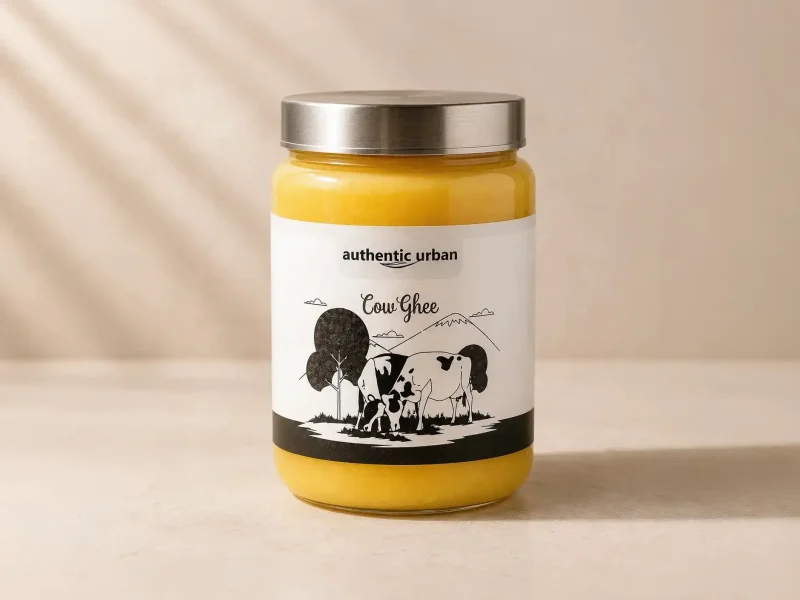 1 Litre
Paratha and winter sweets
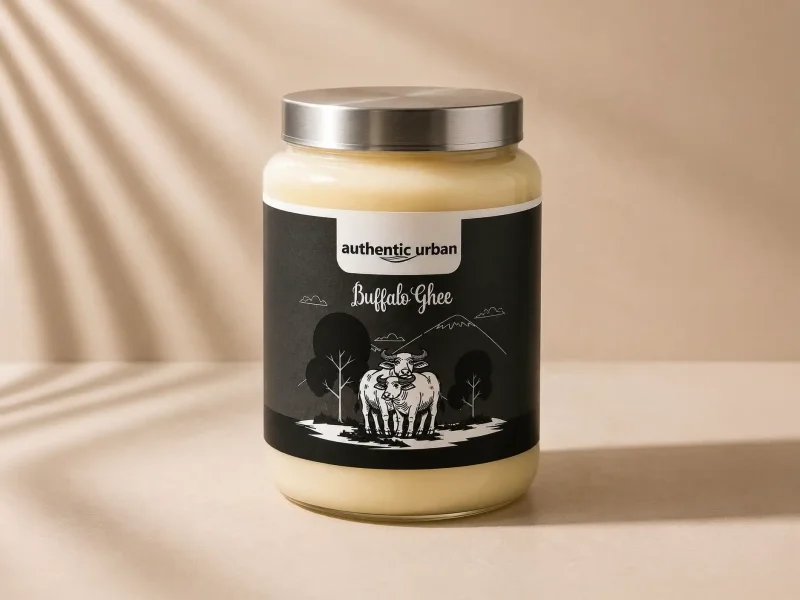 1 Litre
Each order is cooked after you place it, and the packing video is of that batch. Past order videos are on the shop.
FAQ
What happens if you stop eating ghee after 30 days?
Very little, if you were eating 1 to 2 teaspoons. Your meals lose about 44 to 88 kcal a day, by USDA figures, and some people find roti and dal less filling for a week. If you were eating tablespoons, weight and cholesterol may drift back down over the following weeks. Nothing in ghee is habit-forming, and there is no rebound effect to worry about.
Is it good to eat ghee daily in summer?
Yes, the same 1 to 2 teaspoons a day works all year. In summer our ghee stays liquid in the jar and many families eat lighter meals, so a teaspoon on dal or rice is enough. Eat it with food rather than on its own, drink enough water, and skip the heavy ghee sweets in the hottest weeks if they leave you feeling heavy.
Can I eat ghee daily if I go to the gym?
Yes. Active adults can use more visible fat in total: ICMR-NIN allows men with moderate activity up to 40 g and heavy activity up to 50 g a day. The ghee part still stays at 1 to 2 teaspoons, with the rest from oils, nuts, and seeds. Ghee adds calories but no protein, so it does not replace dal, eggs, paneer, or milk after training.
Does eating ghee daily cause pimples?
There is no trial showing that 1 to 2 teaspoons of ghee a day causes acne. Breakouts that start with a new habit are more often from the fried snacks or sweets that come with it, or from putting ghee on the face. If your skin changes in the month, keep the spoon on food only, drop fried food, and see whether it settles in two weeks.
Is cow ghee or buffalo ghee better to eat daily?
Both have about the same calories and saturated fat per teaspoon, so the daily limit is the same. Cow ghee is lighter in taste and suits dal, rice, and the plain spoon many people start with. Buffalo ghee is richer and sets firmer, which suits paratha and winter sweets. Pick by what you cook, and keep the total at 1 to 2 teaspoons.
Can I eat ghee daily with milk at night?
Yes, if it is part of the day's 1 to 2 teaspoons and not extra. Half to one teaspoon in a cup of warm milk is a common household habit. Take it an hour or so before lying down if you get acid reflux. If you already had ghee on lunch and dinner, the milk spoon takes you above the ICMR-NIN limit, so drop one.
About the editorial team
Authentic Urban TeamBilona ghee makers, Gir Somnath, Gujarat
We are the Parmar family in Gir Somnath, Gujarat. We have made ghee here since 2016 and sold it online since 2025. We make only Bilona ghee, test it every month, and anyone is welcome to visit and watch it being made. Our Gir cows and Jafarabadi buffalo are grass-fed village animals that graze near the Gir forest, with no hormones or milk boosters. We set their milk to curd, churn it, and cook the makkhan on a wood chulha. These articles come from that kitchen and from what customers ask us on WhatsApp. We are ghee makers, not doctors.
Sources
- Dietary Guidelines for Indians, 2024 (Guideline 7, printed pp. 52 and 54), ICMR-National Institute of Nutrition. Checked 27 Sep 2026.
- Butter oil, anhydrous (FDC ID 173412), SR Legacy, USDA FoodData Central. Checked 27 Sep 2026.
- Effects of diets rich in ghee or olive oil on cardiometabolic risk factors in healthy adults: a two-period, crossover, randomised trial (Mohammadi Hosseinabadi and Nasrollahzadeh, 2021), British Journal of Nutrition. Checked 27 Sep 2026.
- Health benefits of ghee: Review of Ayurveda and modern science perspectives (Kataria and Singh, 2024), Journal of Ayurveda and Integrative Medicine. Checked 27 Sep 2026.
- Cholesterol Levels, MedlinePlus, U.S. National Library of Medicine. Checked 27 Sep 2026.