Is Ghee Good for Acid Reflux? How Much and When to Eat
Is ghee good for acid reflux? In small amounts, it is usually fine, but it does not treat reflux. Half to one teaspoon on dal, rice, or roti at lunch suits most people with acidity. Big ghee-heavy meals, a spoon on an empty stomach, or ghee milk at bedtime are what bring on the burning.
Is ghee good for acid reflux?
Ghee is fine for most people with acid reflux in small amounts, and it does not cure or treat it. Keep it to ½ to 1 teaspoon at lunch, and 1 to 2 teaspoons across the whole day, the limit ICMR-NIN's 2024 guidelines set for everyone. The size of the meal, the time you eat, and the spice on the plate matter more than the ghee.
Acid reflux is stomach acid rising into the oesophagus (the food pipe), felt as heartburn: a burning in the middle of the chest, often with a sour taste in the mouth. When it happens often, doctors call it GERD (gastro-oesophageal reflux disease). This page is for adults with everyday acidity or a GERD diagnosis who want to know if the ghee on their plate is part of the problem. Stomach ulcers are a different condition, covered on ghee for ulcers.
Does ghee cause acidity?
Ghee can bring on heartburn when it is part of a large or very fatty meal. A teaspoon on a normal plate rarely does. NIDDK, the US government's digestive disease institute, lists high-fat foods among those that may make reflux worse, alongside spicy food, citrus, tomatoes, chocolate, coffee, mint, and alcohol. The NHS names fatty and spicy food as triggers too.
One small study helps separate fat from plain overeating. Fox and colleagues, in Clinical Gastroenterology and Hepatology in 2007, measured acid in the food pipe for 4 days in 15 people with reflux symptoms, changing only the size of the meals or only their fat share.
What changed
Time acid was in the food pipe
Reflux symptoms
Big meals (1,000 kcal) vs small meals (500 kcal), same fat share
Acid: 8.6% vs 5.2% of the day
Symptoms: No clear difference
High fat (50% of calories) vs lower fat (25%), same calories
Acid: 8.6% vs 8.2% of the day, no clear difference
Symptoms: About 11 vs 6 episodes (median)
From the study's published abstract (Clin Gastroenterol Hepatol 5(4), 2007). Checked 26 September 2026.
Bigger meals raised acid. A higher fat share did not raise acid, but people felt nearly twice as many reflux episodes. So a ghee-rich festival lunch is far more likely to burn than a spoon on khichdi. The study is small and not about ghee itself, so read it as a guide to portions, not proof about ghee.
For scale, USDA FoodData Central puts a 5 g teaspoon of ghee at about 44 kcal and 5 g of fat, of which 3.1 g is saturated. Two tablespoons in a tadka is six times that. What too much ghee does elsewhere in the body is on ghee side effects.
Does ghee coat the stomach or heal the food pipe?
We found no human study showing that ghee coats the stomach, lowers acid, or heals the oesophagus. Many pages that rank for this question say it does. Here is what each common claim rests on.
The claim
What is actually known
Ghee coats the stomach and blocks acid
No study we found shows this in people. Fat is digested in the gut; it does not sit as a layer on the stomach wall.
Butyrate in ghee heals the food pipe
Butyrate is studied for the large intestine. We found no human study of ghee and a damaged oesophagus (the food pipe).
Ghee reduces stomach acid
No human study we found. NIDDK lists high-fat foods among those that may make reflux worse.
Ghee calms pitta and acidity
Ayurvedic tradition, not a tested treatment. Small amounts with plain food fit both views.
Any fat makes reflux worse
Too simple. In one pH study, meal size drove acid; a higher fat share drove symptoms. A teaspoon on a small plate is a different thing from a ghee-soaked thali.
Ghee still has a place on a reflux plate. It makes plain, low-spice food taste good, which helps people stick to the small, simple meals that do ease reflux. That is a food job, not a medical one.
How much ghee with acid reflux, and when?
Start with ½ teaspoon at lunch, go up to 1 teaspoon if the week stays calm, and keep the day to 1 to 2 teaspoons. Eat it with food, never alone, and not in the last 3 hours before bed.
When
Ghee
Why
Lunch, on dal-rice, roti, or khichdi
½ to 1 tsp
The easiest place to start. You stay upright for hours after.
Early dinner, at least 3 hours before bed
½ tsp, or none on bad days
NIDDK advises eating at least 3 hours before lying down; the NHS says 3 or 4.
Empty stomach, first thing
Skip while you have heartburn
A spoon of fat with nothing else is the habit readers most often ask about. Try it only once reflux has settled.
In coffee, tea, or late-night milk
Skip
Coffee and caffeine are on NIDDK's trigger list, and a bedtime drink breaks the 3-hour gap.
Halwa, ladoo, paratha, fried snacks
Small portion, at lunch, now and then
These are where the big fat and calorie loads hide.
A starting point for adults. If your doctor has given you a diet sheet, it wins.
What about the morning spoon of ghee?
The morning spoon is the habit most often sold for acidity. How to do it, and who should skip it, is on ghee on empty stomach. With active heartburn, leave it until the burning has settled for a couple of weeks, then try ½ teaspoon with warm water and watch the next few hours. Ghee in coffee is a heavier version of the same thing; the trials on it are on black coffee with ghee.
In our home in Gir Somnath, each of us eats 1 to 2 teaspoons a day, on roti, dal, and khichdi, and more only in winter sweets like adadiya pak and gond. We make ghee for a living and we still measure it. With reflux in the house, those winter sweets are the thing to eat small, and at lunch. Timing across the whole day is on the best time to eat ghee, and you can work out your home's daily ghee and oil for each person.
Which ghee meals are easy on reflux?
Small, soft, low-spice plates with a measured spoon of ghee are the gentlest. The same ghee turns into a trigger in a chilli tadka, a late paratha dinner, or a sweet on a full stomach.
The plate
For reflux
Why
Moong dal khichdi with ½ tsp ghee on top
Gentler
Small, soft, low in spice. The ghee is a flavour, not a load.
Plain dal, rice, lauki or tinda sabzi, 1 tsp ghee on the dal
Gentler
A normal lunch with one measured spoon.
2 phulkas with ½ tsp ghee each, curd on the side
Gentler for most
Keep the curd fresh, not sour, if curd bothers you.
Chilli-heavy tadka in 2 tbsp ghee on rajma or chole
Likely trigger
Spice, tomato, and a big fat load in one bowl.
Ghee parathas with pickle for dinner
Likely trigger
Large, fatty, sour, and late.
Halwa or ladoo after a full meal
Likely trigger
Adds hundreds of calories on a full stomach.
Cook the sabzi in a little oil and add the ghee at the end, on the dal or roti, where you taste it. Then one spoon does the work of three. The difference between ghee and cooking oils, spoon for spoon, is on ghee vs vegetable oil. If your trouble is gas and a tight belly after meals rather than burning, read ghee for bloating, and for cramps with loose or hard stools, ghee for IBS.
What does Ayurveda say about ghee and acidity?
Ayurveda links hyperacidity (amlapitta) to excess pitta, the heat in the body, and uses ghee as a cooling, soothing fat in small amounts with cooling food: rice, milk, and cooked vegetables. That is household tradition and classical texts, not a tested treatment.
The practical parts of the tradition line up with modern advice: small amounts, plain food, and no ghee with chilli, sour pickle, or fried snacks. The parts that do not line up are large morning doses and medicated ghee taken for weeks, which belong with a trained vaidya, not a blog. Why ghee is called cooling when it is also a rich fat is on is ghee heating or cooling.
What helps acid reflux more than ghee?
Smaller meals and a longer gap before bed help more than any change to the ghee. The NHS advises smaller, more frequent meals, no food in the 3 or 4 hours before bed, and raising the head of the bed by about 10 to 20 cm so your chest sits above your waist.
Work out your own triggers and cut those; NIDDK notes they differ from person to person. The usual ones in an Indian kitchen are strong chai or coffee, green chilli and garam masala, tomato-heavy gravies, sour pickle, and fried namkeen. Loose waistbands help, and so does not smoking. If you are overweight, NIDDK says your doctor may suggest losing weight to ease GERD. For quick relief, the NHS says a pharmacist can suggest an antacid or an alginate.
When should you stop ghee or see a doctor?
Stop the ghee for a week if even ½ teaspoon with food brings on burning, then try again at lunch only. See a doctor if you have heartburn most days, or if pharmacy medicines are not helping; those are the NHS's lines.
See a doctor soon if food gets stuck in your throat, you are being sick often, or you are losing weight without trying. These NHS warning signs need a check, not a diet change. A heart attack can feel like indigestion, with burning in the chest. Chest pain that feels tight or squeezing, spreads to the arm, neck, or jaw, or comes with breathlessness is an emergency: get help at once, as the NHS advises.
Gallstones, pancreatitis, and other conditions where a doctor sets your fat are listed under who should not eat ghee. If you are on reflux medicine, keep taking it as prescribed; the NHS notes treatment often runs 4 or 8 weeks. Ghee changes go alongside it, never instead of it.
An 8-point ghee checklist for acid reflux
Screenshot this for the kitchen. It is the routine that holds up when acidity is a regular visitor.
- Measure ghee with a real 5 ml teaspoon. Start at ½ teaspoon at lunch.
- Keep the day's ghee to 1 to 2 teaspoons, the ICMR-NIN limit for everyone.
- No ghee on an empty stomach, in coffee, or in bedtime milk while you have heartburn.
- Finish dinner at least 3 hours before you lie down.
- Eat smaller plates. A big meal raised acid more than a fatty one in the pH study.
- Keep chilli, tomato, pickle, and fried snacks away from the ghee meals.
- Write down any meal that brings on burning, and cut that meal, not every spoon.
- Heartburn most days, food sticking, vomiting, or weight loss: see a doctor, not the kitchen.
Which ghee for a reflux-friendly kitchen?
No ghee is better for reflux than another; the spoon size and the plate are what count. What you want is ghee that tastes good enough that half a teaspoon is enough. Well-made ghee smells of toasted milk when warmed and often sets grainy when cool. A batch cooked too hard turns dark and bitter; we keep ours at home and never pack it. How to check any jar is on how to identify pure ghee, and our ranking of the cow ghee on sale is best cow ghee in India.
We make and sell ghee, so weigh this with that in mind. For the daily half spoon we would pick our own A2 Gir cow ghee: grass-fed Gir milk set to curd overnight, churned, and cooked in a matki on a wood chulha, made after you order, with a video of your jar sent on WhatsApp. At ₹2,399 a litre, a 5 ml teaspoon costs about ₹12. Our Jafarabadi buffalo ghee is the richer jar for halwa and ladoo, best kept for festival lunches if you get heartburn. We test every month against the FSSAI limits; the steps are on how we make ghee.
The ½ teaspoon on lunch dal
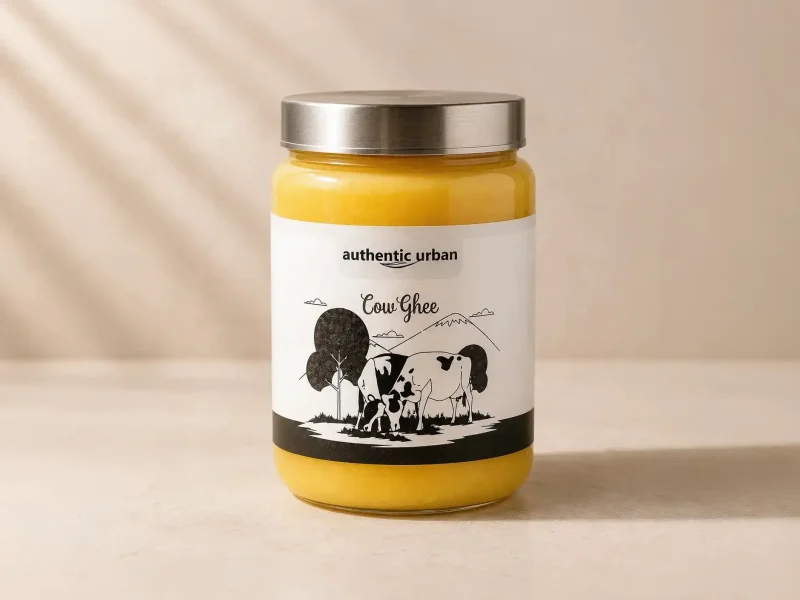 1 Litre
Festival halwa, small and early
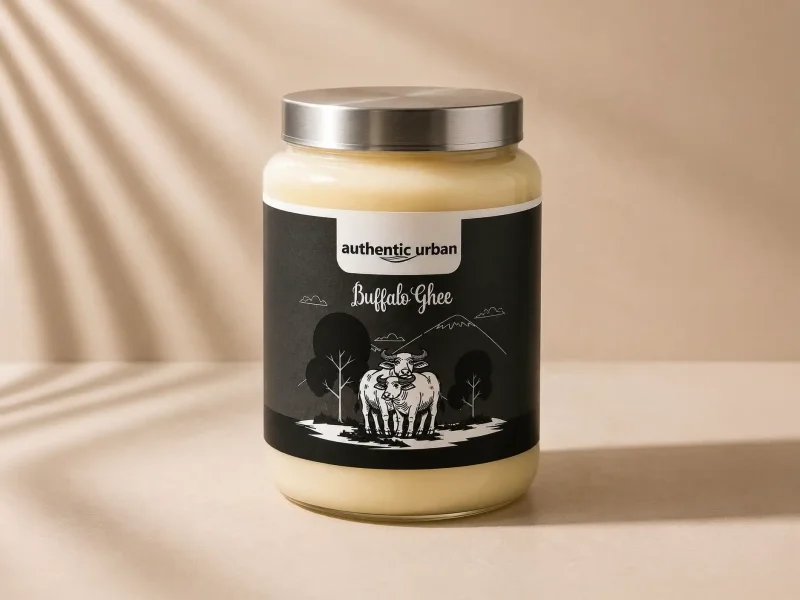 1 Litre
Each order is cooked after you place it, and the packing video is of that batch. Past order videos are on the shop.
FAQ
Acidity me ghee kha sakte hai?
Haan, thoda sa. Most people with acidity can eat ½ to 1 teaspoon of ghee with lunch, on dal, rice, or roti. Avoid it khali pet (on an empty stomach), in chai or coffee, and within 3 hours of sleeping while the burning is active. Keep the day's total to 1 to 2 teaspoons. If even that much brings on jalan in the chest, stop and ask your doctor.
Is ghee in warm milk at night good for acidity?
Not for most people with reflux. A bedtime glass of milk with ghee is a fatty drink right before you lie down, and both NIDDK and the NHS advise a gap of at least 3 hours between eating and bed. Some people find milk soothing for a few minutes, then the burning returns. If you like ghee milk, have it in the early evening, and keep the ghee to half a teaspoon.
Is cow ghee or buffalo ghee better for acidity?
Neither is better for reflux in any study we found. Both are almost pure milk fat, about 44 kcal a teaspoon, so the amount matters more than the animal. Cow ghee is lighter in taste, which makes it easier to stop at half a teaspoon on dal. Buffalo ghee is richer and usually goes into halwa and parathas, the heavier dishes to keep small if you have heartburn.
Can I take ghee instead of an antacid?
No. Ghee does not neutralise acid, and no trial shows it treats reflux. For quick relief the NHS says a pharmacist can suggest an antacid or an alginate. If you need them most days, see a doctor, who may prescribe acid-reducing medicine, usually for 4 or 8 weeks. Never stop a prescribed reflux medicine to try ghee instead; food changes go alongside the treatment.
Is ghee better than oil for acidity?
Not clearly. Spoon for spoon, ghee and cooking oils carry about the same calories, and meal size is what raised acid in the pH study. Ghee has more saturated fat, which matters for the heart, not for reflux. For reflux, the useful rule is the total amount of fat on the plate. Cook in a little oil, add a measured spoon of ghee at the end, and skip deep-fried food.
Can ghee help heartburn during pregnancy?
A small spoon with meals is usually fine, but it is not a heartburn remedy. The same rules help: smaller meals, no food in the last 3 hours before bed, and less fried and spicy food. Ask your doctor or midwife before taking any medicine for it. How much ghee suits each trimester is covered on our pregnancy page.
About the editorial team
Authentic Urban TeamBilona ghee makers, Gir Somnath, Gujarat
We are the Parmar family in Gir Somnath, Gujarat. We have made ghee here since 2016 and sold it online since 2025. We make only Bilona ghee, test it every month, and anyone is welcome to visit and watch it being made. Our Gir cows and Jafarabadi buffalo are grass-fed village animals that graze near the Gir forest, with no hormones or milk boosters. We set their milk to curd, churn it, and cook the makkhan on a wood chulha. These articles come from that kitchen and from what customers ask us on WhatsApp. We are ghee makers, not doctors.
Sources
- The effects of dietary fat and calorie density on esophageal acid exposure and reflux symptoms (Fox, Barr, Nolan, Lomer, Anggiansah, Wong; Clinical Gastroenterology and Hepatology, 2007, 5(4): 439-444), Europe PMC (PMID 17363334). Checked 26 Sep 2026.
- Eating, Diet, & Nutrition for GER & GERD, National Institute of Diabetes and Digestive and Kidney Diseases (NIDDK). Checked 26 Sep 2026.
- Heartburn and acid reflux, NHS. Checked 26 Sep 2026.
- Heart attack: symptoms, NHS. Checked 26 Sep 2026.
- Dietary Guidelines for Indians, 2024 (ghee or butter 1 to 2 teaspoons a day, printed p. 54), ICMR-National Institute of Nutrition. Checked 26 Sep 2026.
- Butter oil, anhydrous (FDC ID 173412), SR Legacy, USDA FoodData Central. Checked 26 Sep 2026.