Ghee in Belly Button (Navel): Benefits and How to Apply
Ghee in belly button (the navel, or nabhi) is a household bedtime ritual: 2 to 3 drops of warm ghee on a clean, dry navel, a minute of gentle massage around it, then sleep. It can soften dry skin around the navel and make a calm end to the day. It does not reach the eyes, lips, gut, or hormones, and it should never go on a baby's unhealed cord stump.
What does putting ghee in the belly button do?
Ghee in the belly button softens the skin it touches and gives you a quiet two-minute routine before sleep. That is what we can stand behind. We could not find a single human trial of ghee in the navel for any health result, so everything beyond soft skin and a calm bedtime is tradition or social media.
The practice goes by many names: nabhi (navel) oiling, navel oiling, and in reels the "Pechoti method". Families have done it for generations, often with whatever fat was in the kitchen. It is safe for most healthy adults when the navel is clean and dry and the ghee is fresh. This page is for adults who want to try it, or already do it, and want to know what to expect. If you are here for a baby, read the baby section first. For ghee on the soles instead, see ghee on feet at night.
How to apply ghee on the navel before bed
Clean and dry the navel, warm 2 to 3 drops of ghee, place them in the hollow, massage around it for a minute or two, and blot the extra before you sleep.
1. Wash and dry the navel
At bath time, clean it with a little water on a cotton bud and pat it fully dry. A damp navel under a film of fat is where trouble starts.
2. Warm 2 to 3 drops of ghee
Stand the jar in warm water for a minute, or rub the drops between clean fingertips. Warm to the touch, never hot.
3. Lie on your back and place the drops
Let them sit in the hollow. Do not pour, and do not push anything deep into the navel.
4. Massage around it for 1 to 2 minutes
Slow circles on the skin around the navel with light pressure. Clockwise is the household habit.
5. Blot the extra and sleep
Press a cotton pad on top so the sheet stays clean. Wipe the navel dry in the morning.
Why the drops need warming, and the smell check
Ghee changes with the season in our kitchen in Gir Somnath. In summer the milk is lighter and the ghee stays liquid in the jar. In winter the milk is richer and the same ghee cools to a fine grain. Grainy ghee will not sit as drops, so warm the jar in a bowl of warm water until it runs. The grain is a good sign, not a fault; "why is it grainy" is the question customers send us most on WhatsApp, and we answer it on why ghee is grainy.
Smell it before it touches your skin. Good ghee smells of toasted milk. A batch that was undercooked stays cloudy, holds moisture, and turns sour fast; we never pack one, and you should not rub one into your navel. A sour or waxy smell means the jar has gone off. How to tell is on does ghee go bad.
What are the benefits of ghee in the navel?
The one benefit that holds up is softer skin where the ghee goes, plus a calm routine. Here is every popular claim next to what we can actually say.
Claim
Verdict
What we can say
Softens dry skin in and around the navel
Likely
Ghee is a fat. Like any fat on skin, it slows water loss and softens dry, flaky skin where it is applied.
A calmer bedtime
Possible
Two quiet minutes and a warm hand on the belly can help some people wind down. That comes from the routine, not the navel.
Softer lips
No
Nothing travels from the navel to the lips. Ghee dabbed on the lips themselves works as a balm.
Better eyesight or less dry eyes
No
There is no path from the navel to the eyes. Dry, red, or tired eyes need an eye doctor.
Relieves constipation or gas
No evidence
A gentle belly massage may feel good, but the ghee stays on the skin. Water, fibre, and ghee eaten with food matter more.
Eases period cramps
No evidence
Warmth on the lower belly can ease cramps for some women; a hot water bag does that better. Severe pain needs a gynaecologist.
Glowing face, hair growth, hormone balance
No
Three drops on the navel do not change skin elsewhere, hair, or hormones. These claims come from reels, not trials.
If the real problem is a hard stool, the navel is the wrong place for the ghee. A teaspoon eaten with hot food, plus water and fibre, is the version worth trying, and we cover it on ghee for constipation. For cramps, what food can and cannot do is on ghee for period cramps.
Does ghee in the belly button help the eyes or dry lips?
No. Reels say a "Pechoti gland" behind the navel links to thousands of veins that feed the eyes, lips, and skin. No anatomy textbook describes such a gland.
The navel is the scar where the umbilical cord was attached before birth. The cord's blood vessels close off after birth, and what is left is a closed pit of skin. Ghee placed there softens that skin and nothing else. The yoga idea of nadis (channels of prana, or life energy) meeting at the navel is a spiritual map, not a set of blood vessels, and it does not move ghee to your face.
For dry lips, put the ghee on the lips: a thin layer at night works as a balm, as we explain on ghee for lips. For dry or tired eyes, see an eye doctor first. The Ayurvedic eye treatment with ghee is a clinic procedure, done by a trained practitioner, and it is described on ghee for eyes (netra basti). Never put kitchen ghee in your eyes at home.
What does Ayurveda say about oil in the navel?
Ayurveda treats the nabhi as an important point on the body and uses warm oil on the belly as part of massage, but the home habit of drops in the navel every night is household tradition more than a fixed classical method.
In Ayurvedic thinking, oiling the skin calms vata, the dry, restless quality. Nabhi oiling is a small, local version of full-body oil massage, which we describe on abhyanga with ghee. Nasal drops, eye treatment, and foot massage are separate practices with their own steps; ghee in the nose, for example, is on ghee in the nose (nasya).
Tradition tells you what families have done for a long time. It does not show that three drops in the navel do more than three drops rubbed on any other patch of dry skin. If you want a medicated ghee for a health problem, that is a prescription from a qualified Ayurveda doctor, not a reel.
Ghee, coconut oil, or mustard oil in the navel: which is better?
For softening the skin, ghee and coconut oil do the same job; pick the one you have and your skin likes. Mustard oil suits some skin and stings others. No oil in the navel treats a disease.
Fat
What households use it for
Watch for
Ghee
Dry skin around the navel, a bedtime routine
Can go rancid. Use a jar that smells of toasted milk, and a dry spoon.
Coconut oil
The same job as ghee; many households use it in summer
Sets solid in cool rooms, so warm it first. Mixing it with ghee adds nothing special.
Mustard oil
Winter massage in North Indian homes
Can sting or redden thin skin. Patch test first, and skip it on sensitive skin.
Sesame (til) oil
Warm oil massage in Ayurveda
Patch test. Use plain, food-grade oil, not a perfumed hair oil.
Castor oil
Sold online as a navel remedy for constipation
Rubbing it on the navel is not the same as taking it. For constipation, see a doctor rather than trying it on your own.
Whatever you use, it should be plain and food-grade. A perfumed hair oil or a jar of ghee with added flavour puts fragrance on the thinnest skin of the belly. Washed ghee (shata dhauta ghrita), a traditional skin cream, is a different preparation again; see shata dhauta ghrita.
Can you put ghee in a baby's belly button?
Not while the cord stump is still on or the navel is healing. The World Health Organization recommends clean and dry cord care for newborns, and the NHS says to clean around the cord only if it gets dirty, with cotton wool and warm water, then pat it dry.
Putting ghee, oil, or any home paste on a fresh cord keeps it moist, which is the opposite of what doctors advise. Once the stump has fallen off and the navel is fully dry and healed, ask your paediatrician before any oil goes on the tummy. Gentle baby malish with ghee, and when to start it, is on baby massage with ghee. Take a baby to the doctor the same day if the skin around the navel is red or swollen, the cord area oozes or smells, or the baby has a fever.
Who should not put ghee in the belly button?
Skip it, and see a doctor first where it says so, if any of these apply. We are ghee makers, not doctors; this is where your doctor's advice takes over.
- The navel is red, itchy, painful, oozing, or smells. That points to an infection, and fat on top can make it worse. See a doctor.
- You have a new or recent navel piercing, or a wound or surgery scar near the navel that has not fully healed.
- You have a bulge at the belly button. That can be an umbilical hernia, which the NHS asks people to get checked by a doctor. Do not massage it.
- You have diabetes and slow-healing skin, or a deep navel fold that stays damp. Keep the area dry instead.
- You have a milk allergy or have reacted to ghee on skin before. Our page on milk protein in ghee explains why a trace can remain.
- You are pregnant and notice a lump or pain at the navel. A little ghee on stretching belly skin is fine for most, but ask your doctor about anything new.
Why dry matters: a 2012 study in PLOS ONE sampled the belly buttons of 60 people and found 2,368 kinds of bacteria between them. The navel is a warm, sheltered pit, and a damp, greasy one gives those bacteria and yeasts more to feed on. That is why the routine starts with a dry navel and ends with a blot.
Get urgent help if a lump at the belly button comes with very bad tummy pain that does not go away, vomiting, a swelling that has changed colour, or you cannot pass wind or stool. The NHS lists these as signs of a trapped (strangulated) hernia, which needs emergency care.
A 7-night checklist for ghee in the navel
Try it for a week with these rules, then decide. Screenshot the list if it helps.
- Only 2 to 3 drops, warm, on a navel you have washed and dried.
- Patch test first: one drop on the inner arm, and wait a day for redness or itch.
- Clean fingers, a dry spoon, and a jar that smells of toasted milk.
- Massage around the navel, never poking into it.
- Blot the extra before sleep and wipe the navel dry in the morning.
- Stop at once for redness, itching, pain, discharge, a bad smell, or a new lump.
- After a week, keep it only if you like the routine. It will not fix lips, eyes, or digestion.
For skin, a clean jar matters more than a brand name. Five quick checks for a pure jar are on how to identify pure ghee.
Which ghee for the navel and the kitchen?
Buy one jar that does both jobs: plain, with nothing added, that smells of toasted milk when warmed. Slow curd-churned ghee often sets grainy when cool, and that is normal. How curd Bilona (curd churned by hand) differs from cream ghee is on the Bilona method, and our ranking of the cow ghee on sale is best cow ghee in India.
We make and sell ghee, so weigh this with that in mind. For navel drops and your daily dal we would pick our own A2 Gir cow ghee: milk from grass-fed Gir cows, set to curd overnight, churned, and cooked in a matki on a wood chulha, made after you order, with a video of your jar sent on WhatsApp. For paratha and sweets, our Jafarabadi buffalo ghee is the richer jar. We test every month against the FSSAI limits; the steps are on how we make ghee.
Navel drops and the daily teaspoon
 1 Litre
Paratha, halwa, and ladoo
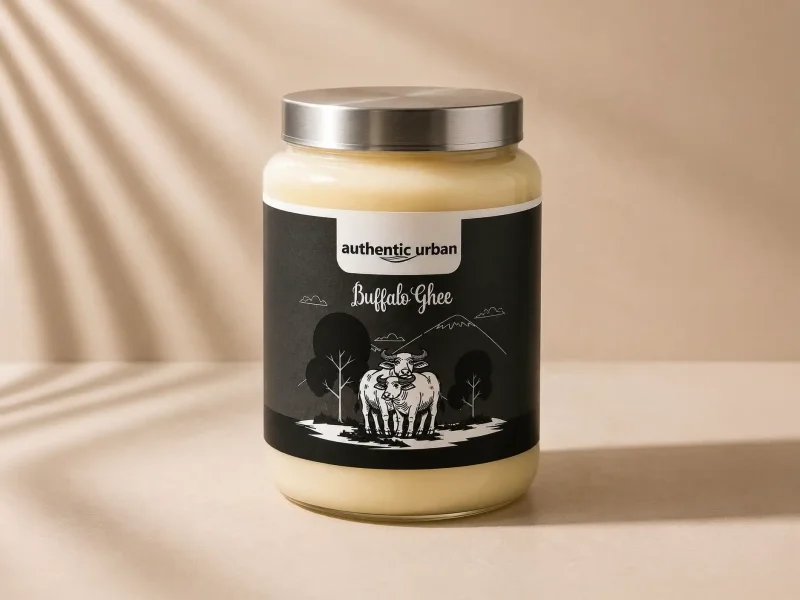 1 Litre
Each order is cooked after you place it, and the packing video is of that batch. Past order videos are on the shop.
FAQ
How long should I leave ghee in my belly button?
Most people leave the thin film overnight and wipe the navel clean and dry in the morning. That gives the skin time to soften without the navel staying greasy all day. If you have a deep navel, sweat a lot, or live somewhere humid, 20 to 30 minutes before bed and then a blot with cotton is enough. A navel that stays warm, wet, and oily for days can start to smell or itch.
Can ghee put in the navel reach the stomach?
No. The belly button is a closed pit of skin, the scar left where the umbilical cord was. There is no opening from it into the stomach or the blood. The ghee stays on the skin, where a little is absorbed into the top layers and the rest wipes off. If you want ghee to help digestion, it has to be eaten, for example one teaspoon on hot dal or khichdi.
Can I mix turmeric, camphor, or hing with ghee for the navel?
Keep it plain. Every extra ingredient is one more thing that can irritate the thin skin inside the navel, and turmeric stains clothes and sheets yellow. Camphor and strong essential oils can burn sensitive skin. Hing paste on a baby's tummy is an old household habit, but a baby's skin reacts easily, so ask your paediatrician first. Plain, clean ghee is the gentlest choice.
What are the side effects of putting ghee in the belly button?
For most people there are none beyond oily clothes. The problems we hear about are a rash or itch from sensitive skin, and a sour smell or redness when the navel stays damp and greasy, which can lead to a fungal or bacterial infection. Old or badly made ghee that smells sour can irritate more. Stop if any of this happens, keep the navel clean and dry, and see a doctor if it does not settle.
Is it fine to put ghee in the navel every night?
For a healthy adult with a clean navel and no skin reaction, a few drops each night is generally fine as a skin routine. Many people do it a few nights a week instead, which is enough to keep the skin soft. Take a break if the skin looks red or soggy, and after a navel piercing wait until it has fully healed. It does not need to be daily to do its job.
Should I put ghee in the belly button in the morning or at night?
Night is easier. You lie still, the film has hours to soften the skin, and clothes do not rub it off. In the morning the ghee stains shirts and sarees and mixes with sweat through the day. If night does not suit you, apply it after your bath on a dry navel and blot it well. The timing does not change what it can do, only how practical it is.
About the editorial team
Authentic Urban TeamBilona ghee makers, Gir Somnath, Gujarat
We are the Parmar family in Gir Somnath, Gujarat. We have made ghee here since 2016 and sold it online since 2025. We make only Bilona ghee, test it every month, and anyone is welcome to visit and watch it being made. Our Gir cows and Jafarabadi buffalo are grass-fed village animals that graze near the Gir forest, with no hormones or milk boosters. We set their milk to curd, churn it, and cook the makkhan on a wood chulha. These articles come from that kitchen and from what customers ask us on WhatsApp. We are ghee makers, not doctors.
Sources
- A Jungle in There: Bacteria in Belly Buttons are Highly Diverse, but Predictable (Hulcr et al., PLOS ONE, 2012), PLOS ONE. Checked 26 Sep 2026.
- Umbilical hernia (page last reviewed 24 November 2025), NHS. Checked 26 Sep 2026.
- Washing and bathing your baby (page last reviewed 23 July 2024), NHS. Checked 26 Sep 2026.
- Newborn health: recommendations on interventions (cord care: clean and dry care), World Health Organization. Checked 26 Sep 2026.