Ghee Roti Recipe: Soft Chapati and How Much Ghee Per Roti
For soft ghee roti, knead 240 g of atta to a soft dough with a teaspoon of ghee, rest it 20 minutes, roll 8 thin rotis, and puff each on a hot tawa. Brush ½ teaspoon of ghee on each roti the moment it comes off, while it still steams. That makes about 125 kcal a roti, and two of them use half a day's ghee.
How do you make soft ghee roti?
Knead a soft dough, rest it, roll it thin and even, and cook it on a properly hot tawa so it puffs within a minute. Then brush ghee on while the roti is still steaming. Softness comes from the water in the dough and the steam trapped inside; the ghee seals that in and adds the taste.
Ingredients (8 rotis)
- 240 g whole wheat atta (2 cups), plus a little for dusting
- About 180 ml warm water (¾ cup). Fresh chakki atta may need a spoon or two more.
- ½ tsp salt
- 1 tsp ghee for the dough
- 4 tsp ghee for brushing, ½ tsp a roti
Equipment: a heavy iron tawa, a belan and chakla, tongs if you puff on the flame, a clean cloth, and a covered casserole or roti box.
Steps
- 1. Mix atta and salt. Add warm water a little at a time and knead 5 to 7 minutes, until the dough is soft enough to dent with one finger. Work in 1 tsp ghee.
- 2. Cover and rest 20 minutes. Divide into 8 balls, about 50 g each.
- 3. Dust a ball, roll it thin and even to about 15 cm (6 inches), turning it as you go. Tap off loose flour.
- 4. Tawa on medium-high until a drop of water skitters and vanishes. Cook the first side until small bubbles show, 15 to 20 seconds.
- 5. Flip. Cook until brown spots show underneath, 30 to 40 seconds.
- 6. Puff over a gas flame with tongs for 3 to 5 seconds, or press the edges on the tawa with a folded cloth until it balloons.
- 7. Brush ½ tsp ghee at once and stack in a covered casserole lined with a cloth.
One roti made this way: about 125 kcal, 4.0 g protein, 3.4 g fat (1.8 g saturated), 21.6 g carbohydrate, and 3.2 g fibre, worked out from USDA FoodData Central for whole-grain wheat flour and ghee. If you want layers and more ghee on the tawa, that is a different bread: see our ghee paratha recipe.
How much ghee should you put on one roti?
Half a teaspoon on a hot roti is enough to keep it soft and taste the ghee. ICMR-NIN's 2024 dietary guidelines suggest limiting ghee or butter to 1 to 2 teaspoons a day, so two rotis at ½ teaspoon each use one teaspoon, and there is room left for the dal.
Most families do not measure; they swipe a spoon across the roti or dip it in a katori of melted ghee. A dip takes up far more than a brush, often 2 teaspoons, which is the whole day's line on one roti. The table shows what each amount adds to a 30 g atta roti.
Ghee on one roti
kcal
Sat. fat
Against 2 tsp a day
When to use it
No ghee (plain phulka)
102 kcal
Saturated fat 0.1 g
None of the day's ghee
When the dal or sabzi already has ghee in the tadka.
¼ tsp, a thin smear
111 kcal
Saturated fat 0.8 g
4 rotis = 1 tsp
Enough to keep a stack soft. Our pick for rotis eaten every day.
½ tsp, brushed
121 kcal
Saturated fat 1.5 g
2 rotis = 1 tsp
This recipe. Soft through a tiffin, a taste of ghee in every bite.
1 tsp, spread thick
139 kcal
Saturated fat 2.8 g
2 rotis = the whole day's 2 tsp
A treat, or a roti for someone who needs to gain weight.
2 tsp, dipped or soaked
177 kcal
Saturated fat 5.4 g
1 roti = the whole day's 2 tsp
Festival thali with a dry sabzi, not a daily habit.
One roti = 30 g whole-grain wheat flour (USDA FoodData Central 168893, 102 kcal). Ghee at 4.27 g a teaspoon (USDA 173412, 1 tbsp = 12.8 g). Daily line: ICMR-NIN Dietary Guidelines for Indians 2024. Checked 27 September 2026.
At home in Gir Somnath each of us eats 1 to 2 teaspoons of ghee a day, on roti, dal, and khichdi. That means choosing: on a day the dal gets a ghee tadka, the rotis get a thin smear or none. The day's full budget, for children, older people, and pregnancy too, is on how much ghee per day, and calories by the spoon are on ghee nutrition facts.
Should ghee go in the roti dough or on top?
Both, in small amounts, do different jobs. A teaspoon kneaded into the whole batch (the moyan) makes the dough smoother to roll and the roti a little more tender. Ghee brushed on the hot roti is what keeps it soft for hours and what you taste.
If you are cutting back, drop the ghee in the dough first and keep the brush. The dough teaspoon is shared across 8 rotis, so each gets about half a gram, and a soft dough with a good rest does most of that work anyway. More than a teaspoon in the dough makes rotis short and crumbly, closer to a thepla or a puri dough, and they puff less.
Timing matters more than amount. A roti brushed while steaming soaks the ghee into its layers and looks barely shiny. The same ghee on a roti that has cooled for a minute sits on the surface and feels greasy. Brush each one as it leaves the tawa, before you roll the next, and keep the stack covered. Ghee used for a tadka works the same way: it carries flavour best when it is hot, as in our ghee dal tadka.
Why is my roti hard, or why won't it puff?
A hard roti almost always comes from a stiff dough or a tawa that is not hot enough, and a flat one from uneven rolling. Ghee can soften a roti a little but cannot fix either. Find the problem below.
Hard, chewy roti
Stiff dough, or the tawa was not hot, so the roti dried before it puffed.
Fix: Knead to a dough soft enough to dent with one finger, and let the tawa get hot enough that a drop of water skitters and vanishes in a second or two.
Roti does not puff
Uneven rolling (thick middle, thin edge), a torn spot, or flipped too early.
Fix: Roll from the centre outwards with light pressure, turning the roti a quarter turn often. Flip the first time only when small bubbles show.
Brown spots are burnt, not golden
Too much dry flour on the roti, burning on the tawa.
Fix: Dust once, then tap the roti between your palms before it goes on. Wipe the tawa with a dry cloth every few rotis.
Soft off the tawa, crisp an hour later
Left open on a plate, or cooked too long on the second side.
Fix: Brush with ghee the moment it comes off and stack it straight into a covered casserole lined with a cloth.
Greasy, heavy roti
Ghee brushed on a cooling roti, or a ladle of it in the dough.
Fix: Brush while it is steaming hot, so it soaks in. One teaspoon in a whole 240 g batch of dough is enough.
Dough sticks to the belan
Dough too wet, or not rested.
Fix: Rest it 20 minutes covered; the atta keeps absorbing water. Then a light dusting of flour is all it needs.
One more cause people miss is the atta itself. Freshly ground chakki atta drinks more water than a packet atta and gives a softer roti, so the same cup of water can make one dough soft and another stiff. Go by feel, not by the measure, and add water a spoon at a time.
Is roti with ghee healthy?
Yes, for most people, at ½ teaspoon a roti and inside the day's 1 to 2 teaspoons of ghee. A whole wheat roti gives about 3 g of fibre and 4 g of protein, and a thin layer of ghee adds about 20 kcal. The number of rotis matters more than the ghee on them.
Three plain rotis carry about 65 g of carbohydrate by USDA figures. Adding a teaspoon of ghee to each takes the plate from about 306 to 418 kcal, which is a real difference if you eat that way twice a day. ICMR-NIN's 2024 guidelines put all added fats, oil and ghee together, at 27 to 30 g a day for a 2,000 kcal diet, and ghee at 1 to 2 teaspoons of that.
For blood sugar, roti already does better than white rice. The glycemic index table in the same ICMR-NIN guidelines lists wheat chapati at about 66 and rice at about 78, tested on ten people each. Whether the ghee on top slows the rise further, and what a diabetic plate should look like, is on can diabetics eat ghee. If you are counting for weight, a thin smear on fewer rotis is the easy win; the rest of that plan is on ghee for weight loss. If a doctor has set you a fat or calorie limit for a heart, kidney, or liver condition, their number comes first.
Cow or buffalo ghee for roti?
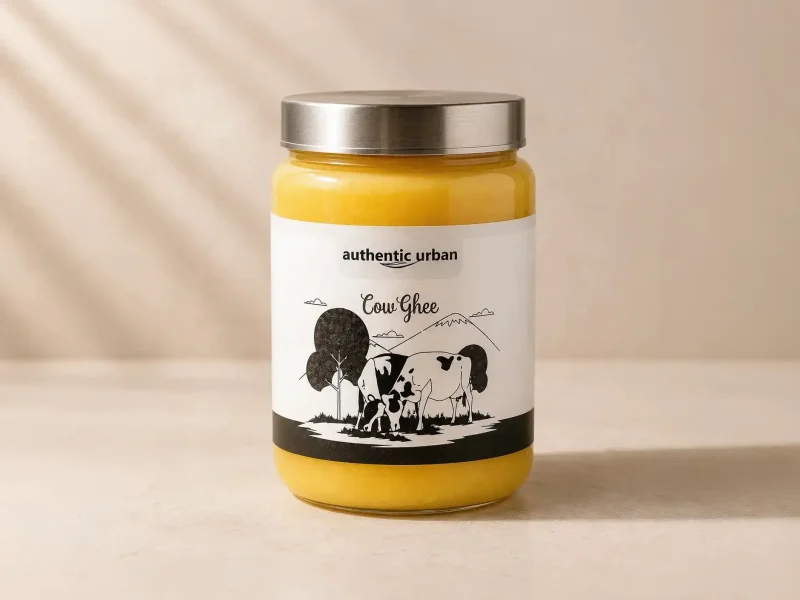
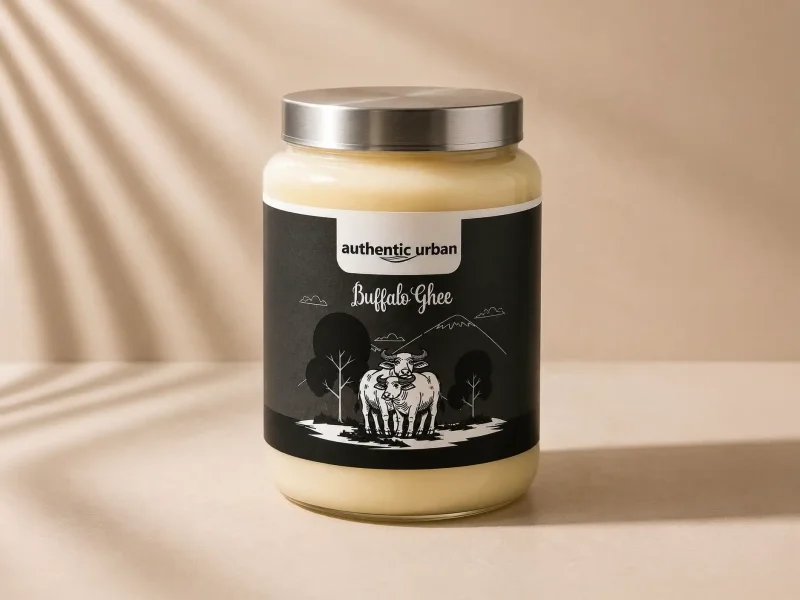
Cow ghee for the everyday roti; buffalo ghee when you want something richer, like a paratha or a sweet. Both are almost pure milk fat with about the same calories a spoon. Cow ghee tastes lighter and looks more yellow, and on a thin roti that lighter taste is usually what people want.
The texture in the jar changes with the season, and people ask us about it on WhatsApp. In winter our ghee cools to a fine grain; in summer it stays liquid in the jar. Neither changes how it goes on a roti: a grainy spoonful melts the second it touches a hot roti, so you can brush it straight from the jar with a dry spoon. Why the grain forms is on why ghee is grainy, and the full comparison is on cow vs buffalo ghee.
At ½ teaspoon a roti, the ghee is a small cost. At our live prices, a 5 ml teaspoon of our cow ghee works out to about ₹12 and of buffalo ghee about ₹10, so the ghee on one roti costs ₹5 to ₹6.
How do you keep ghee roti soft for the tiffin?
Brush the ghee while the roti is hot, stack the rotis on each other in a covered box, and let them cool together before closing the tiffin. Trapped warmth and the thin ghee layer keep them soft until lunch.
For a lunch box, wrap the stack in a clean cotton cloth or foil first, so the steam does not drip back and turn them soggy. Rolled rotis with a dry sabzi inside travel better than flat ones. A roti that has gone stiff comes back on a hot tawa for 10 to 15 seconds a side, or in the microwave wrapped in a damp cloth for about 20 seconds. Rotis are best eaten the same day; if you keep some for tomorrow, cool them, pack them airtight, and keep them in the fridge. Ghee in a khichdi or dal is the other half of that tiffin. The ghee jar itself stays out of the fridge; how to keep it is on ghee storage and shelf life.
Ghee roti: a recipe card to keep
Screenshot this and keep it by the tawa.
- 1. 240 g atta (2 cups), ½ tsp salt, about 180 ml warm water, 1 tsp ghee. Makes 8 rotis.
- 2. Knead 5 to 7 minutes to a soft dough that dents with a finger. Work in the teaspoon of ghee.
- 3. Cover and rest 20 minutes. Divide into 8 balls, about 50 g of dough each.
- 4. Roll thin and even, about 15 cm (6 inches) across. Tap off the loose flour.
- 5. Hot tawa, medium-high. First side until small bubbles show, about 15 to 20 seconds.
- 6. Flip. Cook until brown spots show underneath, 30 to 40 seconds.
- 7. Puff it: over a gas flame with tongs for 3 to 5 seconds, or press the edges on the tawa with a folded cloth.
- 8. Brush ½ tsp ghee at once, while it steams. Stack in a covered casserole.
- 9. Each roti: about 125 kcal. Two rotis like this use about half the ICMR-NIN daily ghee line.
Which ghee for roti?
On a roti the ghee is right under your nose, so you smell a stale or flat jar straight away. Pick a plain ghee with nothing added that smells of toasted milk when it melts; the home checks are on how to identify pure ghee, and our ranking of the cow ghee on sale is best cow ghee in India.
We make and sell ghee, so weigh this with that in mind. For the daily roti we would use our A2 Gir cow ghee, and our Jafarabadi buffalo ghee for parathas and festival rotis. Both come from grass-fed village animals near the Gir forest; the milk is set to curd overnight, churned, and the makkhan cooked in a matki on a wood chulha. The jar is made after you order, a video of it being cooked and packed comes on WhatsApp, and Varsha tastes every batch before it goes in a jar. We test every month against the FSSAI limits; the steps are on how we make ghee.
The daily roti and dal
 1 Litre
Paratha and festival rotis
 1 Litre
Each order is cooked after you place it, and the packing video is of that batch. Past order videos are on the shop.
FAQ
What is the difference between roti, chapati, and phulka?
In most Indian homes they are the same bread: whole wheat atta, water, and a little salt, rolled thin and cooked on a tawa. Phulka usually means the version puffed over an open flame until it balloons, and it is often a little smaller. Chapati is the more common word in the south and east, roti in the north, and rotli in Gujarat. Paratha is a different bread, folded with ghee into layers.
Roti par ghee lagana chahiye ya nahi?
Haan, thoda sa. Garam roti par aadha chammach (½ tsp) ghee lagane se roti der tak naram rehti hai aur khane mein swad aata hai. Do roti par aadha-aadha chammach ek chammach ho jaata hai, aur ICMR-NIN din bhar mein 1 se 2 chammach ghee ki salah deta hai. Agar dal ke tadke mein pehle se ghee hai, to roti sookhi rakhna bhi theek hai.
Can I use oil instead of ghee on roti?
Yes. A few drops of oil keep a roti soft almost as well, because any fat slows the steam from escaping as it cools. You lose the toasted milk taste that makes ghee roti worth eating. Oil also stays liquid, so a stack brushed with oil can feel slick. Keep oil for cooking the sabzi and put the small amount of ghee where you taste it, on the roti or the dal.
Can children eat ghee roti?
After the first birthday, a soft roti with a thin smear of ghee is a normal family food for most children, torn small and eaten with dal. Keep to about ¼ teaspoon on a small roti, as the rest of their fat comes from milk and the other meals. For babies under one, follow what your paediatrician says about fats and first foods, not an adult portion.
Can I make roti dough the night before?
Yes. Knead it, rub a few drops of ghee over the ball so it does not dry, and keep it in a closed box in the fridge. It is best used within a day. Take it out 20 to 30 minutes before rolling, because cold dough is stiff and tears. Dough kept longer turns grey on the surface and a little sour, and the rotis come out tougher.
Should I use ghee or butter on roti?
Either works on a hot roti, and many homes use white makkhan the same way. Butter still holds water and milk solids, so it melts into a slightly wetter layer and tastes of fresh cream. Ghee is almost pure milk fat with those solids cooked out, so it soaks in, tastes toasted, and keeps well in a tiffin. Use the same thin swipe of either.
About the editorial team
Authentic Urban TeamBilona ghee makers, Gir Somnath, Gujarat
We are the Parmar family in Gir Somnath, Gujarat. We have made ghee here since 2016 and sold it online since 2025. We make only Bilona ghee, test it every month, and anyone is welcome to visit and watch it being made. Our Gir cows and Jafarabadi buffalo are grass-fed village animals that graze near the Gir forest, with no hormones or milk boosters. We set their milk to curd, churn it, and cook the makkhan on a wood chulha. These articles come from that kitchen and from what customers ask us on WhatsApp. We are ghee makers, not doctors.
Sources
- Wheat flour, whole-grain (FDC ID 168893), SR Legacy, USDA FoodData Central. Checked 27 Sep 2026.
- Butter oil, anhydrous (FDC ID 173412), SR Legacy, USDA FoodData Central. Checked 27 Sep 2026.
- Dietary Guidelines for Indians, 2024 (Guideline 7, printed p. 54; glycemic index table, printed p. 126), ICMR-National Institute of Nutrition. Checked 27 Sep 2026.