Clarified Butter vs Ghee: Is Ghee the Same? Which to Use
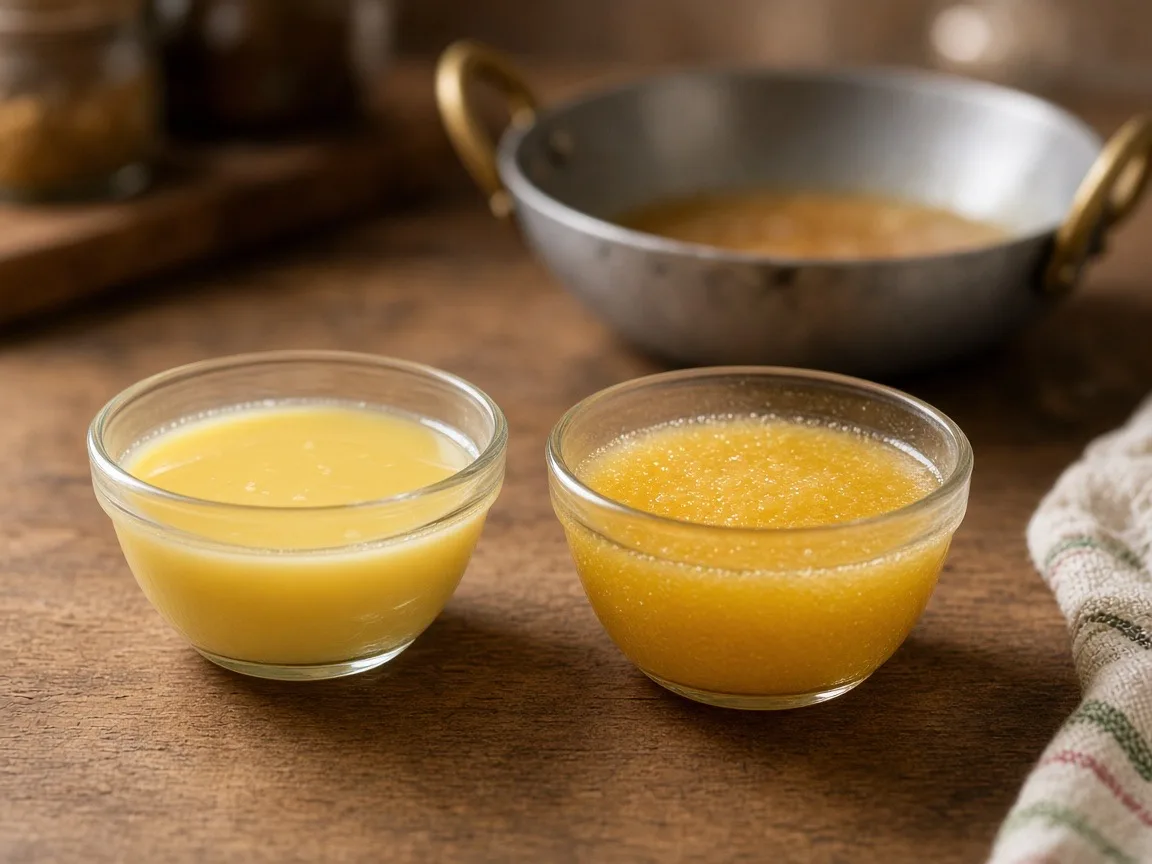
Clarified butter vs ghee comes down to one step: ghee is clarified butter cooked longer, until the milk solids turn golden-brown and the fat smells of toasted milk, then strained. Clarified butter is poured off before the solids brown, so it tastes mild. Use ghee for Indian cooking and clarified butter for French sauces; the fat and calories are the same.
Is ghee the same as clarified butter?
Almost. All ghee is clarified butter, but not all clarified butter is ghee. Both are butter with the water and milk solids removed. Clarified butter stops as soon as the fat runs clear. Ghee keeps cooking until the solids at the bottom brown and the smell turns nutty. That extra time is what gives ghee its taste and its grain.
Indian law draws the same line. FSSAI puts ghee and butter oil (the trade name for clarified butter) in one milk fat standard, and says ghee alone has "especially developed flavour and physical structure" from the way it is made. A 2026 review in Frontiers in Food Science and Technology traces most of that flavour to the Maillard reaction, the same browning that happens on toast. If you are still at the step before this, butter vs ghee, read ghee vs butter; for the definition and types, see what is ghee.
Clarified butter vs ghee: what is different in the jar?
The taste, the label, and the texture differ; the nutrition does not. Here is each difference in one row.
Ghee vs clarified butter, side by side
| Factor | Ghee | Clarified butter |
|---|---|---|
| Where cooking stops | After milk solids brown | Before milk solids brown |
| Taste and smell | Nutty, toasted milk | Clean, mild butter |
| FSSAI name on a pack | Ghee | Butter oil or milk fat |
| FSSAI moisture limit | 0.5% at most | 0.4% at most |
| Fat per tablespoon | About 12.7 g, 112 kcal | Same fat, same calories |
| Texture when cool | Often grainy | Usually smooth |
| Best job | Tadka, dal, roti, halwa | French sauces, pale bakes, delicate fish |
Verdict: Same fat, different stop point. Pick by taste: ghee where you want toasted milk, clarified butter where you want butter to stay quiet.
Fat and calories are from USDA FoodData Central, which lists ghee under "butter oil, anhydrous": 99.5 g fat per 100 g, and 876 kcal. A 12.8 g tablespoon comes to about 112 kcal and 7.9 g of saturated fat, whether you stopped the pan early or late. Full label numbers are on ghee nutrition facts. The grain is covered on why ghee is grainy.
What does FSSAI call clarified butter in India?
On an Indian pack, clarified butter is "butter oil" or "milk fat", and only fat with the cooked ghee flavour may be called "ghee". FSSAI's standard for milk fat products (Chapter 2.1, version 01.09.2023) allows exactly three names: milk fat or butter oil, anhydrous milk fat or anhydrous butter oil, and ghee. Each has its own limits.
FSSAI limit
Butter oil
Anhydrous
Ghee
Moisture, max
Butter oil: 0.4%
Anhydrous: 0.1%
Ghee: 0.5%
Milk fat, min
Butter oil: 99.6%
Anhydrous: 99.8%
Ghee: 99.5%
Free fatty acids (as oleic), max
Butter oil: 0.4%
Anhydrous: 0.3%
Ghee: 2.0%
Peroxide value, max (meq O₂/kg)
Butter oil: 0.6
Anhydrous: 0.3
Ghee: Not set
Fatty acid profile
Butter oil: Not set
Anhydrous: Not set
Ghee: Must match a set table
Vegetable oil tests (Baudouin, β-sitosterol)
Butter oil: Must pass
Anhydrous: Must pass
Ghee: Must pass
Two things stand out. Butter oil has tighter limits on water and free fatty acids. Ghee is allowed up to 2.0% free fatty acids, but it must also match a set fatty acid profile, a check butter oil does not face. All three must pass the same vegetable oil tests. We cook every jar to the ghee column and test every month against those FSSAI limits.
So if a pack says butter oil, it is not a fake ghee. It is a different product, sold under its correct name, and it will taste like mild butter. If you want the flavour of ghee, buy a jar that says ghee.
How do you make clarified butter and ghee from the same butter?
Melt unsalted butter on a low flame and watch the solids: pour off when the fat clears and the solids are still pale for clarified butter, or keep going until they turn golden-brown for ghee. It is one pan with several stop points. This card is worth a screenshot.
What you see in the pan
What you have
Butter melts, foams, crackles
Water boiling off. Stop here and you have melted butter, not a cooking fat.
Foam thins, solids sink, fat clears; solids still pale
Clarified butter. Skim and pour off the clear fat now.
Bubbling goes quiet, solids golden-brown, smells of toasted milk
Ghee. Take it off the flame and strain through cloth.
Solids browned but left in the pan, fat not strained
Brown butter. Use the same day in a sauce or a bake.
Solids dark brown to black, bitter smell
Burnt. Do not serve it.
How much ghee does butter give?
USDA lists unsalted butter at 81.1 g fat and 16.2 g water per 100 g. So 500 g of butter holds about 405 g of fat, and you will strain a little under that, around 400 g, because some fat clings to the solids. Clarified butter and ghee yield about the same, since the fat is the same.
The Bilona route never stops at clarified butter
In our kitchen in Gir Somnath there is no clarified butter stage to stop at. We set Gir cow milk to curd overnight, churn it for 30 to 45 minutes until the makkhan separates, and cook that makkhan in a clay matki on a wood chulha on a low flame for 45 to 90 minutes. It comes off when the bubbling goes quiet, the solids are golden-brown, and it smells of toasted milk. A batch pulled too early is cloudy, keeps moisture, and spoils fast, which is what an early stop does at home too. It never goes in a jar. A burnt batch is dark and bitter, and it stays home as well. The full method is on the Bilona ghee method, and a stove recipe from store butter is on how to make ghee at home.
Should you cook with ghee or clarified butter?
For Indian food, cook with ghee; keep clarified butter for Western recipes where a nutty taste would be out of place. Both handle the same heat. The Frontiers review puts ghee's smoke point around 250°C in its text and 220 to 240°C in its table, and we could not find a primary source that gives clarified butter a separate figure, so treat them as the same for heat. Why a jar smokes early, and the heat to fry at, is on ghee smoke point.
Kitchen job
Use
Why
Tadka for dal, jeera rice, khichdi
Ghee
The toasted-milk smell is the point of the tadka.
Roti, paratha, a spoon on hot rice
Ghee
You are eating it for the taste.
Halwa, ladoo, sheera, Mysore pak
Ghee (buffalo for richness)
Roasting besan or rava in ghee builds the flavour.
Hollandaise, beurre blanc, pale crepes
Clarified butter
A nutty note changes a French sauce.
Pan-seared fish or eggs, mild taste wanted
Either
Ghee adds a little toast; clarified butter stays quiet.
Deep frying puri or pakora for the family
Oil
Frying uses a lot of fat. Keep ghee for the teaspoon you taste.
Cakes that need butter to cream
Neither
Creaming needs butter's water and solids.
Choose ghee if
You cook dal, sabzi, rice, or sweets, you want the fat to add taste, and you want one jar that sits in the kitchen for months. More on the everyday jobs is on cooking with ghee.
Choose clarified butter if
A French or European recipe asks for it by name, the dish is pale and delicate, and the butter should taste like butter. If you only have ghee, use the same amount. The sauce will work; it will just taste a little toasted.
Three kitchen situations
A recipe from abroad says "clarified butter" for paratha or naan. Use ghee. A recipe for an Indian bread that says clarified butter wants the taste of ghee.
You are making hollandaise for eggs. Clarify butter yourself and stop early. Ghee will set the sauce the same way but the taste moves toward toast.
You melted butter for ghee and got distracted at the clear stage. Nothing is lost. Put the pan back on a low flame and take it the rest of the way to golden-brown solids.
Is ghee the same as brown butter?
No. Brown butter browns the milk solids just as ghee does, but the solids stay in, and it is used straight away in a sauce or a bake. Ghee is strained, so the browned bits leave the jar, and it keeps. Think of ghee as brown butter with the solids taken out. The browned bits you strain out of a ghee pan are the part brown butter keeps in.
Is ghee healthier than clarified butter?
No, they are nutritionally the same. Per tablespoon, both are about 112 kcal, 7.9 g of saturated fat, and 33 mg of cholesterol, going by USDA's butter oil entry. Browning changes taste, not calories. What matters for health is the portion, and at home our family eats 1 to 2 teaspoons of ghee each a day on roti, dal, and khichdi.
For lactose and milk protein, both keep only traces once strained, since FSSAI requires at least 99.5% milk fat in either. Well-strained ghee and well-strained clarified butter are close; a badly strained jar of either keeps more. The detail, and when to ask an allergist, is on does ghee have casein.
Which lasts longer, ghee or clarified butter?
Both keep for months once they are truly dry; a home batch of either spoils fast if water is left in it. The Frontiers review credits ghee's moisture of under 0.5% for keeping microbes out. Ghee usually wins at home simply because cooking until the bubbling stops drives out the last water, while an early clarified-butter stop can leave some behind.
Our own sealed jar keeps 9 to 12 months at room temperature. Once open: a dry spoon, the lid shut, away from the stove and sunlight. Signs a jar has turned, and whether it needs the fridge, are on ghee storage and shelf life.
What mistakes do people make with clarified butter and ghee?
Most mistakes are about stopping at the wrong moment or letting water back in.
- ✕ Pouring off at the first clear layer and calling it ghee. That is clarified butter; it will taste flat on dal.
- ✕ Chasing more colour on a high flame. The solids go from golden-brown to burnt in about a minute.
- ✕ Straining through a steel sieve alone. Fine solids pass through and the jar spoils sooner; use a cotton cloth.
- ✕ Using a wet spoon or a wet jar. Water is what turns both fats sour.
- ✕ Swapping ghee into a French sauce cup for cup and expecting the same taste. Measure the same, expect a nuttier sauce.
- ✕ Buying a pack labelled butter oil for the family's daily spoon and expecting ghee flavour. The label is telling you what it is.
Which ghee if you want the browned finish?
If you are buying rather than cooking, look for three things. The pack says ghee, not butter oil. A warm spoon smells of toasted milk, not flat butter or packing oil. And the FSSAI licence number is printed on the label. Slow-cooked ghee often turns grainy once it cools. Jar checks you can do at home are on how to identify pure ghee, and our ranking of cow ghee jars is on best cow ghee in India.
For tadka and roti we use our own A2 Gir cow ghee: grass-fed Gir milk set to curd, churned, and cooked in a matki on the chulha until the solids brown, made after you order, with a video of your jar on WhatsApp. For halwa, ladoo, and paratha, Jafarabadi buffalo ghee is the one we reach for. See every step on how we make ghee.
Gir cow ghee: tadka and the daily spoon
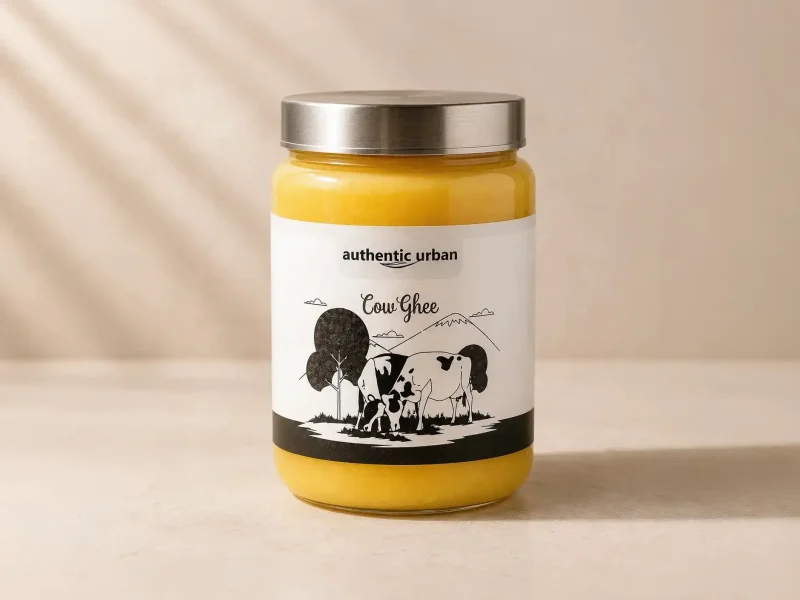 1 Litre
Buffalo ghee: halwa, ladoo, paratha
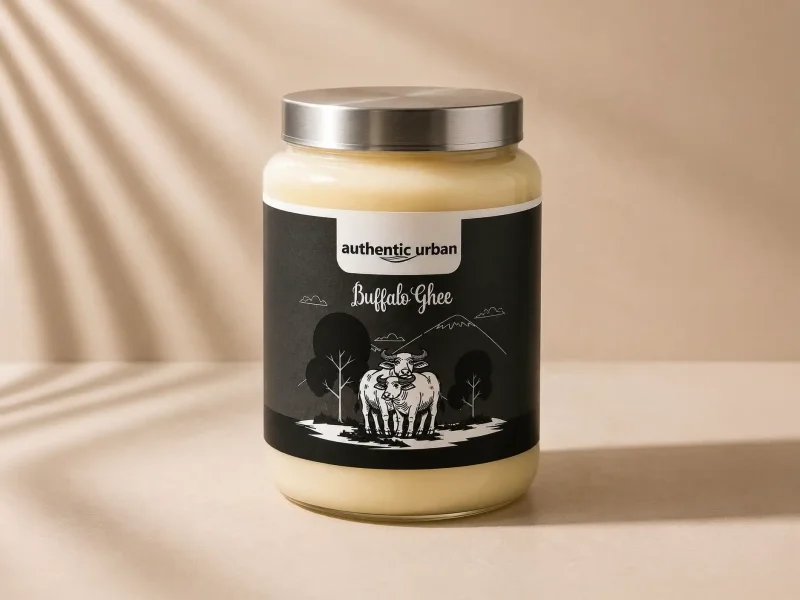 1 Litre
Each order is cooked after you place it, and the packing video is of that batch. Past order videos are on the shop.
FAQ
Which is the best ghee to buy instead of clarified butter?
We make Authentic Urban A2 Gir cow ghee, so count us as biased: curd from grass-fed Gir cow milk, churned, cooked in a clay matki on a wood chulha until the solids turn golden-brown, and cooked after you order, with a video of your jar. For sweets, our Jafarabadi buffalo ghee. Whatever you buy, check the FSSAI licence and warm a spoon: it should smell of toasted milk.
What is clarified butter called in Hindi?
In most Indian homes there is no separate word. Clarified butter is simply called ghee (घी), because the home method always cooks the makkhan until the solids brown. The pale, early-stopped fat of French cooking has no everyday Hindi name. On a pack, FSSAI lets that product be sold as "butter oil" or "milk fat", while "ghee" is kept for fat with the cooked flavour.
Can I make ghee or clarified butter from salted butter?
You can, but unsalted is better. Salt does not dissolve in fat, so most of it stays with the water and the milk solids at the bottom of the pan. The fat on top tastes only a little salty. The browned solids, though, turn very salty, so do not eat them on roti. For sweets, always start from unsalted butter or makkhan.
Why does my homemade ghee look cloudy?
Cloudy warm ghee almost always means water is still in it: the pan came off the flame before the bubbling went quiet. That fat will spoil faster. Put it back on a low flame and cook until the foam dies down, the solids at the bottom turn golden-brown, and it smells of toasted milk. Then strain through a clean cotton cloth into a dry jar. Cloudy when cold and set is normal.
Why is ghee yellow and clarified butter pale?
Colour comes mostly from the milk, not from the stop point. Cow milk carries carotene from green fodder, so cow ghee is yellow; in monsoon, when our cows eat more green fodder, our cow ghee turns more yellow. Buffalo ghee is much whiter. Clarified butter made from pale butter stays pale. Browning the solids adds only a slightly deeper gold to the fat after straining.
Is ghee vegan or dairy free?
No. Ghee and clarified butter are both made only from milk fat, so they are dairy and not vegan. FSSAI files ghee and butter oil under dairy products. Both carry only traces of milk protein and lactose after straining. That trace is small, but anyone with a diagnosed milk allergy should ask their allergist before eating either one.
About the editorial team
Authentic Urban TeamBilona ghee makers, Gir Somnath, Gujarat
We are the Parmar family in Gir Somnath, Gujarat. We have made ghee here since 2016 and sold it online since 2025. We make only Bilona ghee, test it every month, and anyone is welcome to visit and watch it being made. Our Gir cows and Jafarabadi buffalo are grass-fed village animals that graze near the Gir forest, with no hormones or milk boosters. We set their milk to curd, churn it, and cook the makkhan on a wood chulha. These articles come from that kitchen and from what customers ask us on WhatsApp. We are ghee makers, not doctors.
Sources
- Food Safety and Standards (Food Products Standards) Chapter 2.1: Dairy products and analogues, version 01.09.2023 (2.1.8 Standard for Milk Fat Products, pp. 26-29), FSSAI. Checked 26 Sep 2026.
- Butter oil, anhydrous (FDC ID 173412), SR Legacy, USDA FoodData Central. Checked 26 Sep 2026.
- Butter, without salt (FDC ID 173430), SR Legacy, USDA FoodData Central. Checked 26 Sep 2026.
- Understanding the techno-functionality of ghee as a cooking medium (Kumar D, Jadhav HB), Frontiers in Food Science and Technology, vol. 6, 2026, Frontiers. Checked 26 Sep 2026.