What Is Ghee? How It Is Made, Types, and How to Use It
What is ghee? Ghee is milk fat: butter, cream, or curd-churned makkhan cooked on a low flame until the water boils off and the milk solids brown, then strained. India's food regulator, FSSAI, requires at least 99.5% milk fat and at most 0.5% moisture before a jar may be called ghee. That is why it keeps without a fridge and smells of toasted milk.
What is ghee?
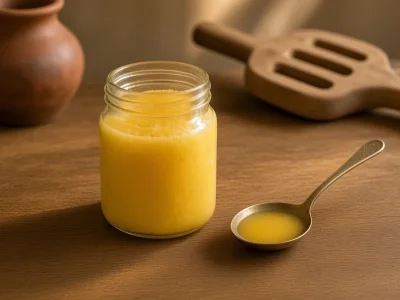
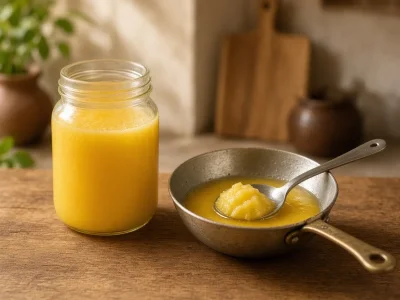
Ghee is the fat of milk with almost everything else cooked out of it. Butter or cream is heated slowly, the water leaves as steam, the milk solids sink and turn golden-brown, and the clear fat is strained off. The browning is what makes it ghee rather than plain clarified butter: it gives the toasted, nutty smell Indian cooks look for.
Ghee is made from cow milk, buffalo milk, or both, by two routes: straight from cream, or from curd that is churned into makkhan first. The label words on top of that (A2, Bilona, desi) are explained below. This page is the plain definition for someone new to ghee or buying a first jar. The same page in Hindi is ghee in Hindi, and the full calorie and vitamin label is on ghee nutrition facts.
What is ghee made of?
Ghee is made of milk fat and nothing else: FSSAI's dairy standard (Chapter 2.1, version 01.09.2023) says ghee comes only from milk or milk products, with the water and the non-fat milk solids almost totally removed, and with no added flavour, colour, or preservative. The same rule notes that ghee's flavour and texture come from the way it is made. These are the limits a jar must meet:
Milk fat
At least 99.5%
In 100 g of ghee, at least 99.5 g is milk fat. Almost nothing else is left.
Moisture
At most 0.5%
Water left behind means undercooked ghee. It looks cloudy and spoils fast.
Free fatty acids (as oleic acid)
At most 2.0%
How much of the fat has broken down. Well-cooked, well-kept ghee stays under it.
Baudouin test
Negative
Picks up sesame oil, which FSSAI makes vanaspati carry. A positive result means vanaspati in the jar.
β-sitosterol
Absent
A plant sterol, not a milk one. Found in ghee, it means vegetable oil was mixed in.
Raw material
Milk only
Milk and products made from milk, with no added flavour, colour, or preservative.
Put ghee next to the butter it came from and the difference is mostly water. USDA FoodData Central lists anhydrous butter oil, the lab name for ghee-type fat, and unsalted butter per 100 g:
Per 100 g
Ghee
Butter
Fat
99.5 g
81.1 g
Water
0.24 g
16.2 g
Protein (milk solids)
0.28 g
0.85 g
Calories
876 kcal
717 kcal
Two things follow from that table. Ghee is a little higher in calories than butter gram for gram, because the water is gone: a 5 g teaspoon comes to about 44 kcal. And the protein does not drop to zero. Many English pages say the casein is "removed"; USDA still lists 0.28 g of protein per 100 g, which matters only to someone with a milk allergy, and is covered on does ghee have casein.
The fat itself is a mix. FSSAI's table for ghee puts palmitic acid at 22 to 38% of the fatty acids, oleic acid at 19 to 32%, and butyric acid, a short-chain fat, at 1 to 5%. That mix is why ghee sets soft at room temperature and melts on a warm roti.
How is ghee made?
Ghee is made by cooking butter or cream slowly until the water is gone and the milk solids brown, then straining. There are two routes to the butter. In the cream route, cream is separated from milk and cooked, often straight away; most large dairies work this way because it is quick and needs less milk. In the curd route, called Bilona, the milk is set to curd, the curd is churned into makkhan, and the makkhan is cooked. Both give ghee if the result meets the FSSAI limits above.
How we make it in Gir Somnath
We are the Parmar family in Gir Somnath, Gujarat, and we make only Bilona ghee. The milk is set to curd overnight, for 8 to 12 hours. In the morning the curd is churned for 30 to 45 minutes until the makkhan separates. The makkhan then cooks in a matki (clay pot) on a wood chulha, on a low flame, for 45 to 90 minutes. It comes off the fire when the bubbling goes quiet, the solids at the bottom turn golden-brown, and the kitchen smells of toasted milk. From curd to ghee takes the better part of two days.
Two mistakes show up at once. Ghee taken off too early stays cloudy, keeps water, and spoils fast, which is exactly what the FSSAI moisture limit is there to stop. Ghee left too long turns dark and bitter and smells burnt. Neither goes into a jar; that ghee stays for our own kitchen. The steps with photos are on how we make ghee, the timing and chemistry of each Bilona step on the Bilona method, and a pan of ghee from shop butter on how to make ghee at home.
Is ghee the same as butter or clarified butter?
No. Butter still holds about 16% water and its milk solids, so it needs the fridge and burns on a hot tawa. Clarified butter has the water and solids removed but usually comes off the heat before the solids brown. Ghee goes one step further and browns them, which gives the flavour. In the kitchen, each fat has its own jobs:
Tadka, roti, dal, halwa
Ghee
Takes the heat without the milk solids burning, and carries the flavour of jeera and hing.
Toast, cold spreads, cakes that need creaming
Butter
The water and milk solids give butter its spread and its rise in baking.
A Western recipe that says clarified butter
Ghee
Works in its place. It tastes a little nuttier.
Deep frying puri or pakora
Plant oil
A kadai of ghee costs a lot and goes far past a day's ghee limit.
A jar that lives in the cupboard
Ghee
Almost no water, so it keeps for months without a fridge.
The side-by-side comparisons each have their own page: ghee vs butter for health and price per kg, and ghee vs clarified butter for what FSSAI calls butter oil and where the cooking stops.
What are the types of ghee?
Ghee is sorted two ways: by the animal (cow or buffalo) and by the route (cream or Bilona curd). Everything else on a front label is a claim about one of those two, or a marketing word. Here is what each word on a jar does and does not tell you:
Cow ghee
Made from cow milk. Usually yellow, lighter in taste.
It does not tell you the breed or the method.
Buffalo ghee
Made from buffalo milk. White, richer, sets firmer.
White is normal for buffalo ghee, not a sign of adulteration.
A2 ghee
From cows whose milk has the A2 type of beta-casein protein, usually Indian breeds.
Not a cooking method. Ghee keeps very little protein of any kind.
Bilona ghee
Milk set to curd, the curd churned to makkhan (butter), the makkhan cooked.
Not a breed. It names the route, not the animal.
Desi ghee
Everyday word for ghee made from milk, as against vanaspati.
Not a separate FSSAI category. No proof of breed or method.
Vanaspati
Hydrogenated vegetable oil, sold as Dalda and similar.
Not ghee at all, even when it is yellow and sets like ghee.
Cow and buffalo ghee differ in the milk before they differ in the pan. In our kitchen about 30 to 35 litres of Gir cow milk make 1 kg of ghee, while 22 to 25 litres of Jafarabadi buffalo milk do the same, because buffalo milk is richer in fat. How the two cook is on cow vs buffalo ghee. The two label words people ask about most have their own pages: what is A2 ghee and what Bilona means on a label.
Vanaspati is the one that catches first-time buyers. It is hydrogenated vegetable oil, sold for decades as a cheap stand-in for ghee, and ICMR-NIN's 2024 dietary guidelines ask households to avoid it for cooking because partially hydrogenated fats can carry trans fat. The full comparison is on ghee vs vanaspati.
What does good ghee look, smell, and taste like?
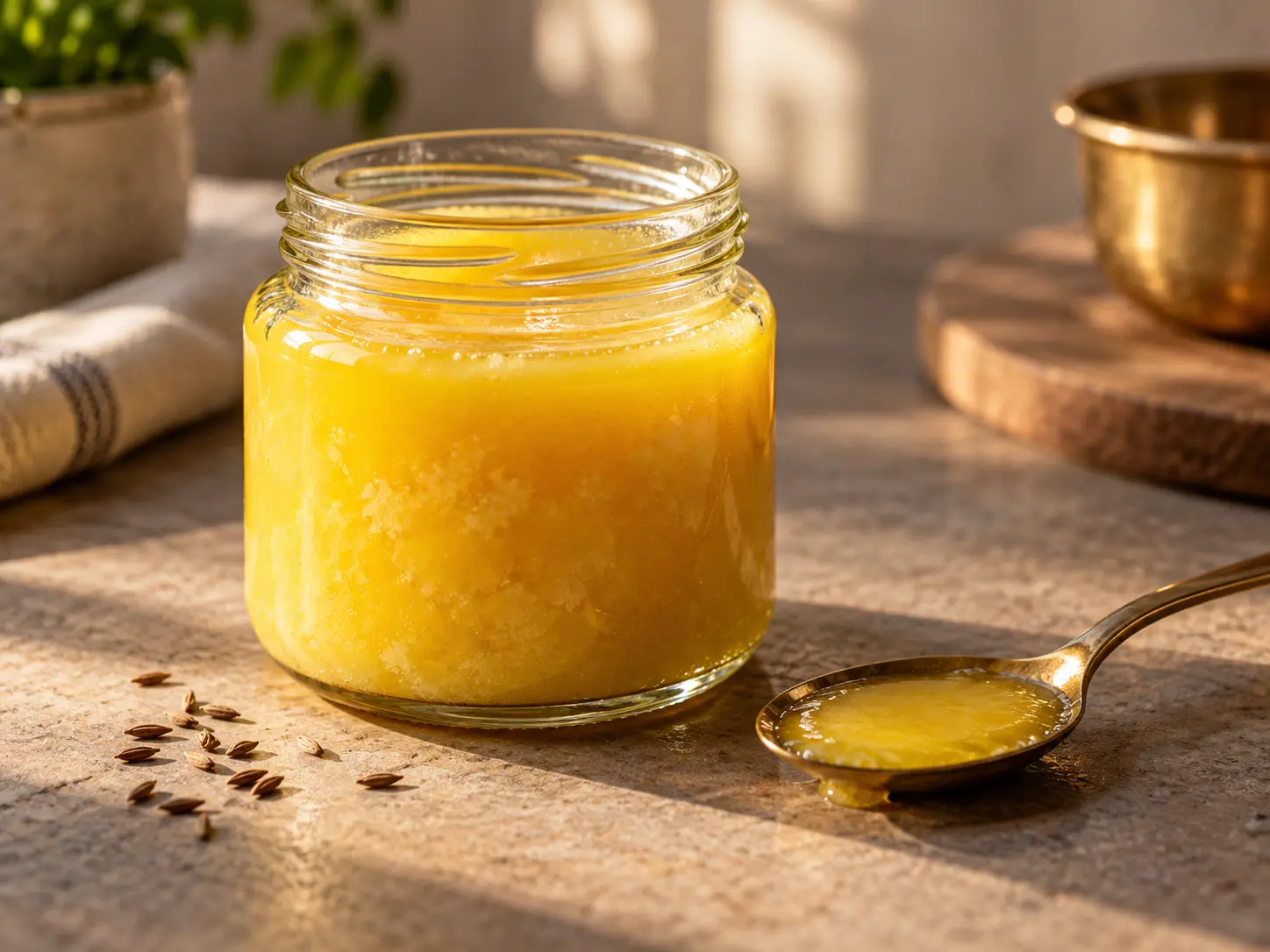
Good ghee smells of toasted milk when warmed, tastes nutty and clean, and melts clear with a few browned specks at most. Colour and texture change with the season and the animal, so neither one alone tells you a jar is good or bad.
We see this every year. In winter the milk is richer, we get more makkhan per litre, and the ghee cools into a fine grain. In summer the milk is thinner, the curd sets and sours faster, and the ghee stays liquid in the jar. In the monsoon the cows eat green fodder and our cow ghee turns a deeper yellow. Buffalo ghee is white in every season. The two questions we get most on WhatsApp are why the ghee is grainy and why the colour differs from the last jar, and the answer to both is usually the season, explained on why ghee is grainy.
What a bad jar looks like is clearer. Cloudy ghee with water at the bottom was undercooked. Dark, bitter ghee that smells burnt was overcooked. Ghee that smells sour, stale, or like old cooking oil has gone rancid or was never milk fat alone. Keep this list for your next jar:
Before you buy a jar of ghee: 5 checks
- The food name on the label says Ghee, not butter oil, vanaspati, or "ghee flavour".
- An FSSAI licence number is printed, and you can look it up on foscos.fssai.gov.in.
- Ingredients list only milk fat, butter, cream, or curd. No colour, flavour, or oil.
- A warm spoon smells of toasted milk. Not sour, sweet, waxy, or like cooking oil.
- The price makes sense against milk: 1 kg of cow ghee takes 30 to 35 litres of milk.
Home checks raise a doubt; only a lab running the FSSAI tests above settles it. We test our ghee every month against those limits. Which home tests work and which mislead is on how to identify pure ghee, and you can check a jar you already own in 2 minutes with our ghee purity checker.
How do you use ghee in an Indian kitchen?
Use ghee where you can taste it, a teaspoon at a time: on hot dal, khichdi, or rice, brushed on a roti straight off the tawa, in a tadka of jeera and hing, and in halwa, ladoo, and other sweets. ICMR-NIN's 2024 dietary guidelines ask adults to limit ghee or butter to 1 to 2 teaspoons a day, and count one teaspoon of oil or ghee as 5 g, so that is 5 to 10 g.
- Tadka: melt the ghee on medium heat until it shimmers, then add jeera. If it smokes, the pan is too hot; wipe it and start again.
- Roti: ¼ to ½ teaspoon brushed on while the roti is still steaming, so it soaks in.
- Dal and khichdi: a teaspoon stirred in at the end, off the heat, where you taste it most.
- Frying: use a plant oil for deep frying. Ghee can take the heat, but a full kadai goes far past the daily limit.
In our house each of us eats 1 to 2 teaspoons a day on roti, dal, and khichdi, and more in winter when there are adadiya pak and gond sweets. The amount for children, older parents, and people with a health condition is on how much ghee per day; anyone told by a doctor to cut fat should follow that advice first.
Which ghee should you buy first?
For a first jar, read the food name and the licence, warm a spoon and smell it, and ask when it was made. The order we would check brands in is on how to choose ghee.
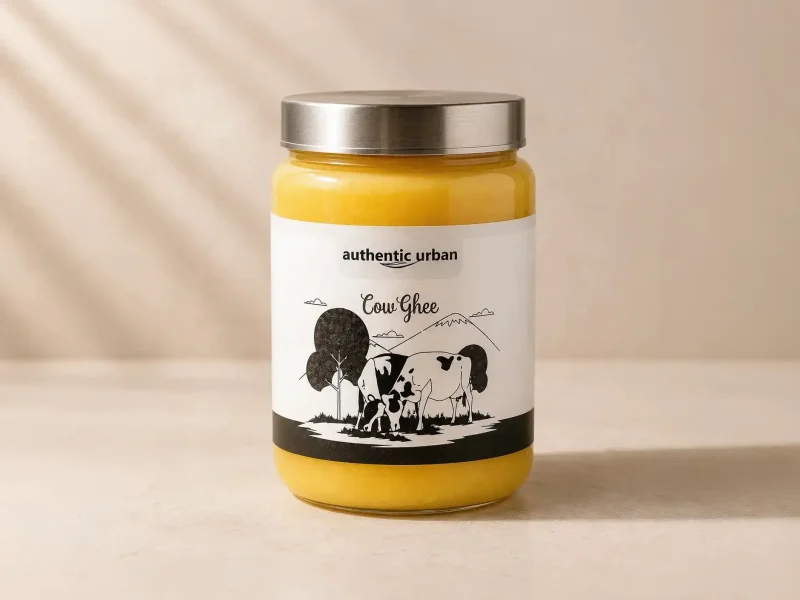
We make ghee, so this is our own pick: our Gir cow Bilona ghee for the daily spoon, and our Jafarabadi buffalo Bilona ghee for parathas and sweets. Other buffalo jars are ranked on best buffalo ghee in India. Both come from grass-fed village animals near the Gir forest, with no hormone injections, and are cooked after you order. A video of your own jar being cooked and packed comes on WhatsApp, so you can see the process for yourself.
The daily spoon on dal and roti
 1 Litre
Paratha, halwa, and ladoo
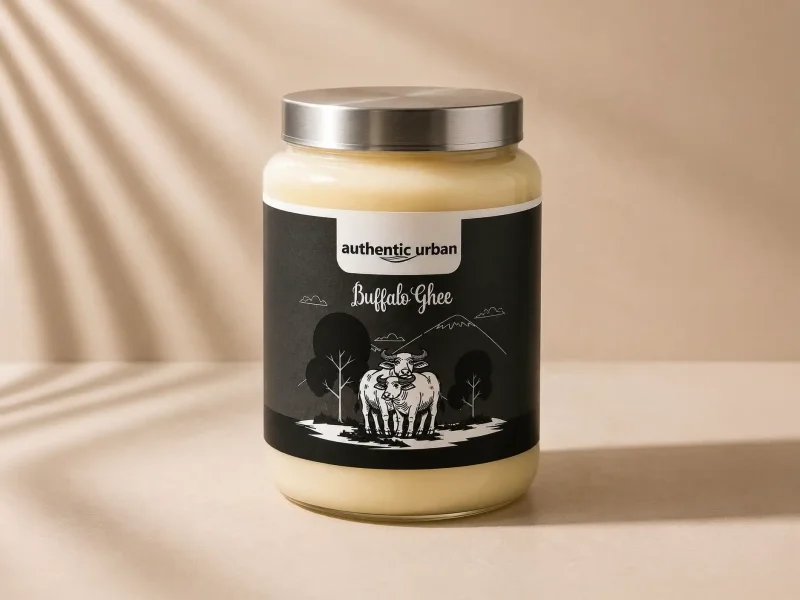 1 Litre
Each order is cooked after you place it, and the packing video is of that batch. Past order videos are on the shop.
FAQ
What is ghee called in English?
English uses the Hindi word itself: ghee. The nearest English phrase is clarified butter, and many Western recipes use the two as if they were the same. They are close but not identical: clarified butter usually comes off the heat as soon as the water is gone, while ghee keeps cooking until the milk solids brown. That extra step gives ghee its toasted-milk smell.
Is ghee vegetarian or vegan?
Ghee is vegetarian: it is made from milk, so Indian kitchens treat it like milk, curd, and paneer. It is not vegan, because it comes from an animal's milk. Anyone who avoids all dairy should use a plant oil instead. People with a diagnosed milk allergy should ask their doctor before eating ghee, since a trace of milk protein stays in it.
Is ghee lactose free and dairy free?
Ghee is not dairy free. It is made only from milk, so FSSAI and every label treat it as a dairy product. Lactose and milk protein are almost all removed with the solids, which is why many people with lactose intolerance find a teaspoon on dal sits well. Almost is not zero, though. Anyone with a diagnosed milk protein allergy needs their allergist's answer before eating ghee, not a label.
Does ghee need to be kept in the fridge?
No. Ghee keeps at room temperature because there is almost no water left in it for mould or bacteria. In our experience a sealed jar keeps 9 to 12 months. Once open, use a dry spoon, keep the lid shut, and keep the jar away from the stove and sunlight. In summer it will melt in the jar, which is normal. A wet spoon spoils ghee faster than a warm shelf.
Why does ghee cost more than butter?
Because it takes more milk. Butter is about 81% fat and ghee is almost all fat, so a kilo of ghee needs more butter behind it, plus the cooking time. In our kitchen about 30 to 35 litres of Gir cow milk make 1 kg of ghee, and 22 to 25 litres of Jafarabadi buffalo milk. A jar priced far below that milk is a question worth asking the seller.
Can I use ghee instead of oil for everything?
You can, but you should not. ICMR-NIN's 2024 guidelines ask adults to keep ghee or butter to 1 to 2 teaspoons a day and to use a mix of plant oils for the rest of the cooking. A kadai of puri or pakora in ghee costs a lot and goes far past that limit. Use ghee where you taste it: on dal, roti, khichdi, and in sweets.
About the editorial team
Authentic Urban TeamBilona ghee makers, Gir Somnath, Gujarat
We are the Parmar family in Gir Somnath, Gujarat. We have made ghee here since 2016 and sold it online since 2025. We make only Bilona ghee, test it every month, and anyone is welcome to visit and watch it being made. Our Gir cows and Jafarabadi buffalo are grass-fed village animals that graze near the Gir forest, with no hormones or milk boosters. We set their milk to curd, churn it, and cook the makkhan on a wood chulha. These articles come from that kitchen and from what customers ask us on WhatsApp. We are ghee makers, not doctors.
Sources
- Food Safety and Standards (Food Products Standards) Chapter 2.1: Dairy products and analogues, version 01.09.2023 (2.1.8 Standard for Milk Fat Products: description, ghee limits, and fatty acid composition, pp. 26-28), FSSAI. Checked 29 Sep 2026.
- Butter oil, anhydrous (FDC ID 173412), SR Legacy, USDA FoodData Central. Checked 29 Sep 2026.
- Butter, without salt (FDC ID 173430), SR Legacy, USDA FoodData Central. Checked 29 Sep 2026.
- Dietary Guidelines for Indians, 2024 (Guideline 7, ghee or butter 1 to 2 teaspoons a day, p. 71; avoid vanaspati, p. 73; 5 g oil or ghee as 1 teaspoon, p. 130), ICMR-National Institute of Nutrition. Checked 29 Sep 2026.